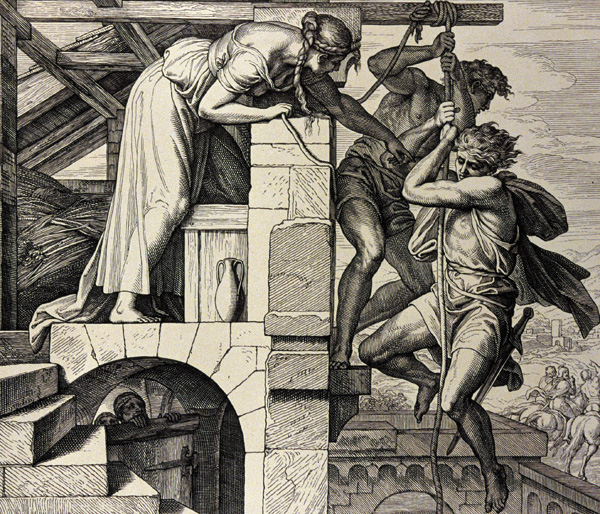
Consider Rahab (Joshua 2:15-24)

Rahab the harlot helps the Israelite spies escape from Jericho

So she [Rahab] let them [the Israelite spies] down by a rope through the window, for the house she lived in was part of the city wall [of Jericho]. She said to them, “Go to the hills so the pursuers will not find you. Hide yourselves there three days until they return, and then go on your way.”

Now the men had said to her, “This oath you made us swear will not be binding on us unless, when we enter the land, you have tied this scarlet cord in the window through which you let us down, and unless you have brought your father and mother, your brothers and all your family into your house. If any of them go outside your house into the street, their blood will be on their own heads; we will not be responsible. As for those who are in the house with you, their blood will be on our head if a hand is laid on them. But if you tell what we are doing, we will be released from the oath you made us swear.”

“Agreed,” she replied. “Let it be as you say.”

So she sent them away, and they departed. And she tied the scarlet cord in the window.

When they left, they went into the hills and stayed there three days, until the pursuers had searched all along the road and returned without finding them. Then the two men started back. They went down out of the hills, forded the river and came to Joshua son of Nun and told him everything that had happened to them. They said to Joshua, “The Lord has surely given the whole land into our hands; all the people are melting in fear because of us.” (New International Version)

A drama unfolded as the Israelites began entering and taking the Promised Land. Joshua, their leader, secretly sent two men as spies to look over the land and check out the prominent city of Jericho. The spies left and ended up in the house of a harlot named Rahab. They hid there because it had been found out they were in the city.

Rahab was able to divert and send away the pursuers who were looking for the spies, telling them that the men left, and that they should leave and go catch them. But she had actually hid them on the roof of her house.

Rahab took the spies into her home because she realized and affirmed that God was giving the land to the Israelites. Everyone in the city had heard the stories of how the Lord brought them out of Egyptian slavery and into the land of Canaan. In an insightful and beautiful confession of faith, Rahab told them:

“I know that God has given you the land. We’re all afraid. Everyone in the country feels hopeless. We heard how God dried up the waters of the Red Sea before you when you left Egypt, and what he did to the two Amorite kings east of the Jordan, Sihon and Og, whom you put under a holy curse and destroyed. We heard it and our hearts sank. We all had the wind knocked out of us. And all because of you, you and God, your God, God of the heavens above and God of the earth below.” (Joshua 2:8-11, MSG)

The men promised to show Rahab and her family mercy when they came to take the city, just as she had shown them grace in the face of trouble. So, today’s Old Testament lesson picks up the story from that point, as she sends the spies safely on their way.

That Rahab, a prostitute, is the heroine of the story is no accident or anomaly. Her profession of faith is central to the drama. She was living in the city wall, which is reflective of her status as being on the margins of society. And having strange men in her home would not have been weird in her neighborhood. It also made it rather easy to get the spies out of the city when trouble was brewing.

Most importantly, however, Rahab – the ultimate outsider in society – becomes the consummate insider. It is astonishing that a Gentile woman of disrepute has a story about her, and even told from her perspective – and not from the point of view of an Israelite man.

Rahab’s bold assertion of faith is both sincere and linked to God’s promise that the Israelites would take the land. Rahab is Exhibit A of the kind of person that inherits the kingdom of God. Rahab’s faith, not her works or reputation, is what spared her life and spared her from judgment.

Please ponder and consider that truth for a bit. Sit with it if you must – the reality that Rahab was judged neither by the spies nor God.

In far too many quarters of the Christian (and broadly religious world) judgment instead of mercy is levied to persons like Rahab. If there is anyone who should have a non-judgmental presence toward “sinners” it is Christians. And, if there is any institution which ought to consistently, both personally and through policy, display unflagging grace and forsake judgment, it is the Church.

Yet, unfortunately, as many have experienced, the Church has often fallen short of the glory of God’s grace in Christ by condemning people of ill repute. Perhaps we all need to rethink what faith truly is: not a checklist of doctrinal beliefs to sign-off on but a confident and bold action based solidly in the promises of God.

Knowing what those promises are, and living our lives appropriately in consideration of them, is the kind of faith that pleases God. Those who attempt to be judge, jury, and executioner need not apply as followers of God.

Genuine righteousness is never earned; it is given by the compassionate grace of God. So, lay hold of God’s promise of grace and mercy with gusto! Let the gracious God, who is full of steadfast love, affect the way we live our lives. Believe with a bold biblical belief that God always does what God has decreed and proclaimed to do.

Lord God, the gracious, almighty, and Holy One of all: I may have not always lived my life well, yet I trust you today that you can and will deliver me from all my troubles because you are with me. May your Holy Spirit give me the gift of faith to believe in such a way that forever impacts how I live my life in service to you and for the common good of all persons – no matter who they are. Amen.

The Church that Makes a Difference (Matthew 16:13-20)

Photo by Felix Mittermeier on Pexels.com

When Jesus came to the region of Caesarea Philippi, he asked his disciples, “Who do people say the Son of Man is?”

They replied, “Some say John the Baptist; others say Elijah; and still others, Jeremiah or one of the prophets.”

“But what about you?” he asked. “Who do you say I am?”

Simon Peter answered, “You are the Messiah, the Son of the living God.”

Jesus replied, “Blessed are you, Simon son of Jonah, for this was not revealed to you by flesh and blood, but by my Father in heaven. And I tell you that you are Peter, and on this rock I will build my church, and the gates of Hades will not overcome it. I will give you the keys of the kingdom of heaven; whatever you bind on earth will be bound in heaven, and whatever you loose on earth will be loosed in heaven.” Then he ordered his disciples not to tell anyone that he was the Messiah. (New International Version)

A lot of research studies have come out in the past 20 years demonstrating that legions of adults, especially between the ages of 18-29, are leaving the Church in droves. This confirms my own anecdotal evidence over the years that about 80% of twenty-somethings drop out of church altogether. So, why are people leaving? Can anything be done about it?

Most of the studies can be boiled down to three major reasons: 

  1. The Church is irrelevant to my life and doesn’t talk about things important to me
  2. The Church is judgmental toward others not like themselves
  3. The Church is hypocritical by saying one thing and yet living another way

A good, right, and real confession of Jesus will speak a relevant word into the culture and into various generations, will proclaim the gospel of grace (not judgment), and will live what it believes.

In today’s Gospel lesson, Jesus and his disciples are in the Gentile (non-Jewish) territory of Caesarea Philippi, a city 25 miles north of the Sea of Galilee. Up to this point, the disciples encountered a lot of people and heard a lot of things said. So, Jesus asked them two questions: 

Who do people say the Son of Man is?

The disciples gave a variety of answers, which is to be expected, with some of them being a bit esoteric. John the Baptist raised from the dead is a stretch. Elijah was a man who never died, but was just taken to heaven; maybe he’s back. Maybe Jeremiah or one of the other prophets got sent back. 

When asking this question to folks today, you will also get a variety of answers as to whom Jesus is – a good teacher, a model humanitarian, a myth or a legend who didn’t really exist. A few times I have been told that Jesus was an alien from another planet. My personal favorite when I asked who Jesus, a guy answered that he was a nudist, and that if we all just took off our clothes, there would be peace in the world.

Who do you say I am?

Peter acted as the spokesperson for the group. Given the disciples’ track record of scratching their heads over nearly everything Jesus said or did, one might expect to hear another crazy answer. But Peter got it right by confessing, “You are the Christ, the Son of the Living God.” 

“Christ” is another way of saying “Messiah,” or “Savior.” It literally means, in the Greek language, “Answer.”  Peter confessed Jesus as being The Answer, the person for whom everything comes down to. Peter may not have fully understood what he was saying, but he said it.

The reason that craziness didn’t come out of Peter’s mouth is that “The Answer” was divinely revealed to him.  Faith in Jesus Christ is a gift given to us by God. 

“All things have been committed to me by my Father. No one knows the Son except the Father, and no one knows the Father except the Son and those to whom the Son chooses to reveal him.” Jesus (Matthew 11:27, NIV)

Peter was blessed – not necessarily because of sincerity, openness, or deserving it – but because of God’s grace which revealed to him that Jesus is the “Answer.”

The Apostle Peter put himself in a position to know by obeying the voice of Jesus to follow him. It took him and the other disciples a while to “get it,” but eventually they did. And if it took years of being with Jesus for the disciples to make a right and good confession of faith, then it’s important that we have a great deal of patience for our friends and relatives.

Jesus proclaimed Peter (which means “rock”) the immovable object from which the Church would be built.  The Apostle Paul framed it this way:

You are no longer foreigners and strangers, but fellow citizens with God’s people and also members of his household, built on the foundation of the apostles and prophets, with Christ Jesus himself as the chief cornerstone. In him the whole building is joined together and rises to become a holy temple in the Lord. (Ephesians 2:19-21, NIV)

Christ is the one who builds the Church – and not me,  nor you. This reality is encouraging and comforting to me. If it was up to me to build the Church, I would screw it up so badly that it would actually be overcome by hell. But I can’t screw it up, because it’s Christ’s Church, not mine. 

So, we can move forward and storm the gates of hell, we can move and work and act and call others to confess, all with the confidence and security of knowing that Jesus is building his Church. There’s no need to worry whether we’re getting it right, or not, because we aren’t the ones in control of the project.

However, I admit what Jesus says next isn’t very comforting to me. Christ told Peter that he will give him the “keys of the kingdom of heaven,” and that whatever he binds on earth will be bound in heaven, and whatever he lets loose on earth will be loosed in heaven.

Giving Peter the keys of the kingdom seems akin to giving an 8 year old the keys to the car and saying, “Go ahead, take it for a spin, you can drive it!” 

What are the keys of the kingdom? 

The preaching of the holy gospel and Christian discipline toward repentance. Both preaching and discipline open the kingdom of heaven to believers and close it to unbelievers. 

How does the preaching of the gospel open and close the kingdom of heaven? 

The kingdom of heaven is opened by proclaiming and publicly declaring to all believers, each and every one, that, as often as they accept the gospel promise in true faith, God, because of what Christ has done, truly forgives all their sins. The kingdom of heaven is closed, however, by proclaiming and publicly declaring to unbelievers and hypocrites that, as long as they do not repent, the anger of God and eternal condemnation rest on them. (The Heidelberg Catechism, Q&A 83, 84 )

The Church is true to its mission when it proclaims the good news of God’s grace in Christ. We possess the keys of the kingdom. Jesus knew exactly what he was doing, that is, the risks and the problems of letting people do the task of proclaiming the gospel. Yet, Christ still tossed us the keys to his Mercedes.

Conclusion

A Church that makes a difference is made up of people who confess Jesus, are called by God, and call others to confess Jesus, too. The de-churched and the disaffected want to see a Church that seeks to understand the world, to provide relevant ministry to others, and to tackle the injustice that exists everywhere.

We must use the power given us with the keys of the kingdom to bestow mercy to the weak, the oppressed, and the lost. We need to live what we believe with a passionate heart and an unashamed faith.

Together, as God’s people, we can extend the hospitality and the kindness to make a difference in the church and the world. 

May our confession of Christ shape our words and our actions. And may it give us the confidence and boldness to live as Jesus did, and to enjoy him forever. Amen.

Joshua 2:1-14 – The Faith of Rahab

Then Joshua son of Nun secretly sent two spies from Shittim. “Go, look over the land,” he said, “especially Jericho.” So, they went and entered the house of a prostitute named Rahab and stayed there.

The king of Jericho was told, “Look, some of the Israelites have come here tonight to spy out the land.” So, the king of Jericho sent this message to Rahab: “Bring out the men who came to you and entered your house, because they have come to spy out the whole land.”

But the woman had taken the two men and hidden them. She said, “Yes, the men came to me, but I did not know where they had come from. At dusk, when it was time to close the city gate, they left. I don’t know which way they went. Go after them quickly. You may catch up with them.” (But she had taken them up to the roof and hidden them under the stalks of flax she had laid out on the roof.) So the men set out in pursuit of the spies on the road that leads to the fords of the Jordan, and as soon as the pursuers had gone out, the gate was shut.

Before the spies lay down for the night, she went up on the roof and said to them, “I know that the Lord has given you this land and that a great fear of you has fallen on us, so that all who live in this country are melting in fear because of you. We have heard how the Lord dried up the water of the Red Sea for you when you came out of Egypt, and what you did to Sihon and Og, the two kings of the Amorites east of the Jordan, whom you completely destroyed. When we heard of it, our hearts melted in fear and everyone’s courage failed because of you, for the Lord your God is God in heaven above and on the earth below.

“Now then, please swear to me by the Lord that you will show kindness to my family, because I have shown kindness to you. Give me a sure sign that you will spare the lives of my father and mother, my brothers and sisters, and all who belong to them—and that you will save us from death.”

“Our lives for your lives!” the men assured her. “If you don’t tell what we are doing, we will treat you kindly and faithfully when the Lord gives us the land.” (NIV)

I personally know of many persons who struggle with the notion that persons of ill repute can exhibit any kind of faith. *Sigh* Methinks such persons ought to reread their Bibles with more acumen, for “sinners” of all kinds fill the pages of Holy Scripture.

In our Old Testament lesson for today, Rahab the prostitute not only displays faith; she displays the kind of belief that lands her in the great hall of faith in the New Testament:

Rahab, the prostitute, welcomed the Israelite spies like friends. And because of her faith, she was not killed with the ones who refused to obey. (Hebrews 11:31, ERV)

Rahab evidenced a confident and unwavering belief that God existed and would surely overtake her city of Jericho with a profession of faith which rivals any life-long pious believer:

“I know that the Lord has given you the land, and that dread of you has fallen on us, and that all the inhabitants of the land melt in fear before you.” (Joshua 1:9, NRSV)

Rahab’s bold assertion of faith is both sincere and linked to God’s promise that the Israelites would take the land. Rahab is Exhibit A of the kind of person that inherits the kingdom of God. Rahab’s faith, not her works or reputation, is what spared her life and spared her from judgment.

Please ponder and consider that truth for a bit. Sit with it if you must. Rahab was not judged by God or the spies. In far too many quarters of the Christian world, judgment instead of mercy is levied to persons like Rahab. If there is anyone who should have a non-judgmental presence toward “sinners” it is Christians. And, if there is any institution which ought to consistently, both personally and through policy, display unflagging grace and forsake judgment, it is the Church.

Yet, unfortunately, as many have experienced, the Church has often fallen short of the glory of God’s grace in Christ by condemning people of ill repute. *Sigh* Perhaps we all need to rethink what faith truly is: not a checklist of doctrinal beliefs to sign-off on but a confident and bold action based solidly in the promises of God.

Knowing what those promises are, and living our lives appropriately in consideration of them, is the kind of faith that pleases God. Those who attempt to be judge, jury, and executioner need not apply as followers of God.

Genuine righteousness is never earned; it is given by the compassionate grace of God. So, let us lay hold of God’s promise of grace and mercy with gusto! Let the gracious God, who is full of steadfast love, effect the way we live our lives. Let us believe with a bold biblical belief that God always does what has been decreed and proclaimed.

Lord God Almighty, I may have not always lived my life well, yet I trust you today that you can and will deliver me from all my troubles because you are with me.  May your Holy Spirit give me the gift of faith to believe in such a way that forever impacts how I live my life.  Amen.