Oppressors Are On Notice (Nahum 1:1-13)

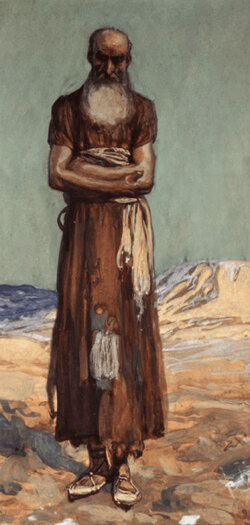
Nahum, by James Tissot, 1888

A prophecy concerning Nineveh. The book of the vision of Nahum the Elkoshite.

The Lord is a jealous and avenging God;
    the Lord takes vengeance and is filled with wrath.
The Lord takes vengeance on his foes
    and vents his wrath against his enemies.
The Lord is slow to anger but great in power;
    the Lord will not leave the guilty unpunished.
His way is in the whirlwind and the storm,
    and clouds are the dust of his feet.
He rebukes the sea and dries it up;
    he makes all the rivers run dry.
Bashan and Carmel wither
    and the blossoms of Lebanon fade.
The mountains quake before him
    and the hills melt away.
The earth trembles at his presence,
    the world and all who live in it.
Who can withstand his indignation?
    Who can endure his fierce anger?
His wrath is poured out like fire;
    the rocks are shattered before him.

The Lord is good,
    a refuge in times of trouble.
He cares for those who trust in him,
    but with an overwhelming flood
he will make an end of Nineveh;
    he will pursue his foes into the realm of darkness.

Whatever they plot against the Lord
    he will bring to an end;
    trouble will not come a second time.
They will be entangled among thorns
    and drunk from their wine;
    they will be consumed like dry stubble.
From you, Nineveh, has one come forth
    who plots evil against the Lord
    and devises wicked plans.

This is what the Lord says:

“Although they have allies and are numerous,
    they will be destroyed and pass away.
Although I have afflicted you, Judah,
    I will afflict you no more.
Now I will break their yoke from your neck
    and tear your shackles away.” (New International Version)

I’m willing to wager you’ve never heard a sermon on the Old Testament book of Nahum. It’s unfortunate that many Bible-readers have never read the prophecy of Nahum, let alone know that this book even exists in Holy Scripture.

Each individual book of the Bible has its own particular message that is wise for us to understand. Although Nahum’s prophecy is against the long-dead empire of Assyria, it still contains a timeless message for us.

Nineveh

The capital city of Assyria, Nineveh, was a large and influential city in the centuries of 600-900 B.C.E. The Assyrians were a cruel people even by ancient standards. Their army was feared, and rightly so. Army officers were experts at torture, having turned it into an art form with all kinds of different ways of killing and maiming captured people from their conquests.

The prophet Nahum focused on the sure destruction of Nineveh, and the overwhelming judgment and justice of God. And at the same time, Nahum was also attuned to the great and many sins of Israel – their predilection for idolatry and immorality, as well as their purposeful ignoring of social responsibilities.

No matter who we are, or where we are from, the Lord God, the Almighty, shows no favoritism in condemning the guilty, and upholding the innocent. Unlike us, who have a nasty tendency toward practicing cronyism, bigotry, and ethnocentrism, Yahweh extends grace, judgment, and fairness in an even-handed way.

We humans also have a bent toward emphasizing one trait of God over another. There are those who talk only of love when it comes to the Lord; and others who always speak of God’s wrath and judgment.

Yet, in truth, God is the sovereign Lord of both wrath and love, judgment and grace. And, if we are able to hear it, God’s wrath is an expression of God’s love – not willing for oppression and violence to run amok among the powerless.

What’s more, God’s love has a penetrating way of arousing the conscience and bringing deep conviction of guilt for things we have done, and have left undone. So, when we talk of God, let us keep in mind that God is the Lord of both wrath and love, judgment and grace.

Nahum described Yahweh as a powerful God who is the avenging Lord against violence, cruelty, and injustice. If this God can make mountains move, oceans froth, and the earth heave, then no one, including the mighty Assyrian warriors, can stand against Yahweh’s indignation.

It is also true that with the Lord God there is abundant goodness which provides protection for those who seek refuge in Yahweh. Throughout Holy Scripture, including the prophecy of Nahum, divine vengeance and wrath is continually set in the context of divine mercy and grace.

Because God is holy and just, sovereign and powerful, God is Judge of the nations. Mercy only really has meaning when wrath is necessary. If everything were always unicorns and bunny rabbits, there would never be a need for mercy. But we live in a terribly broken world in which oppression and cruelty too often make sinister inroads into our lives.

Although the Lord is slow to anger and God’s fuse is long, divine patience has its limits. Yahweh does not let calloused hearts and selfish minds go on with impunity. Eventually, there will be hell to pay.

God saw all the foolish destruction and misery that Assyria brought to others. And so, Nineveh would see their own terrible destruction. This is why we now talk of Assyria as a long-past ancient empire; they no longer exist in any way, shape, or form. The Lord wiped the Assyrians off of the map.

As for Judah, there would be comfort. Even though it was true that God used the Assyrians to extend judgment upon Israel, there was also merciful relief and gracious rest from Assyria for the people.

With God, relief, rest, and recovery are sure and certain. Violence and oppression shall not last. Mercy always ends up winning the day.

This is most assuredly good news for us who seek the just, the right, and the good in this fallen world. The foolish decisions of contemporary politicians shall not win the day. God will have the final word on all things.

In a time when it seems the other shoe keeps dropping, we can be a hopeful people, because there is a transcendent God in heaven who sees it all, and will have mercy upon the innocent, while judging the guilty.

Therefore, those who engage in grift, corruption, violence, and cruelty, with no concern for the weak and needy, will eventually find themselves on the side of God’s vengeful wrath.

Whereas, those who are powerless against an evil misuse of authority, eventually they will know what it is to experience hope and deliverance from that evil. They shall know safety and perfect peace.

The overarching message of Nahum is that God is sovereign over all the world and all of history. The Lord will judge and love according to God’s own sense of divine wrath and divine grace.

Since God is the ultimate champion of the frustrated and the helpless, God will by no means acquit the guilty. The universe is God’s dominion, and in this dominion, violence, corruption, and oppression will face an awesome judgment which eradicates evil.

No nation, no person, and no government can withstand the God who is over all. Every corrupt person, especially politicians who have their eye only on themselves, should be on notice.

O God, by whom the meek are guided in decision-making, and light rises up in darkness for the godly: Grant us, in all our doubts and uncertainties, the grace to ask what you would have us to do, so that the Spirit of wisdom may save us from all false choices, and that in your light we may see light, and in your straight path may not stumble; through Jesus Christ our Lord. Amen.

Who Is Running from God? (Jonah 1:1-17)

The Lord gave this message to Jonah son of Amittai: “Get up and go to the great city of Nineveh. Announce my judgment against it because I have seen how wicked its people are.”

But Jonah got up and went in the opposite direction to get away from the Lord. He went down to the port of Joppa, where he found a ship leaving for Tarshish. He bought a ticket and went on board, hoping to escape from the Lord by sailing to Tarshish.

But the Lord hurled a powerful wind over the sea, causing a violent storm that threatened to break the ship apart. Fearing for their lives, the desperate sailors shouted to their gods for help and threw the cargo overboard to lighten the ship.

But all this time Jonah was sound asleep down in the hold. So the captain went down after him. “How can you sleep at a time like this?” he shouted. “Get up and pray to your god! Maybe he will pay attention to us and spare our lives.”

Then the crew cast lots to see which of them had offended the gods and caused the terrible storm. When they did this, the lots identified Jonah as the culprit. “Why has this awful storm come down on us?” they demanded. “Who are you? What is your line of work? What country are you from? What is your nationality?”

Jonah answered, “I am a Hebrew, and I worship the Lord, the God of heaven, who made the sea and the land.”

The sailors were terrified when they heard this, for he had already told them he was running away from the Lord. “Oh, why did you do it?” they groaned. And since the storm was getting worse all the time, they asked him, “What should we do to you to stop this storm?”

“Throw me into the sea,” Jonah said, “and it will become calm again. I know that this terrible storm is all my fault.”

Instead, the sailors rowed even harder to get the ship to the land. But the stormy sea was too violent for them, and they couldn’t make it. Then they cried out to the Lord, Jonah’s God. “O Lord,” they pleaded, “don’t make us die for this man’s sin. And don’t hold us responsible for his death. O Lord, you have sent this storm upon him for your own good reasons.”

Then the sailors picked Jonah up and threw him into the raging sea, and the storm stopped at once! The sailors were awestruck by the Lord’s great power, and they offered him a sacrifice and vowed to serve him.

Now the Lord had arranged for a great fish to swallow Jonah. And Jonah was inside the fish for three days and three nights. (New Living Translation)

God said, “Go!”

Jonah said, “No!”

And, God said, “Oh!?”

Jonah did a complete turn-and-run from God’s clear instructions to go to the city of Nineveh. That doesn’t sound like a good idea. So, why did Jonah run? And why do we run?

Who were the Assyrians?

Nineveh was a large city in the ancient world, and the capital of Assyria. The Assyrians had a reputation as fierce soldiers and conquered the Middle East. They are mentioned many times in the Old Testament. It was Assyria that God used to judge the northern kingdom of Israel.

The typical military practice of the Assyrians was to attack a city and completely subjugate it by deporting most of the people and repopulating it with some of their own people. They did this so that the conquered people could not mount a revolt or resistance to their rule.

The Assyrians, the Ninevites, were notorious in the ancient world for their brutality toward conquered peoples. Many forms of torture that we are aware of today were invented by the Assyrians. Their methods were awful and inhumane. The Assyrians were experts at thinking up and executing extreme forms of torture on everyone who resisted their power. It was a very violent culture.

Who is God?

God isn’t at all like the Ninevites. The ways of the Assyrians caught the notice of God, who was ready to pronounce judgment on the heart of the Assyrian Empire, the capital city of Nineveh. So, as God typically did in the Old Testament, he told one of his prophets to go and give a message.

The message was simple: “Go to the great city of Nineveh and preach against it, because its wickedness has come up before me.” Lest we think God was determined to wipe Nineveh off the map, think again. Jonah confesses later in the book, “I knew that you are a gracious and compassionate God, slow to anger and abounding in love, a God who relents from sending calamity.” (Jonah 4:2)

Who was Jonah?

Jonah did not like the Assyrians. More than that, he hated their guts. They killed, maimed, executed, and deported Jonah’s fellow Israelites. The last thing Jonah wanted was to have effective preaching and see Nineveh repent of their violent ways. Jonah wanted judgment, not grace.

In this little four-chapter prophetic book of the Old Testament, it is Jonah who needs divine deliverance as much as the Ninevites do. In fact, Jonah’s need for rescue gets more attention than the evil Assyrians. The message of Jonah comes down to this:

Racism and hatred, however much perceived to be legitimate, have no part whatsoever in the kingdom of God.

Who are we?

Christians are the community of the redeemed. New life in Jesus Christ involves a wholesale jettison of bigotry and the manure pile of hatred directed toward any ethnic and/or religious group of people, period. New life means adopting the love of God. It involves becoming a dispenser of grace and mercy with all people, not just the ones we feel deserve it.

What does God want us to learn?

To share the same heart as God has – a heart that beats for people to know and live by a better way – a heart that has grace and compassion even in the face of flat-out evil. We are meant to think twice about pointing the finger at others. Instead, we are to take the plank out of our own eye before we address the splinter in another’s eye.

It wasn’t the Assyrians who were running from God; it was Jonah. In God’s upside-down realm, the wicked become the righteous, and the righteous are exposed as wicked. The unrighteous run to God, whereas the religious run from God. Nineveh eventually turned from their evil ways.

So, let’s keep to the side of mercy, not judgment.

O God, you created all people in your image. We thank you for the astonishing variety of races and cultures in this world. Enrich our lives by ever-widening circles of friendship, and show us your presence in those who differ most from us, until our knowledge of your love is made perfect in our love for all your children; through your Son, Jesus Christ our Lord. Amen.

Grace and Anger


            I once dealt with a woman who was so upset with her husband that she was literally shaking with anger.  There had been a time when her husband had been abusive, but he came to know Christ and became a loving person.  What was so upsetting to this woman is that God saved her husband instead of punishing him for all the abuse he had dished out.  She wanted some divine payback!  She was actually furious about God showing grace and compassion.
 
            This is not a novel or new experience.  In the ancient world, the Assyrians were notorious for their brutality toward conquered peoples.  They thought up forms of torture as a creative past-time. It was a violent culture full of inhumane practices and soldiers who were the scourge of the Middle East.
 
            We know from the little Old Testament book of Jonah that the ways of the Assyrians caught the notice of God, who was ready to pronounce judgment on the heart of the Assyrian Empire, Nineveh.  So, as God typically did in the Old Testament, he tells one of his prophets to go and give a message.  And the message was simple:  “Go to the great city of Nineveh and preach against it, because its wickedness has come up before me” (Jonah 1:2). 
 
            For whatever reasons, when Jonah did not immediately obey God, God stuck with him.  God did not call another prophet to take his place, but insisted that Jonah be the one to preach.  If God calls us to something and we neglect to do it, we cannot simply think that someone else will do it.  Sometimes God insists that we do it, not someone else.
 
            Jonah eventually does go to Nineveh (after the infamous being in the belly of a great fish for three days and nights) and there is a great repentance of sin.  The entire city turns from their evil ways.  God saw this mass repentance and relented from sending disaster.  Instead of destroying the city with all its inhabitants and animals, he was gracious and compassionate, abounding in love.  If there is a response God delights in more than anything it is humility and the courage to admit personal evil and turn from it.
 
            But Jonah has a problem with what is going on.  He is not just a little ticked-off; he is greatly displeased.  He is angry enough about this whole affair to want to die.  Jonah was actually annoyed and angry by God’s goodness.  He wanted justice and judgment, not grace!  The grace of God is so massive that it even extends to some of the most evil people in history, and Jonah wanted no part of that theology.
 
            God asked Jonah twice:  “Do you have a right to be angry?”  It is the same question that God is asking his people today.  Jonah wanted destruction and pay-back for all the sin of the Assyrians.  But God searches our hearts and to expose our expectations.  Often, when those expectations do not happen we are disappointed.  But more than that, when the very opposite happens of what we want and expect, we can become very angry and upset.
 
            A lot of people are angry about radical Muslim groups killing and torturing Christians.  It is evil and it is upsetting.  In fact, many of the killings have taken place in the same geographical area as the ancient city of Nineveh.  Yet, perhaps God is asking us Western Christians who are looking for judgment the same question the little book of Jonah ends on:  “But there are 1.6 billion Muslims in the world; should I not be concerned about that great number?”


            God wanted Jonah to share the same heart he has, and God desires to see us have a heart that beats for lost people to know Jesus – a heart that has grace and compassion even in the face of flat-out evil.  Sometimes God calls us to do what we least want to do in order to reveal what is really in our heart.  Hating people to the point of wanting nothing but destruction upon them does nothing to bring about the righteous life that God desires.  But the blood of Jesus Christ has the power to bring healing and hope, even to the worst of sinners.  Thank you, Jesus, may it be so.