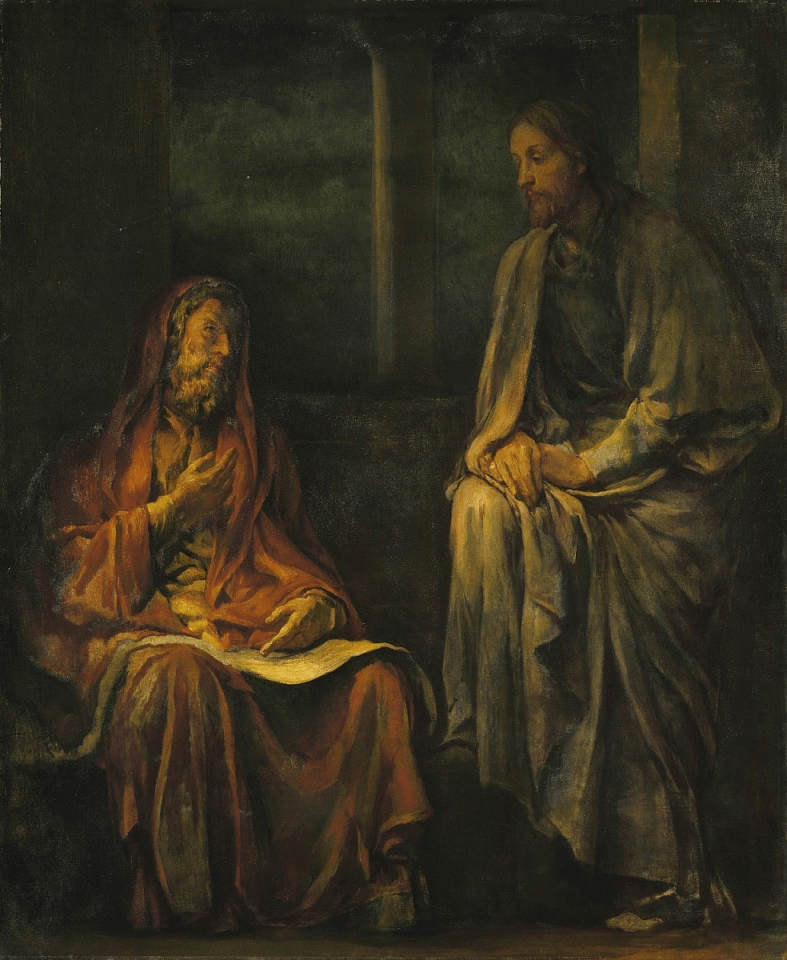
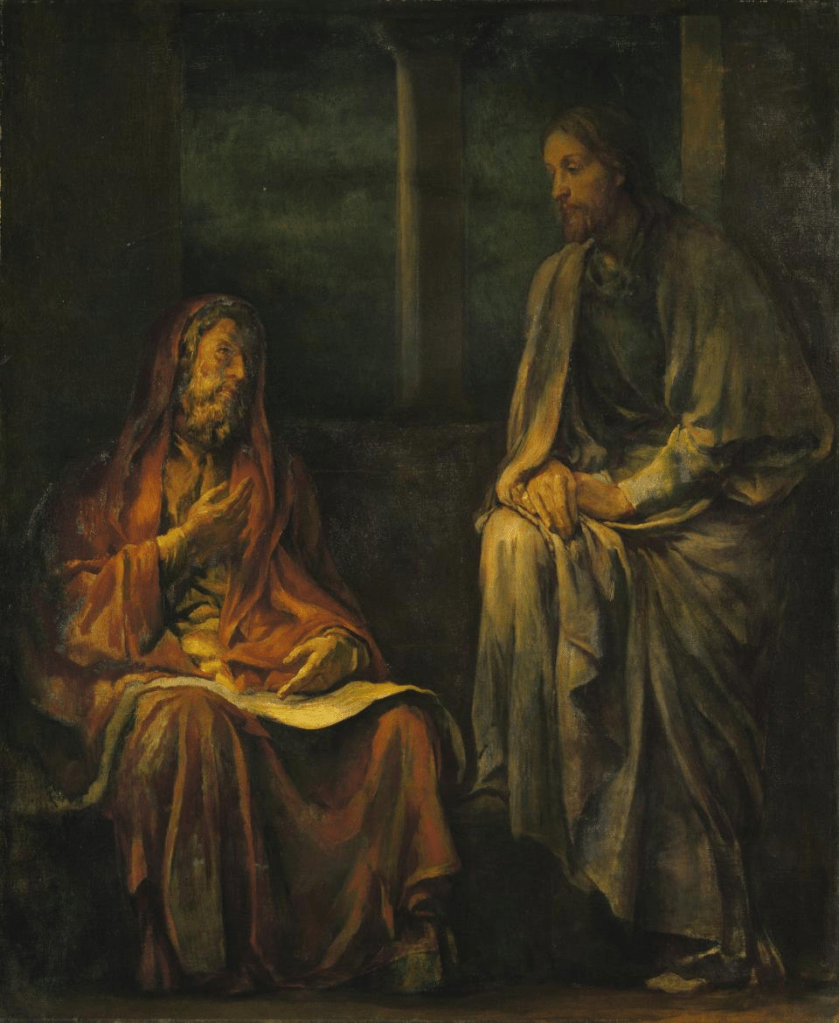
Visit of Nicodemus to Christ, by John LaFarge, 1880
Now there was a Pharisee named Nicodemus, a leader of the Jews. He came to Jesus by night and said to him, “Rabbi, we know that you are a teacher who has come from God, for no one can do these signs that you do unless God is with that person.”
Jesus answered him, “Very truly, I tell you, no one can see the kingdom of God without being born from above.”
Nicodemus said to him, “How can anyone be born after having grown old? Can one enter a second time into the mother’s womb and be born?”
Jesus answered, “Very truly, I tell you, no one can enter the kingdom of God without being born of water and Spirit. What is born of the flesh is flesh, and what is born of the Spirit is spirit. Do not be astonished that I said to you, ‘You must be born from above.’The wind blows where it chooses, and you hear the sound of it, but you do not know where it comes from or where it goes. So it is with everyone who is born of the Spirit.”
Nicodemus said to him, “How can these things be?”
Jesus answered him, “Are you the teacher of Israel, and yet you do not understand these things?
“Very truly, I tell you, we speak of what we know and testify to what we have seen, yet you do not receive our testimony. If I have told you about earthly things and you do not believe, how can you believe if I tell you about heavenly things? No one has ascended into heaven except the one who descended from heaven, the Son of Man. And just as Moses lifted up the serpent in the wilderness, so must the Son of Man be lifted up, that whoever believes in him may have eternal life.
“For God so loved the world that he gave his only Son, so that everyone who believes in him may not perish but may have eternal life.
“Indeed, God did not send the Son into the world to condemn the world but in order that the world might be saved through him. (New Revised Standard Version)
Christians serve a triune God – Father, Son, and Spirit. This Holy Trinity of three persons, yet one God, conspires to plan and orchestrate the deliverance of people from sin, death, and hell. The Lord makes it possible for people to be born again.
Maybe you’re ready to tune out with the phrase “born again” or “born from above” because either this is old hat to you; or you want to distance yourself from the obnoxious evangelist who is the pester pup toward others’ salvation.
However, today’s Gospel lesson is for me and you. So instead of tuning out, consider the person of Nicodemus in the story:
Served God
Good guy
Upstanding Jewish citizen
Devout and pious man
Faithful temple worship attendance
Member of a prestigious religious group
And yet, it was to Nicodemus that Jesus said, “You must be born again.” But why? Because although Nicodemus was a really good egg, he was an adoring fan of Jesus, but not a committed follower of Jesus.
Nicodemus Visiting Christ, by Henry Ossawa Tanner, 1899
Admiration and kudos isn’t the same as taking up your cross and following Christ. Nicodemus didn’t need to adjust his life and make some tweaks here and there; it was time for a new life in walking the path of discipleship with Jesus.
The further away we are from birth, the easier it is to take God for granted; and to have a spiritually settled way of life in which the mystery, wonder, and awe of life is slowly drained from us. That’s why I think two year olds probably know more about God than anyone around – since they can articulate the wonder of life being only a few short years from their birth.
One night I came home and walked into the kitchen to find my then four-year old grandson unashamedly crawling on all fours with his face barely off the floor. I said, “What in the world are you doing?” He looked up at me with a twinkle in his eye and a serious tone in his voice and said, “I’m sniffing for clues.”
I honestly do not expect you to sniff for clues on your kitchen floor. But would any of us be found sniffing for clues of God? Would we seek hard and doggedly pursue the Lord?
Because Nicodemus was such a good guy, he did not see himself in need of new life. Meeting Jesus at night is deeply symbolic of the fact that Nicodemus was literally in the dark about his spiritual condition. He was actually clueless to many of God’s ways, and how the world works in God’s kingdom. Nicodemus maintained a respectable distance as a fan of Jesus.
How do we move from being a fan to a follower of Jesus?
Believe. To believe in Jesus means to move from only an intellectual faith of acknowledging doctrinal beliefs about Christ and God. There is to be movement from observing the works of God to a life of complete trust as a dedicated follower of Jesus.
Christian discipleship is more than asking Christ to help out in a jam or bad situation. And it is certainly more than praying a particular prayer. Rather, it’s letting Jesus decide what to do with us and remove any shortcomings, character defects, guilt, shame, and general crud from us.
We are to be made pure, to be cleansed – as if we were a new person or born again, from above. There is the willingness to depend on something other than myself, my resources, and my connections.
In Christianity, Jesus is much more than a wise teacher and a miracle worker; Christ is Savior for whom the follower gives complete allegiance to. In other words, we let Jesus use us for divine purposes, instead of us using Jesus for our own puny human purposes.
Let us intentionally and deliberately relinquish control of our lives, and of everything, to Jesus and become his faithful followers. Information is not transformation; and, seeing transformation in another person’s life is not a substitute for transformation in my own life.
Interview Between Jesus and Nicodemus, by James Tissot (1839-1902)
Nicodemus had to grab ahold of the reality that Jesus did not only come to save others, but to save him, as well. We must be born from above, to have a new life, to be “born of water and spirit.” Nicodemus would have immediately been reminded of John the Baptist’s ministry of a baptizing for the repentance and forgiveness of sins.
Jesus was letting Nicodemus know that he, too, needed repentance from trusting in those good deeds, and of simply acknowledging Christ. The practices of fasting, praying, and giving; and the dedication to thrift and morality is quite admirable. Yet, these are not the things which move a person from darkness to light. And they don’t give us a leg up to heaven.
Jesus is the One who has worked hard for us. God conceives us as Christians, and then nurtures us in the womb of faith. At some point, we come to full term, and God births us spiritually into new life.
Maybe it’s time to move from darkness to light; from staying warm and cozy inside the womb to the bright outside world; from being a fan of Jesus to a follower of Jesus; from being in the dark audience to the bright lights of the stage for all to see.
The issue is not in saving yourself, but to let God be God; and let God do the work in you that God wants to do.
If there is no gestation from Jesus as Teacher to Jesus as Savior, there is no birth. If there is no gestation from Jesus as Miracle-Worker to Jesus as Savior, there is no birth.
The Apostle John was making the point here in describing the conversation that if Nicodemus, who is the upstanding religious citizen, needed to be born again by Jesus, then how much more do we need to have a new life, to move from the comfortable confines of being a fan to the playing field of being a follower of Jesus?
Jesus does not need a bunch of groupies admiring him at night. But conversely, we need Jesus.
Fans sometimes confuse their admiration for devotion; people mistake their knowledge of Jesus for an actual relationship with Jesus. Fans assume that their good works and good intentions are sufficient. Yet, new life requires giving up an old life. And that, my friends, is what’s at stake in Christian discipleship.
May God the Holy Trinity make us strong in faith and love, and birth us into new life through Christ our Lord. Guide us in truth and peace; and may the blessing of God Almighty – Father, Son, and Holy Spirit – be among us, and remain with us always. Amen.
Today’s Gospel lesson encompasses the full two chapters of events surrounding the arrest, torture, crucifixion, and death of Christ. Jesus died not only for white European heritage persons (like me) but for people of all races and ethnicities everywhere. And so, it is good and appropriate that the following comes from the First Nations Version: An Indigenous Translation of the New Testament.
Every English translation of the Bible is accomplished by people translating from their own cultural perspectives and understandings. This particular translation comes through the cultural lens of American Indigenous peoples. And, in my view, this is a much needed addition to the many versions of the Bible now in print.
We have so many various translations, because we deem Holy Scripture important enough to be translated for all of the various peoples who exist – with all of their particular societal assumptions, and angles on spirituality.
So, please read this slowly, out loud if you can, and let the redemptive events of Jesus be seen in a way that will help your own understanding of Christ and his loving sacrifice for the whole world. This is Good Friday…
When he finished sending up his prayers, he and the ones who walked the road with him walked across the Valley of Darkness (Kidron) and entered a garden with many olive trees.
Speaks Well Of (Judas), the betrayer, knew about this place because Creator Sets Free (Jesus) would often go there with his followers. The betrayer came into the garden, and with him came a band of lodge soldiers sent from the scroll keepers, head holy men, and Separated Ones (Pharisees), representing the elders of the Grand Council. The air was filled with the smell of burning torches as they entered the garden carrying clubs and long knives.
Creator Sets Free (Jesus) knew all this would happen, yet he turned to the soldiers and asked, “Who have you come for?”
With one voice they answered back, “Creator Sets Free (Jesus) from Seed Planter Village (Nazareth)!”
The betrayer, Speaks Well Of (Judas), was standing there with the lodge soldiers when Creator Sets Free (Jesus) answered, “I am he!”
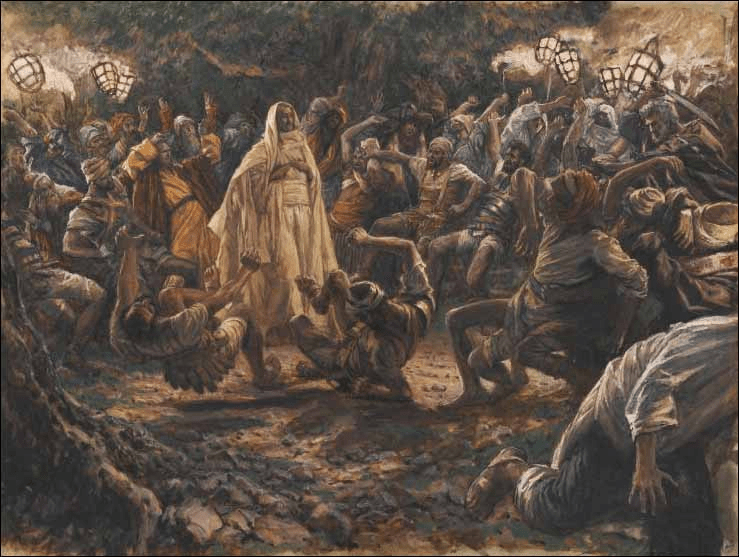
The Guards Falling Backwards, by James J. Tissot (1836-1902)
At the sound of his voice they all moved back and fell to the ground.
He asked them again, “Who have you come for?”
They answered, “Creator Sets Free (Jesus) from Seed Planter Village (Nazareth).”
“I told you already, I am the one you are looking for,” he said, “Let these other men go.”
He said this to fulfill his promise, “None of the ones you gave to me have been lost.”
Right then, Stands on the Rock (Peter) drew his long knife from its sheath and cut off the right ear of the servant of the chief holy man. The servant’s name was Chieftain (Malchus).
Creator Sets Free (Jesus) turned to Stands on the Rock (Peter) and cried out, “Enough of this! Put your long knife back into its sheath. Shall I not drink the cup of suffering my Father has asked of me?”
The lodge soldiers, along with their head soldier and the Grand Council representatives, the took hold of Creator Sets Free (Jesus), tied him securely with cowhide strips, and took him first to Walks Humbly (Annas), one of the high holy men. He was the father of the wife of Hollow in the Rock (Caiaphas), the chief holy man who had advised the Grand Council by saying, “It will be better if one man dies for all the people.”
Stands on the Rock (Peter) and one other follower had been watching from a distance. Since this follower was known by the chief holy man, he entered the courtyard of the house. But Stands on the Rock (Peter) stood outside the gate. This follower spoke to the gatekeeper, a young woman, who then let Stands on the Rock (Peter) in.
The Denial of St. Peter, by Gerard Seghers, c.1620
She said to him, “Are you not one of his followers?”
“No!” he told her, “I am not.”
The night was growing cold, so some of the men, along with the solider guards from the lodge, built a fire in the courtyard to keep warm. Stands on the Rock (Peter) stood there with them, trying to stay warm.
Back inside, the chief holy man began to question Creator Sets Free (Jesus) about his followers and his teachings. Creator Sets Free (Jesus) said to him, “I have spoken openly to all, in the gathering houses and the sacred lodge. I said nothing in secret. Why ask me? Ask the ones who heard me. They will know.”
One of the head soldiers struck him in the face and said, “Is that how you answer a chief holy man?”
Creator Sets Free (Jesus) answered him back, “If I have spoken wrongly, tell what I said wrong. If I spoke what is true, then by what right do you strike me?”
Walks Humbly (Annas) decided to send Creator Sets Free (Jesus) to Hollow in the Rock (Caiaphas), the chief holy man. So they took him, still bound by ropes, to Hollow in the Rock (Caiaphas).
Outside in the courtyard, Stands on the Rock (Peter) was still warming himself by the fire. The other asked him, “You are not one of his followers, are you?”
“No!” Stands on the Rock (Peter) denied. “I am not!”
One of the servants of the chief holy man, a relative of the man whose ear had been cut off, looked at him, and said, “Yes, you are! I saw you in the garden with him!”
Stands on the Rock (Peter) shook his head in denial – and right then a rooster began to crow.
Creator Sets Free (Jesus) was taken from the house of Hollow in the Rock (Caiaphas) to the lodge of the governor of the People of Iron (Romans). The tribal leaders stayed outside, for they did not want to become ceremonially unclean by going inside. It was early in the morning, and many of them had not yet eaten the ceremonial meal of Passover.
Spear of the Great Waters (Pilate) came outside to meet them.
They took Creator Sets Free (Jesus) and stood him before Spear of the Great Waters (Pilate). He took a good long look at him, then turned back to the crowd.
“What has this man done wrong?” he asked them.
“If he were not a criminal, would we have brought him to you?” they answered.
“Take him away!” Spear of the Great Waters (Pilate) said to them. “Use your own law to decide what to do.”
“Our tribal law will not permit us to put him to death,” they answered.
This proved that Creator Sets Free (Jesus) was right when he told them how he would die – by being nailed to a tree-pole – the cross.
Christ Before Pilate, by Duccio di Buoninsegna, 1310
Spear of the Great Waters (Pilate) went back into his lodge and had Creator Sets Free (Jesus) brought to him, so he could question him in private.
Once inside, he said to him, “Are you the chief of the tribes of Wrestles with Creator (Israel)?
“Is this your question,” Creator Sets Free (Jesus) asked, “or are you listening to others?”
“I am not from your tribes,” Spear of the Great Waters (Pilate) answered. “It is your own people and their head holy men who have turned you over to me. What have you done?”
“My way of ruling is a good road. It is not in the ways of this world. If it were, my followers would have fought to keep me from being captured.”
“So, then, you are a chief,” he said back to him.
“It is you who have said it,” Creator Sets Free (Jesus) answered. “I was born for this and have come into the world for this purpose – to tell about the truth. The ones who belong to the truth will listen to my voice.”
Spear of the Great Waters (Pilate) shook his head and said, “What is truth?”
Then Spear of the Great Waters went outside to the tribal leaders and said to them, “I find no guilt in this man. By your own tradition we set free one criminal during your Passover Festival. Do you want me to release Creator Sets Free (Jesus), your chief?”
“No! Not him,” the crowd roared back. “Release Son of His Father (Barabbas)!”
Son of His Father (Barabbas) was a troublemaker who had caused an uprising.
Spear of the Great Waters (Pilate) turned Creator Sets Free (Jesus) over to his soldiers to have him beaten. The soldiers twisted together a headdress from a thorn bush, pressed the thorns into his head, and wrapped a purple chief blanket around him. They bowed down before him, making a big show of it, and kept mocking him, saying, “Honor! Honor to the Great Chief of the tribes of Wrestles with Creator (Israel).”
Christ Mocked by Soldiers, by Georges Rouault (1871-1958)
They took turns hitting him on his face until he was bruised and bloodied.
Spear of the Great Waters (Pilate) stood before the crowd again and said, “I bring to you the one in whom I have found no guilt.”
Creator Sets Free (Jesus) was brought forward, blood flowing down his bruised face. He was wearing the headdress of thorns and the purple chief blanket that was wrapped around him.
“Behold the man!” Spear of the Great Waters (Pilate) said to them, “Take a good long look at him!”
The crowd stared at him in stunned silence.
But then the head holy men and the lodge guards began to shout, “Death! Death on the cross!”
“Then take him and kill him yourselves,” Spear of the Great Waters (Pilate) said to them. “I find no guilt in him!”
They answered him back, “Our law tells us he must die, for he has represented himself as the Son of the Great Spirit.”
When Spear of the Great Waters (Pilate) heard this, his fear grew stronger, so he took Creator Sets Free (Jesus) back inside his lodge.
“Who are you, and where are you from?” he questioned him.
Creator Sets Free (Jesus) stood there and remained silent.
“Speak to me! Do you not know I have the power of life and death over you? I can have you killed or set you free,” he warned him. “Have you nothing to say?”
“The only power you have is what has been given you from above,” he answered. “The ones who turned you over to me carry the greater guilt.”
Spear of the Great Waters (Pilate) tried harder to have Creator Sets Free (Jesus) released, but the people would not have it.
They stood their ground, saying, “If you release a man who says he is a chief, you are not honoring the ruler of your people, for anyone who claims to be a chief challenges his power.”
When Spear of the Great Waters (Pilate) heard this, he took Creator Sets Free (Jesus) and went to the Stone of Deciding, called Gabbatha in the tribal language, and sat down. It was now midday on the Day of Preparation for the Passover Festival.
He brought Creator Sets Free (Jesus) before the people and said, “Here is your chief.”
“Take him away! Take him away!” the crowd shouted with one voice. “Nail him to the cross!”
“Would you have me nail your chief to the cross?” he asked them.
This time the head holy men answered back, “We have no other chief than the Ruler of the People Iron (Caesar).”
Spear of the Great Waters (Pilate) then turned Creator Sets Free (Jesus) over to the soldiers to have him put to death on a tree-pole – the cross – so they took him away.
The cross was an instrument of torture and terror used by the People of Iron (Romans) to strike fear into the hearts of any who dared to rise up against their empire. The victim’s hands and feet would be pierced with large iron nails, fastening them to the cross. The victims would hang there, sometimes for days, until they were dead. This was one of the most cruel and painful ways to die ever devised by human beings.
The soldiers placed a wooden crossbeam on his back and forced him to carry it to the place where he would be executed.
Creator Sets Free (Jesus) carried the crossbeam to the Place of the Skull, which is called Golgotha in the tribal language. There they nailed his hands and feet to the cross, along with the two others, and placed his cross between the two of them.
Spear of the Great Waters (Pilate) fastened a sign to the top of the cross where they attached the crossbeam with these words written on it:
CREATOR SETS FREE
FROM SEED PLANTERS VILLAGE
CHIEF OF THE TRIBES
OF WRESTLES WITH CREATOR
This was near Village of Peace (Jerusalem). So that many of the Tribal Members could read it, the sign was written in Aramaic, their tribal language, but also in Latin and Greek, the languages of the People of Iron (Romans).
The chief head holy men and the tribal leaders said to Spear of the Great Waters (Pilate), “Do not write ‘chief of the tribes.’ Instead write, ‘He said he is chief.’”
But he answered, “What I have written will stand.”
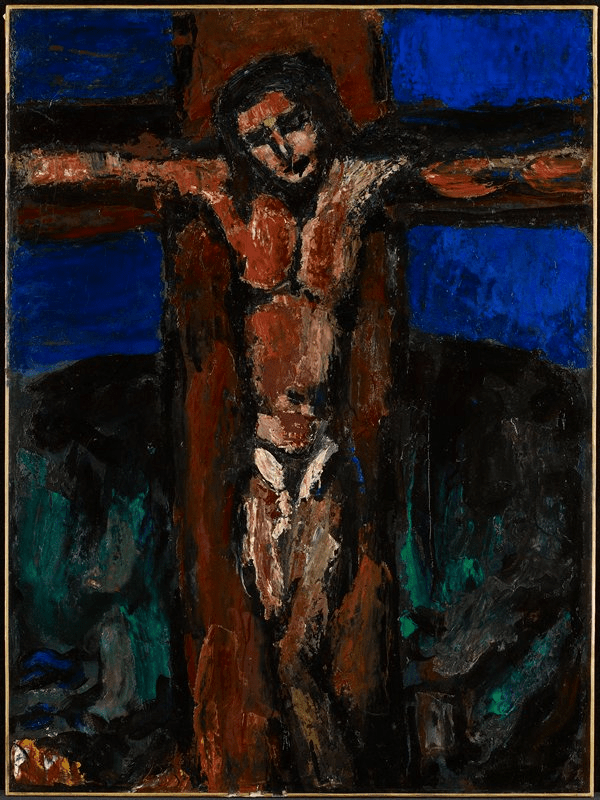
The Crucifixion, by Georges Rouault
The soldiers stripped his clothes from him when they nailed his hands and feet to the cross. They tore one of his garments in to four pieces, one for each guard. His long outer garment was woven together into one piece, so they said, “Let us not tear this, we can draw straws for it.”
This gave full meaning to the Sacred Teachings that said, “They divided my clothes between them and gambled for my garment.” This is what the soldiers did as they kept watch over Creator Sets Free (Jesus).
Standing near the cross was Bitter Tears (Mary), the mother of Creator Sets Free (Jesus), who had come to see him, along with her sister. Two other women also came with her, Brooding Tears (Mary) the wife of Trader (Clopas), and Strong Tears (Mary) from Creator’s High Lodge (Magdala). He Shows Goodwill (John), the much loved follower of Creator Sets Free (Jesus), was also there with them.
When Creator Sets Free (Jesus) looked down and saw them, he said to his mother, “Honored woman, look to your son.” The he said to his follower, “Look to your mother.”
From that time the follower took Bitter Tears (Mary) into his family and cared for her.
Creator Sets Free (Jesus), knowing he had done all the ancient Sacred Teachings had foretold, said, “I thirst.”
There was a vessel of sour and bitter wine standing nearby. One of the soldiers dipped a cloth in it to soak up some wine. He wrapped the cloth around the tip of a hyssop branch and held it up to the mouth of Creator Sets Free (Jesus).
He then tasted the bitter wine, turned his head to the sky and cried out loud, “It is done!”
He then lowered his head to his chest and, with his last breath, gave up his spirit.
Creator Sets Free (Jesus) was dead.
Soon the sun would set and a special Day of Resting would begin when no work could be done. It was time to prepare for this day, so the Tribal members asked Spear of the Great Waters (Pilate) to have the legs of the men on the crosses broken, which would make them die sooner. Then they could take the bodies down and prepare them for burial.
The soldiers came and broke the legs of the two men on each side of Creator Sets Free (Jesus). When they came to him, they saw he was already dead. Instead of breaking his legs, one of the soldiers took a spear and pierced his side. Blood and water flowed out from the wound.
The one who saw these things with his own eyes is telling the truth about this – so that all will believe. This was foretold in the ancient Sacred Teachings that say, “Not one of his bones was broken,” (Psalm 34:20) and, “They will look upon the one they have pierced.” (Zechariah 12:10)
Christ being lifted by Joseph of Arimathea and Nicodemus, by Antonio Canova (1757–1822)
He Gets More (Joseph) from High Mountain (Arimathea), a man with many possessions, was a follower of Creator Sets Free (Jesus), but in secret, because he feared the tribal leaders. Since it would soon be sunset, when the Day of Resting would begin, he went to Spear of the Great Waters (Pilate) and asked permission to remove the body of Creator Sets Free (Jesus) from the cross.
Spear of the Great Waters (Pilate) released the body to him. So he and another man, Conquers the People (Nicodemus), who had come to Creator Sets Free (Jesus) in secret at night, took his body away to prepare it ceremonially for burial. Conquers the People (Nicodemus) had brought a mixture of myrrh and oils weighing about seventy-five pounds. Together they ceremonially wrapped his body for burial in the traditional way, using strips of cloth and herbal spices and oils.
So because it was the Day of Preparation for the Passover Festival, and the day of resting was about to begin, they laid the body of Creator Sets Free (Jesus) in a nearby burial cave that had never been used and then returned to their homes.
Interview Between Jesus and Nicodemus, by James Tissot (1836-1902)
Just as Moses lifted up the snake in the wilderness, so the Son of Man must be lifted up,that everyone who believes may have eternal life in him.”
For God so loved the world that he gave his one and only Son, that whoever believes in him shall not perish but have eternal life. For God did not send his Son into the world to condemn the world, but to save the world through him. Whoever believes in him is not condemned, but whoever does not believe stands condemned already because they have not believed in the name of God’s one and only Son.
This is the verdict: Light has come into the world, but people loved darkness instead of light because their deeds were evil. Everyone who does evil hates the light, and will not come into the light for fear that their deeds will be exposed. But whoever lives by the truth comes into the light, so that it may be seen plainly that what they have done has been done in the sight of God. (New International Version)
For many, the truth about God’s purposes in Christ is confusing, even troubling. It was for Nicodemus. And even though there many today who simplify the exchange between Jesus and Nicodemus with a single Bible verse of John 3:16, taking a good look at the Gospel of John puts most of us with Nicodemus.
Nicodemus, a learned Jewish scholar, a Pharisee, found Christ’s words both confusing and troubling because it required him to let go of everything he understood – to let go and become like a newborn baby, receiving and discovering the world on new and different terms. In other words, Nicodemus had to unlearn some things before he could learn truth.
There are some things that are hard to grasp, not because they are so intellectually challenging, but because those things ask a lot of us, demanding our very lives. And so, we don’t so much want to understand; it would require a radical change.
But why would anyone not want to understand the good news that God so loved the world that gave the Son so that we may believe and have eternal life? Because we would then have to contend with the ways Jesus describes himself.
Jesus likened himself to the serpent that Moses lifted up in the desert (John 3:14; Numbers 21:4-9). In that story of Moses in the Old Testament book of Numbers, God sent poisonous snakes into the Israelite camp as punishment for the people’s incessant complaining against God.
Then, when the people repented, God told Moses to make a bronze snake, put it on a pole, and lift it up, so that anyone bitten by one of the poisonous snakes could see it and live. Jesus likened himself to the story. In the same way the bronze snake was lifted on a pole, Jesus explained that so must the Son of Man be lifted up, or exalted high above the people.
Visit of Nicodemus to Christ, by John La Farge, 1880
In the typical language of the Apostle John, using double meanings to a single concept, he meant to communicate that Jesus would be physically lifted onto the cross, above the people; and also that Jesus would be lifted up by God as the exalted One above all creation. (John 8:28; 12:32)
Just as the ancient Israelites were facing death because of their sin, and deliverance because of God’s action through Moses, so people everywhere in every age face the consequences of their sinful complaining; yet through the action of God through Christ’s crucifixion, resurrection and ascension, they can look up to the exalted and glorified Lord and receive deliverance from sin, death, and hell.
There is more to looking up at the lifted One than a mere incline of the head and eyes. In modern terms, we would refer to the sheer action of looking as an intellectual assent to faith. The Apostle John, however, means to have us believe, not simply acknowledge.
Jesus did not tell Nicodemus to simply acknowledge him as Savior, to accept him into the heart, and so, be saved. No, this was an encounter that left an intelligent man and an accomplished scholar scratching his head in bewilderment as he went back out into the darkness.
Today’s Gospel lesson is a story about how any one of us might reject the light offered to us because of the way it exposes what is dark within us. Therefore, to believe requires ultimate trust in another. It isn’t to acknowledge that Jesus was real and had an actual ministry on earth; it’s more than believing something happened in history in the ancient world of the first century.
To believe is to let our own lives be transformed by the Jesus we encounter in this story. And here is what that means:
Realizing and becoming aware of the ways we are complicit in and benefit from having our loyalties elsewhere, other than Jesus. To believe demands us answering the question: Whom shall you serve?
Placing our ultimate trust, allegiance, and loyalty in Jesus Christ. To believe begs the question: To whom will you commit all that you have, and all that you are?
Forsaking all other competing loyalties and “gods,” including both secular and religious deities. To believe means a single-minded devotion, which asks of us all: To whom and to what will you forsake in order to embrace Jesus?
Confronting inconvenient truths of our own personal values which clash with Christ’s ideals of righteousness. To believe presses us to answer the question: To whom and for what are you truly living for?
Willing to die to self and to anything that would hinder knowing Jesus and him crucified, risen, ascended, and coming again. To believe forces us to ask ourselves: Am I willing to die for Jesus?
While there is nothing in this world worth killing for, there are things worth dying for. The lifting up of Jesus lets us know that the true life God has promised us is not the life that we can secure for ourselves through self-interest, caution, and theological debate.
Most merciful God, we confess that we have sinned against you in thought, word, and deed, by what we have done, and by what we have left undone. We have not loved you with our whole heart; we have not loved our neighbors as ourselves. We are truly sorry and we humbly repent. For the sake of your Son Jesus Christ, have mercy on us and forgive us; that we may delight in your will, and walk in your ways, to the glory of your Name. Amen.
The Light of the World, by William Holman Hunt, c.1853
On hearing his words, some of the people said, “Surely this man is the Prophet.”
Others said, “He is the Messiah.”
Still others asked, “How can the Messiah come from Galilee? Does not Scripture say that the Messiah will come from David’s descendants and from Bethlehem, the town where David lived?” Thus the people were divided because of Jesus. Some wanted to seize him, but no one laid a hand on him.
Finally the temple guards went back to the chief priests and the Pharisees, who asked them, “Why didn’t you bring him in?”
“No one ever spoke the way this man does,” the guards replied.
“You mean he has deceived you also?” the Pharisees retorted. “Have any of the rulers or of the Pharisees believed in him? No! But this mob that knows nothing of the law—there is a curse on them.”
Nicodemus, who had gone to Jesus earlier and who was one of their own number, asked, “Does our law condemn a man without first hearing him to find out what he has been doing?”
They replied, “Are you from Galilee, too? Look into it, and you will find that a prophet does not come out of Galilee.” (New International Version)
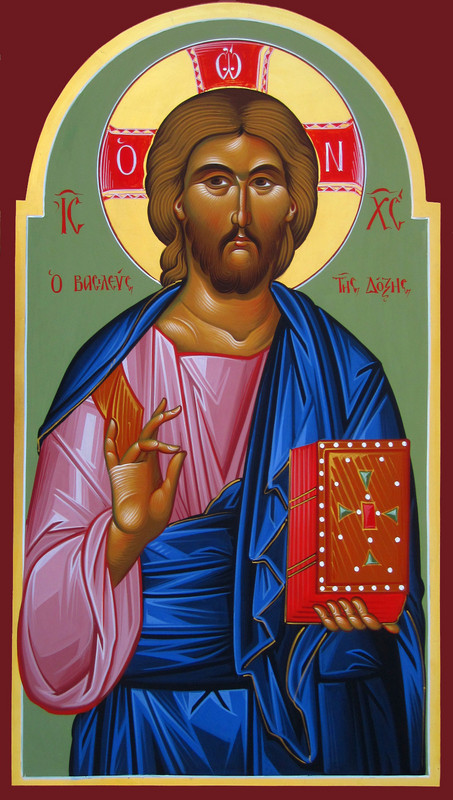
Orthodox Christian icon of Jesus Christ
There was a lot of buzz in Christ’s day of who Jesus really was. Prophet? Messiah? And, if Jesus really is a big deal, would he really come from Hicksville Nazareth? What about his credentials? His class? His pedigree?
Opinions on Jesus haven’t really changed all that much from the ancient world. They are still just as diverse now as when he was on this earth.
Unlike today, ancient people could not simply “Google” Jesus and find out where he was born and grew up. And they had no access to doing background checks in a matter of minutes to find out all kinds of things about him. Had the religious authorities bothered to do their homework and investigated Jesus, they would have found that, indeed, he was born of the Davidic line and in Bethlehem.
The short of it is that a chunk of the people simply assumed they knew Jesus wasn’t of proper Messiah credentials. They assumed and did not investigate because they did not want to know. No one can be faulted for ignorance. However, purposeful ignorance is perhaps the greatest of all sins, betraying a deep egoism of pride and prejudice.
In their hubris, the religious leaders sent the temple guards to bring Jesus in. Yet, in a clear demonstration of heavenly authority, the guards actually listened to Jesus and saw for themselves who he really is. Their simple confession testifies to Christ’s credibility. If one would but just see and listen for themselves, and engage in a genuine investigation, they could walk away finding truth.
6th-Century Byzantine mosaic of Jesus
Opponents of Jesus for the past two thousand years assume that Christians have been duped into taking the opiate of the people. Many think that followers of Christ were manipulated by religious hacks trying to gain power over others. But that’s a curious opinion, considering Jesus continually did just the opposite of that and was a champion for the poor, the powerless, and the marginalized persons of society.
When professional people with recognized degrees and competence do not believe you, nor take your own experience and learning seriously, what do you do?
Well, you could listen to them, or you could listen to your own gut telling you that you’re being gaslighted by a bunch of highly intelligent simpletons who are unfamiliar – are ignorant – of the faith you are familiar with.
What’s more, there are always smart and experienced people in the room who know better. Nicodemus was such a person. He was a serious scholar, and chose to speak up about these things. Authorities and credentials matter, yet of first importance is to know how to go about any sort of inquiry – rather than just passing over an objective investigation and assuming you know better.
Ethiopian artist depiction of Jesus teaching
For decades, I have (graciously) challenged others who do not believe in Jesus to actually read the Gospel accounts and at least engage in some minimal investigation – rather than giving opinions based on limited knowledge and secondary sources.
After all, as Nicodemus pointed out so long ago, shouldn’t we first give Jesus a fair hearing before we start dismissing him as nothing more than a religious figure that a bunch of people follow?
And I must also point out that this applies to us Christians, as well. Rather than waving aside Buddha or Muhammad or any other religious figure as false, don’t you owe their followers the basic respect of hearing them out before you dismiss them as fake, or in some cases, worse than that?
If you accuse another point of view, which is different than your own, as wrong or not real, without first hearing the accused and gathering objective evidence, then we really have no business getting uppity when another person accuses or dismisses our own faith.
Sadly, the colleagues of Nicodemus chose not to answer him but to instead engage in the age old practice of ad hominem argumentation by attacking the person, thereby deflecting having to give an answer.
People attack other people out of fear. And, in this case, it seems to me the religious leaders were downright afraid of investigating Jesus and giving him an honest hearing. Because if they did, they just might have their world turned upside-down; and they wanted the status quo to be maintained, at all costs, even if it meant ignoring the truth.
Jesus Washing the Feet of His Disciple, by Japanese artist Sadao Watanabe (1913-1996)
You don’t have to take my word on any of these things about Christ or Christianity. Read the Gospel of John for yourself – in one sitting if possible. Ingest the words. Drink in the experiences. Then, come and have a conversation with me.
Jesus, Lamb of God, have mercy on us.
Jesus, Bearer of our sins, have mercy on us.
Jesus, Redeemer of the world, give us your peace.
Jesus, Light of the world, shine in our hearts.
Jesus, Hope of all, be our companion on our way.
Jesus, Great Physician, heal our broken lives.
Jesus, Beloved Son of God, kindle within us the fire of your love. Amen.












 Rev. Tim Ehrhardt