How To Be Honest, Just, and Fair (Proverbs 1:1-7)

Solomon writing Proverbs by Gustave Doré (1832-1883)

The proverbs of Solomon, son of David and king of Israel.

Here are proverbs that will help you recognize wisdom and good advice, and understand sayings with deep meaning. 

They can teach you how to live intelligently and how to be honest, just, and fair. They can make an inexperienced person clever and teach young people how to be resourceful. 

These proverbs can even add to the knowledge of the wise and give guidance to the educated, so that they can understand the hidden meanings of proverbs and the problems that the wise raise.

To have knowledge, you must first have reverence for the Lord. Stupid people have no respect for wisdom and refuse to learn. (Good News Translation)

At the beginning of this year, if you like making new year’s resolutions, or are looking for a good practice to adopt, I have a suggestion: Consider committing yourself to the reading, reflection, and study of the biblical proverbs. At the least, read a chapter of Proverbs every day throughout this month. Since there are 31 chapters, and 31 days in the month of January, you have a guide in what to read every day.

The pursuit of wisdom is a noble aspiration for the New Year. One of the best places to go in that pursuit is the biblical book of Proverbs because it is all about living wisely and not foolishly. To acquire and live by wisdom means learning how to grow in being right, just, and fair in all our interactions and dealings with others.

Honest

“Honest” is “right” or “righteous.” For King Solomon of old, this is a relational term – to be righteous, to have honest and right relationships with God and other people. Righteousness involves experiencing peaceful, harmonious, and fruitful relations. 

For the Christian, right living is to know the wonderful freedom and joy of an unhindered relationship through Jesus Christ in dependence upon the Holy Spirit. When it comes to fellow human relations, a person characterized by righteousness does not, for example, let the sun go down on their anger. It is to know personal peace as well as to be a peacemaker, so that relationships do not remain strained, but enjoy harmony.

Just

“Just” is closely related to “right.” We might tend toward primarily understanding justice as a punitive act – and that is certainly a part of the term. God punishes the wicked with appropriate timing and wisdom; and deals with those who withhold righteousness and love through their uncaring, inattentive, or evil acts. 

Solomon understood justice as mostly concerned with providing a person with the necessities of life. So, for example, if someone is hungry and needs food, or does not have clean water to drink, it is a “just” act for us to provide those critical needs. God is deeply concerned for justice, and expects people to act in this same manner.

Fair

“Fair” is to be egalitarian. Fairness and equity binds righteousness and peace together by avoiding prejudice toward others and their needs. It means to not show favoritism because there is an unshakable belief in the equality of all people, no matter where they are from, what they do, or who they are.

Therefore, if we exercise righteousness and justice exclusively with individuals and groups we like, but ignore others in need, there is no fairness. To give our love and service to all persons without strings attached, or without being concerned to get paid back, is the practice of being fair in everything we do and say.

To live in the way of being honest, just, and fair in all our interactions is to be wise. Conversely, the classic fool is one who judges others, creates discord, and ranks persons according to their own personal standard of who deserves help, and who does not. Trying to have a useful and gracious conversation with a fool is like trying to reason with a toddler – you will get nowhere. 

A good way of pursuing the wise and biblical virtues of honest righteousness, restorative justice, and egalitarian fairness is to ask God to open our eyes to those within our sphere of influence who need both physical and relational needs met. Then, follow through by loving those persons for whom God brings into our lives.

Almighty God, the essence and source of wisdom, you are always right, just, and fair in all things. I praise you for your infinite and abundant wisdom.

Whereas you abound in wisdom, I am lacking. Please help me to grow in wisdom, as I increase in my knowledge and respect of your divine presence.

By means of your Spirit, please increase my depth of insight as I study your Holy Word. Hold me back from leaning on my own understanding and enable me to wholeheartedly embrace the wisdom from above.

Since you are a just God who shows no favoritism, lead me into being like you in my dealings with others through the example of Jesus Christ, in the strength of the Holy Spirit. Amen.

A New Year’s Blessing (Numbers 6:22-27)

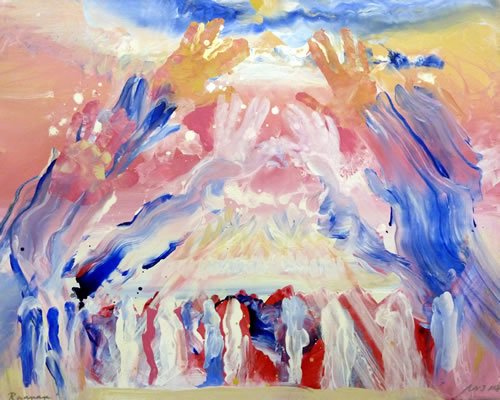
The Priestly Blessing, by Yoram Raanan

The Lord spoke to Moses, saying, “Speak to Aaron and his sons, saying: Thus you shall bless the Israelites: You shall say to them:

The Lord bless you and keep you;
the Lord make his face to shine upon you and be gracious to you;
the Lord lift up his countenance upon you and give you peace.

“So they shall put my name on the Israelites, and I will bless them.” (New Revised Standard Version)

Perhaps we are living in a famine of blessing. Maybe so many people are short-tempered, rude, drive their cars recklessly, ignore others’ needs, swear like sailors, and speak enough sarcasm to bury the earth six feet deep in cynicism, because they are not being blessed; and it could be they haven’t been blessed for a very long time, even never.

At the beginning of this New Year, we are reminded of deep longings and hopes for fresh starts. I invite you to consider the value and significance of giving and receiving a blessing.

Life operates by blessing, not cursing.

The world cannot stand up under the curse. The new earth will endure forever with a blessing.

People wither without a blessing. They die when cursed. Not necessarily in body. Most definitely in spirit.

Something must be said about the word “blessing.” It gets used (and misused) a lot, especially by Christians.

As with most words in the Old Testament, “blessing” is a relational word. It means to have God’s stamp of approval on your life. It’s meant to convey that the Lord’s presence is with us.

To be blessed by God is a multi-dimensional experience – receiving promises, enjoying peace, having right relationships with both God and other people, and knowing divine comfort and security.

A blessing isn’t simply having lots of money, plenty of family, or a good job. One could have none of those and still be blessed by God. And being blessed is not getting everything you want. Some people continually get what they want and are cursed, not blessed.

Blessing is tied not to human activity but to divine initiative.

We can’t finagle a blessing out of God. Plenty of folks try to do that, and, like Jacob, they might get away with it in their family – but it will not work with God. The grace of blessing is freely bestowed by a benevolent and merciful Lord.

Everything comes down to God. The Lord is not stingy but generous – not subject to the whimsy of human cajoling but deeply influenced by the unending unity, harmony, and love within the divine godhead.

In other words, divine blessing is a gift – not something earned or cleverly received through trickery or manipulation.

Blessing one another is also a gift. In fact, God clearly communicated to Moses and Aaron how they were to bless the people with powerful words.

I believe we all intuitively know that words and language have the power of life and of death, of blessing and cursing. And withholding words of blessing and keeping silent is to withhold goodness and love from another.

Speaking words of blessing and backing up those words with an active commitment, is vital to humanity’s spiritual and emotional health.

Fathers and mothers everywhere across the world stand in a unique and special position as those who have the power of bestowing a blessing on their children – a blessing of being with them, approving of them, affirming their gifts and abilities, envisioning for them a special future of how God can use them.

Those words of blessing have the power to help children navigate the world with assurance and confidence. Armed with blessing, they can filter-out the choices in front of them and walk in the way of God.

Notice in the New Testament Gospels how the God the Father blessed the Son:

And when Jesus had been baptized, just as he came up from the water, suddenly the heavens were opened to him and he saw the Spirit of God descending like a dove and alighting on him. And a voice from heaven said, “This is my Son, the Beloved, with whom I am well pleased.” (Matthew 3:16-17, NRSV)

God provided a constant presence and an active commitment through the Spirit; God spoke words of approval and affirmation; God the Father had a special future for Jesus the Son, which helped Jesus to repel the words of Satan. Since Jesus needed and received a blessing from his Father, how much more do we?

Jesus passed the blessing to his disciples with a promise of presence and commitment:

Jesus came near and spoke to them, “I’ve received all authority in heaven and on earth. Therefore, go and make disciples of all nations, baptizing them in the name of the Father and of the Son and of the Holy Spirit, teaching them to obey everything that I’ve commanded you. Look, I myself will be with you every day until the end of this present age.” (Matthew 28:18-20, CEB)

Jesus informed the disciples his presence would be with them; communicated an active commitment to give them authority to do the job of disciple-making; pictured for them a special future of reaching the nations; affirmed and approved them. “The Great Commission” is really a statement of God’s blessing.

One reality needs to be recognized and affirmed with all confidence: You and I already possess God’s blessing; there is no need to try and earn it. The words of blessing state what is, in fact, already true.

We have the privilege and the ability to reverse the world’s curse and turn it into blessing.

Those blessed with money can be a blessing by giving it away.

Those blessed by growing up in a loving family can provide love to others who are unloved and need a special blessing.

Those blessed with wisdom can mentor and instruct those who need wisdom.

Those blessed with the mercy of God can be merciful to others.

Those blessed with a wonderful relationship with God can pray people into the kingdom of God.

Parents, it is never too late to bless your children, even if they are adults. Children, it is never too late to bless your parents and your siblings, even if they are prickly and hard. To not bless is to curse.

Bless your family through words that build up, and do not tear down. Use those words to picture a special future of what God can do. Follow through with those words by demonstrating an active commitment to embodying blessing.

I leave you with this blessing for the New Year:

May God answer you when you are in distress; may the name of Jesus protect you. 

May the Lord send help when you need it and give you support when you cry out to him. 

May the God of heaven remember your good deeds done in faith and accept you just as you are. 

May the Lord give you the desire of your heart and make all your plans succeed.

When the Almighty goes out of the way to answer your prayers, then I will be the first to shout with joy!

I know the Lord is God. There is a special future for you beyond what you can even ask or think. And I will be there on the sidelines, encouraging you all the way.

Some people trust in the political process, others trust in the strength of the economy; but we trust in the name of the Lord our God. 

May God answer when you call.

May God bless you with an everlasting love. 

May you know Christ, and him crucified, risen, and coming again. 

May God’s presence and power be with you now and forever. Amen.

Ecclesiastes 3:1-13 – It’s Time

For everything there is a season,
    a time for every activity under heaven.
A time to be born and a time to die.
    A time to plant and a time to harvest.
A time to kill and a time to heal.
    A time to tear down and a time to build up.
A time to cry and a time to laugh.
    A time to grieve and a time to dance.
A time to scatter stones and a time to gather stones.
    A time to embrace and a time to turn away.
A time to search and a time to quit searching.
    A time to keep and a time to throw away.
A time to tear and a time to mend.
    A time to be quiet and a time to speak.
A time to love and a time to hate.
    A time for war and a time for peace.

What do people really get for all their hard work? I have seen the burden God has placed on us all. Yet God has made everything beautiful for its own time. He has planted eternity in the human heart, but even so, people cannot see the whole scope of God’s work from beginning to end. So, I concluded there is nothing better than to be happy and enjoy ourselves as long as we can. And people should eat and drink and enjoy the fruits of their labor, for these are gifts from God. (New Living Translation)

Maybe we enjoy celebrating the first day of a new year because it gives us a sense of having a clean slate. Perhaps we internally and/or unconsciously realize we wasted great chunks of time in the past year. So, we look forward to amending our ways and making new resolutions.

Time Is Finite

We cannot get it back once we lose it – hence, the lamenting of so much squandered time. We want to use our time in ways that reflect our most cherished values and commitments. For that, we need wisdom to know what to do, what not to do, and when to do it.

There needs to be a sense of purpose – of values which drive our goals and our actions – if we are to use our time in redemptive ways. Time is a gift, bestowed to us by a Creator who desires we steward that precious gift with sage understanding and wise discernment.

Time is a temporary commodity to be used for good purposes before the end of all time comes.

One of the realities of time is that our lives are full of seasonal rhythms and change over time. These are built into the life God has given us. The book of Ecclesiastes, throughout its contents, explains that nothing we pursue has any permanence to it. We throw ourselves into some work or activity, but what does that activity really do for us in the end?

Time Marches On

Time marches inexorably forward, no matter what we do or don’t do. Therefore, we must respect, and learn to work with, it’s slow and constant movement.

When I was twenty years old, I thought nothing of playing a round of golf in the morning, three sets of tennis in the afternoon, then staying up late at night with friends. If I did that same thing today, I would be in the hospital well before the sun sets.

We all, at some point, try to defy time and act like we can do the things we once did in the past. Sometimes it takes a lot for us to accept our limitations, whether it is our play or our work. Ecclesiastes teaches us that outside forces always seem to dictate what we can do and not do.

Time Is In Control

The cycles and rhythms of life can appear meaningless. We may feel as if we are prisoners of time. Yet, for the believer, time can be redeemed with godly purpose and meaning, no matter what the season of life is.

Because there is time, and all things will someday come to an end – all activity, or the lack of it, will be judged according to how we denied or accepted our limitations due to time. 

Ecclesiastes also offers to us what seems a subversive perspective that is counter-cultural to our society. Many Americans believe that by working hard and doing the right thing, we can shape our own destiny and prosperity.

However, the Teacher of Ecclesiastes insists we submit and move with the events, rhythms, and seasons God has established. Apart from God, time is futile and meaningless. In our denial of the power and effects of time, it is no wonder many Americans are so unhappy with their lives.

In the experiences we have from birth to death, the conclusion of Ecclesiastes is that everything is out of our control. Too many of us try to exert control over events, people, and circumstances when, in truth, any control we have is an illusion. I call this the “c-clamp syndrome,” trying to clamp down on others to get them to submit to our agenda.

Self-Control

Instead, Holy Scripture directs us to practice self-control – to focus on myself and my own actions:

Moderation is better than muscle, self-control better than political power. (Proverbs 16:32, MSG)

Prepare your minds for action and exercise self-control. Put all your hope in the gracious salvation that will come to you when Jesus Christ is revealed to the world. (1 Peter 1:13, NLT)

The end of everything has come. Therefore, be self-controlled and clearheaded so you can pray. (1 Peter 4:7, CEB)

Do your best to improve your faith. You can do this by adding goodness, understanding, self-control, patience, devotion to God, concern for others, and love. If you keep growing in this way, it will show that what you know about our Lord Jesus Christ has made your lives useful and meaningful. (2 Peter 1:5-7, CEV)

We cannot force time to stand still. So, instead, we must focus on how we spend our time now.

It is time for us to lay aside lesser pursuits and diligently pursue what is right, just, and good. We each must give ourselves to the unforced rhythms of grace and let God redeem the time.

What time is it?  It’s time to live in harmony with the clock, with God, and with others.

God of all time help us to know ourselves. Teach us to recognize our weaknesses and work to walk in holiness. Let us follow you in all things, submitting to the times you have for us. Thank you for your unending grace and mercy toward us when we need it most. Help us to trust you with our lives through Jesus Christ our Lord in the power of the Holy Spirit. Amen.

Psalm 8

As we embark on yet another new year, Psalm 8 helps to remind us of who we are and the possibilities that exist for the future.  This little psalm grounds us in reality by dealing with the ultimate questions of our existence:  Who am I?  Why do I exist?  What is the purpose of my life? 
 
            Living on such a big planet actually makes some people feel quite small and wondering how they fit in.  With such a large universe we may ask along with psalmist, “What is man that you are mindful of him?”  This question forms the center of the psalm.  Hebrew poetry is typically set up to have the front and the end of the poem point to the middle as its main focus.  That is, the psalmist purposely wrote this psalm so we would consider this great question of what God thinks of humanity within the scope of this very large universe.
 
            Out of the billions of galaxies in the universe, what is the planet Earth that God should care about it?  On our planet there are billions of creatures.  Yet out of all of those bugs, animals, fish, and birds, God has a special relationship with us, humanity, and cares for us deeply.  We know that God cares for us, according to this psalm, because he has entrusted us with the responsibility to care for creation.  We are the only creatures who have the charge to steward all that God has created.  To put it another way, we, as people created in the image of God, have a job that is befitting of a king, and it is not just a duty for us, but a delight.
 
Only we as people have the self-awareness and perspective of the world that is needed to govern the world.  So, then, we can only find our true purpose and belonging in the stewardship of creation.  Caregiving is actually at the heart of being a person.
 
            So, in this next year we have the possibilities of engaging in good stewardship of all that God has given us.  We have the opportunity to use our words in ways that care for others and build them up, rather than saying uncaring things that are not helpful.  We have the chance to be attentive to all the little things of life, whether gardening, building a bird house, working with diligence and care at our jobs, or keeping our community clean and its citizens healthy and happy, it is all important and has a significant place in God’s wondrous world.
            Let us, then, continually improve what we do, no matter what it is, so that it befits us as God’s people crowned with honor.  May this year be one of joy and contentment in knowing the majesty that you share with God as a human being in his wondrous world.