Remember Passover (Deuteronomy 16:1-8)

Exodus, by Yoram Raanan

Observe the month of Aviv and celebrate the Passover of the Lord your God, because in the month of Aviv he brought you out of Egypt by night. Sacrifice as the Passover to the Lord your God an animal from your flock or herd at the place the Lord will choose as a dwelling for his Name. Do not eat it with bread made with yeast, but for seven days eat unleavened bread, the bread of affliction, because you left Egypt in haste—so that all the days of your life you may remember the time of your departure from Egypt. Let no yeast be found in your possession in all your land for seven days. Do not let any of the meat you sacrifice on the evening of the first day remain until morning.

You must not sacrifice the Passover in any town the Lord your God gives you except in the place he will choose as a dwelling for his Name. There you must sacrifice the Passover in the evening, when the sun goes down, on the anniversary of your departure from Egypt. Roast it and eat it at the place the Lord your God will choose. Then in the morning return to your tents. For six days eat unleavened bread and on the seventh day hold an assembly to the Lord your God and do no work. (New International Version)

The first five books of the Old Testament are known by Christians as the Pentateuch. These same books are the Torah in Judaism. Deuteronomy is the fifth and final book; it is a restatement of God’s Law for the Israelites about to enter the Promised Land.

Several prominent theological themes are highlighted in the book of Deuteronomy. It vigorously advocates for exclusive loyalty to the monotheistic God, Yahweh. Yahweh is characterized as a transcendent Being, full of steadfast love and transformative justice.

Deuteronomy places significant emphasis upon the covenant relationship between God and Israel. The covenant was established with the patriarchs – Abraham, Isaac, and Jacob – and affirmed at Mount Sinai after the exodus from Egypt, at the giving of the Law. This Law was graciously provided by God for the people; it is encapsulated in the Ten Commandments, and is to be reaffirmed as soon as Israel enters the land.
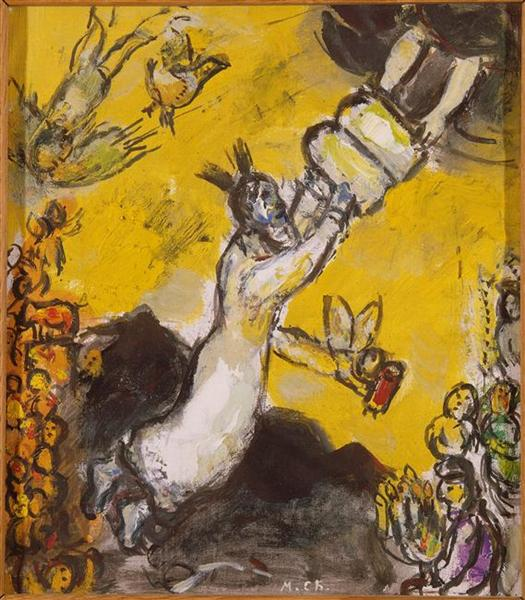
Moses receiving the Tablets of Law, by Marc Chagall, 1963

Therefore, the entire book of Deuteronomy looks forward toward a new existence in the Promised Land. This new society is to pursue justice and be devoted to righteousness. All Israel is to live in harmony with God and one another, enjoying the land and the covenant relationship.

The welfare of Israel depends upon upholding and maintaining the social and religious laws given by Yahweh. God’s commands are a divine gift, and if closely followed, will be the best humanitarian way of caring for the poor and disadvantaged, as well as bringing the people close to Yahweh.

The sacrificial system will revolve around a singular sanctuary in the religious capital. By locating sacrifices in a particular place, this has the effect of Jewish faith not becoming dependent on offerings, but instead on mercy, love, learning the law, and rituals that uphold reverence for God.

Perhaps the greatest of all the rituals is Passover. Israel’s experience of deliverance at the Red Sea and the centralization of worship in Jerusalem is remembered and celebrated at the festival of Passover every year.

In the original Passover, at the time of the exodus, the blood of a sacrificed lamb was smeared on the doorposts of each Jewish home. In doing this, it let the angel of death know to “pass over” that house, thereby only entering Egyptian homes that did not revere nor recognize God. This act was also the final miraculous act of ten plagues leveled on Egypt.

And There Was a Great Cry in Egypt, by Arthur Hacker, 1897

As the households of Egypt were grieving their dead, Israel was urged by the Egyptians to get out. Egypt feared what would happen if the Israelites remained. Therefore, Israel left post haste. They didn’t have any time for their bread to rise. The people ate unleavened bread so they could immediately leave Egypt.

So, from then on, every year in early Spring, Israel commemorates and remembers God’s deliverance of the people from slavery. God, through Moses, instructed the Israelites to mark Aviv as the first month; it is then that the Passover festival is to occur.

I believe that what we can takeaway from this Scripture, is that perhaps, we ought to stop trying to always have takeaways for everything – as if the Bible can be boiled down to some neat personal application for my life.

Aside from admitting I’ve had a bit of a cynical streak lately, we really must contend with seasons like Passover and Lent, and matters such as social justice and religious worship. These religious seasons are important enough to warrant what the late Eugene Peterson called “a long obedience in the same direction.”

By that phrase, Peterson meant that there are some spiritual practices that we must commit ourselves to year after year, even day after day, for the rest of our lives. Generations before did, and generations after us will need to, as well.

Spiritual growth and maturity take time; and we must patiently and consistently cultivate a sense of justice and a practice of righteousness over and over again.

Passover Seder, by Melita Kraus

One must fight for what they believe, each and every day. Spiritual growth takes a lot of time, grit, tenacity, and resilience. It requires patience and grace, perseverance and a good nature. And it is very much a skill which demands daily practice.

Contemporary society is obsessed with quick fixes and easy solutions. But the time-tested practices of Lent, rooted in the remembrances of Passover, are a Christian discipleship that is long on obedience in the same well-worn ancient directions.

We need to keep moving in the directions of deepening a life of prayer, learning the joy of service, growing in the worship of God, and discovering the virtues of humility and a concern for the welfare of everyone in the community.

In other words, to truly observe something, we need to do it, over and over, year after year. In observing the significant events and dates and seasons of the Christian Year, we can find the sort of spiritual support that will fortify our soul, and bless others.

Almighty and everlasting God, you hate nothing you have made and forgive the sins of all who are penitent: Create and make within us new and contrite hearts, so that we may acknowledge our guilt and lament our shame. Let us obtain from you, O merciful God, reconciliation through the Cross, and empowerment through the Spirit, to do justice, love mercy, and walk humbly with you. Amen.

Follow Me (Mark 1:14-20)

Come Follow Me, by Jorge Cocco Santángelo 

Now after John was arrested, Jesus came to Galilee proclaiming the good news of God and saying, “The time is fulfilled, and the kingdom of God has come near; repent, and believe in the good news.”

As Jesus passed along the Sea of Galilee, he saw Simon and his brother Andrew casting a net into the sea, for they were fishers. And Jesus said to them, “Follow me, and I will make you fishers of people.” And immediately they left their nets and followed him. As he went a little farther, he saw James son of Zebedee and his brother John, who were in their boat mending the nets. Immediately he called them, and they left their father Zebedee in the boat with the hired men and followed him. (New Revised Standard Version)

For all the talk of leadership, developing leaders, and being a leader, there is precious little conversation these days about becoming a follower. Perhaps we have such a dearth of leadership for this very reason, because one can only become a good leader if they experientially know what being a follower is.

The Call of Jesus

The call of Jesus is to pursue him, and he will develop us. Follow Jesus, and he’ll show you how to fish for people. All of Christ’s original disciples listened to Jesus, dropped everything they were doing, and immediately followed him.

I am wondering what would make you drop literally everything you are presently doing to pursue an entirely new life. I am curious what would cause you to follow Jesus without any conditions attached whatsoever. 

I am impressed that Peter and Andrew immediately responded to Jesus. They didn’t question Jesus as to whether this was a short term project or a long term assignment he was calling them to. They did not seek a contract with Jesus or ask how he would impact their stock portfolio. 

The first disciples simply dropped everything and left with Jesus.

I suspect they followed Jesus for the same reason I originally decided to follow him – because Jesus is such a compelling person, so gracious, interesting, and loving, that it was really no decision at all. Everything else pales in comparison with Jesus.

Read all four Gospels and the book of Acts and you will find that believers in Jesus follow Jesus; and those who do not follow Jesus are not believers. Followers follow, and those who do not follow are not Christ’s followers.

Jesus still calls people. He calls us to follow him and he will make us fishers of humanity. Maybe you are concerned about this and say, “I have no idea how to fish for people.” The good news is that Jesus said he would make us fishers of people. Jesus is not looking for people with skills he can use; instead, he calls, then develops people into fishers.

Christ always forms people with the ability to follow his call. Jesus will train us; we only need to answer the call to follow. 

When I was five years old my Dad took the training wheels off my bike and told me to ride it. I told him I couldn’t. He told me to get on the bike and he would run beside me. I got on the bike and started to ride with him holding it. When I began to panic, approaching a tree, I started talking to my Dad. But he didn’t answer… because he wasn’t beside me. He dropped out from shagging me a long way back.

We are not called to follow Jesus based on our skills, but on the lack of them so that Jesus will do in us a work of total allegiance and loyalty to the kingdom of God. 

Jesus will make sure to develop the skills we need in order to do what he has called us to do. We only need to hear and answer the call of Jesus to follow. The following is a parable about the church and being fishers of people: 

“Now it came to pass that a group existed who called themselves fishermen. Week after week those who called themselves fishermen met in meetings and talked about their call to fish, the abundance of fish, and how they might go about fishing. They discussed the importance of fishing and that fishing is the task of every fisherman.  They listened to special speakers talk about fishing and they promoted fishing and looked at all the latest equipment for fishing. They built large buildings called ‘Fishing Headquarters’ so that they could tell as many people as possible about fishing. They organized boards of people to send out fishermen to other places. They offered teaching and classes on how to fish and the best and latest fishing methods. With much training a good many persons got their fishing licenses and became upstanding members of Fishing Headquarters. There was just one thing that they did not do: They didn’t fish. When one person dared to suggest that those who do not catch fish are really not fishermen, the group became angry and kicked that crazy person out their group.”

The Message of Jesus

Jesus said the kingdom of God is near, so repent and believe the good news. For Jesus, the word “kingdom” means God’s intentions and will for this world to come true. Jesus was saying that he is creating a new society – which meant Caesar was not Lord and that people’s loyalty was not ultimately to the Roman Empire. 

The kingdom of heaven, God’s dream society, will eventually spread across the entire earth so that the whole world is God’s sacred space, devoted to love, shaped by justice, living in peace, and abounding with wisdom.  Jesus encouraged us to pray consistent with this idea saying, “May your kingdom come and your will be done on earth as it is in heaven.” (Matthew 6:10)

If we find ourselves not really working toward Christ’s idea of kingdom, then we need to “repent and believe the good news” that God is working toward restoring all things to their original beauty and luster. The word “repent” means a change of mind which leads to a change of behavior. And “believe” means to put all your eggs in God’s kingdom basket.

None of this is a suggestion, but is rather a straightforward call to follow Jesus in his kingdom building enterprise on this earth. It would, therefore, be a travesty to simply think about the message for a while and follow Jesus if we feel like it, or get around to it.

Jesus wants to make fishers within family systems, workplaces, neighborhoods, and all the places within a typical sphere of living: This requires the following:

  1. Go where the fish are. Fishing would be easy if we could put a basket by the water and have the fish jump into them! But that is not how it works. Rather, it takes intentional activities that connect people together.
  2. Cast the nets. Peter and Andrew did more than take their boat out to the middle of the lake. To catch fish, they threw their nets into the water. Here is what I believe this means for us: We do what is fair and just to our neighbors. We extend compassion to them and are steadfast in our love, even when others are unlovely. And we do not take ourselves too seriously.
  3. Obey Jesus and walk with him. After Christ’s resurrection, Jesus came to some of the disciples, who had fished unsuccessfully all night. He told them to throw their nets on the other side of the boat – which seemed like nonsense, but they did it anyway. It resulted in a great catch (John 21:1-14). During the three years of Christ’s earthly ministry, the disciples did everything with him – they walked, talked, and ate with Jesus. And when he ascended to heaven, they acted on the Great Commission given to them by Jesus to make other disciples.

May God cleanse our lips and our lives so that we might proclaim the good news of Christ’s kingdom with glad and sincere hearts to the glory of Father, Son, and Spirit.

Eternal God, the refuge and help of all your children, we praise you for all you have given us, for all you have done for us, for all that you are to us. In our weakness, you are strength, in our darkness, you are light, in our sorrow, you are comfort and peace. We cannot number your blessings; we cannot declare your love: For all your blessings we bless you. May we live as in your presence, and love the things that you love, and serve you in our daily lives, through Jesus Christ our Lord. Amen.

Beat the Swords into Plowshares (Micah 4:1-5)

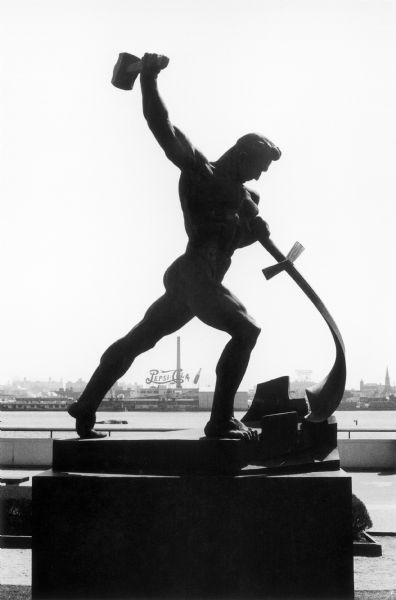
Let Us Beat Swords into Plowshares, by Yevgeniy Vuchetich (1908-1974)

In days to come
    the mountain of the Lord’s temple
shall be established as the highest of the mountains
    and shall be raised up above the hills.
Peoples shall stream to it,
    and many nations shall come and say:
“Come, let us go up to the mountain of the Lord,
    to the house of the God of Jacob,
that he may teach us his ways
    and that we may walk in his paths.”
For out of Zion shall go forth instruction,
    and the word of the Lord from Jerusalem.
He shall judge between many peoples
    and shall arbitrate between strong nations far away;
they shall beat their swords into plowshares
    and their spears into pruning hooks;
nation shall not lift up sword against nation;
    neither shall they learn war anymore;
but they shall all sit under their own vines and under their own fig trees,
    and no one shall make them afraid,
    for the mouth of the Lord of hosts has spoken.

For all the peoples walk,
    each in the name of its god,
but we will walk in the name of the Lord our God
    forever and ever. (New Revised Standard Version)

Yes, we are presently in the muck of the world. But no, it will not always be this way. There is a time coming, when all is said and done, when justice shall prevail. People will seek after God, and they will stop thinking about how to kill each other.

Weapons will be a thing of the past. They’ll just be repurposed for fostering life instead of death. Peace and security will take hold so that each person will be able to work and rest without worrying about poverty or protection.

If this sounds like an idyllic world and a utopian society, that’s because it is. I believe there is a longing within each of us to realize this hope. And someday, in God’s good time, it will happen.

It seems almost impossible, in this contemporary world of ours, that we could live without constant fear and anxiety, that people could actually live together in unity, harmony, and wholeness of being. We were meant for peace, which is why we yearn for it more than an Iowa boy yearning for bacon at breakfast.

Just because this is a prophetic utterance that the faithful believe will happen, doesn’t mean that we need not work toward this ideal now. For it is very possible, and likely real, that we have a large part to play in God’s drama of making a new world.

The day of the Lord will come like a thief. The heavens will disappear with a roar; the elements will be destroyed by fire, and the earth and everything done in it will be laid bare. Since everything will be destroyed in this way, what kind of people ought you to be? You ought to live holy and godly lives as you look forward to the day of God and speed its coming. (emphasis mine, 2 Peter 3:10-12, NIV)

If we are impatient to see an end to wars and rumors of wars, of oppression and hate, then let’s roll up our sleeves and do everything humanly possible (and trusting in divine power!) to bring justice everywhere we can. The future idyllic hope we have is not yet a present reality. We have a bit of say whether it’s going to be sooner or later.

It’s easy to destroy. It takes little imagination and effort to criticize and tear down someone with our words. It’s nothing to send missiles and rockets of destruction in order to raze a community. Bombs can be dropped with but a switch. A neighborhood can disappear in days with just a few bulldozers.

But to bring life and security and peace to a people requires our best efforts and everything we’ve got to make it happen. It’s hard, and takes a lot of committed sweaty work. Building something that will last always takes a great deal of time, resolve, and struggle.

We need the hard work of healers, not the easy path of harmers; we need peacemakers, not warmongers; public servants, not public strangers; faithful leaders, not fat louses; arbitrators, not disputers; religious penitents, not pious know-it-alls; and lovers, not haters.

In short, we need a whole cadre of caring citizens for a new society that prizes egalitarian relations, social and economic justice, personal and public righteousness, and compassionate service.

Injustice must be dismantled; and we need to become content with having enough. That’s what it means to walk in the name of the Lord our God.

If all things belong to God (which they do) and believers hold all things loosely as stewards (which they should) then there is no need to dig in and defend something which is not ours to begin with. Fear is taken away. Injustice becomes irrelevant.

Although we may not be able to make everything right in this present evil age, we can still make a difference and continue to pray:

Maranatha. Come, Lord Jesus, come. Amen.

New Rules for a New Society (Ephesians 4:25-32)

We are part of the same body. Stop lying and start telling each other the truth. Don’t get so angry that you sin. Don’t go to bed angry and don’t give the devil a chance.

If you are a thief, quit stealing. Be honest and work hard, so you will have something to give to people in need.

Stop all your dirty talk. Say the right thing at the right time and help others by what you say.

Don’t make God’s Spirit sad. The Spirit makes you sure that someday you will be free from your sins.

Stop being bitter and angry and mad at others. Don’t yell at one another or curse each other or ever be rude. Instead, be kind and merciful, and forgive others, just as God forgave you because of Christ. (Contemporary English Version)

New life means being a part of a new society; and a new society means new rules to live by which benefit and uplift the entire community. Old destructive practices must be replaced with new encouraging and supportive ways of being together. Stop taking the broad easy road to destruction and start walking the hard path to life and contentment.

Stop Lying and Start Telling the Truth

Lying exists because people believe that being truthful and transparent is too traumatic. Many people don’t think that being open, honest, real, vulnerable, and genuine is worth the risk. They have believed the lie that they won’t be accepted, that they’ll lose face with others, or that people will just gossip about me if they really knew about me. So, we hide from others and avoid the truth.

In truth, we are responsible for one another – to make and keep promises to each other because that is what God does with us. Churches that love truth will make a safe place for the awkwardness of confession, forgiveness, and healing.

Truthful communities are places of hospitality where we are safe to be real. No one ought to ever suffer in silence, cry alone, or wonder whether others will forsake them. We belong to one another. Therefore, to have union with Christ is to have union with one another; you can’t have one without the other.

Stop Stealing and Start Giving

Theft comes in many forms, especially in our contemporary age. Embezzlement, shoplifting, fraud, plagiarism, and robbery are just a few examples of the ways in which we humans steal from one another.

Embezzlement is the theft of assets (money or property) by a person who has been trusted to keep those assets safe. Instead of embezzling funds, we are to steward those assets well, distributing them with care and a conscience – using them for the benefit of others, not simply ourselves.

Shoplifting involves stealing goods from retail establishments. Some people steal because they are in dire need. Many more steal because they can and want to. We must stop taking things we want, and learn to be satisfied with what we have. And we will only do this by using our own money to buy things for others who are in need.

Fraud is stealing that involves convincing the victim to surrender their money or property under false pretenses. This is nothing more than manipulating someone to get what you want. Work hard to defend the defenseless and ensure their justice, rather than commit a gross injustice against them.

Plagiarism is the practice of taking someone else’s work or ideas and passing them off as one’s own. It’s cheap. It’s easy. And don’t do it, period. Someone else worked very hard to create what you may nonchalantly use for your quick benefit. Take the pains to credit someone else’s work and document the sources you use.

Robbery is a theft that involves using violence, intimidation, or threats to obtain property. Put the threats, guns, and false confidence away. In it’s place, do whatever it takes to do things right, hold a job, and give something back to society.

Stop All the Unhelpful Talk and Start Encouraging

Corrupt or dirty talk is totally unnecessary. It’s unwholesome and benefits nobody. Rather, make it your aim to use your words for good by encouraging others.

Encouragement involves strongly urging someone to do something with an equal commitment to lovingly come alongside and help. This requires both verbal exhortations and tangible assistance. Encouragement is the glue which holds a people together. Without it, a society degenerates into watching-out-for-number-one, and destructive personal survival tactics which will say anything to get what one wants.

Stop the Bitterness and Start Forgiving

Forgiveness is choosing not to hold another’s persons offensive words or actions over their head. It is:

  • Specific to an event, action, or words.
  • A process: it takes time to truly forgive.
  • Something anybody can do, regardless of race, creed, religion, etc.
  • Hard.
  • Freeing.
  • Ongoing.
  • Gracious.

“To forgive is to set a prisoner free and discover that the prisoner was you.”

Lewis Smedes, Forgive and Forget: Healing the Hurts We Don’t Deserve

Bitterness, however, wants to hold onto a grudge and seeks to punish the one who has offended them. That’s the way of Satan, not God. Even if the person has set themselves up as your enemy, we have clear exhortations from Jesus to love our enemies and do good to them, not harm. (Matthew 5:43-48)

The world revolves on the axis of mercy, not judgment. The sooner we get in the groove of how things actually operate for us to live a good life, the better that our relationships and society will be.

Good and gracious God, we ask that you make our life journey safe as we choose integrity, not disintegration. Shed light on those who follow crooked paths. May their dishonesty be exposed so that corrections can be made before further damage occurs. Help our nations, neighborhoods, and faith communities choose a path of mercy and goodness, rather than the crooked way of lies, theft, vitriol, and grudge-bearing. May we see a new wave of integrity sweeping over our world, through Jesus Christ our Lord, by the power of your Holy Spirit. Amen.