Face Reality (Numbers 20:22-29)

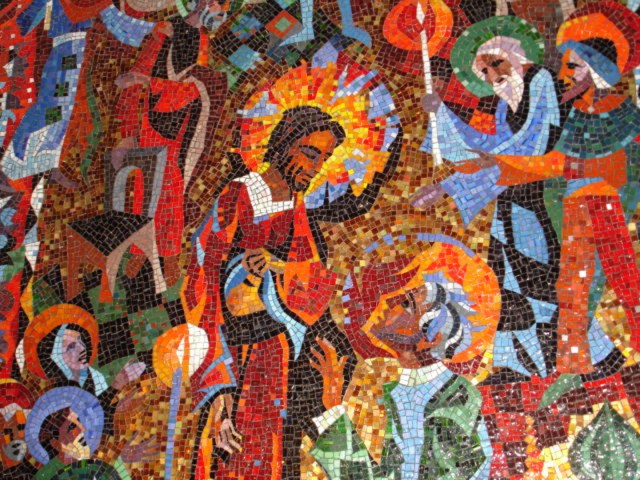
Aaron’s Death, by David Roberts, 1842

The whole community of Israel left Kadesh and arrived at Mount Hor. There, on the border of the land of Edom, the Lord said to Moses and Aaron, “The time has come for Aaron to join his ancestors in death. He will not enter the land I am giving the people of Israel, because the two of you rebelled against my instructions concerning the water at Meribah. Now take Aaron and his son Eleazar up Mount Hor. There you will remove Aaron’s priestly garments and put them on Eleazar, his son. Aaron will die there and join his ancestors.”

So Moses did as the Lord commanded. The three of them went up Mount Hor together as the whole community watched. At the summit, Moses removed the priestly garments from Aaron and put them on Eleazar, Aaron’s son. Then Aaron died there on top of the mountain, and Moses and Eleazar went back down. When the people realized that Aaron had died, all Israel mourned for him thirty days. (New Living Translation)

There is a tendency for us “enlightened” humans to believe that we are far more advanced than our ancestors – who did not know all that we very smart people today know.

Such a mental stance only demonstrates that perhaps we are getting more stupid as the centuries and the millennia wear on.

Despite all of our accumulated knowledge and research, and incredible technical advances, we have (in my humble opinion) strayed rather far from a wise understanding of anthropology and theology. In other words, many people in this contemporary world have little to no idea about who they are, why they are here, and what to do when life and death happens.

The death of Aaron the priest happened over 3,500 years ago. Yet, here I am, referencing it. Why? Because there is meaning to it. The ancients have a great deal to teach us, that is, if we have the spiritual and emotional ears to hear, and eyes to see. Notice just some of the lessons they continue to teach us…

The Need to Accept Death

Just as we have all been born into this world, we shall all die someday. If we are such an enlightened people, it would seem to me that we all might have highly developed coping skills, strategies, and ways of honoring and accepting the inevitable death of another – not to mention having adequately prepared for our own demise.

And yet, we go on, day after day, as if we will live forever. Then, when someone we care about dies, it’s as if we cannot believe it has happened. But there is only one sure event in this life, and that is death. It is inexorably coming, whether we like it, or not.

It also seems to me that a great deal of contemporary religious piety is shallow, and does not plumb the depths of real spiritual substance. The irony of it, for many, is that they long for heaven, but ignore death. This is nothing but the denial of reality. Our very real lives here and now must be contended with, including the inevitable death to come.

Reality is the one substantial door that must be acknowledged, experienced with all of our senses and emotions, and passed through – not denied. Only through complete acceptance of this world can the greater reality of the world to come be truly known.

Fantasy and endless gospel songs about heaven can only lead us astray. We picture a future of our own imaginations, which deludes and dulls us of how to actually pass from one dimension to another.

Death was a daily reality amongst the Israelites in their forty years of desert wandering. They understood that each individual passing was inextricably connected to the whole of the community.

John Donne was an Anglican priest and poet in seventeenth century England. He was insistent that all humanity is connected, that whatever happens to one of us, happens to all of us. I take some liberties in contemporizing his Old English language written in 1627:

“No one is an island, entirely independent. Every person is a piece of the continent, a part of the main body of land. If a clod of dirt happens to be washed away by the sea, the whole land mass is the less, just as if an entire peninsula fell off into the water. Whether a friend dies, or anyone in the world dies, it diminishes me because I am involved in the whole of humanity. Therefore, never question to know for whom the bell of death tolls; it tolls for you.”

John Donne (1572-1631)

The Need for Bereavement

A story is told of an old Sufi mystic who visited a sheikh in Baghdad. He found the sheikh gazing into a bowl filled with water. So, he inquired about this odd practice. The sheikh replied that he was watching the moon in the basin. To which the Sufi mystic cried out:

“Unless you have a boil on the back of your neck, lift up your head and look at the sky! There you will see the moon as it is, and not in this basin. Why are you leaning over basins, when all you are really doing is depriving yourself of what you are really looking for?”

Sufi Master, 13th century

As a Pastor and Chaplain who engages in a lot of grief support for those who have lost loved ones to death, and who has dealt with hundreds of people with significant emotional issues, I can say that a lot of people’s grief goes unattended. A good many people go looking for comfort, all by themselves, in staring into a bowl of water.

Death is real. And when someone close to us dies, it hurts like hell. It’s as if somebody came along and pulled the rug out from underneath us. We are flat on our backs and unable to get up.

The only way we can get back up is with the help of others. When Aaron died, the entire community mourned for a full month. Perhaps nothing speaks more to the modern delusion of death and grief than of taking a day or two off work, then expecting to return as if nothing ever happened. No wonder so many people end up in significant depression and anxiety.

The Need for God

Ignoring God is what got the Israelites in their predicament of desert wandering in the first place. And it is also what got both Aaron and Moses a refusal by the Lord to enter the Promised Land.

God isn’t some genie in a bottle that we can control, or a divine Santa to receive presents from. Like death, God is a reality that must be contended with. To go your own way, and decide which commands and instructions you’d like to keep, and which one’s you’ll discard, will not end well – not to mention simply stating that there is no God at all.

Humans are creatures, formed by their Creator. Obedience to God is vital, not optional, because the Lord’s presence is much like the unseen and constant force of gravity. You ignore it at your own peril.

Although we have a lot of freedom in how we can live our lives, and the choices we can make, there yet remains a basic way of existence for everyone. And that way is meant for good, not evil; it has its foundation in the character of God. The Lord is pure love, justice, righteousness, and goodness.

Therefore, as people in God’s image and likeness, we too, are to live in a way that is just, right, good, and loving. To not live in this way would be like walking off the roof of your house because you don’t believe in gravity – then blaming God for your broken body (and soul).

The Need for Ritual in Transition

Israel was transitioning from desert wandering to entering the Promised Land. They were also transitioning leadership from Aaron to Eleazar. And it was all acknowledged with rituals to help people make those transitions.

The community did not simply get an email from Moses informing them of a new priest and welcoming Eleazar to the company. There was an extended time of mourning the loss of Aaron, and a meaningful ritual that demonstrated the change of leaders.

Transitions can be hard. But with every change there is a transition time that must be faced and walked through. Rituals can help us with that. If we ignore this reality, we will find ourselves unable to navigate changes that we personally never asked for. 

The following are some things that I have found helpful in handling change and dealing with the transition from one reality to another:

  1. Maintain personal spiritual rituals. If the change is one that I did not choose, then having regular times of silence and solitude, prayer and bible reading, fasting and journaling help me make sense of what is happening and put it in proper perspective.
  2. Maintain personal health rituals. Freaking out by burning the candles at both ends, forgetting to eat sensibly, and ignoring exercise only exacerbates the change and makes the transition time unbearable.  Instead, take the time necessary to remain healthy through proper sleep, nutrition, and activity.
  3. Grieve and ritualize your losses. Lament, I would argue, is a spiritual practice – a necessary one. It is also biblical.  To focus on next steps without acknowledging transition is to set oneself up for later emotional difficulty and/or trauma. Unpack the heart and allow yourself to feel the loss.
  4. Be patient. Rituals cannot be hurried. The Lord cares more about our spiritual growth and character development than avoiding painful transitions. Let God teach you all that you need to learn.

Institutions and faith communities are sometimes notorious for being inflexible and allergic to change. But, after all, they are made up of real flesh and blood people. To struggle with change is to be human.

Let’s first help ourselves to know how to cope with needed transitions so that we can do the important work of transitioning others from one spiritual place to another. 

It’s high time for us to face the reality that the ancients have much to teach us – including ancient literature such as the Bible.

Living Into a New Story (Deuteronomy 5:22-33)

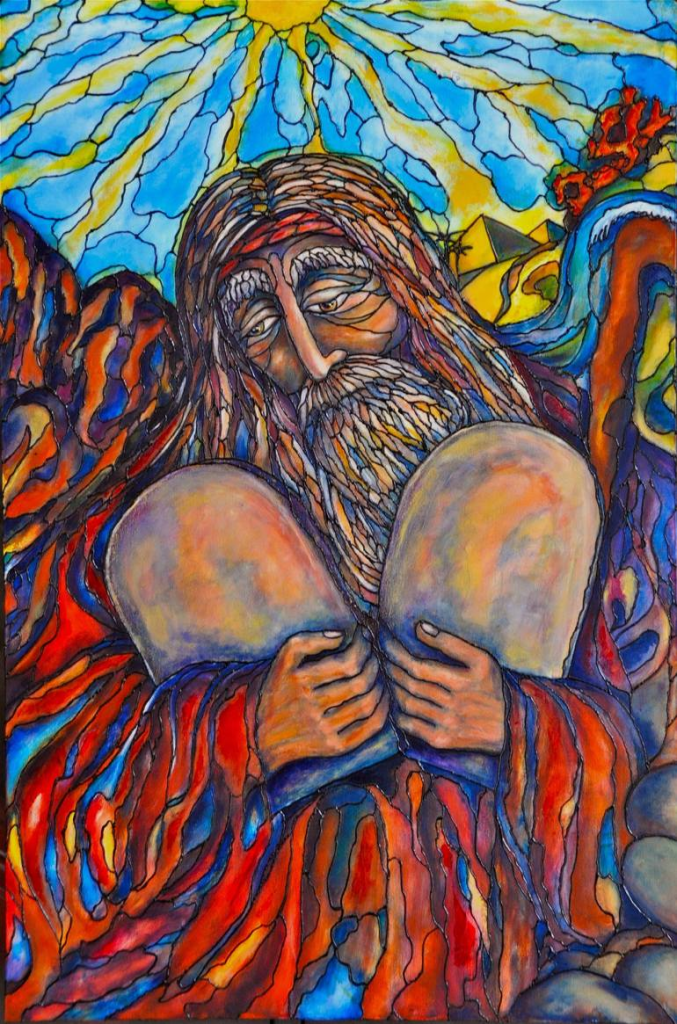
Moses, by Rae Chichilnitsky

“These are the commandments the Lord gave to all of you when you were gathered at the mountain. When he spoke with a mighty voice from the fire and from the thick clouds, he gave these commandments and no others. Then he wrote them on two stone tablets and gave them to me.

“When the whole mountain was on fire and you heard the voice from the darkness, your leaders and the chiefs of your tribes came to me and said, ‘The Lord our God showed us his greatness and his glory when we heard him speak from the fire! Today we have seen that it is possible for people to continue to live, even though God has spoken to them. But why should we risk death again? That terrible fire will destroy us. We are sure to die if we hear the Lord our God speak again. Has any human being ever lived after hearing the living God speak from a fire? Go back, Moses, and listen to everything that the Lord our God says. Then return and tell us what he said to you. We will listen and obey.’

“When the Lord heard this, he said to me, ‘I have heard what these people said, and they are right. If only they would always feel this way! If only they would always honor me and obey all my commands, so that everything would go well with them and their descendants forever. Go and tell them to return to their tents. But you, Moses, stay here with me, and I will give you all my laws and commands. Teach them to the people, so that they will obey them in the land that I am giving them.’

“People of Israel, be sure that you do everything that the Lord your God has commanded you. Do not disobey any of his laws. Obey them all, so that everything will go well with you and so that you will continue to live in the land that you are going to occupy. (Good News Translation)

The people were at the cusp of entering the Promised Land. They had experienced four hundred years of slavery; deliverance from Egyptian bondage; and forty years of wandering around the desert with no permanent home. Now, Moses gathers everyone together and restates God’s Law for a new generation about to realize God’s promise.

In today’s Old Testament lesson, Moses recalls his experience of receiving the two stone tablets, known to many as the Ten Commandments. Moses does this because he does not want this new generation of Israelites to be like their parents and grandparents – who experienced a failure of faith, resulting in their sojourn in the wilderness.

Obedience to God and all of God’s commands is central to a life of faith.

For that obedience to happen, all obstacles must be removed so that we can have an unhindered path in living the way we want to live. The Israelites were in slavery four hundred years. They needed a new story, which meant changing the old one. The people could participate with God by doing the following:

  1. Accept their wounded past of slavery. We cannot let something go and die without acknowledging it and having full acceptance that it happened.
  2. Don’t accept the limitations others put on us. The Israelites were slaves for so long that the Egyptians would have liked them to believe that’s all they could ever be. But the reality is that they are the people of God, meant for infinitely more than bondage.
  3. Trust the process of moving out of one story and into another. And it will take time. Forty years of wandering the desert helped the people wrap their minds and hearts around new possibilities.
  4. Take charge of your life by being a full participant in what the Lord is doing. Acting apart from God is pride. Failing to act is a lack of faith. But a divine/human participation knows what God does and what human responsibility is.
  5. Embrace all the emotions that go with what’s happening. Old ways often die hard. It didn’t take long after leaving Egypt for the people to long for the garlic and leeks of their former life. Holding and sitting with our feelings is an important piece of embracing a new story.
  6. Pay attention to constructing a soul which can serve you for a lifetime by taking initiative and action, reflecting on experiences, and living the insights gained.
  7. Discover new sources of growth and development for your new story and the next chapter of life. The same sources and resources which got you to this point may not be the same ones that will carry you on.

Moving through this liminal space enables us to obey God in new and fresh ways for the future. Obedience itself is not the hard thing; its ensuring a solid theological ground to stand on that is free of spiritual impediments that can hinder our faith.

Spiritual growth implies movement and change. This is necessary in order for the strengthening of faith. In allowing God’s commands and God’s sovereignty to have their way within us, we purposely engraft what’s needed for a lifetime of faith, hope, and love.

Glorious and sovereign God, give us your Spirit, so that we will be wise in how we live our lives. Help us to know you better through all of the experiences and learning we acquire in this life.

May our minds be opened to see your light, so that you will know the hope to which you have called us; and how rich are the wonderful blessings you promise us.

Grant us your strength so that we might remove every obstacle to faith. That spiritual power working in us is the same as the mighty strength which you used when raising Christ from death and exalting him above all things. Amen.

Jesus Shows Up (John 20:19-31)

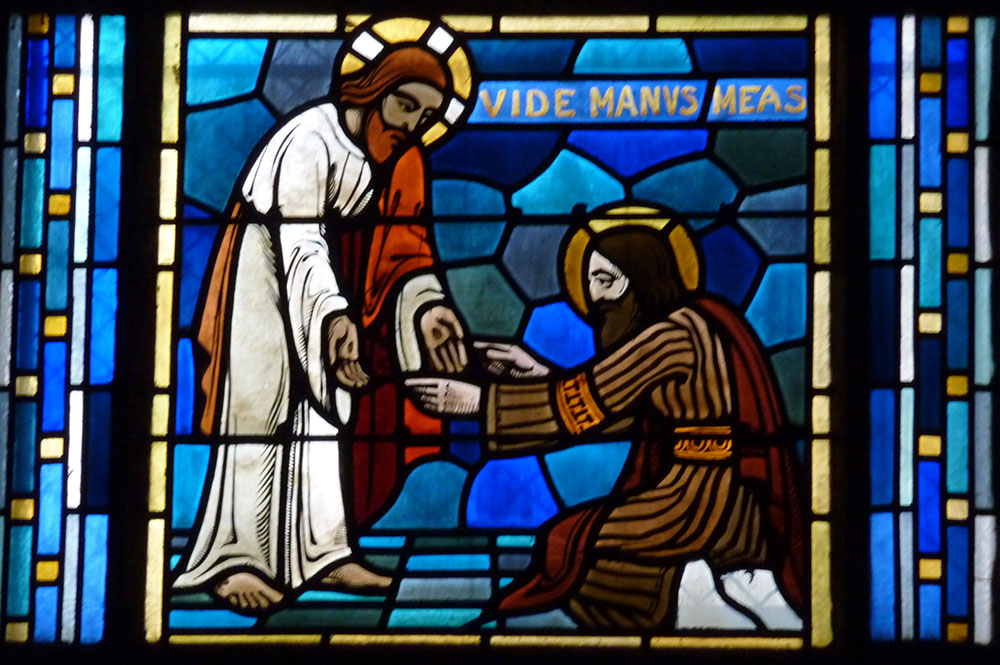
Jesus shows himself to Thomas, by Rowan and Irene LeCompte

On the evening of that first day of the week, when the disciples were together, with the doors locked for fear of the Jewish leaders, Jesus came and stood among them and said, “Peace be with you!” After he said this, he showed them his hands and side. The disciples were overjoyed when they saw the Lord.

Again Jesus said, “Peace be with you! As the Father has sent me, I am sending you.” And with that he breathed on them and said, “Receive the Holy Spirit. If you forgive anyone’s sins, their sins are forgiven; if you do not forgive them, they are not forgiven.”

Now Thomas (also known as Didymus), one of the Twelve, was not with the disciples when Jesus came. So the other disciples told him, “We have seen the Lord!”

But he said to them, “Unless I see the nail marks in his hands and put my finger where the nails were, and put my hand into his side, I will not believe.”

A week later his disciples were in the house again, and Thomas was with them. Though the doors were locked, Jesus came and stood among them and said, “Peace be with you!” Then he said to Thomas, “Put your finger here; see my hands. Reach out your hand and put it into my side. Stop doubting and believe.”

Thomas said to him, “My Lord and my God!”

Then Jesus told him, “Because you have seen me, you have believed; blessed are those who have not seen and yet have believed.”

Jesus performed many other signs in the presence of his disciples, which are not recorded in this book. But these are written that you may believe that Jesus is the Messiah, the Son of God, and that by believing you may have life in his name. (New International Version)

When Jesus shows up, there is peace. Wherever Jesus goes, the Spirit of God is there. When Jesus appears, people believe.

The Meeting

After the crucifixion of Christ, the disciples were huddled together, mostly in fear of being found out and put out by the religious authorities. Out of nowhere, Jesus showed up, smack in the middle of the anxious group of men.

Christ in the center makes all the difference. From this central place, Jesus bestowed to the disciples his peace. The very first word the risen Christ spoke to his disciples was neither a command to stop being afraid, nor a rebuke for sitting around and doing nothing, or disappointment that they all ran away in the final hour of need at the crucifixion; instead, the first word of Christ was a gift of peace.

The presence and peace of Christ melted the disciples’ fear. Christ-centered peace is graciously given; so let us gratefully receive it.

The Reality

Jesus showed up, then showed off his hands and his side. He was not fabricated out of the disciples’ imagination; he was not some ghostly apparition. Rather, Christ was standing in the middle of them, very real, very physical, and very alive.

Christ gave his disciples real truth: actual wounded hands and side on a real body. Christ is risen and alive – not just spiritually, but physically. Since the resurrection of Jesus really happened, then nothing else matters; our joy is complete. We have what we need.

The Mission

As Jesus was sent by the Father, so Jesus sent his disciples; and is still sending us out into the world. And as Jesus came not to condemn the world but to save it, so we go out with words of grace and peace. The church exists for the life of the world – to bless it with the presence and peace of Christ.

“Whoever believes in me does not believe in me only, but in the one who sent me. The one who looks at me is seeing the one who sent me. I have come into the world as a light, so that no one who believes in me should stay in darkness.” (John 12:44-46, NIV)

Our spiritual DNA makes us little Christ’s walking around, doing the will of God, for the benefit of a world in darkness. We bear the name of Christ: Christians, proclaiming a message of life, delighting in God and creation; and not destroying the earth and its inhabitants.

The Gift

Right now, we are not alone. The Holy Spirit has been graciously given to us by Jesus. Although our mission is a big one, our resource for accomplishing it is even bigger. Jesus gives the Spirit in the same way he gives himself – as a sheer gift with no strings attached. Just as God breathed life into the very first people on earth, so Jesus breathes on the disciples and gives them new life and a new heart.

I will give you a new heart and put a new spirit in you; I will remove from you your heart of stone and give you a heart of flesh. And I will put my Spirit in you and move you to follow my decrees and be careful to keep my laws… and you will be my people, and I will be your God. (Ezekiel 36:26-28, NIV)

The Privilege

Christ has redeemed us, forgave us of our guilt and shame. Now, we have the privilege of passing the forgiveness to others. The special mission of the Church is giving Jesus to others with grace and peace, so that they may believe he is truly the risen Lord; and so, receive Jesus, the Spirit, forgiveness, and purpose in life, with Christ at the center of all things.

For the one whom God has sent speaks the words of God, for God gives the Spirit without limit. The Father loves the Son and has placed everything in his hands. Whoever believes in the Son has eternal life, but whoever rejects the Son will not see life, for God’s wrath remains on them.” (John 3:34-36, NIV)

The Risen Lord, by He Qi

The Appearance

When Jesus appears, its good if we also show up to see him. It seems Thomas was late for church and missed the beginning of the service. He wasn’t with the other gathered disciples. Nobody knows where he was or what he was doing. But the important thing is that he did eventually show up, because showing up is the beginning of a changed life.

The Witness

After Jesus showed up, the disciples bore witness to what they saw and heard to Thomas. Yet Thomas, bless his doubting heart, wasn’t having it. He’s a realist. He wants proof, some actual physical evidence. Thomas was clearly a tactile learner because he needs some touch to believe any of this crazy talk of his disciple brothers.

Sometimes Thomas gets a bad rap, but he is really our Everyman. Doubt and skepticism are an important part of a full-orbed and honest faith. Jesus gave Thomas some space, time, and respect to begin wrapping his head and heart around this new reality of resurrection. I wonder if we all can do the same with others.

The Middle

A second time, Jesus shows up in the middle of the disciples. The Word became flesh and dwelt among us – and didn’t become a ghost and hang out in secret places. Once again, peace is given by Jesus to his followers.

Both appearances happen on a Sunday (which is why Christians have always worshiped on Sundays); and both meetings are literally Christ-centered (which every Christian meeting is supposed to be). Every Sunday. Christ always in the middle. Keep those two, and keep them together, and you can’t go wrong.

Jesus appears to Thomas with the Latin words, “See my hands,” in Notre-Dame-du-Rosaire Church, Saint-Ouen, France 

The Invitation

There’s no beating around the bush with Jesus. He immediately engaged Thomas and invited him to touch the wounds on his very real body. Christ knew Thomas’ hang-up, and went right to it. Thomas wanted evidence; Jesus offered it. If we get anything out of this encounter, it is that risen Christ honors honest doubt.

The evidence is here. Now believe it, and stop disbelieving. We have documentary evidence of the Old and New Testaments; the Church’s witness in Creeds, Confessions, and contemporary narratives of changed lives; and the internal testimony of the Holy Spirit. Therefore, look into them carefully and draw a sound conclusion.

The Confession

“My Lord and my God!” That’s the confession and the conclusion Thomas drew from the evidence – not only that Jesus is real, alive, existed, a good teacher; or other people’s Lord and God – but that he is my Lord and my God.

Jesus cared enough for Thomas to specifically meet him personally at his point of need. The grace of God keeps coming and never runs out. Jesus is filled up to the full in both grace and truth.

The Believer

Thomas had the physical evidence. But it doesn’t take that to truly believe. God blesses those who’ve never seen nor touched, but still believe. Jesus was thinking of you and me, and not only the people in front of him at the time. The Lord Jesus blesses us with the gift of peace, grace, and faith.

Though you have not seen him, you love him; and even though you do not see him now, you believe in him and are filled with an inexpressible and glorious joy, for you are receiving the end result of your faith, the salvation of your souls. (1 Peter 1:8-9, NIV)

The Conclusion

All this is for our benefit, so that we, too, may believe that Jesus is the Christ, the Son of the living God. Since Jesus is alive, he continues to bless us with his presence, power, and peace.

Jesus is with us:

  • through the Word of God, giving us his peace, showing up and meeting needs people.
  • at the Table in the sacrament of communion, bringing grace and forgiveness
  • in the person of the Holy Spirit, enabling and energizing us for mission and ministry to the world

It’s a life worth living, a Christ-centered life, full of God’s blessing.

O God and Father of our Lord Jesus Christ, in whom we receive the legacy of a living hope, born again not only from his death but also from his resurrection. May we who have received forgiveness of sins, set others free, until we enter the inheritance that is imperishable and unfading, where Christ lives and reigns with you and the Holy Spirit, one God, now and forever. Amen.

The Power of Deliverance (Exodus 14:10-31, 15:20-21)

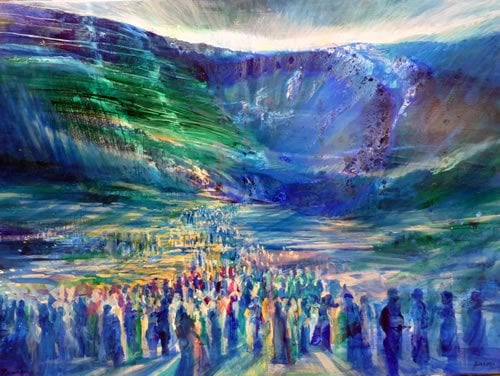
The Parting of the Sea, by Yoram Ranaan

As Pharaoh approached, the Israelites looked up and saw that the Egyptians were coming after them. Terrified, the Israelites cried out to the Lord. They said to Moses, “Did you bring us out into the desert to die because there were no graves in Egypt? Look what you’ve done by bringing us out of Egypt! Didn’t we tell you in Egypt, ‘Leave us alone! Let us go on serving the Egyptians’? It would have been better for us to serve the Egyptians than to die in the desert!”

Moses answered the people, “Don’t be afraid! Stand still, and see what the Lord will do to save you today. You will never see these Egyptians again. The Lord is fighting for you! So be still!”

Then the Lord said to Moses, “Why are you crying out to me? Tell the Israelites to start moving. Raise your staff, stretch out your hand over the sea, and divide the water. Then the Israelites will go through the sea on dry ground. I am making the Egyptians so stubborn that they will follow the Israelites. I will receive honor because of what I will do to Pharaoh, his entire army, his chariots, and cavalry. The Egyptians will know that I am the Lord when I am honored for what I did to Pharaoh, his chariots, and his cavalry.”

The Messenger of God, who had been in front of the Israelites, moved behind them. So the column of smoke moved from in front of the Israelites and stood behind them between the Egyptian camp and the Israelite camp. The column of smoke was there when darkness came, and it lit up the night. Neither side came near the other all night long.

Then Moses stretched out his hand over the sea. All that night the Lord pushed back the sea with a strong east wind and turned the sea into dry ground. The water divided, and the Israelites went through the middle of the sea on dry ground. The water stood like a wall on their right and on their left.

The Egyptians pursued them, and all Pharaoh’s horses, chariots, and cavalry followed them into the sea. Just before dawn, the Lord looked down from the column of fire and smoke and threw the Egyptian camp into a panic. He made the wheels of their chariots come off so that they could hardly move. Then the Egyptians shouted, “Let’s get out of here! The Lord is fighting for Israel! He’s against us!”

Then the Lord said to Moses, “Stretch out your hand over the sea so that the water will flow back over the Egyptians, their chariots, and their cavalry.”

Moses stretched his hand over the sea, and at daybreak the water returned to its usual place. The Egyptians tried to escape, but the Lord swept them into the sea. The water flowed back and covered Pharaoh’s entire army, as well as the chariots and the cavalry that had followed Israel into the sea. Not one of them survived.

Meanwhile, the Israelites had gone through the sea on dry ground while the water stood like a wall on their right and on their left. That day the Lord saved Israel from the Egyptians, and Israel saw the Egyptians lying dead on the seashore. When the Israelites saw the great power the Lord had used against the Egyptians, they feared the Lord and believed in him and in his servant Moses….

Then the prophet Miriam, Aaron’s sister, took a tambourine in her hand. All the women, dancing with tambourines, followed her. Miriam sang to them:

“Sing to the Lord.
He has won a glorious victory.
He has thrown horses and their riders into the sea.” (God’s Word Translation)

Things can change quickly.

One day, you’re living in slavery, and the next, you’re free. One minute, you’re celebrating freedom, then the next minute, you’re backed into a corner, and it looks like the end – only to be dramatically delivered from calamity.

One day (Holy Saturday) the disciples were lower than a snake’s belly in a wagon wheel rut; the next day (Easter Sunday) they’re wondrously slack-jawed with hopes higher than the sky.

Today’s Old Testament reading impresses on us the necessity of trusting God one day at a time, one minute at a time. Circumstances will change; God’s basic character will not change. Therefore, we have the continual opportunity of exercising our faith, and practicing trust in the Lord, by living into a new reality.

In this Christian season of Eastertide (spanning the next 50 days until the Day of Pentecost) we discover resurrection power in putting to death old unhealthy practices and adopting new healthy life-giving habits. Eastertide’s intentional focus is to recognize and celebrate the resurrection of the Lord Jesus Christ, and so, to exult in our own new life in him.

Revisiting both Christ’s resurrection, and the Red Sea deliverance, helps to remind us God’s invisible power to save is stronger and greater than any visible powers on this earth. Both of these deliverance stories keep us focused on the hope of individual renewal, corporate revitalization, and worldwide revival.

Eastertide is the season to engage in some renewal practices. The following are a few ideas for living into our deliverance from God:

  • Pray for revival of spirituality. Christ brings salvation and life, so praying to God for revival is a deliberate way of connecting with God.
  • Pay attention to words. Gossip, back-biting, slander, and other sins of the tongue kill people. Instead, consider how to use your speech for encouragement, love, mercy, forgiveness, and building up one another. This promotes growth, health, and life.
  • Proclaim resurrection. I believe the church is meant to be the hope of the world because Christ is the risen Lord. Graciously proclaim the resurrected Christ and how the spiritual life makes a difference in life.
  • Put yourself out there. Start the new ministry you always believed would make a difference. Take a risk. You’ve been given eternal life, so can you really fail?
  • Promote daily habits of spiritual health and life. Develop a realistic and workable plan for yourself when it comes to basic spiritual practices of Scripture reading, prayer, worship, etc. And stick to it by involving others.

There will always be people in our lives who try and pull us from what’s most important, even persons who want to keep the status quo to the point of seeking to destroy us. Be ready. Keep Eastertide in front of you; God has raised us to new life.

Allow Christ’s resurrection take root in your heart to such an extent that life itself informs all your thinking, speaking, feeling, and acting. The victory is won. So, sing to the Lord!