What Does God Want? (John 11:1-45)

The Raising of Lazarus, by Rembrandt, c.1632

Now a man named Lazarus was sick. He was from Bethany, the village of Mary and her sister Martha. (This Mary, whose brother Lazarus now lay sick, was the same one who poured perfume on the Lord and wiped his feet with her hair.) So the sisters sent word to Jesus, “Lord, the one you love is sick.”

When he heard this, Jesus said, “This sickness will not end in death. No, it is for God’s glory so that God’s Son may be glorified through it.” Now Jesus loved Martha and her sister and Lazarus. So when he heard that Lazarus was sick, he stayed where he was two more days, and then he said to his disciples, “Let us go back to Judea.”

“But Rabbi,” they said, “a short while ago the Jews there tried to stone you, and yet you are going back?”

Jesus answered, “Are there not twelve hours of daylight? Anyone who walks in the daytime will not stumble, for they see by this world’s light. It is when a person walks at night that they stumble, for they have no light.”

After he had said this, he went on to tell them, “Our friend Lazarus has fallen asleep; but I am going there to wake him up.”

His disciples replied, “Lord, if he sleeps, he will get better.” Jesus had been speaking of his death, but his disciples thought he meant natural sleep.

So then he told them plainly, “Lazarus is dead, and for your sake I am glad I was not there, so that you may believe. But let us go to him.”

Then Thomas (also known as Didymus) said to the rest of the disciples, “Let us also go, that we may die with him.”

On his arrival, Jesus found that Lazarus had already been in the tomb for four days. Now Bethany was less than two miles from Jerusalem, and many Jews had come to Martha and Mary to comfort them in the loss of their brother. When Martha heard that Jesus was coming, she went out to meet him, but Mary stayed at home.

“Lord,” Martha said to Jesus, “if you had been here, my brother would not have died. But I know that even now God will give you whatever you ask.”

Jesus said to her, “Your brother will rise again.”

Martha answered, “I know he will rise again in the resurrection at the last day.”

Jesus said to her, “I am the resurrection and the life. The one who believes in me will live, even though they die; and whoever lives by believing in me will never die. Do you believe this?”

“Yes, Lord,” she replied, “I believe that you are the Messiah, the Son of God, who is to come into the world.”

After she had said this, she went back and called her sister Mary aside. “The Teacher is here,” she said, “and is asking for you.” When Mary heard this, she got up quickly and went to him. Now Jesus had not yet entered the village, but was still at the place where Martha had met him. When the Jews who had been with Mary in the house, comforting her, noticed how quickly she got up and went out, they followed her, supposing she was going to the tomb to mourn there.

When Mary reached the place where Jesus was and saw him, she fell at his feet and said, “Lord, if you had been here, my brother would not have died.”

When Jesus saw her weeping, and the Jews who had come along with her also weeping, he was deeply moved in spirit and troubled. “Where have you laid him?” he asked.

“Come and see, Lord,” they replied.

Jesus wept.

Then the Jews said, “See how he loved him!”

But some of them said, “Could not he who opened the eyes of the blind man have kept this man from dying?”

Jesus, once more deeply moved, came to the tomb. It was a cave with a stone laid across the entrance. “Take away the stone,” he said.

“But, Lord,” said Martha, the sister of the dead man, “by this time there is a bad odor, for he has been there four days.”

Then Jesus said, “Did I not tell you that if you believe, you will see the glory of God?”

So they took away the stone. Then Jesus looked up and said, “Father, I thank you that you have heard me. I knew that you always hear me, but I said this for the benefit of the people standing here, that they may believe that you sent me.”

When he had said this, Jesus called in a loud voice, “Lazarus, come out!” The dead man came out, his hands and feet wrapped with strips of linen, and a cloth around his face.

Jesus said to them, “Take off the grave clothes and let him go.”

Therefore many of the Jews who had come to visit Mary, and had seen what Jesus did, believed in him. (New International Version)

The Raising of Lazarus, by Vincent Van Gogh, 1890

Here’s a Captain Obvious observation:

what God wants, and what we want, is not always the same thing. 

Today’s Gospel story centers around a man named Lazarus, the brother of Mary and Martha. The disciples were familiar with them since they were committed followers of Jesus. 

Their friend Lazarus became deathly ill. Christ and the disciples caught wind of it. Everyone believed Jesus could do something about this. But Jesus stayed put. He didn’t make a move to go to his sick friend. 

After a few days, Lazarus died. It was only then, that Jesus made his move.

The religious authorities in Jerusalem had it out for Jesus. But Jesus decided to go to Bethany and Jerusalem anyway. This made no sense to the disciples. Lazarus was lying dead in Bethany. Going there would put everyone at risk – which is why Thomas uttered the defeatist and dramatic statement, “Let us also go, that we may die with him.”

Yet, they all went. And once they arrived, Christ and his disciples found the grieving sisters. Mary and Martha believed that Jesus was the promised Messiah who would come and save the people. They didn’t understand why Jesus stayed away and didn’t come sooner. 

If Jesus had been there, he could have healed Lazarus. He healed other people, so why not a friend and a brother?

The death of Lazarus seemed to be the end. No one was happy with how things shook-out. Lazarus died. The disciples’ plans were dead. Mary and Martha’s expectations died…

but death is exactly what it takes in to have resurrection.

There’s no such thing as a painless miracle. Death isn’t a pleasant affair. I have been with countless people at the end of life, and I will tell you that, although it’s possible for a death to be peaceful, it’s still ugly business. 

It’s also painful to watch carefully laid and prayed over plans die. It hurts to see a long sought after dream just go up in smoke and die. To see anything or anyone we deeply care about die is gut-wrenching. Yet, in order for a resurrection to occur, there must first be a death.

There cannot be a new life unless there’s an old one. 

Jesus did the impossible by raising Lazarus from death and giving him new life. And the resurrection of Lazarus pointed to an even greater truth: Christ’s own death and resurrection was coming, and it will change everything.

Whenever what we want dies, then we are in a position to ask: So, what does God want? 

God wanted something better than what everybody else wanted. By allowing ourselves to be consumed with what God wants, it turns out to be the very best thing for us, even if it does not quite jive with what I want.

Everyone’s expectations needed to die, along with Lazarus, for the resurrection to become reality. Only then did Jesus act by rising Lazarus from death.

Jesus pointed to himself as the one able to bring life to all that is dead among us. Sometimes:

  • dreams must die so that Jesus can resurrect them to new life, with outcomes far more glorious than you and I could ever imagine
  • plans have to be dead and buried before Jesus will breathe new life into them, making those plans so much more than they could ever have been in our hands.
  • ministries, even churches, need to be dead as a doorknob so that Jesus can resurrect them and give them new life, invigorated with spiritual resurrection power.

If we desire to see the miracle of resurrection, we must die to ourselves – take up our crosses and follow Jesus into the grave so that he can transform our lowly expectations into a glorious new existence. Death does not have the last word because Christ’s resurrection makes it possible for us to have new life. Again, I ask:

What does God want? God wants to raise the dead to life.

Do you believe this? Yes, I believe. Help me in my unbelief.

Follow the path of what God wants and watch what the Lord will do for you.

New Rules for a New Society (Ephesians 4:25-32)

We are part of the same body. Stop lying and start telling each other the truth. Don’t get so angry that you sin. Don’t go to bed angry and don’t give the devil a chance.

If you are a thief, quit stealing. Be honest and work hard, so you will have something to give to people in need.

Stop all your dirty talk. Say the right thing at the right time and help others by what you say.

Don’t make God’s Spirit sad. The Spirit makes you sure that someday you will be free from your sins.

Stop being bitter and angry and mad at others. Don’t yell at one another or curse each other or ever be rude. Instead, be kind and merciful, and forgive others, just as God forgave you because of Christ. (Contemporary English Version)

New life means being a part of a new society; and a new society means new rules to live by which benefit and uplift the entire community. Old destructive practices must be replaced with new encouraging and supportive ways of being together. Stop taking the broad easy road to destruction and start walking the hard path to life and contentment.

Stop Lying and Start Telling the Truth

Lying exists because people believe that being truthful and transparent is too traumatic. Many people don’t think that being open, honest, real, vulnerable, and genuine is worth the risk. They have believed the lie that they won’t be accepted, that they’ll lose face with others, or that people will just gossip about me if they really knew about me. So, we hide from others and avoid the truth.

In truth, we are responsible for one another – to make and keep promises to each other because that is what God does with us. Churches that love truth will make a safe place for the awkwardness of confession, forgiveness, and healing.

Truthful communities are places of hospitality where we are safe to be real. No one ought to ever suffer in silence, cry alone, or wonder whether others will forsake them. We belong to one another. Therefore, to have union with Christ is to have union with one another; you can’t have one without the other.

Stop Stealing and Start Giving

Theft comes in many forms, especially in our contemporary age. Embezzlement, shoplifting, fraud, plagiarism, and robbery are just a few examples of the ways in which we humans steal from one another.

Embezzlement is the theft of assets (money or property) by a person who has been trusted to keep those assets safe. Instead of embezzling funds, we are to steward those assets well, distributing them with care and a conscience – using them for the benefit of others, not simply ourselves.

Shoplifting involves stealing goods from retail establishments. Some people steal because they are in dire need. Many more steal because they can and want to. We must stop taking things we want, and learn to be satisfied with what we have. And we will only do this by using our own money to buy things for others who are in need.

Fraud is stealing that involves convincing the victim to surrender their money or property under false pretenses. This is nothing more than manipulating someone to get what you want. Work hard to defend the defenseless and ensure their justice, rather than commit a gross injustice against them.

Plagiarism is the practice of taking someone else’s work or ideas and passing them off as one’s own. It’s cheap. It’s easy. And don’t do it, period. Someone else worked very hard to create what you may nonchalantly use for your quick benefit. Take the pains to credit someone else’s work and document the sources you use.

Robbery is a theft that involves using violence, intimidation, or threats to obtain property. Put the threats, guns, and false confidence away. In it’s place, do whatever it takes to do things right, hold a job, and give something back to society.

Stop All the Unhelpful Talk and Start Encouraging

Corrupt or dirty talk is totally unnecessary. It’s unwholesome and benefits nobody. Rather, make it your aim to use your words for good by encouraging others.

Encouragement involves strongly urging someone to do something with an equal commitment to lovingly come alongside and help. This requires both verbal exhortations and tangible assistance. Encouragement is the glue which holds a people together. Without it, a society degenerates into watching-out-for-number-one, and destructive personal survival tactics which will say anything to get what one wants.

Stop the Bitterness and Start Forgiving

Forgiveness is choosing not to hold another’s persons offensive words or actions over their head. It is:

  • Specific to an event, action, or words.
  • A process: it takes time to truly forgive.
  • Something anybody can do, regardless of race, creed, religion, etc.
  • Hard.
  • Freeing.
  • Ongoing.
  • Gracious.

“To forgive is to set a prisoner free and discover that the prisoner was you.”

Lewis Smedes, Forgive and Forget: Healing the Hurts We Don’t Deserve

Bitterness, however, wants to hold onto a grudge and seeks to punish the one who has offended them. That’s the way of Satan, not God. Even if the person has set themselves up as your enemy, we have clear exhortations from Jesus to love our enemies and do good to them, not harm. (Matthew 5:43-48)

The world revolves on the axis of mercy, not judgment. The sooner we get in the groove of how things actually operate for us to live a good life, the better that our relationships and society will be.

Good and gracious God, we ask that you make our life journey safe as we choose integrity, not disintegration. Shed light on those who follow crooked paths. May their dishonesty be exposed so that corrections can be made before further damage occurs. Help our nations, neighborhoods, and faith communities choose a path of mercy and goodness, rather than the crooked way of lies, theft, vitriol, and grudge-bearing. May we see a new wave of integrity sweeping over our world, through Jesus Christ our Lord, by the power of your Holy Spirit. Amen.

The Ministry of Jesus (Matthew 4:12-23)

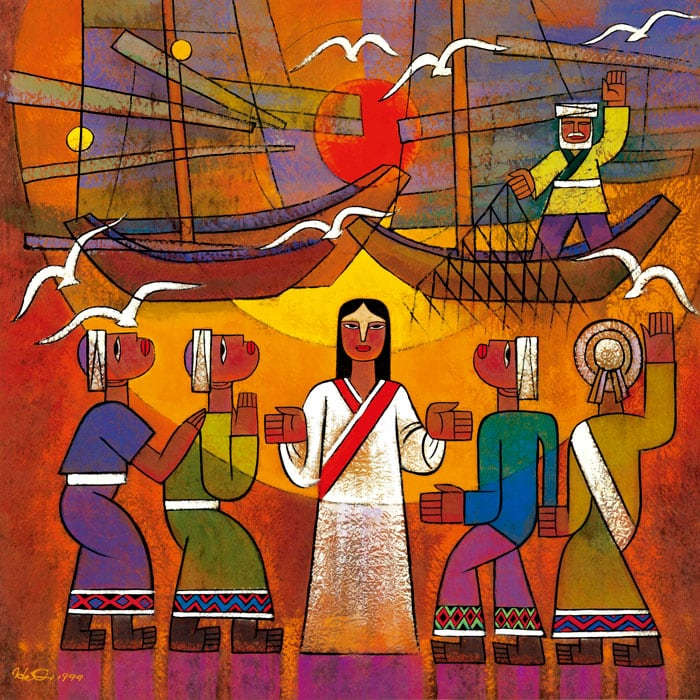
Jesus Calls His Disciples by He Qi

When Jesus heard that John had been put in prison, he withdrew to Galilee. Leaving Nazareth, he went and lived in Capernaum, which was by the lake in the area of Zebulun and Naphtali—to fulfill what was said through the prophet Isaiah:

“Land of Zebulun and land of Naphtali,
    the Way of the Sea, beyond the Jordan,
    Galilee of the Gentiles—
the people living in darkness
    have seen a great light;
on those living in the land of the shadow of death
    a light has dawned.”

From that time on Jesus began to preach, “Repent, for the kingdom of heaven has come near.”

As Jesus was walking beside the Sea of Galilee, he saw two brothers, Simon called Peter and his brother Andrew. They were casting a net into the lake, for they were fishermen. “Come, follow me,” Jesus said, “and I will send you out to fish for people.” At once they left their nets and followed him.

Going on from there, he saw two other brothers, James son of Zebedee and his brother John. They were in a boat with their father Zebedee, preparing their nets. Jesus called them, and immediately they left the boat and their father and followed him.

Jesus went throughout Galilee, teaching in their synagogues, proclaiming the good news of the kingdom, and healing every disease and sickness among the people. (New International Version)

What is “ministry”? 

For some, ministry is only about the souls of people; it is seeing as many people respond to the message of salvation in Christ as possible. 

For others, ministry is meeting the tangible needs of people because there is such a breadth and depth of human social and physical problems. 

And, for others, ministry is defined in terms of what takes place within the four walls of a church building, led by pastors and church leaders.

“Ministry takes place when divine resources meet human needs through loving channels to the glory of God.”

Warren Wiersbe

Problems, however, arise whenever we:

  • Focus on one dimension of ministry. Because, in reality, ministry is multidimensional.
  • Fulfill the outward, administrative demands of ministry – without going after the relational heart of what ministry entails. 
  • Forget about whole groups of people who are different than us. Ministry is for everyone, not some.

We need to look at the ministry of Jesus – what he did and why he did it. Christ’s purpose is to be our purpose: Minister to the total life of all people.

Jesus Preaching

Before there were newspapers, CNN, and 24 hour news cycles, ancient people heard what was happening from heralds or preachers who loudly announced in the streets the important news of the day.

Jesus had a ministry to both Jew and Gentile. Although his ministry was chiefly directed toward his fellow Jews, Christ went out of his way to engage Gentiles, as well, with a message of repentance.

Repentance is turning the whole person – body, soul, mind, will, and emotions – from sin and disobedience to God in obedience to the message of Christ. It involves humility, sorrow for sin, and a commitment to following Jesus.

To repent doesn’t mean to manage sin or clean up parts of my life; it’s a radical conversion from an old way of life to a new way of life. Repentance is not simply adding Jesus to our schedule but is a complete change of how we live.

Christianity is a life, not just an event. Following Jesus is a journey, a life-long process of inner transformation; a complete forsaking of anything that does not please God; and a desire to reorient my life around what’s important to God. 

To illustrate this in a contemporary context, I ask, “What does it mean to follow the Green Bay Packers football team?” A fan not only watches all the games from start to finish, but cheers loudly for the Packers; talks about the Packers with everyone, even strangers; and doesn’t cheer for the Chicago Bears! Fans are committed to their team.

The difference, however, between football and Christianity, is that followers of a team are fans, whereas followers of Jesus are not fans in the stands or watching the television. Instead, Christ followers are on the field of play as teammates with Jesus.

So, when it comes to repentance, we turn from being fans of Jesus to followers of Jesus, doing what he did and saying what he said. We are active participants in the kingdom of God – embracing and embodying a message of repentance to new life in Christ.

Jesus Calling

Jesus calling the first disciples illustrates the kingdom message: a radical break with the old life. Each disciple walked away from a good life and embraced of a new life following Jesus.

Some understanding of Jewish culture in the time of Jesus is helpful here. Central to the life of any Jew was the Torah, the Law. Around age 6, Jewish boys would begin to go to the synagogue for schooling in the Torah by the local rabbi. 

This first level of education was called Beth Sefer (“House of the Book”) and would last until about age 10. In those four years, the first five books of the Old Testament, the Pentateuch, were thoroughly memorized.

By age 10, some of the boys would distinguish themselves as good students and able to handle Torah. So, they would continue on in the second level of schooling called Beth Talmud (“House of Learning”). Those that did not continue with school would then learn the family trade and become an apprentice. Those that went on with school would then memorize the rest of the Old Testament.

At about age 14, only the best of the best were studying Torah. At the completion of their studies, they would apply to a well-known rabbi in order to become his disciple. The goal of this third level was to become just like the rabbi. This was called Beth Midrash (“House of Study”). The rabbi essentially interviews the teenager to find out if he has the stuff to become like the rabbi. 

If the rabbi believes the kid doesn’t have it in him, he tells him to go back to the family business. If, however, the rabbi grills the kid and finds he has what it takes, then he will say to him, “Come, follow me.” It was considered a great privilege and opportunity, and the teenager would leave everything to literally follow the rabbi everywhere he went.

Now, let’s return to Christ’s disciples. Jesus calls Andrew, Peter, James, and John. At the time, they were fishing because they were fishermen. That meant somewhere along the line they didn’t have what it took to further their education, or to follow a rabbi. 

Let’s, then, not miss the import and impact of Jesus saying to them, “Come, follow me!”  Jesus is expressing a belief that these men can become just like him. Well, of course you drop your nets and follow him! Jesus believes I can be like him! Jesus took a group of young men who couldn’t make the grade and used them to change human history. 

Jesus also says the same thing to you and me: I choose you. Come, follow me. 

Christ believed in us before we believed in him. Yes, Jesus believes you can do all the work of embodying the very words of God and becoming like him.

The attitude here is not, “Oh, geez, I have to go do ministry,” as if I were a teenager who was just asked to do the dishes. Rather, the attitude is of privilege and opportunity. If we fail to view ministry in this way, then we must come back to the message of repentance and have an attitude adjustment. People who follow Jesus do so because they get to, not because they have to.

Jesus Healing

            Envision yourself walking with Jesus and following him. You observe several things about his ministry of healing:

  • Jesus heals every problem. Christ has the power and authority to do so.
  • Jesus heals the whole person – not just the physical, or just the spiritual.
  • Jesus heals people whether they repent or not. Christ never made repentance a prerequisite for healing. He heals simply because he wants to.
  • Jesus heals to defeat the devil. Christ continually looks to reverse the hold that sin has on people.
  • Jesus chose to focus on healing the destitute, the poor, and the disadvantaged – rather than directing ministry to the higher classes and royalty to mediate his wishes to the people.

Who are the people – the least, the lonely, the lost – in need of healing in your family, neighborhood, and community?

  1. Those who are ill with various diseases
  2. Those suffering severe pain – of body, mind, emotion, and spirit
  3. The demon possessed or demonically influenced
  4. Prisoners and ex-convicts
  5. The working poor, and the elderly poor
  6. Those in the hospital with no one to visit them
  7. Those who grieve alone
  8. Those with addictions and behavioral issues
  9. Victims of verbal or physical abuse
  10. And many, many more….

Jesus had a ministry of both word and deed. To follow Christ is to become like him and pass on what we have learned to reliable people who will do the same.

Why Did Jesus Come? (Matthew 9:14-17)

Then John’s disciples came and asked him, “How is it that we and the Pharisees fast often, but your disciples do not fast?”

Jesus answered, “How can the guests of the bridegroom mourn while he is with them? The time will come when the bridegroom will be taken from them; then they will fast.

“No one sews a patch of unshrunk cloth on an old garment, for the patch will pull away from the garment, making the tear worse. Neither do people pour new wine into old wineskins. If they do, the skins will burst; the wine will run out and the wineskins will be ruined. No, they pour new wine into new wineskins, and both are preserved.” (New International Version)

The late Abigail Van Buren, better known in her day as the columnist, “Dear Abby,” was the person who made famous the phrase, “The church is a hospital for sinners, not a museum of saints.”

We occasionally need words like Dear Abby’s that are reminders of why Christians and Churches exist in the first place. The Church does not remain on this earth solely for its own benefit, any more than a hospital exists for the benefit of doctors or insurance companies. 

The Church exists to extend the mission of Jesus through proclamation of the gospel, the good news of forgiveness and new life in Christ. The Church calls people who are ensnared, entrapped, and in bondage to guilt and shame, and who need the restorative touch of grace. 

Our calling is not to find out what others can do for us (e.g. tithing and attendance) but what we can do for others. That’s why we are the continuing presence of Jesus on this earth as the temple of the Holy Spirit. 

Even though I am a church pastor, it is not my church. The church is not your church. It is Christ’s Church and we are to act in accordance with that truth.

Some of you reading this blog post are unhealthy. Some of you are sick with sin; some are heart-sick; others are just plain sick and tired of being sick and tired. Jesus (nor me!) is not looking to heap on you a load of expectations and guilt for things you are not doing; but instead is pointing you to the source of healing and change and inviting you to admit your need and come to him. 

Conversely, you may be healthy, spiritually alive and well. Therefore, it’s your job to roll up your sleeves and serve, to participate fully in the mission of Jesus for the church and the world.

Why did Jesus come? 

Jesus came to set up a new structure that could embrace his mission of bringing new life to people.

Christ used the occasion of John’s disciples asking him about fasting to communicate that his mission of reaching people through mercy and forgiveness will need a significant structural change. 

The two illustrations Jesus used – cloth and wineskins – is to simply point out that old and new wineskins are incompatible; and old and new pieces of cloth don’t go together. I would put it this way: You don’t put a new collar on a dead dog.

The Lord Jesus didn’t come to this earth just to perpetuate the status quo; he didn’t enter this world through the incarnation to simply dress up the Jewish religion, or to make a few minor adjustments to what already is going on. No! Christ came to change the old and do something new so that his mission could go forward through us.

We need a structural system which can accommodate the finished work of Jesus on the cross.

The entire sacrificial system and ritual laws of the Old Testament were only a matter of food and drink and various ceremonial washings – external regulations applying until the time of the new order.(Hebrews 9:10)

Christ is the one who arranges a new covenant, so that those who have been called by God may receive the eternal blessings that God has promised. This can be done because there has been a death which sets people free from the wrongs they did while the first covenant was in effect. (Hebrews 9:15, GNT)

Jesus canceled the first covenant in order to put the second into effect; the old is obsolete and has served it’s purpose. Now, Christ’s new covenant is in effect – a system big enough to hold the mission of the Church. (Hebrews 8:13; 10:9)

I wonder:

  • Is there anything in your life or in your church that is obsolete?
  • Is there a practice, ministry, system, or structure that is ineffective and not contributing to the mission that Jesus has for us in reaching others? 
  • Are there any dead dogs you keep trying to prop up on its legs?
  • Are you focused on what is important to Jesus? Do you know what’s important to him?
  • Do you keep performing the same rituals over and over because that is what you’ve always done?
  • What needs to change in your life to accommodate the mission of Jesus?

If the mission of Jesus is to occur we must develop:

  1. A relationship with Jesus. Engaging in spiritual disciplines of prayer, giving, fasting, reading and meditating on Scripture, are activities that put us in a position to know Christ better and respond to what is important to him.
  2. Relationships with each other that are not superficial but help one another to grow in Christ. We need to hold one another accountable for how the mission of Jesus is being accomplished, or not.
  3. Relationships with those outside of the church. This world is filled with sick, needy, hurting, lonely, unhealthy people who are stuck. They need a major change of life that can come from Jesus working through his followers. 

May it be so. Soli Deo Gloria.