It’s Time for a Change (Matthew 12:38-42)

Later a few religion scholars and Pharisees cornered him. “Teacher, we want to see your credentials. Give us some hard evidence that God is in this. How about a miracle?”

Jesus said, “You’re looking for proof, but you’re looking for the wrong kind. All you want is something to titillate your curiosity, satisfy your lust for miracles. The only proof you’re going to get is what looks like the absence of proof: Jonah-evidence. Like Jonah, three days and nights in the fish’s belly, the Son of Man will be gone three days and nights in a deep grave.

“On Judgment Day, the Ninevites will stand up and give evidence that will condemn this generation, because when Jonah preached to them they changed their lives. A far greater preacher than Jonah is here, and you squabble about ‘proofs.’ On Judgment Day, the Queen of Sheba will come forward and bring evidence that will condemn this generation, because she traveled from a far corner of the earth to listen to wise Solomon. Wisdom far greater than Solomon’s is right in front of you, and you quibble over ‘evidence.’ (The Message)

I believe the greatest miracle and the best evidence of God’s work in the world is a changed life.

I’m not talking about rearranging a few things or tweaking some habits – but a wholesale renovation of the heart. A transformed life is a new life, and not a reconstituted life.

Far too many people put their focus on others changing. They’ve bought into the belief that other people need to see things how they seem them – that everyone else must bend their lives to how they believe things ought to be. But this is really nothing more than sinful pride and hubris, as if the world revolves around me.

Change is for everyone, not just a select few, or for others for whom we believe need to get right or get left. Jesus made a lot of waves with the religious establishment by hobnobbing with the least, the lost, and the lowly of society.

Christ actively sought out the marginal folks, healing many of them from sickness, disease, and sin so that they could be united with God and no longer remain on the fringes of society.

If you’re not in the transformation business, then healing a bunch of low-life people means nothing to you. For the religious leaders of Christ’s day, Jesus was not flexing any real Messiah muscle for them; he was not beating up Roman gentiles and kicking them out of Palestine. So, they wanted a sign from heaven that would authenticate the proper Messiah credentials of Jesus.

But a sign already exists: The sign of Jonah. As Jonah was three days and three nights in the belly of a big fish, so Jesus would be in the earth for three days and nights. The death and resurrection of Jesus is needed, and when faced with this information, the only appropriate response is to change, to do a complete U-turn in life.

Jonah was all but dead. But God caused the great fish to belch up Jonah onto the land. He went forth a changed man. The experience of having stomach fluids work on a person for three days and nights will certainly change you! Jonah was spiritually and physically different – bleached completely white and an incredible sight to see.

Yet another sign exists: The Queen of Sheba’s sign. When she encountered King Solomon, she was overwhelmed with the experience. It changed her. So therefore, how much more ought we to change when encountering Jesus?

The appropriate response to Jesus is a changed life. Jesus was looking for status quo malcontents, for a desire to change. The process of change is hardwired into creation – from seasons of the year to the seasons of people’s lives – all are designed for a sustained process of time to revolutionize us.

Jesus modeled this for us. He switched his address of heaven and moved into our neighborhood in order to bring us new life. Jesus continually extends the invitation to change. All he asks is to let God do the work of change within us, to be patient with the construction of the soul he is doing, and to persist with daily routines of faith.

Yes, it’s time for a change. But change for change’s sake is not the point. Change that reflects godly values is the point. And in order to realize this good sort of change, we must be attentive and hear Holy Scripture, seek the mind and heart of God, and be willing to let Jesus come and have the run of the house.

We must unlearn before we learn. We need to let go so that we can take up. Change involves the humility to admit when we are lost, ask for help, and go in a different direction. New life is not rebranding oneself but is akin to being born again.

Almighty God, we desire to be transformed by you and allow the life of Jesus to be expressed in and through us. We desire to walk in the light of your Spirit. Reveal to us those things in our lives that need to change. Allow us to discern between flesh and spirit so that we can choose a healthy holy path.

Continue to give us spiritual awareness. Transform us into something new altogether. May our old life and old ways disappear, and may new life emerge that will bless both the church and the world, through Jesus Christ our Lord, in the power of the Holy Spirit. Amen.

Free to Live a New Life (Romans 7:1-6)

You shouldn’t have any trouble understanding this, friends, for you know all the ins and outs of the law—how it works and how its power touches only the living. For instance, a wife is legally tied to her husband while he lives, but if he dies, she’s free. If she lives with another man while her husband is living, she’s obviously an adulteress. But if he dies, she is quite free to marry another man in good conscience, with no one’s disapproval.

So, my friends, this is something like what has taken place with you. When Christ died he took that entire rule-dominated way of life down with him and left it in the tomb, leaving you free to “marry” a resurrection life and bear “offspring” of faith for God. For as long as we lived that old way of life, doing whatever we felt we could get away with, sin was calling most of the shots as the old law code hemmed us in. And this made us all the more rebellious. In the end, all we had to show for it was miscarriages and stillbirths. But now that we’re no longer shackled to that domineering mate of sin, and out from under all those oppressive regulations and fine print, we’re free to live a new life in the freedom of God. (The Message)

The goal of salvation is to be delivered from oppressive bondage so that we are free to live a true and beautiful life – a holy life, set apart for good.

Romans chapters 6-8 are the Apostle Paul’s pointed discussion of how we become holy in a real and practical way. The theological word we typically use for this is “sanctification,” which means “to become holy,” and “set apart” for God. To be delivered from sin, death, and hell through the person and work of Jesus Christ is not the end of the story; it is just the beginning.

Becoming holy and good in our everyday lives boils down to this: identity and belonging.

One of the healthiest ways of looking at the entirety of the Bible’s message is that we belong to God. Our identities are thoroughly wrapped around Jesus. The process of realizing this, and coming to grips with it, is how we grow as people in holiness and righteousness.

Because of Christ’s finished work on the cross, we have been delivered from the realm of sin. Our change in status from condemned to accepted provides us the awareness to make daily affirmations of faith and live a new life.

Yet, the sinful nature (flesh) or the old person is still there. Although it is now toothless, our past can, and may often, exert a powerful influence on us. Even though there is a medium-rare T-bone steak on the table for us to enjoy, there are times we go back to the old bologna sandwich with stale white bread.

We no longer need to fall short of our true humanity. That’s because we belong to God. We are adopted into God’s family, having been orphaned by sin’s cruel influence.

However, just because we have been saved from the power of sin, sin itself is not extinct. We still must deal with it. We are alive to God and need to take up this great spiritual reality and live into it, for the force of sin still exerts a powerful influence in the world.

We deal with sin’s continued presence (the world, the flesh, and the devil) through embracing God’s grace versus trying to overcome it with the law.

Paul used an illustration from marriage to expand our understanding of grafting grace into our daily lives. By law, a married woman is bound to her husband (keeping in mind this sense of belonging was the predominant view of marriage in the Apostle’s day). But if the husband dies, the wife is released from the legal marriage. If she were to give herself to another man while her husband is still alive and they are married, then she becomes an adulteress. However, if she is a widow, then marries again, she is not an adulteress.

Paul applies this understanding to our relationship with the law. Death has separated us from the law. We died with Christ. Therefore, we have been set free from the law and have become alive to grace. As believers in Jesus, God’s grace and love changed our lives:

  • We now “belong to another, to him who was raised from the dead.” (Romans 7:4)
  • “When Christ’s body hung upon the cross, when God spared not his own Son but gave him up for us all.” (Romans 8:32)
  • “Christ took on himself for us all the curse of the law which inflicted all of us.” (Galatians 3:13)
  • We died to the law. God’s grace has made the death of Jesus the death of all from the realm of sin. (2 Corinthians 5:14)

As a married man, let me use Paul’s illustration to get down to the gist of his teaching. Yes, I am legally married and belong to my wife. I made vows to my wife on our wedding day which bind me legally to do what I said I would do. Yet, if I fulfill those vows in a strictly legalistic manner, I can vouch for my wife that this would not qualify as an acceptable situation for her. You see, my wife (and, me, too!) are freely bound to one another in love and grace. I care for my wife because I love her deeply, and not because it is my legal duty to do so.

The Christian life was neither designed nor meant to serve as a bare legal contract or covenant between us and God. God forbid such a thought! Jesus died to clear us from all the legality stuff so that we could freely love and serve God with joyful abundance and gratitude.

I am follower of Jesus because I love him deeply. What impels and motivates me is God’s grace. The law is there and has its place. However, it is not the law that causes me to be a Christian; it is the love of Christ which saved me from myself and compels me to live like Jesus.

May the God of peace make you pure, belonging only to him. May your whole self—spirit, soul, and body—be kept safe and blameless when our Lord Jesus Christ comes. The one who chose you will do that for you. You can trust him. Amen.

In the Place of Life (1 Peter 4:1-6)

Therefore, since Christ suffered in his body, arm yourselves also with the same attitude, because whoever suffers in the body is done with sin. As a result, they do not live the rest of their earthly lives for evil human desires, but rather for the will of God. For you have spent enough time in the past doing what pagans choose to do—living in debauchery, lust, drunkenness, orgies, carousing and detestable idolatry. They are surprised that you do not join them in their reckless, wild living, and they heap abuse on you. But they will have to give account to him who is ready to judge the living and the dead. For this is the reason the gospel was preached even to those who are now dead, so that they might be judged according to human standards in regard to the body, but live according to God in regard to the spirit. (New International Version)

I haven’t been a confessing Christian my entire life. And so, I can relate to Peter’s exhortation. I still remember what it feels like to live my life without any thought to God or spiritual matters. I also have many memories of giving my life to Christ and, for years, having people puzzled as to why I didn’t want to join them in activities which would clearly diminish my spirit and suck the soul out of me.

The thing about partying and immorality is that it’s a life filled with constant movement. Slowing down only makes one come face-to-face with what is truly inside the soul. And if someone has an empty vacuous soul, or a damaged spirit, or a broken heart, then attempting to drink or work away the inner pain makes sense when there’s no regard for God. 

The last thing I ever wanted to do was suffer, yet before my own spiritual awakening, it seemed I could never outrun the hurt no matter how hard I tried, even with all the constant locomotion.

But I found in a committed Christianity the slow and quiet place I so desperately needed. I discovered in ancient Christian practices of solitude, silence, and stillness the opportunity of finding my true self.

There are times in our lives when we need to explore the place between our hurting hearts and the hunting for joy. It’s actually a quiet place sandwiched between the ignominy of the cross and the celebration of resurrection. 

Within the geography of the soul, this is something of a lost country for many folks. Some people have never had the thought that such a place even exists. Yet, this is the very place which gives meaning and focus to a disjointed and frenetic lifestyle.

To be even more specific and focused, there cannot be a better life, a new life without a death to the old life and dying to self. There must be suffering before there can be glory.

I’m a heady sort of guy. Most things, for me, have to go through my brain. Although I have come to appreciate and value my heart and my gut, I still find myself sometimes gravitating toward my intellect as the answer for my stress. Yet, there are many times (maybe even most times) when I really need to get out of my head, connect to my gut, and wrap my heart around whatever problem or challenge is before me. 

I have been a devoted follower of Jesus for many decades now. Yet, I still encounter a sizable chunk of Christians who devalue the place between the real suffering on Good Friday, along with the very real death of Holy Saturday. In the tomb, there is no movement. All is silent and still. 

Jesus was in the solitude of a dark tomb. So, there’s no getting around it. If we want a Resurrection Day with all its celebration and glory, then we cannot circumvent the place of darkness and stillness.

To be a Christian means a readiness to follow Jesus and suffer as he did. It involves a willingness to stop our striving, manifested through constant movement, and embrace the disciplines of solitude, silence, and stillness with its contemplation and radical acceptance of what is – and not just what we want something to be. 

This requires the sense enough to pray and please a higher power than fair weather friends. It demands a Christian counter-cultural shift to face the ridicule of friends so that we might take some much-needed time to be with Jesus in his life, ministry, suffering, death, resurrection, and ascension.

Put plainly and bluntly: If you and I want to live with Jesus, we must die with Jesus.

I could give you ten steps to having a better life, but this would ultimately mean nothing apart from the willingness to spend some time and sit in the place of suffering and death.

And, ironically, in doing so, we find the life that is truly life, and discover a way of existence which is far greater and better than we could have ever dreamed.

Merciful and almighty God and Father of our Lord Jesus Christ, we submit ourselves to you, knowing that our lives are in the hands of a gracious and sovereign Being who cares deeply for all creation and every creature. May our longings for transcendence result in the deep and good desires of our hearts to be met fully in Christ, who with you and the Holy Spirit are one God, now and forever. Amen.

Living Into a New Story (Deuteronomy 5:22-33)

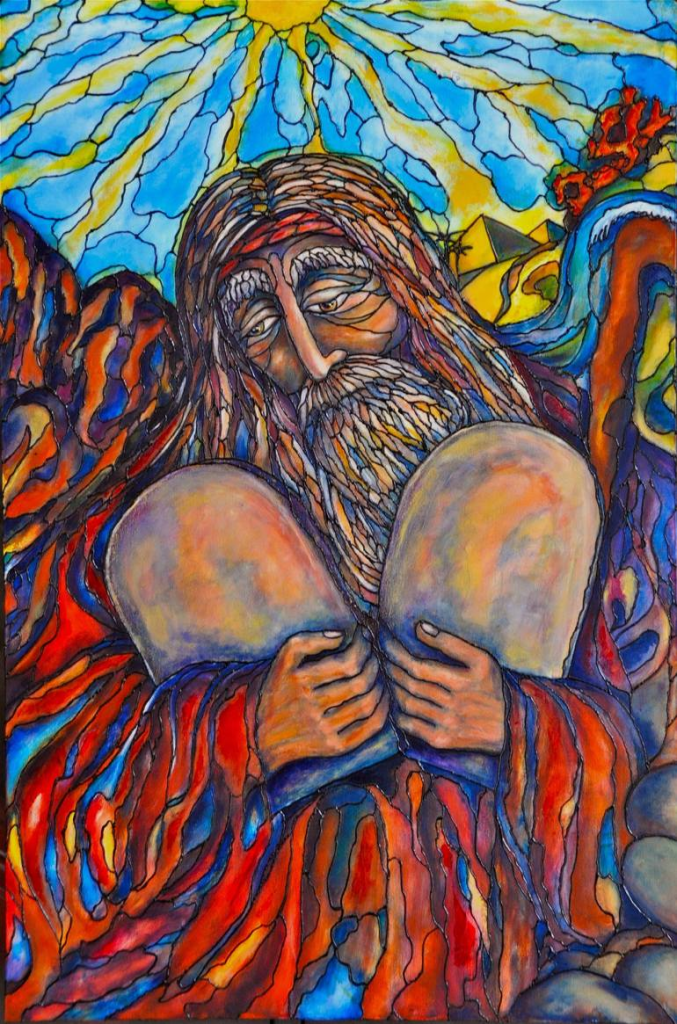
Moses, by Rae Chichilnitsky

“These are the commandments the Lord gave to all of you when you were gathered at the mountain. When he spoke with a mighty voice from the fire and from the thick clouds, he gave these commandments and no others. Then he wrote them on two stone tablets and gave them to me.

“When the whole mountain was on fire and you heard the voice from the darkness, your leaders and the chiefs of your tribes came to me and said, ‘The Lord our God showed us his greatness and his glory when we heard him speak from the fire! Today we have seen that it is possible for people to continue to live, even though God has spoken to them. But why should we risk death again? That terrible fire will destroy us. We are sure to die if we hear the Lord our God speak again. Has any human being ever lived after hearing the living God speak from a fire? Go back, Moses, and listen to everything that the Lord our God says. Then return and tell us what he said to you. We will listen and obey.’

“When the Lord heard this, he said to me, ‘I have heard what these people said, and they are right. If only they would always feel this way! If only they would always honor me and obey all my commands, so that everything would go well with them and their descendants forever. Go and tell them to return to their tents. But you, Moses, stay here with me, and I will give you all my laws and commands. Teach them to the people, so that they will obey them in the land that I am giving them.’

“People of Israel, be sure that you do everything that the Lord your God has commanded you. Do not disobey any of his laws. Obey them all, so that everything will go well with you and so that you will continue to live in the land that you are going to occupy. (Good News Translation)

The people were at the cusp of entering the Promised Land. They had experienced four hundred years of slavery; deliverance from Egyptian bondage; and forty years of wandering around the desert with no permanent home. Now, Moses gathers everyone together and restates God’s Law for a new generation about to realize God’s promise.

In today’s Old Testament lesson, Moses recalls his experience of receiving the two stone tablets, known to many as the Ten Commandments. Moses does this because he does not want this new generation of Israelites to be like their parents and grandparents – who experienced a failure of faith, resulting in their sojourn in the wilderness.

Obedience to God and all of God’s commands is central to a life of faith.

For that obedience to happen, all obstacles must be removed so that we can have an unhindered path in living the way we want to live. The Israelites were in slavery four hundred years. They needed a new story, which meant changing the old one. The people could participate with God by doing the following:

  1. Accept their wounded past of slavery. We cannot let something go and die without acknowledging it and having full acceptance that it happened.
  2. Don’t accept the limitations others put on us. The Israelites were slaves for so long that the Egyptians would have liked them to believe that’s all they could ever be. But the reality is that they are the people of God, meant for infinitely more than bondage.
  3. Trust the process of moving out of one story and into another. And it will take time. Forty years of wandering the desert helped the people wrap their minds and hearts around new possibilities.
  4. Take charge of your life by being a full participant in what the Lord is doing. Acting apart from God is pride. Failing to act is a lack of faith. But a divine/human participation knows what God does and what human responsibility is.
  5. Embrace all the emotions that go with what’s happening. Old ways often die hard. It didn’t take long after leaving Egypt for the people to long for the garlic and leeks of their former life. Holding and sitting with our feelings is an important piece of embracing a new story.
  6. Pay attention to constructing a soul which can serve you for a lifetime by taking initiative and action, reflecting on experiences, and living the insights gained.
  7. Discover new sources of growth and development for your new story and the next chapter of life. The same sources and resources which got you to this point may not be the same ones that will carry you on.

Moving through this liminal space enables us to obey God in new and fresh ways for the future. Obedience itself is not the hard thing; its ensuring a solid theological ground to stand on that is free of spiritual impediments that can hinder our faith.

Spiritual growth implies movement and change. This is necessary in order for the strengthening of faith. In allowing God’s commands and God’s sovereignty to have their way within us, we purposely engraft what’s needed for a lifetime of faith, hope, and love.

Glorious and sovereign God, give us your Spirit, so that we will be wise in how we live our lives. Help us to know you better through all of the experiences and learning we acquire in this life.

May our minds be opened to see your light, so that you will know the hope to which you have called us; and how rich are the wonderful blessings you promise us.

Grant us your strength so that we might remove every obstacle to faith. That spiritual power working in us is the same as the mighty strength which you used when raising Christ from death and exalting him above all things. Amen.