
Matthew 12:38-42 – The Sign

Jonah in the belly

One day some teachers of religious law and Pharisees came to Jesus and said, “Teacher, we want you to show us a miraculous sign to prove your authority.”

But Jesus replied, “Only an evil, adulterous generation would demand a miraculous sign; but the only sign I will give them is the sign of the prophet Jonah. For as Jonah was in the belly of the great fish for three days and three nights, so will the Son of Man be in the heart of the earth for three days and three nights.

“The people of Nineveh will stand up against this generation on judgment day and condemn it, for they repented of their sins at the preaching of Jonah. Now someone greater than Jonah is here—but you refuse to repent. The queen of Sheba will also stand up against this generation on judgment day and condemn it, for she came from a distant land to hear the wisdom of Solomon. Now someone greater than Solomon is here—but you refuse to listen. (NLT)

We often must unlearn before we learn. We need to let go so that we can take on. Repentance is the key to transformation. To repent is to change; and, change involves the humility to admit when we are lost, ask for help, and go in a different direction. The greatest miracle, the best evidence of God’s work in the world, is a changed life – both personal and corporate transformation. Genuine change is not a minor tweak of habits; it is a wholesale reorientation of the heart. New life is not re-branding oneself but is akin to being born again.

For many folks, when it comes to change and transformation, the focus is on others changing – other people need to bend their lives and organizations to how I believe things need to be. As you can tell, this sounds an awful lot like pride and hubris. And, it is.

Repentance and new life is for everyone, not just a select few or others for whom we believe need to change.

Jesus made waves with lots of people by hobnobbing with the least, the lost, and the lowly. Christ actively sought such people out, and healed many of them from sickness, disease, and sin so that they would be united with God and no longer remain on the fringes of society.

Some within the religious establishment of the day did not take the healing ministry of Jesus into consideration because they themselves were not in the transformation business. So, healing miracles which created new life meant nothing for them. For them, Jesus was not flexing any real Messiah muscle and improving their designs to see Gentiles kicked out of Palestine. They even went so far as to ascribe the healing ministry as the work of the devil. They wanted a sign from heaven that would authenticate proper Messiah credentials.
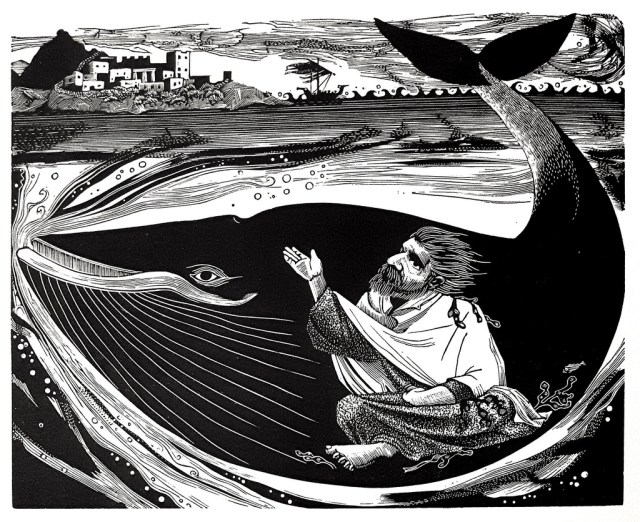
Jonah sign

Jesus said there is already an existing sign: Jonah. As Jonah was three days and three nights in the belly of a whale, so Jesus would be in the earth for three days and nights. The death and resurrection of Jesus is needed, and when faced with this information, the only appropriate response is repentance, a complete U-turn, to a changed life.

Jesus mentioned the Queen of the South to make the same point. When the ancient Ninevites, who were a sinful people, encountered the person of Jonah, they repented; when the Queen encountered the person of Solomon, she changed.  Therefore, how much more ought we to change when encountering the person of Christ?

Jesus himself is the sign. Jonah was in the belly of a whale. He was all but dead. But God caused the whale to belch up Jonah, and he went out as a changed man. The experience of having stomach fluids work on a person for three days and nights would have changed a person both spiritually and physically – bleached completely white and an incredible sight to see!

The whole point of bringing up Jonah was to communicate the great need for repentance when faced with Jesus, his life, his teaching, his ministry. The appropriate response to Jesus is a changed life. Jesus was looking for status quo malcontents, and a desire for transformation and new life. The process of change is hardwired into all creation – from seasons of the year to the seasons of people’s lives – all are designed for a sustained process of time to renew and revolutionize us.

Jesus modeled this for us. He switched his address of heaven and moved into our neighborhood to bring us new life. As the Master of conversion, Jesus extends the invitation to change. All he asks is to let God do the work of change within us, be patient with the construction of the soul he is doing and persist with daily routines of faith individually and with one another.

It pleases Jesus and it is the heart of God to realize new life. Change for change’s sake is not the point. Change that reflects the values of God is. So, we must hear the Scriptures, and we must pray to seek the mind and heart of God.

God Almighty, we desire to be transformed by you and allow the life of Jesus to be expressed through us. We desire to walk in the light of your spirit. Reveal to us those things in our life that need to be made anew. Allow us to discern between flesh and spirit so that we can choose a healthy holy path. Continue to give us spiritual awareness. Transform us into something new altogether. May our old life and way disappear, and our new life emerge for the blessing of the world, through Jesus Christ our Lord in the power of the Holy Spirit. Amen.

Ephesians 2:1-7 – Raised with Christ

Ascension

You were dead through the trespasses and sins in which you once lived, following the course of this world, following the ruler of the power of the air, the spirit that is now at work among those who are disobedient. All of us once lived among them in the passions of our flesh, following the desires of flesh and senses, and we were by nature children of wrath, like everyone else. But God, who is rich in mercy, out of the great love with which he loved us even when we were dead through our trespasses, made us alive together with Christ—by grace you have been saved— and raised us up with him and seated us with him in the heavenly places in Christ Jesus, so that in the ages to come he might show the immeasurable riches of his grace in kindness toward us in Christ Jesus. (NRSV)

In the wake of recognizing and remembering Ascension Day, Christ’s ascension to heaven, we must linger a bit with the implications of that great redemptive event for us. Today’s New Testament lesson from the letter to the Ephesians is a wondrous place to do some holy loitering.

The Apostle Paul wrote to the Ephesian church and gave them a theological explanation of their true position as Christians. They were once located in the realm darkness, the place of disobedience and selfishness. Now, however, as believers in Jesus Christ, they have been relocated to the realm of light, the place of love and kindness. This major relocation project is the direct effort of God’s merciful initiative. Jesus descended in his incarnation and lived at the garbage dump with us. Christ’s life and death delivered us from that putrid existence. Jesus ascended to heaven. He did not leave us in the dump.

The rich theology which Paul expresses to the Ephesians is so robust that he makes up new words just to try and communicate it. Through God’s gracious action he “made us alive together with Christ,” “raised us up with him,” and “seated us with him in the heavenly places.” Paul took words and smashed them together to create new compound words to try and communicate the amazing reality of the Christian’s position in Jesus Christ. In English, we need to use several words to translate Paul’s original compound words.

Paul used new words because he was expressing a new reality. Ascension is more than Christ’s own – he, spiritually, takes us with him. We belong with him. Our union, our intimacy, with Jesus is so vitally connected that what happens with Jesus happens with us. With Jesus as the Head of the Church, and we as the Body of Christ, there is absolutely no separation between the two.

The implications of this understanding are tectonic:

  • Since God’s action was done out of love, our spiritual DNA has love written all over it. We no longer feel as if we must manipulate, cajole, or twist arms to be noticed and have our needs met.
  • Since God is rich in mercy, we have a new place to live – with Christ – and no longer hang out in the shame lounge drinking cheap wine and smoking nasty cigars.
  • Since God has given us new life in Christ, we are aware of our position and now can deliberately choose to participate with him in a mind-blowing, gut-busting, heart-exploding divine/human adventure beyond what we could ever have imagined. We no longer are in the position to create selfish agendas and ignore the common good of all humanity.
  • Since God has picked us up, cleaned us up, and sat us down next to Jesus, we have a front row seat to the triune God showing kindness to us and so many others. We no longer have a truncated worldview which sees only pain and heartbreak.
  • Since God has orchestrated deliverance from the old life; since Christ has achieved that deliverance for us; and, since the Spirit has awakened us – we now have a new life thoroughly imbibed with the medicine of faith, the healing power of hope, and the elixir of love. With grace binding our lives together with God, no more judging, blaming, shaming, nor hating need occur anymore.
  • Since we belong to God, we enjoy all the love of the Father, the mercy of the Son, and the vigor of the Holy Spirit. We have risen above all the terrible muck of sin and given a new place to live. Since Jesus ascended, we ascend with him. Praise be to God!

As people, we live into who we believe we are. We are the precious children of God, redeemed and adopted into a divine family. May we live up to our position in Jesus Christ.

Almighty and merciful God, in your goodness keep me, I pray, from returning to the pig pen of an old life. May I be ready in both body and soul to freely choose things which belong to your purposes of love; through Jesus Christ my Lord, who lives and reigns with you and the Holy Spirit, one God, now and forever. Amen.

John 16:16-24 – From Grief to Joy

Light Shining in Darkness
“Even a happy life cannot be without a measure of darkness, and the word happy would lose its meaning if it were not balanced by sadness. It is far better take things as they come along with patience and equanimity.” ~ Carl Jung

Jesus went on to say, “In a little while you will see me no more, and then after a little while you will see me.”

At this, some of his disciples said to one another, “What does he mean by saying, ‘In a little while you will see me no more, and then after a little while you will see me,’ and ‘Because I am going to the Father’?” They kept asking, “What does he mean by ‘a little while’? We don’t understand what he is saying.”

Jesus saw that they wanted to ask him about this, so he said to them, “Are you asking one another what I meant when I said, ‘In a little while you will see me no more, and then after a little while you will see me’? Very truly I tell you, you will weep and mourn while the world rejoices. You will grieve, but your grief will turn to joy. A woman giving birth to a child has pain because her time has come; but when her baby is born, she forgets the anguish because of her joy that a child is born into the world. So, with you: Now is your time of grief, but I will see you again and you will rejoice, and no one will take away your joy. In that day you will no longer ask me anything. Very truly I tell you, my Father will give you whatever you ask in my name. Until now you have not asked for anything in my name. Ask and you will receive, and your joy will be complete. (NIV)

Jesus tended to say things that were neither expected nor wanted. That was even true of Christ’s own disciples who walked and talked with him for three years. Jesus consistently told them there must be suffering before glory. Getting them to buy into such an idea is like trying to get a bunch of Baptists to write their names on a sign-up sheet at church.

Christ was speaking to his disciples in the Upper Room, the last meal he had with them before his death. When they were called by Jesus three years earlier, the disciples were not expecting all the gibberish about leaving and grieving. To put this in contemporary terms, the disciples’ response was akin to saying, “I only think positive. I don’t listen to things that are negative.” Suffering, death, and grief were far from the disciples’ expectations of how things would and should shake-out. They had a hard time understanding what the heck Jesus was saying because his words were out of alignment with their assumptions. Yes, there would be glory and joy. First, however, there must be suffering and grief.

I tend to think in metaphors, so I like that Jesus uses one to bring some context about leaving and returning. And I resonate a lot with his metaphor. My dear wife spent 128 days on total bed rest before our youngest daughter was born. During those four months, we agonized over the health of our little peanut in the womb. I was also in a constant state of concern for my wife’s health. This kind of pregnancy we were not expecting. Those months were hard not only for us but also for our two daughters who needed to step up and participate in family life in new and different ways.

There were months of pain and hardship, not to mention the actual pain of childbirth. Finally, our little girl was born – a bit small, yet, quite healthy. Our grief turned to joy. Nothing could ever take away that joy. We prayed hard back in those days. We asked. We received. And our joy was complete. When I look back on those days, I can remember the anguish. Yet, what prominently stands out is the joy because true unmitigated joy has the power to swallow grief and despondency whole.

In talking through with his disciples about their disappointment of his leaving and their grieving, Jesus graciously gave them the gift of joy. Yes, there can be and is joy in the mourning. Not every story has a happy ending. I can say, however, that the grandest story of all – Jesus Christ’s suffering and death – has resulted in resurrection and ascension. It will all be complete when Christ returns to judge the living and the dead. Then, the grand narrative of redemption will have its conclusion of no more crying, tears, or pain. There will be only unending joy.

For now, we still experience heartache along with the joy of new life. It can be confusing living in the awkward state of simultaneous grief and joy. Yet, keep in mind that the grief is temporary, and the despair will not last. Joy, on the other hand, has staying power and will be the permanent state of the believer. It is only the smaller stories which may or may not end well. The big story of redemption already has the ending written – joy without grief.

Christ is risen! Therefore, we need not wait to be happy or expect that everything must go our way to have joy. The good news is that there are always fresh opportunities to be happy through asking and receiving. Imagine a Partridge Family kind of bus coming around to all the bus stops of life. Happy times and music arrive around the clock. Chances are the opportunity to be happy has already arrived. Often, it is right in front of us; we just missed the bus because we were daydreaming about a future state of joy.

We are living in the days of the new normal and continual change. Just as there was no going back to a three-year hiatus of the disciples walking with Jesus, so we need to embrace new and different ways of life together here on planet earth. We have the gift of joy. Its just a matter of unpacking it.

Now to him who is able to do immeasurably more than all we ask or imagine, according to his power that is at work within us, to him be glory in the church and in Christ Jesus throughout all generations, for ever and ever! Amen.

Matthew 20:17-28 – On Being a Servant

Jesus bronze sculpture washing feet
Bronze statue of Jesus washing Peter’s feet, Pittsburgh, Texas

Now Jesus was going up to Jerusalem. On the way, he took the Twelve aside and said to them, “We are going up to Jerusalem, and the Son of Man will be delivered over to the chief priests and the teachers of the law. They will condemn him to death and will hand him over to the Gentiles to be mocked and flogged and crucified. On the third day he will be raised to life!”

Then the mother of Zebedee’s sons came to Jesus with her sons and, kneeling, asked a favor of him.

“What is it you want?” he asked.

She said, “Grant that one of these two sons of mine may sit at your right and the other at your left in your kingdom.”

 “You don’t know what you are asking,” Jesus said to them. “Can you drink the cup I am going to drink?”

“We can,” they answered.

Jesus said to them, “You will indeed drink from my cup, but to sit at my right or left is not for me to grant. These places belong to those for whom they have been prepared by my Father.”

When the ten heard about this, they were indignant with the two brothers. Jesus called them together and said, “You know that the rulers of the Gentiles lord it over them, and their high officials exercise authority over them. Not so with you. Instead, whoever wants to become great among you must be your servant, and whoever wants to be first must be your slave— just as the Son of Man did not come to be served, but to serve, and to give his life as a ransom for many.” (NIV)

Today’s story from the Gospel of Matthew is the very description of not being on the same page. There were two variant responses from Jesus and from everyone else because there were two different agendas.

Jesus was quite clear about how things were going to shake out. Torture, insults, crucifixion, and death was ahead for him. The disciples and the mother of James and John missed the memo on this. Christ’s words went way over their heads. It could be the disciples simply did not hear what Jesus was saying to them (repeatedly!). It is more likely that the message of Jesus got filtered through an existing agenda of how they believed things ought to go.

The disciples, along with a lot of other Jewish folk in the first century, were looking for a Messiah in the mold of King David – a strong leader who would come and beat up the Romans, exert all kinds of power and influence, and establish an earthly rule over all the people they don’t like. Submission to torture, humility before the very people they detested, and being killed by them were not factors into the disciples understanding of leadership and government.

Much like the powerful Aslan who had a thorough understanding of the world’s deep magic and submitted himself to the White Witch and death in C.S. Lewis’s The Lion, the Witch, and the Wardrobe – Jesus knew what he was doing while everyone else seemed clueless about the true power which exists in the universe.

So, let us be perfectly clear about what that power really is: Grace. Yes, grace. Powerful, resplendent, subversive, scandalous, and radical grace. Mercy was the missing factor in the disciples’ agenda. Jesus is not like other rulers. He does not operate by throwing his weight around to forcefully impose a crushing my-way-or-the-highway kind of rule (even though, ironically, he is The Way). No, Jesus freely and unabashedly uses grace with its merciful tools of humility, gentleness, kindness, goodness, and love to introduce and establish a new kind of rule which is not posturing for selfish power.

Power, authority, and the positions which go with them are to be used for the common good of all persons. To be in any kind of leadership is to be a servant of grace for the benefit of humanity and the world. And, if Christ’s disciples had looked a bit closer into their Old Testament, they might have noticed, for all his power and authority, King David trafficked in grace. When David was at the pinnacle of power his first act as King was to look over the kingdom and see who from the family of his enemy, the former King Saul (who was into the power thing for himself) was around so he could show grace (2 Samuel 9). It was typical of ancient kings to secure their rule and power through killing-off rivals and former family members of previous kings. Not so with David. And not so with Jesus.

Wherever there is posturing for position, preening for power, and a pestering for privilege – there you will find everything grace is not: reliance on making and calling-in favors; overinflated egos; unrealistic expectations; suspicion; judgment, arrogance; an insistence on recognition; compulsive control over everything and everyone; unilateral decision-making; shaming of others; hoarding of resources; coups; in-fighting; hatred; and, a demand of rights. We in the western world may not be in the habit of offing leaders and killing others to consolidate power, yet, we still too often rely on violent speech and language, partisan policies, and good-old-boy systems which are foreign to the way of Christ. In contrast to this, grace exists.

Grace is the deep magic which resides within the universe.

Wherever grace operates, there you will find the heart of a servant: attending to the needs of all persons; freely consulting and collaborating with others; focusing on responsibility; loving discipline; embracing accountability; pursuing truth; sharing power and resources; encouraging others; giving generously; and, looking for ways to show mercy.

In this Christian season of Eastertide, the Church focuses on exploring new life, and new ways of being with one another and the world. The old life is consumed with unmerciful uses of position and power. New life brings a shift to a gracious means of wielding such authority. Yes, it will likely bring some short-term suffering. It will hurt. Grace, however, results in a longevity of righteousness and peace for those who have been trained by it. True service is being a servant of grace.

May it be so, to the glory of God.

Click Make Me a Servant by the Maranatha Singers and allow it to be our prayer today and everyday.