

Ephesians 4:17-24 – Put Off the Old, Put On the New

So, I tell you this, and insist on it in the Lord, that you must no longer live as the Gentiles do, in the futility of their thinking. They are darkened in their understanding and separated from the life of God because of the ignorance that is in them due to the hardening of their hearts. Having lost all sensitivity, they have given themselves over to sensuality so as to indulge in every kind of impurity, and they are full of greed.

That, however, is not the way of life you learned when you heard about Christ and were taught in him in accordance with the truth that is in Jesus. You were taught, with regard to your former way of life, to put off your old self, which is being corrupted by its deceitful desires; to be made new in the attitude of your minds; and to put on the new self, created to be like God in true righteousness and holiness. (New International Version)

What breeds ignorance and immorality amongst people?

I’m sure if you asked that question to a dozen people you might get a dozen different responses.

According to the Apostle Paul, it comes from a disconnection from truth. And biblically, since the very character of God is truth, then ignorance and a closed heart also result from estrangement from God.

The Christian tradition informs us that Jesus is the way, the truth, and the life. Life together is to be shaped around the person and work of Christ. Since Christians share a common confession of Jesus, we are to share a common life together. That life is to revolve around the truth of Jesus.

That means we will put off non-Christian ways of relating to each other and put on a Christian way of relating to each other. 

We will, then, speak truthfully and live honestly, because we belong to each other – we are responsible for one another.

Just as Jesus so closely identified with us in his life, death, and resurrection, so we are to so closely identify with each other that we take responsibility for each other and hold one another accountable. My problems are your problems – your issues are my issues. This is a stance of connection, not division.

Believers are firmly moored to Christ and to Christian community. With the enablement of the Holy Spirit, they are able to forsake the old life with its unhealthy routines of living and embrace a new life with good healthy habits of daily life.

Some people continually struggle to overcome bad habits. In part, it’s because they are living a half-truth life. They might be connected to Jesus as Truth yet remain stubbornly independent. Such persons remain disconnected from Christ’s Church.

One never realizes sustainable holiness over a lifetime apart from Christian community. In other words, real and lasting change comes from both the truth of Christ and the truth of Christ’s Church.

“No one can have God as his father who does not have the Church as his mother,” said both St. Augustine and St. Cyprian.

The magisterial Reformer, John Calvin, upheld the ancient teaching of the Church:

“The Church is our mother, inasmuch as God has committed to her the kind office of bringing us up in the faith. This method of education is not to be despised…. She has the milk and the food by which she continually nourishes her offspring. This is why the Church is called the mother of believers. And certainly, the one who refuses to be a child of the Church desires in vain to have God as Father.”

John Calvin

This is a consistent understanding throughout Christian history. That’s because the ancient church fathers (and mothers!) knew people are hard-wired for community. What’s more, truth is located not only in the Head of Christ but also in the Body of Christ. Decapitating head from body is to sever the truth in half. Head and Body, Christ and Church, have always been meant to go together as one.

To know the truth intellectually and cerebrally is only half of personal transformation. There also must be a bodily living of the truth – and to do that takes the Body of Christ. Life in Christ is life together as Christians.

Just as it was not our choice to be born into our biological family, so we are born again into a spiritual family, the Church. And just as that crazy uncle, obnoxious cousin, bossy big sister, and the entire family system can be difficult in our biological family, so it is the same in our spiritual family.

We might choose to be estranged from Church, but this in no way diminishes the truth that we need a faith family and a spiritual community.

I very much understand that both biological family and spiritual family can be (and are) toxic for many people. I am not suggesting we passively remain in abusive relationships. What I am saying is that doing away with community altogether is an awfully bad idea.

As much as I, in the past, have wished to run away and live alone in the woods with only bears and raccoons as my friends, I didn’t do it, mainly because I knew better. I knew I needed a supportive community of redeemed people if I was every going to truly honor God and experience becoming holy as God is holy.

If we want to participate in the life of God, it comes with community.

It is, therefore, necessary to hold one another accountable, as well as help each other to be truly holy.

We need to embrace the teachings of the New Testament toward one another:

  • Love one another (John 13:34)
  • Be devoted to one another (Romans 12:10)
  • Encourage one another (1 Thessalonians 5:11)
  • Exhort one another (Hebrews 3:13)
  • Confess your sins to one another (James 5:16)

A lack of self-awareness, empathy, and understanding comes from being disconnected from community. Yet, when we embrace the truth of Christ and Christ’s Church, we aren’t fooled by evil, and we discover the strength of life together in the Spirit.

So, like a new set of clothes, take off the old tattered ones and put on the mind of Christ.

Grant, almighty God, that all who confess your Name may be united in your truth, live together in your love, and reveal your glory in the world. Guide the people of all nations in the ways of justice and peace; that we may honor one another and serve the common good. And guide us to live together as countercultural models of goodness and reconciliation, in our neighborhoods and beyond, through Jesus Christ our Lord. Amen.

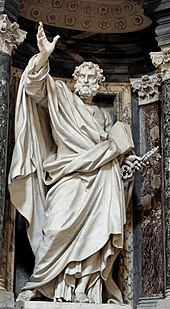
Acts 2:22-36 – From Flake to Fearless

Statue of St. Peter in Rome

“Fellow Israelites, listen to this: Jesus of Nazareth was a man accredited by God to you by miracles, wonders and signs, which God did among you through him, as you yourselves know. This man was handed over to you by God’s deliberate plan and foreknowledge; and you, with the help of wicked men, put him to death by nailing him to the cross.But God raised him from the dead, freeing him from the agony of death, because it was impossible for death to keep its hold on him.David said about him:

“‘I saw the Lord always before me.
    Because he is at my right hand,
    I will not be shaken.
Therefore my heart is glad and my tongue rejoices;
    my body also will rest in hope,
because you will not abandon me to the realm of the dead,
    you will not let your holy one see decay.
You have made known to me the paths of life;
    you will fill me with joy in your presence.’

“Fellow Israelites, I can tell you confidently that the patriarch David died and was buried, and his tomb is here to this day. But he was a prophet and knew that God had promised him on oath that he would place one of his descendants on his throne. Seeing what was to come, he spoke of the resurrection of the Messiah, that he was not abandoned to the realm of the dead, nor did his body see decay. God has raised this Jesus to life, and we are all witnesses of it. Exalted to the right hand of God, he has received from the Father the promised Holy Spirit and has poured out what you now see and hear. For David did not ascend to heaven, and yet he said,

“‘The Lord said to my Lord:
    “Sit at my right hand
until I make your enemies
    a footstool for your feet.”’

“Therefore, let all Israel be assured of this: God has made this Jesus, whom you crucified, both Lord and Messiah.” (New International Version)

Throughout my ministerial life, there have been individuals who have come to me a bit discouraged because they have not experienced a changed life. After trying, time and again, to be different, they say to me, “Nobody ever really changes. We’re basically the same people throughout our whole lives.”

I couldn’t disagree more.

In the New Testament Gospels, the Apostle Peter was a flake. He sometimes was discerning and got it, and sometimes didn’t. 

Peter could understand Jesus was Messiah, but then turn around and refuse that Christ had to die on a cross. He would get bold and walk on water, but then also end up afraid, needing help from drowning. Peter stood tall for Jesus, ready to take on the world, and then turn around and deny the Lord three successive times.

However, when we come to biblical book of Acts, Peter is a completely changed man. Peter gets it. He is brave and fearless. He boldly confesses Christ. And all the while he does not falter, flinch, or back down. 

So, what in heaven’s name, happened and made the difference for Peter between the Gospels and Acts? 

The Holy Spirit, that’s what, or rather, who.

God’s Spirit comes upon Peter, and he is never the same again. He is a changed man. Peter goes from flake, to fearless.

Everything falls into place for Peter, who preaches with such boldness and effectiveness that thousands turn from their previous ways of thinking and living and turn to Jesus as the hope of the world. They changed, too.

Peter was all-in with a simple and straightforward message of good news, that God raised Jesus from death. He went on to insist, without wavering and with firm conviction, that this was so, because it was not possible for the Son of God to be held by anything, even death. The proof being the resurrection.

If it was impossible for death to keep a grip on Jesus, then there is absolutely nothing that can deter Jesus or hold him back from accomplishing what he wants to accomplish. 

Flaky believers are not going to frustrate Jesus or upset his plans; he’ll just send the Holy Spirit. 

We may too often imprison ourselves in self-made spiritual jail cells. Like the pre-Pentecostal Peter, we flake and flip-flop in the Christian life. Once-in-a-while we are spot-on, but cannot really explain why, like a golfer who hits an amazing shot but can’t reproduce it no matter how hard he tries. 

The truth is that Jesus has conquered sin, death, and hell. By faith, we have forgiveness of sins in him, and have the way opened to a new life in the Spirit. It isn’t a secret; it’s a new reality.

At the front end of the Christian season of Ordinary Time, we are reminded that God’s Holy Spirit is with us. We remember what good old Peter said so long ago, which is still relevant for us today:

We have everything we need to live a life that pleases God. It was all given to us by God’s own power, when we learned he had invited us to share in his wonderful goodness. God made great and marvelous promises, so his nature would become part of us. Then we could escape our evil desires and the corrupt influences of this world. (2 Peter 1:3-4, CEV)

The message Peter proclaimed was powerful, not only because it was inherently potent, but also that the gospel dwelled mightily in Peter and inhabited a central place within him.

We, too, have that same opportunity and privilege.

Loving Lord Jesus, I confess my faults, shortcomings, sins, and rebellious acts, and ask you to forgive me. I embrace you as my Savior and Lord. Thank you for your atoning death on the cross in obedience to your Father’s will to put away my sins. Be in charge of every part of my life. Indwell and empower me with your Holy Spirit, so that I may live as your faithful follower, now and forever. Amen.

Galatians 6:1-16 – Fulfill the Law of Christ

Brothers and sisters, if someone is caught in a sin, you who live by the Spirit should restore that person gently. But watch yourselves, or you also may be tempted. Carry each other’s burdens, and in this way you will fulfill the law of Christ. If anyone thinks they are something when they are not, they deceive themselves. Each one should test their own actions. Then they can take pride in themselves alone, without comparing themselves to someone else, for each one should carry their own load. Nevertheless, the one who receives instruction in the word should share all good things with their instructor.

Do not be deceived: God cannot be mocked. A man reaps what he sows. Whoever sows to please their flesh, from the flesh will reap destruction; whoever sows to please the Spirit, from the Spirit will reap eternal life. Let us not become weary in doing good, for at the proper time we will reap a harvest if we do not give up. Therefore, as we have opportunity, let us do good to all people, especially to those who belong to the family of believers.

See what large letters I use as I write to you with my own hand!

Those who want to impress people by means of the flesh are trying to compel you to be circumcised. The only reason they do this is to avoid being persecuted for the cross of Christ. Not even those who are circumcised keep the law, yet they want you to be circumcised that they may boast about your circumcision in the flesh. May I never boast except in the cross of our Lord Jesus Christ, through which the world has been crucified to me, and I to the world. Neither circumcision nor uncircumcision means anything; what counts is the new creation. Peace and mercy to all who follow this rule—to the Israel of God. (New International Version)

It’s all about grace. God’s grace. Not rules. Not a list of principles to live by. Not judgment. Not punishment or penance. Grace – amazing, wonderful, scandalous grace.

The Law of Christ is to help each other in our troubles, no matter what.

Overwhelming physical, mental, emotional, and spiritual burdens can become even more heavy through failing to live up to someone’s or some group’s unwritten list of rules. “Keep a stiff upper lip.” “Everything is possible for those who love God.” “Stay positive.” “Just have faith and trust God.” Or someone’s silence…. These and hundred other phrases communicate to people with crushing spiritual and emotional loads that they will have to carry them alone.

The letter to the Galatian believers spells out what is to truly characterize Christian interactions, and what it means to walk in the Spirit. Believers in Jesus are to emulate the behavior of Christ, the ultimate burden-bearer, who came to restore sinners, not condemn them. We have a responsibility to rescue, renew, and revitalize persons who have lost their way. We are our brother’s and our sister’s keeper.

Someone caught in the crosshairs of a bad decision, or ensnared by making a wrong step, who is now in over their heads, needs help. In such a case, we are to restore, not punish. The person’s wound needs spiritual cauterizing. The broken spirit needs to be set back into place to heal properly.

The tone and the attitude which we do this important work of restoring people is through gentleness (meekness). We are to have a mindset and a heart stance which understands there is no moral superiority with me. I could easily be that person in need of restoration.

With a gentle spirit, we discern no one is above falling into the same trouble. We, too, are ethically and morally vulnerable. So, the church has a corporate responsibility to bear one another’s burdens.

There are other people who, through no fault of their own, find themselves in over their heads, too. Their physical struggles, mental health challenges, the emotional weight of hard circumstances, and their broken spirits require others to help shoulder the load so that the weighted-down person is not crushed.

Burden-bearing is the work of everyone and not a select few. You and I are to take responsibility for our own backpack of stuff – our own actions and attitudes. A mature spiritual community of people are able to distinguish those loads which individuals must bear for themselves, and those burdens where help is sorely needed. We are accountable to carry our own backpack. And we are also accountable before Christ to share our load with others when it becomes too heavy to carry.

If we choose not to allow others to assist us when we need it, then we will reap what we sow – we’ll feel the full weight and consequences of our silence. The planting and harvesting metaphor isn’t just for those who have engaged in wrongdoing. It is also for those who don’t put any seeds in the ground to begin with. They shouldn’t expect a harvest, at all.

Grace lived out in real experiences knows when to get under a load and help carry it. And grace also knows when to be kind to self and share the heavy burden with others who can help shoulder it for a bit. This is a Christianity which relies on the enablement of the Spirit, made possible by Christ, who carried our crushing weight of guilt and shame for us.

“Come to me, all you who are weary and burdened, and I will give you rest. Take my yoke upon you and learn from me, for I am gentle and humble in heart, and you will find rest for your souls. For my yoke is easy and my burden is light.”

Jesus (Matthew 11:28-30, NIV)

Motives matter. The interior life of a person is important. Life is neither a mere getting things done nor doing what is needed on the exterior. A house may be beautiful and orderly on the outside, with careful landscaping, a manicured lawn, and attractive appearance – yet on the inside it might be disorderly, full of relational discord, and completely discombobulated.

The exterior life of a person is also important. But it’s only half the person. And, unlike God who sees the heart, we aren’t always privy to what’s going on inside someone. Folks who are enamored with outward displays of spirituality and righteousness tend to be compulsive about maintaining appearances – for both themselves, and everyone else.

Policing outward forms of righteousness through clear identifiable means is really nothing more than old fashioned judging of one another. It’s antithetical to grace. And it smacks of the snooty superiority of Star-Bellied Sneetches.

Rather than a star on the belly, in the Apostle Paul’s day it was circumcision. Those who had it were “in” and those without it were “out.” Never mind the interior life. A hard outward boundary of righteousness was established by false teachers who made the Christian life easy by simply holding to readily observable forms, like circumcision.

It wasn’t that circumcision was a bad thing. The issue was making it a necessary part of the Christian life. Not circumcised? Not a Christian, insisted the false teachers. In other words, one had to become Jewish before becoming a Christian. I can picture the Apostle Paul doing a  face palm, saying, “Oy vey.”

For the Christian, one must be vigilant not to exaggerate baptism. On the one hand, I would argue far too many believers underestimate the significance and importance of baptism. Flippantly making it a personal choice, as if the individual is in complete control of one’s own salvation, is not only wrongheaded – it’s downright blasphemous.

Yet, on the other hand, a preoccupation with getting a person, especially a child, baptized, as if the world might end if it doesn’t happen, betrays the same problem as Paul faced with circumcision in the first century.

The proper approach, it seems to me, is to embrace the full spectrum of Christianity – both outward and inward – the whole person. And Paul addresses this by anticipating a question of the Galatian congregation: What, then, is of central importance?

The answer is: a new creation. To be transformed by the power of the Spirit is what really counts. The grace of God in Christ, applied to a person, brings a change to inner motives and attitudes, as well as outer behavior through loving actions.

We must always keep in mind that the sign points to the substance. It would be weird if I were traveling to Milwaukee on I-94 and pulled over on the interstate next to the sign marking the city is ahead, crawl all over it, and say, “I’m here!”

The overall thrust of Paul’s letter to the Galatians is that they were debasing the true worship of God into an outward show, honoring Christ with their lips but not holding him in their hearts through carrying one another’s burdens.

Christianity is fundamentally not about what we do for God but what God has done for us in Jesus Christ. It is divine grace which saves people. We belong to God. Just as we neither chose our own parents nor the time when we were born, so also, before we chose God, God chose us. We don’t “born again” ourselves; God does the rebirthing.

Since salvation is solely the work of God in us, there is zero reason to boast about the circumstances of our new birth and becoming a new creation in Christ. We didn’t save ourselves. It would be like getting a COVID-19 vaccine and then bragging about how we personally stopped the pandemic.

Instead, we are to bear the spiritual marks of Christ’s crucifixion on our inner selves. No one is saved because they deserve it but simply because they need saving. That’s what grace truly is – and that’s how we are to live toward one another.

Merciful God, you are our Burden-Bearer. Awaken our hearts to remember your love. Open our eyes to see your grace. Stir up hope in those who are overwhelmed with sorrow and fear. Teach them to place their burdens at your feet as an offering — a sacrifice well-pleasing to you. Teach us all to allow others to help us in our time of need, through Jesus Christ our Lord, who with you and the Holy Spirit are one God, now and forever. Amen.

2 Kings 4:32-37 – But That Is Not the End of the Story

Elisha and the Shunammite woman by Dutch painter Gerbrand van den Eeckhout (1621-1674)

Elisha entered the house and found the boy stretched out on the bed dead. He went into the room and locked the door—just the two of them in the room—and prayed to God. He then got into bed with the boy and covered him with his body, mouth on mouth, eyes on eyes, hands on hands. As he was stretched out over him like that, the boy’s body became warm. Elisha got up and paced back and forth in the room. Then he went back and stretched himself upon the boy again. The boy started sneezing—seven times he sneezed!—and opened his eyes.

He called Gehazi and said, “Get the Shunammite woman in here!” He called her and she came in.

Elisha said, “Embrace your son!”

She fell at Elisha’s feet, face to the ground in reverent awe. Then she embraced her son and went out with him. (The Message)

Life sometimes feels like a roller coaster. Our emotions go up and down alongside the circumstances which bring them forth.

Elisha was one of the all-time great prophets in ancient Israel. He developed an ongoing friendship with a woman from the town of Shunem. It was her simple hospitality to a stranger that brought about the enduring relationship.

Whenever Elisha passed through on his prophetic business, he would stop in and have a meal or spend the night in a special room set aside just for him.

But that is not the end of the story….

The woman was about to have a big change of life, a life she could not have ever seen coming and only dreamed of.

The Shunammite woman had no children and was not able to conceive. Yet, on one of his visits, Elisha promised her she would hold her very own infant child… which she eventually did. A year after Elisha’s pronouncement, the woman and her husband had a son.

The woman went from discouraged to elated. The child grew. The Shunammite and her family were content and living well.

But that is not the end of the story….

In today’s Old Testament lesson, we pick up the narrative as the child is a small boy, the family happy and healthy… until they weren’t.

One day the boy was playing, as he did every day. Whatever happened, he developed such a terrible headache that his dear mother rocked him for hours, trying to comfort him. The worst case scenario happened. The boy died.

The woman went from joy to despair in a matter of hours.

But that is not the end of the story….

The grieving mother refused to let death have the last word on her son. She saddled her donkey and went directly to Elisha. The Shunammite lamented to him about her son, and in her grief, cried out how Elisha had gotten her hopes up, only to be dashed by that dark enemy of death.

The prophet responded to the woman’s plea and set off  post haste to her home, which had now become a sort of funeral parlor. Elisha went into the room by himself with the dead boy. In an odd process similar to what Jesus would do centuries later, Elisha did some physical actions in bringing about a miraculous resurrection.

The boy sneezed, got up, and was given back to his mother. Her lowest of the low grinding sadness of distress and despair now turned to the highest of the high elation of joy and gratitude.

But that is not the end of the story….

The story continues because the larger overarching story of God’s gracious intervention into this world to bring about the redemption of all creation.

Along the way, across the millennia, the Lord continues to use faithful people to bring about renewal, restoration, and redemption. In the Christian tradition, the apex of this merciful work is fulfilled in the person of Jesus Christ.

God himself was pleased
    to live fully in his Son.
And God was pleased
    for him to make peace
by sacrificing his blood
    on the cross,
so that all beings in heaven
    and on earth
would be brought back to God. (Colossians 1:19-20, CEV)

The resurrection of the boy, and all risings from death before Jesus, prefigured and foretold the ultimate resurrection of Christ. And because Christ is risen, we too, shall rise from death – both spiritually and bodily.

Therefore, we have been buried with him through baptism into death, in order that just as Christ was raised from the dead through the glory of the Father, so we too may live a new life. For if we have become united with him in the likeness of his death, we will certainly also be united in the likeness of his resurrection. (Romans 6:4-5, NET)

The end of the grand narrative story is moving to a climax. Jesus is coming again to judge the living and the dead. All things shall be restored. All will be made right. We may sorrow in the night, but joy comes in the morning.

Then I saw a new heaven and a new earth, for the first heaven and the first earth had passed away, and the sea was no more. And I saw the holy city, the new Jerusalem, coming down out of heaven from God, prepared as a bride adorned for her husband. And I heard a loud voice from the throne saying,

“See, the home of God is among mortals.
He will dwell with them;
they will be his peoples,
and God himself will be with them and be their God;
he will wipe every tear from their eyes.
Death will be no more;
mourning and crying and pain will be no more,
for the first things have passed away.”

And the one who was seated on the throne said, “See, I am making all things new.” Also, he said, “Write this, for these words are trustworthy and true.” Then he said to me, “It is done! I am the Alpha and the Omega, the Beginning and the End. To the thirsty I will give water as a gift from the spring of the water of life. (Revelation 21:1-6, NRSV)

Our past grief and our present troubles will give way to a future hope – an ending to the story we can barely imagine, a glorious existence with our God which will have no end.

May the Lord come soon.

I pray the Lord Jesus will be kind to you.

May faith, hope, and love surround everyone who belongs to Christ Jesus. Amen.