His Resurrection Is Ours

The Resurrection, by Andrea Mantegna, c.1458 C.E.

The story of Christianity, the very heart and essence of the religion, is a tale of transformation from all the obstacles, impediments, and barriers which confine or cripple. The person and work of Jesus accomplished this. In his earthly ministry, Christ continually called people to transformative change into the reality of God’s gracious and benevolent realm.

“I have come to give the good life, a life that overflows with beauty and harmony.”

Jesus (John 10:10, First Nations Version)

Christ’s resurrection made possible our own transformative new life. This is both exciting and scary. Resurrection is frightening because it’s a call to live a life without any of the walls which have defined us and/or imprisoned us.

The massive stone covering the tomb of Jesus Christ was rolled away. He walked out of the grave by the power of resurrection. The cave of death was changed into the place of liberation.

That place is a powerful image of moving aside any and all obstacles to our own faith and freedom. The prison doors have been opened. Our self-contrived inner prisons, as well as the unjust shackles placed upon us, have dropped away.

As a result, those who have been exiled, excommunicated, and treated as expendable are visited by the luminous healing presence of God’s great liberating force: resurrection.

All of these words may either seem strange and/or compelling. If this is the case, it is a sad situation. Because it’s quite necessary that we become familiar with such language. Unfortunately, the gap between the world we are presently living in, and the world our hearts yearn to know, is quickly coming to an unsustainable place of high stress.

There is now a profound disconnect between the love deep inside us, and the way in which we are living our day-to-day lives on this earth. The issue has become so great as to warrant the need for resurrection.

And I am not simply addressing Christians. In his earthly ministry, Jesus was not only talking to his own Jewish people; he came for the whole world. Jesus is for everyone – whether we acknowledge him according to Christian dogma and doctrine, or not.

The evil gaslighting sort of person wants you to believe that you are alone, bereft of any help – that somehow you need to assert yourself aggressively into the dog-eat-dog world. Wickedness always looks to chaos and war as the path to gaining the life one wants.

But Jesus is the bridge to another kind of thinking, another sort of life. He is the guide to the greatest power which exists in the world: Love. And Love is why resurrection is a reality.

Although we suffer from systemic evil and all kinds of structural “ism’s” in this world, our shackles and chains have been largely forged by ourselves, through spiritual ignorance and misunderstandings of who we are and why we are here.

Resurrection opens us to new life. It provides identity, purpose, and passion to live the good life. Even though we live in this world below, our answers to living in the here-and-now are found in the world above.

All of us have experienced walking a dark path in life. But now it is high time to walk away from uncontrolled emotions and evil ways. There are plenty of lying spirits who intend on deceiving you and I for their own selfish purposes. Instead, we can refuse and resist such evil.

We can live in ways that represent the good, the right, and the just. We can experience living a resurrected life. Let us choose the pure path of the new person in Christ, the person you and I were created to be.

The telltale signs of the person living into resurrection are a deep feeling for the pain of others, kindness, humility of heart, a gentle spirit, and long-suffering patience with others. Such persons wear forgiveness like a well-worn pair of jeans.

This is the path of resurrection, the way of unity, peace, and harmony. And these qualities will always guide us and inform us in helpful and sacred ways.

Our current global decline comes from an accumulation of greed and sheer lovelessness. But the possibility of rebirth, of resurrection, rises from our deep universal yearning for the good and the true. It comes from our radical willingness to change and live a different counter-cultural life.

Resurrection does not occur because of lofty thoughts; it comes from a humble, and contrite heart which yearns for a better and more sacred existence.

Only until we find our present life on this world as intolerable with its injustice and persistent carelessness, will we see that we must put love where love is not.

The great lesson of resurrection is that Love makes all things right.

May resurrection move from being merely a theological concept, to a powerful reality that permeates and fills your life with meaning, power, and love. Amen.

Third Sunday of Advent – The Ministry of John the Baptist (Luke 3:7-18)

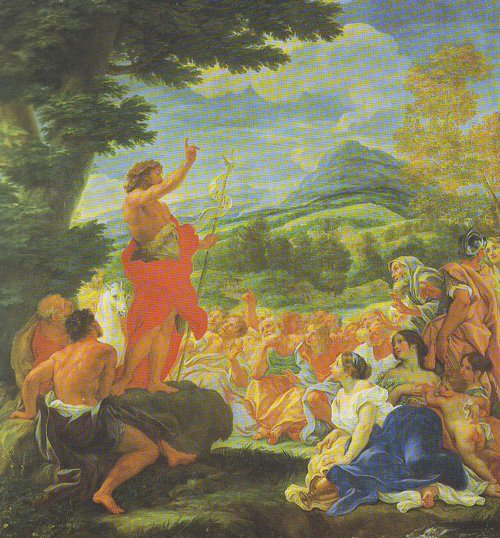
St. John the Baptist Preaching, by Giovanni Battista Gaulli (1639-1709)

John said to the crowds coming out to be baptized by him, “You brood of vipers! Who warned you to flee from the coming wrath? Therefore, bear fruits worthy of repentance, and do not begin to say to yourselves, ‘We have Abraham as our ancestor,’ for I tell you, God is able from these stones to raise up children to Abraham. Even now the ax is lying at the root of the trees; therefore every tree that does not bear good fruit will be cut down and thrown into the fire.”

And the crowds asked him, “What, then, should we do?” In reply he said to them, “Whoever has two coats must share with anyone who has none, and whoever has food must do likewise.” Even tax collectors came to be baptized, and they asked him, “Teacher, what should we do?” He said to them, “Collect no more than the amount prescribed for you.” Soldiers also asked him, “And we, what should we do?” He said to them, “Do not extort money from anyone by threats or false accusation, and be satisfied with your wages.”

As the people were filled with expectation and all were questioning in their hearts concerning John, whether he might be the Messiah, John answered all of them by saying, “I baptize you with water, but one who is more powerful than I is coming; I am not worthy to untie the strap of his sandals. He will baptize you with the Holy Spirit and fire. His winnowing fork is in his hand to clear his threshing floor and to gather the wheat into his granary, but the chaff he will burn with unquenchable fire.”

So with many other exhortations he proclaimed the good news to the people. (New Revised Standard Version)

John’s ministry was meant to be one of preparing people for the Lord’s coming. His understanding of that preparation may seem odd, even harsh, to us.

Yet, John believed that the coming of the Lord meant that Judgment Day was at hand. So, his words are consistent with that sort of theological understanding.

What John did not see at the time – nor anyone else, for that matter – was that the coming of the Lord was happening in two advents, and not just one.

The first advent, or coming, was the incarnation and earthly life of Jesus. This first coming is not yet the time for judgment. The second advent, however, will be all about judgment for both the living and the dead.

That reality, however, doesn’t mean John’s feisty words have no meaning for us. In fact, they have more meaning than ever, because the judgment he foresaw is still yet to come.

We need to hear John’s words, and have the ears to receive those words, because we are in a world that seems ripe for divine judgment.

Repentance – a change of mind and heart that leads to a new life of active justice (not judgment) – is the appropriate preparation for us in this current Advent season.

Amongst the crowds who gathered around John, some recognized how they had fallen short of loving God and neighbor. Some had a profound sense of failing to live faithfully. Others were overwhelmed and came to see and hear the Baptist preach.

Above all, however, John had a warning to the people about relying on their privilege as Jews. It isn’t pedigree that gets anyone anywhere in God’s kingdom.

Instead of putting faith in something like ethnicity or religious beliefs, people ought to be putting their efforts into living a good, right, and just life.

For us today, nobody can rely on special privileges either. It has always been humanity’s responsibility and obligation to love, not hate; serve, not always looking to be served; and showing mercy, not revenge.

The axe comes in many forms, yet it consistently exists to cut off something. Far too many persons, during this time of year, and especially in this season, feel cut off from family or friends. Many sense they are cut off from light, or sanity, as if the world is a surreal place filled with clowns and oligarchs who care nothing for others.

There’s a lot of suffering going on. And any threats of axes and separation are already a reality for too many persons. So, what are we to do with all these icky and unwanted thoughts, feelings, and situations?

John said to the crowd that they were to bear fruit that is worthy of repentance. That is a very biblically language-based way of saying that, for God’s sake, we had better start practicing forgiveness, and see one another from a different angle.

We need a changed viewpoint that leads to a changed heart and life.

There must be a new, or renewed, relationship with God.

If there is doubt about what to do, the answer lies within the problem:

  • For the money-hungry, don’t be greedy, but learn to give away resources
  • For those in authority, don’t abuse power through extortion, but learn to give it away, along with your wages
  • For those who talk a good line, don’t manipulate others, but learn to give your hands and feet to working for a better world, and for your neighbor next door

Learning how to change and be different in this season of Advent is the very best way of preparing to receive the Christ child at Christmas.

One greater than John is coming, with something better than anyone can imagine. It is the gift of a different baptism – fire and spirit – that breathes the power of God into everything it touches.

The axe may be at the root of the tree. There may already be plenty of separation and disconnection. But this year doesn’t have to end in disaster or destruction or disappointment.

You and I, along with everyone who calls on the name of the Lord, can experience deliverance from evil, and freedom to be the people we were always meant to be.

O God of the lost and the displaced, you promise restoration and wholeness through the power of Jesus Christ. Give us faith to live joyfully, sustained by your promises, as we eagerly await the day when they will be fulfilled for all the world to see; through the coming of your Son, Jesus Christ. Amen.

The Gospel Is For Everyone (Acts 11:1-18)

The Preaching of St. Peter In Jerusalem, by Charles Poërson, 1642

The apostles and the believers throughout Judea heard that the Gentiles also had received the word of God. So when Peter went up to Jerusalem, the circumcised believers criticized him and said, “You went into the house of uncircumcised men and ate with them.”

Starting from the beginning, Peter told them the whole story:“I was in the city of Joppa praying, and in a trance I saw a vision. I saw something like a large sheet being let down from heaven by its four corners, and it came down to where I was. I looked into it and saw four-footed animals of the earth, wild beasts, reptiles and birds. Then I heard a voice telling me, ‘Get up, Peter. Kill and eat.’

“I replied, ‘Surely not, Lord! Nothing impure or unclean has ever entered my mouth.’

“The voice spoke from heaven a second time, ‘Do not call anything impure that God has made clean.’ This happened three times, and then it was all pulled up to heaven again.

“Right then three men who had been sent to me from Caesarea stopped at the house where I was staying. The Spirit told me to have no hesitation about going with them. These six brothers also went with me, and we entered the man’s house. He told us how he had seen an angel appear in his house and say, ‘Send to Joppa for Simon who is called Peter. He will bring you a message through which you and all your household will be saved.’

“As I began to speak, the Holy Spirit came on them as he had come on us at the beginning. Then I remembered what the Lord had said: ‘John baptized with water, but you will be baptized with the Holy Spirit.’ So if God gave them the same gift he gave us who believed in the Lord Jesus Christ, who was I to think that I could stand in God’s way?”

When they heard this, they had no further objections and praised God, saying, “So then, even to Gentiles God has granted repentance that leads to life.” (New International Version)

In this Advent season, the Revised Common Lectionary Daily Readings for Year C direct us toward the good news that Christ’s incarnation is not only for Jewish people; it is also for everyone.

But Peter needed some remedial teaching about this gospel. He had to get the reality that God grants repentance leading to new life for Gentiles, firmly into his Jewish head and heart.

The first advent of Jesus Christ – his incarnation as the God-Man on this earth – was meant for the world, and not exclusively for the Jewish people. Sometimes, however, it takes a vision or a dream to really get the message across.

And God is gracious to do whatever it takes in order to gain our attention and bring us to a point of changing our minds about things we are in error about.

The Gospel is for everyone.

The Gospel is Jews and Gentiles. The Gospel is for you and for me. It’s for your grumpy neighbor and your crazy uncle. It’s for that obnoxious co-worker and the persnickety church lady. It’s for the Grinches and Scrooges of this world, as well as for the already convinced.

Yes, indeed, the good news of Jesus Christ is for everyone, without exception.

I do so hope that you don’t have to learn that truth the hard way. I do rather hope that you have a wonderful experience of discovering a Cornelius of whom you had no idea even existed, until the mercy of God led you otherwise.

It is my prayer that you have (or will have) a story to tell, much like Peter’s, in which you found that the grace of God has no limits, that there is plenty of Christ to go around for everyone.

There is no need to stand in God’s way, because no one can stop God’s grace. When the mercy of God starts moving, it becomes a giant snowball gaining speed and strength and size going downhill. And when it hits, you’re going to feel it!

Grace overcomes and overwhelms everything. 

One of the most scandalous truths of Christianity is that God graces common ordinary people who seem as dead as a bowling ball with the Holy Spirit and gives them life. 

The Apostle Peter had to learn this with some difficulty, but he embraced the work of God among the non-Jewish Gentiles. “The Holy Spirit fell on them just as on us at the beginning” was Peter’s plain account and confession of the reality that God grants repentance that leads to life for all kinds of people no matter what their race, ethnicity, gender, class, or background. 

It is a wondrous and astounding spiritual truth that God’s gracious concern is not limited to a certain type of person.

Along with Peter and the other believers so long ago, let us rejoice in the work of God that brings deliverance and transformation. 

Grace is and ought to be the guiding factor in how we interact with people. 

Losing sight of grace leads to being critical and defensive. Whereas, embracing grace leads to the humility of seeing the image of God in people very different from ourselves. 

Grace tears down barriers and causes us to do away with unnecessary distinctions between others. Our appropriate response to such a grace is to glorify God for his marvelous and amazing work. 

The Gospel is not only a gift to receive; it is also a wonderful gift to give.

Gracious God, just as you brought deliverance and salvation that leads to life for people from ancient times, and gifted them with your Holy Spirit, so today continue your mighty work of transformation in the hearts of people that I share the good news of Jesus with. Amen.

From Adversaries to Allies (Isaiah 19:18-25)

In that day five cities in Egypt will speak the language of Canaan and swear allegiance to the Lord Almighty. One of them will be called the City of the Sun.

In that day there will be an altar to the Lord in the heart of Egypt, and a monument to the Lord at its border. It will be a sign and witness to the Lord Almighty in the land of Egypt. When they cry out to the Lord because of their oppressors, he will send them a savior and defender, and he will rescue them. 

So the Lord will make himself known to the Egyptians, and in that day they will acknowledge the Lord. They will worship with sacrifices and grain offerings; they will make vows to the Lord and keep them. The Lord will strike Egypt with a plague; he will strike them and heal them. They will turn to the Lord, and he will respond to their pleas and heal them.

In that day there will be a highway from Egypt to Assyria. The Assyrians will go to Egypt and the Egyptians to Assyria. The Egyptians and Assyrians will worship together. In that day Israel will be the third, along with Egypt and Assyria, a blessing on the earth. The Lord Almighty will bless them, saying, “Blessed be Egypt my people, Assyria my handiwork, and Israel my inheritance.” (New International Version)

Yahweh is so much more than an ancient local Israelite deity. This is the Lord God almighty, creator of heaven and earth. God is the Lord of the universe, and Israel is not just a sliver of land in the Middle East.

As such, all peoples belong to God. And God is concerned for all the nations. In the ancient world, the Lord was even concerned for places like Egypt and Assyria – two nations which historically treated Israel with contempt and oppression.

The Lord God, Yahweh, as the prophet Isaiah stated, will be revealed to the Egyptians, so that they, too, will worship the Lord with sacrifices and offerings. They will revere God with a monument to Yahweh’s saving power.

The Egyptians will make religious vows and fulfill them. And there will also be relations with Assyria. Israel will exist alongside – and literally geographically in the middle – the powers of Egypt and Assyria. And Israel will serve as a blessing between them.

In other words, God will choose to bless, bringing both religious and political balance and peace. It is rather extraordinary that the Lord speaks of Egypt as “my people” and Assyria as “my handiwork.” God’s vision is always much larger than our own puny human sight or imagination.

In a biblical book filled with sad visions of judgment and God’s wrath, today’s Old Testament lesson is a beautiful vision of hope and peace. This, my friends, is what can be! It doesn’t have to be a pipe dream that various peoples who are historical enemies of one another can walk together in the peace and wholeness of God’s blessing. This is no impossible, although it appears highly improbable.

It takes little effort to hold onto hate and enmity; but it takes a great deal of energy to work on peacemaking, and loving those who have harmed others so terribly.

The fact of the matter is that Yahweh responds to every people who cry out in their oppression – even those who were once oppressors themselves.

That is called “grace,” and it is why grace is so scandalous, because a lot of folks don’t want to see grace extended to those they dislike, hate, and even want dead.

God will do for other nations what God did for Israel, in delivering them from their harsh slavery. The Lord’s ears hear everyone on the earth, and not just some people.

All of the hard-hearted resistance of the past, personified so stubbornly in the Pharaoh who would not let go of Israel, is remarkably overcome and reversed.

This is how it always seems to operate throughout history, including today. People cry out and are delivered, then worship the God who granted them grace and freedom. We very often come to believe because we were in some sort of awful trouble, which caused us to cry out and acknowledge the God who saves.

God both strikes and heals, attacks and helps. God moves people from rancorous relationships to robust reconciliation.

People, however, are not passive in any of this process. Those who are already blessed and enjoy God must relinquish any sort of exclusive thoughts or practices and be willing to share their identity and privilege with others who were once enemies.

Unity, harmony, wholeness, and a true ecumenical spirit and vision will bring people together. The benefits are wonderful, yet let it also be acknowledged that reconciliation and relationships require giving up any sense of being better than the other, or holding on to primacy of positions and power.

Stated positively, it means that we embrace a diversity of people, including them in every way possible, because we discern them as being equals, and not so different from me.

God has other chosen people besides me and you. Can you accept that?

“Egypt comes home to its true self only as Israel opens its sense of privilege to its adversaries.”

Walter Brueggemann

The Lord opposes the arrogant and proud, but gives grace to the humble. God will gladly deliver and welcome all peoples.

If we have the spiritual eyes to see, we will notice and observe that the world is God’s chosen people.

O God, hear our humble prayer, so that we may serve you in holiness and faith, giving voice to your divine presence among us until the coming of your Son, Jesus Christ, who lives and reigns forever and ever. Amen.