Free to Live a New Life (Romans 7:1-6)

You shouldn’t have any trouble understanding this, friends, for you know all the ins and outs of the law—how it works and how its power touches only the living. For instance, a wife is legally tied to her husband while he lives, but if he dies, she’s free. If she lives with another man while her husband is living, she’s obviously an adulteress. But if he dies, she is quite free to marry another man in good conscience, with no one’s disapproval.

So, my friends, this is something like what has taken place with you. When Christ died he took that entire rule-dominated way of life down with him and left it in the tomb, leaving you free to “marry” a resurrection life and bear “offspring” of faith for God. For as long as we lived that old way of life, doing whatever we felt we could get away with, sin was calling most of the shots as the old law code hemmed us in. And this made us all the more rebellious. In the end, all we had to show for it was miscarriages and stillbirths. But now that we’re no longer shackled to that domineering mate of sin, and out from under all those oppressive regulations and fine print, we’re free to live a new life in the freedom of God. (The Message)

The goal of salvation is to be delivered from oppressive bondage so that we are free to live a true and beautiful life – a holy life, set apart for good.

Romans chapters 6-8 are the Apostle Paul’s pointed discussion of how we become holy in a real and practical way. The theological word we typically use for this is “sanctification,” which means “to become holy,” and “set apart” for God. To be delivered from sin, death, and hell through the person and work of Jesus Christ is not the end of the story; it is just the beginning.

Becoming holy and good in our everyday lives boils down to this: identity and belonging.

One of the healthiest ways of looking at the entirety of the Bible’s message is that we belong to God. Our identities are thoroughly wrapped around Jesus. The process of realizing this, and coming to grips with it, is how we grow as people in holiness and righteousness.

Because of Christ’s finished work on the cross, we have been delivered from the realm of sin. Our change in status from condemned to accepted provides us the awareness to make daily affirmations of faith and live a new life.

Yet, the sinful nature (flesh) or the old person is still there. Although it is now toothless, our past can, and may often, exert a powerful influence on us. Even though there is a medium-rare T-bone steak on the table for us to enjoy, there are times we go back to the old bologna sandwich with stale white bread.

We no longer need to fall short of our true humanity. That’s because we belong to God. We are adopted into God’s family, having been orphaned by sin’s cruel influence.

However, just because we have been saved from the power of sin, sin itself is not extinct. We still must deal with it. We are alive to God and need to take up this great spiritual reality and live into it, for the force of sin still exerts a powerful influence in the world.

We deal with sin’s continued presence (the world, the flesh, and the devil) through embracing God’s grace versus trying to overcome it with the law.

Paul used an illustration from marriage to expand our understanding of grafting grace into our daily lives. By law, a married woman is bound to her husband (keeping in mind this sense of belonging was the predominant view of marriage in the Apostle’s day). But if the husband dies, the wife is released from the legal marriage. If she were to give herself to another man while her husband is still alive and they are married, then she becomes an adulteress. However, if she is a widow, then marries again, she is not an adulteress.

Paul applies this understanding to our relationship with the law. Death has separated us from the law. We died with Christ. Therefore, we have been set free from the law and have become alive to grace. As believers in Jesus, God’s grace and love changed our lives:

  • We now “belong to another, to him who was raised from the dead.” (Romans 7:4)
  • “When Christ’s body hung upon the cross, when God spared not his own Son but gave him up for us all.” (Romans 8:32)
  • “Christ took on himself for us all the curse of the law which inflicted all of us.” (Galatians 3:13)
  • We died to the law. God’s grace has made the death of Jesus the death of all from the realm of sin. (2 Corinthians 5:14)

As a married man, let me use Paul’s illustration to get down to the gist of his teaching. Yes, I am legally married and belong to my wife. I made vows to my wife on our wedding day which bind me legally to do what I said I would do. Yet, if I fulfill those vows in a strictly legalistic manner, I can vouch for my wife that this would not qualify as an acceptable situation for her. You see, my wife (and, me, too!) are freely bound to one another in love and grace. I care for my wife because I love her deeply, and not because it is my legal duty to do so.

The Christian life was neither designed nor meant to serve as a bare legal contract or covenant between us and God. God forbid such a thought! Jesus died to clear us from all the legality stuff so that we could freely love and serve God with joyful abundance and gratitude.

I am follower of Jesus because I love him deeply. What impels and motivates me is God’s grace. The law is there and has its place. However, it is not the law that causes me to be a Christian; it is the love of Christ which saved me from myself and compels me to live like Jesus.

May the God of peace make you pure, belonging only to him. May your whole self—spirit, soul, and body—be kept safe and blameless when our Lord Jesus Christ comes. The one who chose you will do that for you. You can trust him. Amen.

Colossians 2:6-15 – Our Identity in Christ

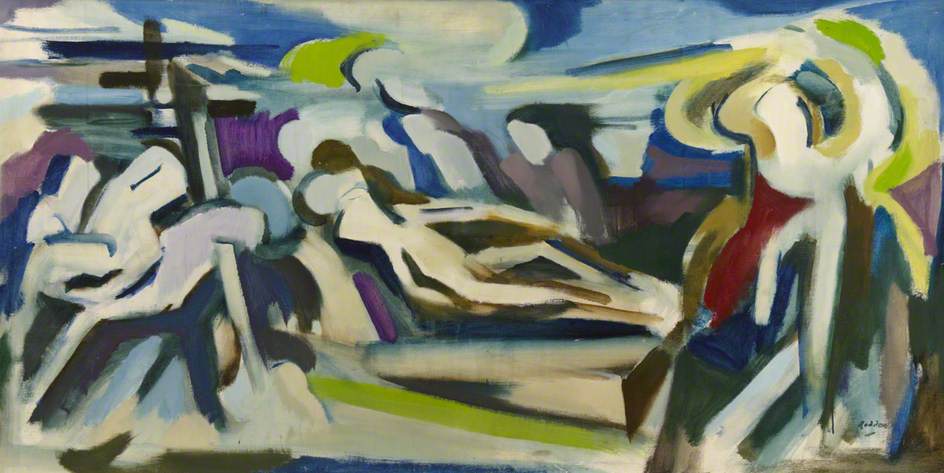
Death, Burial, and Resurrection of Christ by Guy Roddon (1919-2006)

So then, just as you received Christ Jesus as Lord, continue to live your lives in him, rooted and built up in him, strengthened in the faith as you were taught, and overflowing with thankfulness.

See to it that no one takes you captive through hollow and deceptive philosophy, which depends on human tradition and the elemental spiritual forces of this world rather than on Christ.

For in Christ all the fullness of the Deity lives in bodily form, and in Christ you have been brought to fullness. He is the head over every power and authority. In him you were also circumcised with a circumcision not performed by human hands. Your whole self, ruled by the flesh, was put off when you were circumcised by Christ, having been buried with him in baptism, in which you were also raised with him through your faith in the working of God, who raised him from the dead.

When you were dead in your sins and in the uncircumcision of your flesh, God made you alive with Christ. He forgave us all our sins, having canceled the charge of our legal indebtedness, which stood against us and condemned us; he has taken it away, nailing it to the cross. And having disarmed the powers and authorities, he made a public spectacle of them, triumphing over them by the cross. (New International Version)

I like kids. Since I believe them to be closer to God’s kingdom than most adults, I respect them by bending down to talk with them on their level. I take an interest in what they have to say and what’s going on with them. And I pay attention in ways that helps solidify their sense of worth, identity, and belonging. Indeed, how we treat children within the family, the church, and in public can make a significant difference in the trajectory of how they grow up and think of themselves.

One of the most fundamental of all Christian truths is that we belong to Christ. We are God’s children. God has given us everything we need for a solid awareness of our true identity. 

The follower of Jesus is a person who has moved from the realm of being in the world to the sphere of being in Christ. The Christian’s knowledge, understanding, and sense of identity are vitally important because we tend to live up to how we view ourselves.  

Today’s New Testament lesson is dense with the teaching of who we are in Christ. We are to live our lives in Christ. We are rooted and built up in Christ. We have been filled in Christ. We have a spiritual circumcision in Christ. We have been raised in Christ to new life. We are triumphant in Christ.  All this is meant to saturate us with the richness and security of being in the realm of Jesus Christ.

In Jesus Christ:

I am God’s child (John 1:12)

I have been justified (Romans 5:1)

I am Christ’s friend (John 15:15)

I belong to God (1 Corinthians 6:20)

I am a member of Christ’s Body (1 Corinthians 12:27)

I am assured all things work together for good (Romans 8:28)

I am confident that God will perfect the work begun in me (Philippians 1:6)

I am a citizen of heaven (Philippians 3:20)

I am hidden with Christ in God (Colossians 3:3)

I am brave, strong, and self-disciplined (2 Timothy 1:7)

I am born of God and the evil one cannot touch me (1 John 5:18)

I am blessed in the heavenly realms with every spiritual blessing (Ephesians 1:3)

I am chosen before the creation of the world (Ephesians 1:4, 11)

I am holy and blameless (Ephesians 1:4)

I am adopted as God’s child (Ephesians 1:5)

I am lavishly given God’s glorious grace (Ephesians 1:5,8)

I am redeemed (Ephesians 1:8)

I am forgiven (Ephesians 1:8; Colossians 1:14)

I am hopeful (Ephesians 1:12)

I am included (Ephesians 1:13)

I am sealed with the promised Holy Spirit (Ephesians 1:13)

I am a saint (Ephesians 1:18)

I am the salt and light of the earth (Matthew 5:13-14)

I am God’s coworker (2 Corinthians 6:1)

I am a minister of reconciliation (2 Corinthians 5:17-20)

I am alive with Christ (Ephesians 2:5)

I am raised up with Christ (Ephesians 2:6; Colossians 2:12)

I am seated with Christ in the heavenly realms (Ephesians 2:6)

I am rich with God’s grace (Ephesians 2:7)

I am a recipient of God’s kindness (Ephesians 2:7)

I am God’s workmanship (Ephesians 2:10)

I am close to God (Ephesians 2:13)

I am peaceful (Ephesians 2:14)

I am a member of God’s household (Ephesians 2:19)

I am secure (Ephesians 2:20)

I am a holy temple (Ephesians 2:21; 1 Corinthians 6:19)

I am a dwelling for the Holy Spirit (Ephesians 2:22)

I am a friend of God (Ephesians 3:6)

I am free and confident (Ephesians 3:12)

I am joyful in my sufferings (Ephesians 3:13)

I am loved and can love others (Ephesians 3:18)

I am called (Ephesians 4:1; 2 Timothy 1:9)

I am humble, gentle, patient, and tolerant of others (Ephesians 4:2)

I am truthful (Ephesians 4:17)

I am living a new life (Ephesians 4:21-32)

I am kind and compassionate to others (Ephesians 4:32)

I am forgiving of others (Ephesians 4:32)

I am good (Ephesians 5:8-9)

I am grateful (Ephesians 5:20)

I am secure (Ephesians 6:13)

I am dead to sin (Romans 1:12)

I am not alone (Hebrews 13:5)

I am growing (Colossians 2:7)

I am united with other believers (John 17:20-23)

I am victorious (I John 5:4)

I am chosen and dearly loved (Colossians 3:12)

I am blameless (I Corinthians 1:8)

I am more than a conqueror (Romans 8:37)

I am safe (I John 5:18)

I am healed (I Peter 2:24)

I am no longer condemned (Romans 8:1, 2)

I am not helpless (Philippians 4:13)

I am overcoming (I John 4:4)

I am persevering (Philippians 3:14)

I am protected (John 10:28)

I am born again (I Peter 1:23)

I am a new creation (2 Corinthians 5:17)

I am delivered (Colossians 1:13)

I am redeemed from the curse of the Law (Galatians 3:13)

I am qualified to share in Christ’s inheritance (Colossians 1:12)

I am victorious (1 Corinthians 15:57)

Take ten minutes today and focus on one of the phrases or words from these verses. Think about its meaning. Ponder how it makes a difference in your Christian life. Then decide what you will do with the insight God gives you. Finally, share it with a friend. In all these ways we can press the truth of our identity firmly into our souls and live into the reality that we belong to Christ.

Gracious God, you have brought me from death to life, from being of the world to being in Christ. Solidify my sense of identity with Jesus and release that self-knowledge into loving practice toward others. Amen.

Children of God, Loved by God

By Unknown artist

See what great love the Father has lavished on us, that we should be called children of God! And that is what we are! The reason the world does not know us is that it did not know him. Dear friends, now we are children of God, and what we will be has not yet been made known. But we know that when Christ appears, we shall be like him, for we shall see him as he is. All who have this hope in him purify themselves, just as he is pure.

Everyone who sins breaks the law; in fact, sin is lawlessness. But you know that he appeared so that he might take away our sins. And in him is no sin. No one who lives in him keeps on sinning. No one who continues to sin has either seen him or known him.

Dear children, do not let anyone lead you astray. The one who does what is right is righteous, just as he is righteous. (1 John 3:1-7, NIV)

True children of God, Christians, are loved by God – that is their status and identity. This cannot be changed any more than a tiger can change his stripes.

True children of God live, remain, abide, and continue in their identity as Christians. They know who they are and how they are to live.

Who We Are

When Jesus was on this earth, he was misunderstood by a lot of people. Christians must learn to expect the same. True children loved by God will neither fit in with the world nor seek the world’s affirmation and accolades. The practical difference between Christianity and the world is that Christians locate their primary identity, allegiance, and purpose in Christ, whereas the world finds their identity elsewhere.

Being loved by God brings assurance, peace, security, and hope. These qualities cannot be manufactured by us because they are results of being loved. The world cannot give us these characteristics. This does not mean that Christians always have it all together. We are continually in a process of discovering our identity and growing more and more into that uniqueness. The reason Jesus lived his life without needing the world’s recognition is that he was firmly and securely assured of the Father’s love and care for him. 

Christians continue to learn what it means to be loved by God in Christ. This love helps fortify our faith so that we will not find our identities in worldly roles, however intrinsically good those roles might be. For example, a parent with the primary identity as mother or father will view salvation as coming through the family. Or a person with the primary identity as teacher will see deliverance coming through education. 

When Christians have their primary identity as children of God, loved by God, then they see deliverance from guilt, shame, darkness, and oppression as coming through Jesus. When the church, living and serving together, secure in their identity as children of God, loved by God, then she can withstand any adulterous flirtations from the world to woo them away from Jesus.

We are children of God. We are not children of the world’s institutions, systems, organizations, ethos, mores, and values. Everyone who has hope in Christ is pure and holy. When we locate our primary identity in being loved by God, we avoid defiling ourselves with the world’s grime. We take regular spiritual baths which cleanse us from the world’s crud. We keep reminding ourselves and each other of our true status as God’s children. We do not allow any other identity to topple or replace our wonderful reality of being loved by God.

How we view ourselves will determine how we live our lives.

How We Are to Live

True children of God abide by the law because they abide in Christ. Jesus said all the law could be summed up in two commands: Love God. Love neighbor. Breaking the law means:

  • Hating instead of loving.
  • Working to undermine someone instead of seeking their best interests.
  • Excluding others instead of including others.
  • Dividing and opposing instead of unifying and cooperating. 

No one abiding in Christ continues the same trajectory they had before knowing Christ. Jesus came to take care of the sin issue once for all through the cross. Therefore, Christians, loved by God, cannot be lawbreakers if they are abiding; the two cannot co-exist with each other.

So, our primary task as Christians is to abide in Jesus and remain firmly in our identity as children of God, loved by God. We are to love by remaining in God’s love and allowing love to shape all our thoughts, words, and actions. We will continue to be steadfast in that love. We will not be led astray. We will abide in Christ.

Identity and life work together. For example, I am currently a citizen of the state of Wisconsin. I not only geographically live in Wisconsin, but I am to abide in the state as a responsible person. Being a Wisconsinite is different from the rest of the world. Wisconsinites are readily identifiable by their sports and their food.

Lambeau Field, home of the Green Bay Packers

Diehard Green Bay Packer fans forsake any identification as Lions, Bears, or the god-forsaken pagan Vikings. They like their prep and collegiate sports, flock to curling clubs, get married in bowling alleys, and observe time through the various hunting seasons. Citizens of Wisconsin like their food and drink. Nothing compares to the Friday night fish fry, cheese curds, venison, mustard – all washed down with either a Spotted Cow, Leinenkugel’s, or a trip to the bubbler.

We are to become more and more like Christ. Our identity as loved by God means we will seek to live in Christ by living a life of love. The people of Wisconsin have a general reputation of being polite and helpful, not rude and unhelpful. All their citizens should live into this identity and behavior. And as Christians whose primary identity is in being children of God, loved by God, we should abide in Christ through love and obedience. 

“I am the true vine, and my Father is the gardener. He cuts off every branch in me that bears no fruit, while every branch that does bear fruit, he prunes so that it will be even more fruitful. You are already clean because of the word I have spoken to you. Remain in me, as I also remain in you. No branch can bear fruit by itself; it must remain in the vine. Neither can you bear fruit unless you remain in me.

I am the vine; you are the branches. If you remain in me and I in you, you will bear much fruit; apart from me you can do nothing. If you do not remain in me, you are like a branch that is thrown away and withers; such branches are picked up, thrown into the fire and burned. If you remain in me and my words remain in you, ask whatever you wish, and it will be done for you. This is to my Father’s glory, that you bear much fruit, showing yourselves to be my disciples.

As the Father has loved me, so have I loved you. Now remain in my love. If you keep my commands, you will remain in my love, just as I have kept my Father’s commands and remain in his love. I have told you this so that my joy may be in you and that your joy may be complete. My command is this: Love each other as I have loved you. Greater love has no one than this: to lay down one’s life for one’s friends. You are my friends if you do what I command. I no longer call you servants because a servant does not know his master’s business. Instead, I have called you friends, for everything that I learned from my Father I have made known to you. You did not choose me, but I chose you and appointed you so that you might go and bear fruit—fruit that will last—and so that whatever you ask in my name the Father will give you. This is my command: Love each other.” (John 15:1-17, NIV)

Conclusion

A true Christian is a child of God, not the world. Our behavior flows from who we are. If our primary identity is securely in being a loved child of God, then what comes out of us will be loving words and actions, even to those in the world who might not believe or understand.

When we think about our world, it can be a sad place, devoid of love. People from different cultures and backgrounds often do not get along with each other. Political parties have difficulty finding common ground. Some Christians cannot seem to get along with other Christians. In the world, differences often divide us. Can people different from each other get along? 

The early church did. And they did it without all the stuff we have – sanctuaries, church buildings, programs. Those early believers did it through the message of the cross using the basic tool of love. Not every Christian will serve on the foreign mission field or serve in a professional ministry position. However, every Christian can be loving.

True children of God are loved by God. They are characterized by the Christian practices of hospitably loving the immigrant and stranger, loving their enemies, forgiving those who have sinned against them, and obeying God’s commands. These practices stem the tide of evil and hate in the world and usher in the love of God in Christ.

A Crippling Grace

Jacob Wrestling the Angel by Karen Laub-Novak
Jacob Wrestling the Angel by Karen Laub-Novak (1937-2009)

Confrontation and struggle were a way of life for me in my first solo pastorate.  In the first six weeks of being in the church I faced every kind of sin imaginable, to the point that my mentor in the faith recommended I take some time off. I had not even been there for two months!  Although that was a difficult time, the greatest struggle was with God himself and feeling like my prayers were doing nothing but bouncing off the ceiling.  In fact, I spent several years of my life in an extended wrestling match with God.  He touched me and crippled me by his grace, reminding me how much he is in control.  Since that time, I walk with a limp that is not visible – an invisible limp which reminds me I am a different person – one who knows Jesus better and is much more at peace with life.

If we do not wrestle with God in the stressful times of our lives, we will have difficulty discovering what genuine humility is, how much we need the Holy Spirit, and the grace that can be ours to face the rest of our lives.  Five hundred years ago Thomas à Kempis wrote to new priests entering ministry with this advice:

“We should so firmly establish ourselves in God that we have no need to seek much human encouragement.  It is when a man of good will is distressed or tempted, or afflicted with evil thoughts, that he best understands the overwhelming need he has for God, without whom he can do nothing.  While enduring these afflictions he takes himself to prayer with sighs and groans; he grows tired of this life and wishes to die so that he could be undone to live with Christ.  It is in such times of trial that he realizes that perfect security and full peace are not to be found in this world.”

The Old Testament patriarch, Jacob, was worried and stressed.  He knew he had deceived his brother Esau many years earlier to gain their father’s blessing.  Now Jacob is about to meet Esau after all these years, and he is downright afraid for himself and his large family.  So, he divided them up into two groups, thinking that if Esau were to attack, the other group could escape. The night before the big stressful meeting, Jacob sent his wives and family across a tributary of the Jordan River, the Jabbok, and spent the night alone wrestling with God. (Genesis 32:22-31)

God will put us in life-compromising positions to create divine encounters so that we will walk away changed.  Those events usually come in the form of engaging God with all the questions and difficulties of an incredibly stressful situation.  The inner change that occurs comes in the form of a new identity, a new limp, and a renewed understanding of God’s grace. A new confidence arises, convinced that through disability and weakness we are strong and able.

Jacob Wrestling with the Angel by Lippy Lipshitz
Jacob Wrestling with the Angel by Israel Isaac Lipshitz (1903-1980)

There is a good deal of symbolism happening in the story of Jacob wrestling with the angel of God.  First, take note that this Scripture story raises more questions than it answers, such as: Who was the man Jacob wrestled? Was he God, an angel, or someone else? Why have a wrestling match? What in the world is going on here?  The unanswered questions are symbolic of the reality that we do not and probably will not get the clarity we are looking for in our struggles with God.  Sometimes we might not even know it is God whom we are wrestling with.  It is quite possible where we see God estranged from us, he really has us in the grip of grace and will not let go.

Second, Jacob got up during the night, representing his dark night of the soul and struggle with the circumstance he must face.  Jacob was left alone with no one to deceive (his typical modus operandi) which is symbolic of his great need – he had no “tricks up his sleeve” and had nowhere to turn but to God.  Jacob was asked by his wrestling opponent what his name is. Jacob’s answer is a humble one, confessing who he really is (Jacob means “schemer” or “deceiver”).  Jacob asked for a blessing, which in itself is an act of humility because it is an honest profession that he lacks something necessary for life that he cannot provide on his own through any kind of ingenuity on his part.

Third, Jacob asked for God’s name – and got no answer to his question, no clarity, and no satisfaction.  This is deeply symbolic of the fact that God is mysterious, and we will not always get the answers to our questions we want.  God will not kowtow to our puny attempts at controlling him.  Jacob would not let the wrestling match end and held on, just like he grasped the heel of his brother Esau at their birth.  This is a symbolic reference to Jacob’s stubbornness which was redeemed and transformed into tenacity, rather than a manipulation of people to get what he wanted.

Fourth, God renamed Jacob, “Israel.”  Jacob is now distinguished from the old deceiver with a new identity.  Israel literally means “God fights” which is a reference of hope for Jacob’s descendants.  That Jacob struggled with God and was able to walk away from it is not really a statement of physical victory so much as a reference to Jacob’s having overcome his constant fear and need for control which prompted his continual trickery.

Jacob Wrestles the Angel by Christina Mattison Ebert

Fifth, Jacob’s limp is a permanent sign of God’s grace to Jacob. God is with him and his descendants.  Jacob is a different person having encountered God, and the limp is a continual reminder God changed his life forever – Jacob will never be the same after this.  Ironically, the limp made Jacob stronger, not weaker.  From this point forward in Jacob’s life, he is mindful of his limitations and that God is the One who will arise to fight, protect, and carry on the covenant promises.  There is no longer any need or even desire to scheme to accomplish anything.

It will be difficult to find grace apart from wrestling with God in the painful situations of life.  It is in such times we must be crippled by grace.  We need to be willing to fight with God. It is necessary to get in the match and struggle with God rather than worry within ourselves or just pretend everything is okay so that we will avoid the hard contest in front of us.

Has God left a permanent mark on you?  Do you carry a limp from him?  What is your name?  How does God identify you?  Our great need is not in being clever, smart, or working harder; it is God’s grace that we all need.  As a kid, when my parents left the house, my brother and I would rearrange the furniture so that we could have a good-solid-knock-down-drag-out wrestling match.  Since my brother was older, it usually ended badly for me with a pile-driver that left me incapacitated.  It is seriously a miracle that I am still alive after being dropped on my head so many times.

Whenever Christians approach the Lord’s Table, we are reminded of the Son who wrestled with the Father in prayer in the garden of Gethsemane and came away confident of facing a cruel cross so that we might have life.  The Lord Jesus carries with him even now the reminders of his suffering – the marks on his hands and his feet from a crucifixion that accomplished deliverance from sin on our behalf.  The elements of bread and cup are deeply symbolic reminders of what Jesus did as the cost for our salvation.  And they are further reminders that just as we eat this bread and drink this cup we will drink again with Jesus at the end of the age.  It is faith in Jesus alone that creates and secures for us a transformed life so that we can share in a crippling grace from him forever.