I Am Responsible and Accountable (Ezekiel 18:1-32)

The word of the Lord came to me: “What do you people mean by quoting this proverb about the land of Israel:

“‘The parents eat sour grapes,
    and the children’s teeth are set on edge’?

“As surely as I live, declares the Sovereign Lord, you will no longer quote this proverb in Israel. For everyone belongs to me, the parent as well as the child—both alike belong to me. The one who sins is the one who will die.

“Suppose there is a righteous man
    who does what is just and right.
He does not eat at the mountain shrines
    or look to the idols of Israel.
He does not defile his neighbor’s wife
    or have sexual relations with a woman during her period.
He does not oppress anyone,
    but returns what he took in pledge for a loan.
He does not commit robbery
    but gives his food to the hungry
    and provides clothing for the naked.
He does not lend to them at interest
    or take a profit from them.
He withholds his hand from doing wrong
    and judges fairly between two parties.
He follows my decrees
    and faithfully keeps my laws.
That man is righteous;
    he will surely live,
declares the Sovereign Lord.

“Suppose he has a violent son, who sheds blood or does any of these other things (though the father has done none of them):

“He eats at the mountain shrines.
He defiles his neighbor’s wife.
He oppresses the poor and needy.
He commits robbery.
He does not return what he took in pledge.
He looks to the idols.
He does detestable things.
He lends at interest and takes a profit.

Will such a man live? He will not! Because he has done all these detestable things, he is to be put to death; his blood will be on his own head.

“But suppose this son has a son who sees all the sins his father commits, and though he sees them, he does not do such things:

“He does not eat at the mountain shrines
    or look to the idols of Israel.
He does not defile his neighbor’s wife.
He does not oppress anyone
    or require a pledge for a loan.
He does not commit robbery
    but gives his food to the hungry
    and provides clothing for the naked.
He withholds his hand from mistreating the poor
    and takes no interest or profit from them.
He keeps my laws and follows my decrees.

He will not die for his father’s sin; he will surely live. But his father will die for his own sin, because he practiced extortion, robbed his brother and did what was wrong among his people.

“Yet you ask, ‘Why does the son not share the guilt of his father?’ Since the son has done what is just and right and has been careful to keep all my decrees, he will surely live. The one who sins is the one who will die. The child will not share the guilt of the parent, nor will the parent share the guilt of the child. The righteousness of the righteous will be credited to them, and the wickedness of the wicked will be charged against them.

“But if a wicked person turns away from all the sins they have committed and keeps all my decrees and does what is just and right, that person will surely live; they will not die. None of the offenses they have committed will be remembered against them. Because of the righteous things they have done, they will live. Do I take any pleasure in the death of the wicked? declares the Sovereign Lord. Rather, am I not pleased when they turn from their ways and live?

“But if a righteous person turns from their righteousness and commits sin and does the same detestable things the wicked person does, will they live? None of the righteous things that person has done will be remembered. Because of the unfaithfulness they are guilty of and because of the sins they have committed, they will die.

“Yet you say, ‘The way of the Lord is not just.’ Hear, you Israelites: Is my way unjust? Is it not your ways that are unjust? If a righteous person turns from their righteousness and commits sin, they will die for it; because of the sin they have committed they will die. But if a wicked person turns away from the wickedness they have committed and does what is just, and right, they will save their life. Because they consider all the offenses they have committed and turn away from them, that person will surely live; they will not die. Yet the Israelites say, ‘The way of the Lord is not just.’ Are my ways unjust, people of Israel? Is it not your ways that are unjust?

“Therefore, you Israelites, I will judge each of you according to your own ways, declares the Sovereign Lord. Repent! Turn away from all your offenses; then sin will not be your downfall. Rid yourselves of all the offenses you have committed, and get a new heart and a new spirit. Why will you die, people of Israel? For I take no pleasure in the death of anyone, declares the Sovereign Lord. Repent and live! (New International Version)

Every single one of us is accountable to one another for what we say and how we conduct ourselves. Above all, we are accountable to God for our motives, words, and actions in this life.

The flipside to stating that we are accountable, is saying that none of us are responsible for another person’s intentions, words, or actions.

Other people may influence us. We may be either participants in or victims of another’s actions. Some folks might take credit for something another person said or did. Yet, ultimately, we are responsible for our own life.

Whatever I think, say, or do is on me, period.

What’s more, one’s past actions do not replace our current actions. The prophet Ezekiel emphasized individual responsibility and accountability. All of the other Old Testament prophets addressed whole nations, and not individuals. They denounced the social, economic, and political systems and institutions, upholding communal ideals of justice.

Ezekiel communicated that children shall not be punished for their parent’s sins. Only the person who sins will face judgment.

A person ought only to pay for their own sins; punishment should not carry forward to future generations. The prophet also insisted that each individual person has the opportunity to change their behavior, and so, avoid their deserved penalty.

Every individual has the opportunity to change their personal ways of injustice or unrighteousness. For those who refuse, there is a and right and just Judge who knows how to dispense what is needed for each person – whether it is judgment to the arrogant, comfort to a victim, or justice for the underprivileged.

God cares that every person on earth receives what they need to thrive and flourish in this life. And to those who don’t give a wit about others, the Lord gives an opportunity to turn from arrogance and change.

Refusing to change, however, will end badly for the stubborn person.

The prophet Ezekiel calls on individuals to speak and act in ways that are helpful, not harmful. And whenever one harms another, that one must acknowledge the irresponsibility, because I am held accountable for what I say and do.

All words and actions come with consequences. It would do us a lot of good to consider how what we say and do (or fail to say and do) impacts the next generation of people. Everyone leaves a legacy of some sort – whether good or bad – so we need to be aware of how we live.

Each person must take up the mantle to do good, not evil; and to live righteously, not wickedly. Living selfishly with impunity leads to divine judgment. Yet, mercy is always there, if we seek to amend our ways.

Conversely, living righteously, and then resting on my laurels and living however I want, does not inoculate me from divine judgment.

You and I must live one day at a time, trusting God and seeking the welfare of others. And when I mess up, I am to keep a short account with God by admitting my fault and receiving grace.

We humans have quite enough responsibility in our lives without taking on the extra job of exacting judgment on another person. If we live a righteous life to begin with, then there is no need for a new heart and life.

Yet, if I need it, a new existence is there, through a change of direction which humility grants us.

Almighty God, help me to prioritize your values, and put my faith into action. Enable me to use the talents, resources, and time with which I have been blessed. Empower me to serve my community and my world. May I serve you always, and pray with a joyful spirit. Amen.

God Will Give a New Heart (Ezekiel 36:24-28)

I will take you from every nation and country and bring you back to your own land. I will sprinkle clean water on you and make you clean from all your idols and everything else that has defiled you. I will give you a new heart and a new mind. I will take away your stubborn heart of stone and give you an obedient heart. I will put my spirit in you and will see to it that you follow my laws and keep all the commands I have given you. Then you will live in the land I gave your ancestors. You will be my people, and I will be your God. (Good News Translation)

As a hospital chaplain who has spent a great deal of time on cardiac care units, I have had several occasions to follow patients through the process of a heart transplant. I sat with them as they wondered if they would ever get a new one, because their own heart could no longer sustain the rest of their life. Would they die before receiving one? What would happen to their families?

Then, finally the day came for many (unfortunately, not all); there is a heart for them! After the incredible transplant surgery, joy abounds, knowing there is a new lease on life, a fresh experience. Through weeks or months of waiting and flirting with the Grim Reaper of death, hope is realized. Their old useless heart now replaced with a vibrant one, full of life!

However, the process is not yet over. Typically, about two or three days into possessing this new heart, a new realization comes along with it: Someone else had to die so that I could live….

He personally carried our sins
    in his body on the cross
so that we can be dead to sin
    and live for what is right.
By his wounds
    you are healed. (1 Peter 2:24, NLT)

God will…

Life comes from death. Resurrection can only happen when there is a crucifixion. Gaining a new spiritual heart has been achieved at the greatest of costs. “I will” is uttered nine times by God in five verses of Ezekiel’s prophecy. In gracious acts of determination to restore fallen people, God makes promises and has the authority and power to back them up.

Our new heart is waiting to be animated by God’s Spirit so that our observance of God’s law is infused with divine might. Our consent to surgery is all that is needed. Consider just a few of the great “I will” statements of Holy Scripture:

I will instruct you and teach you in the way you should go; I will counsel you with my loving eye on you.” (Psalm 32:8, NIV)

“If someone trusts me, I will save them.
    I will protect my followers who call to me for help.
When my followers call to me, I will answer them.
    I will be with them when they are in trouble.
    I will rescue them and honor them.
I will give my followers a long life
    and show them my power to save.” (Psalm 91:14-16, ERV)

I will strengthen you; I will help you; I will uphold you with my victorious right hand.” (Isaiah 41:10, NRSV)

“Call to me and I will answer you and tell you great and unsearchable things you do not know.” (Jeremiah 33:3, NIV)

I will never leave you nor forsake you.” (Hebrews 13:5, NKJV)

The emphasis in today’s Old Testament lesson is on God’s role, not ours. The prophet Ezekiel’s hope is not in the faithfulness of the people in following some new set of rules. Instead, God is their hope. God will save them by gathering, cleansing, and giving Israel a new heart, mind, and spirit to obey God’s words.

God will gather

Those in diaspora, scattered far and abroad in exile, will be gathered back from the nations and into their own land. God will reverse the experience of dispersion by reassembling the people.

He will raise a banner for the nations
    and gather the exiles of Israel;
he will assemble the scattered people of Judah
    from the four quarters of the earth. (Isaiah 11:12, NIV)

God will cleanse

God will purify the people, cleansing them from their rebellion and defilement. Since the people’s exile was a punishment for their corruption, they were therefore in need of purification.

I will cleanse them from all the sin they have committed against me and will forgive all their sins of rebellion against me. (Jeremiah 33:8, NIV)

God will give

Specifically, God does the seemingly impossible: gives a new heart. The people’s old sinful stubbornness is replaced wholesale with fresh desires for justice and righteousness. They will think and act differently because of this gracious newness.

Much like the real physical heart that can barely function any longer, the people’s collective heart was nearly dead, and as unresponsive as a stone. They needed a transplant, so that they could come alive again to God’s moral law and benevolent rule in the world.

“This is the covenant I will make with the people of Israel
    after that time,” declares the Lord.
“I will put my law in their minds
    and write it on their hearts.
I will be their God,
    and they will be my people.” (Jeremiah 31:33, NIV)

Despite all the threats of judgment throughout the long prophecy of Ezekiel, and all the distressing experiences of the people’s exile, God still desired to be their God. The Lord wants a relationship with people, and will do what it takes to restore it when it becomes broken and damaged. Indeed the Lord is a God of restoration.  

May Christ make his home in your heart as you trust in him.

May your spiritual roots grow down deep into God’s love and keep you strong.

May you have the power to grasp, along with all God’s people, how wide, how long, how high, and how deep is the love of God.

May you experience the love of Christ, though it is too great to understand fully.

May you be made complete with all the fullness of life and power that comes from God.

May your new heart pump with the grace of Jesus Christ, the love of God, and the encouragement of the Spirit. Amen.

A New Covenant (Jeremiah 31:31-34)

The Lord says, “The time is coming when I will make a new covenant with the people of Israel and with the people of Judah. It will not be like the old covenant that I made with their ancestors when I took them by the hand and led them out of Egypt. Although I was like a husband to them, they did not keep that covenant. The new covenant that I will make with the people of Israel will be this:

I will put my law within them and write it on their hearts. I will be their God, and they will be my people. None of them will have to teach a neighbor to know the Lord, because all will know me, from the least to the greatest. I will forgive their sins and I will no longer remember their wrongs. I, the Lord, have spoken.” (Good News Translation)

It’s important to pass on the faith to future generations of believers. The key to embracing a life of faith is obeying God’s commands and decrees.

Yet, both within the Old Testament and within our own contemporary religious milieu, God’s people persist in going through significant times of unfaithfulness, infidelity, and disobedience.., Oftentimes, people cannot seem to keep their eyes off the glittering gods that surround them, as if they had some sort of spiritual A.D.H.D.

Also persistent is the God who possesses a faithful remnant of people devoted to observing the covenant and living into the divine promises given to them. Yet, the kingdom of Judah in the prophet Jeremiah’s day, floundered in their commitments and broke faith with the teaching provided for them.

Since God’s grace has the last word, the sins and shortcomings of backslidden people who failed to pass on the covenant teachings to their progeny will have a better ending than that of divine judgment. God’s answer to repeated human failings is to establish a new covenant, unprecedented in its audacious mercy.

Rather than rewriting commands on stone tablets (as with Moses on Mount Sinai) and having a remedial class on the divine covenant and promises for the people, God will instead do the extraordinary, by writing the law on human hearts. That way, people will know the Lord in a direct and immediate way.

And on top of that, it will be for everybody; it won’t only be for the remnant, nor for just the spiritual elite. From the least to the greatest, from young to old, even from Jew to Gentile, God will forgive sins and shortcoming, guilt and shame, once and for all with the new covenant.

If that’s not the most gracious act ever decreed, I’m not sure what is. This is a radical move of spiritual amnesty. It’s completely undeserved. And it’s definitely not something any other god from any other nation would ever do. It’s unthinkable – completely off everyone’s radar. Yet, that is exactly what grace does. Grace provides a way where there seems to be none.

From a New Testament (New Covenant) perspective, Jesus is the fulfillment of all God’s good covenant promises to the people. Furthermore, God’s Holy Spirit serves as the continuing presence of Jesus within us, teaching us and guiding us in the ways of God. 

Our only task, then, is to live into those promises – to know them, claim them, and bank on them. We are most obedient when we believe the promises of God and throw all our hope in them.

The implications of the divine decree of a new covenant are enormous. It means:

  • I cannot do a darn thing to earn God’s acceptance, because I already have it! (John 6:37; Colossians 1:21-22; Romans 8:33-39, 15:7-12)
  • I don’t need to be afraid of judgment because Jesus has already taken care of the sin issue, once for all! (Romans 6:5-10; Hebrews 7:27-28, 10:5-10; 1 John 4:17-18)
  • I lack nothing, because God has already given me everything I need for life and godliness in this present evil age! (Philippians 4:19; 2 Peter 1:3-4)
  • I can know God, right now, without jumping through spiritual hoops or over imposed hurdles, because Jesus leveled the way and made it clear! (John 14:6; Ephesians 2:8-9; Hebrews 2:9-18)
  • I can enjoy forgiveness and a clean heart because God has decreed it to be so! (Psalm 103:8-12; Ezekiel 36:25-27; Luke 22:20; Hebrews 8:7-13, 10:14-18)

If this were not enough, Jesus has sent the Spirit to be with us forever, to guide us and lead us into realizing the law written on our hearts. We are never alone. God is with us.

Jesus said, “The Companion, the Holy Spirit, whom the Father sends, will teach you everything and will remind you of everything I told you. Peace I leave with you. My peace I give you. I give to you not as the world gives. Do not be troubled or afraid.” (John 14:26-27, CEB)

In this world of trepidation, fear, uncertainty, and unrest, there is peace, grace, and love because the Father, Son, and Spirit, the one true God, the Blessed Holy Trinity, the Divine Warrior who fights our battles, the Lord of Hosts, has our backs. Yes, this God, and no other god, has the chutzpah to make promises to us and the power to back them up.

Our Father in heaven,
Reveal who you are.
Set the world right;
Do what’s best—as above, so below.
Keep us alive with three square meals.
Keep us forgiven with you and forgiving others.
Keep us safe from ourselves and the Devil.
You’re in charge!
You can do anything you want!
You’re ablaze in beauty!
Yes! Yes! Amen!

Jesus Shows Up (John 20:19-31)

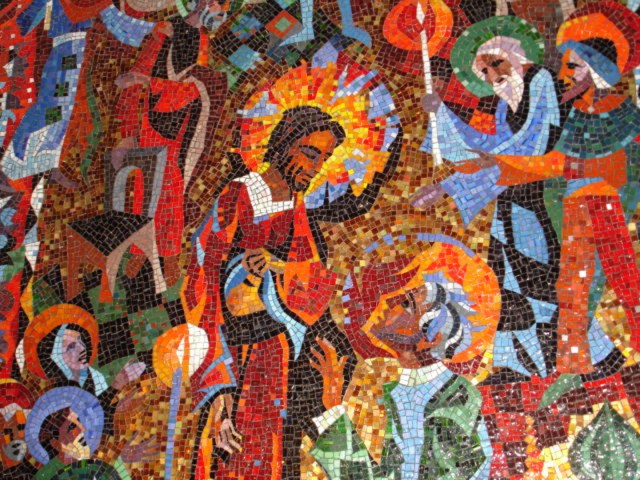
Jesus shows himself to Thomas, by Rowan and Irene LeCompte

On the evening of that first day of the week, when the disciples were together, with the doors locked for fear of the Jewish leaders, Jesus came and stood among them and said, “Peace be with you!” After he said this, he showed them his hands and side. The disciples were overjoyed when they saw the Lord.

Again Jesus said, “Peace be with you! As the Father has sent me, I am sending you.” And with that he breathed on them and said, “Receive the Holy Spirit. If you forgive anyone’s sins, their sins are forgiven; if you do not forgive them, they are not forgiven.”

Now Thomas (also known as Didymus), one of the Twelve, was not with the disciples when Jesus came. So the other disciples told him, “We have seen the Lord!”

But he said to them, “Unless I see the nail marks in his hands and put my finger where the nails were, and put my hand into his side, I will not believe.”

A week later his disciples were in the house again, and Thomas was with them. Though the doors were locked, Jesus came and stood among them and said, “Peace be with you!” Then he said to Thomas, “Put your finger here; see my hands. Reach out your hand and put it into my side. Stop doubting and believe.”

Thomas said to him, “My Lord and my God!”

Then Jesus told him, “Because you have seen me, you have believed; blessed are those who have not seen and yet have believed.”

Jesus performed many other signs in the presence of his disciples, which are not recorded in this book. But these are written that you may believe that Jesus is the Messiah, the Son of God, and that by believing you may have life in his name. (New International Version)

When Jesus shows up, there is peace. Wherever Jesus goes, the Spirit of God is there. When Jesus appears, people believe.

The Meeting

After the crucifixion of Christ, the disciples were huddled together, mostly in fear of being found out and put out by the religious authorities. Out of nowhere, Jesus showed up, smack in the middle of the anxious group of men.

Christ in the center makes all the difference. From this central place, Jesus bestowed to the disciples his peace. The very first word the risen Christ spoke to his disciples was neither a command to stop being afraid, nor a rebuke for sitting around and doing nothing, or disappointment that they all ran away in the final hour of need at the crucifixion; instead, the first word of Christ was a gift of peace.

The presence and peace of Christ melted the disciples’ fear. Christ-centered peace is graciously given; so let us gratefully receive it.

The Reality

Jesus showed up, then showed off his hands and his side. He was not fabricated out of the disciples’ imagination; he was not some ghostly apparition. Rather, Christ was standing in the middle of them, very real, very physical, and very alive.

Christ gave his disciples real truth: actual wounded hands and side on a real body. Christ is risen and alive – not just spiritually, but physically. Since the resurrection of Jesus really happened, then nothing else matters; our joy is complete. We have what we need.

The Mission

As Jesus was sent by the Father, so Jesus sent his disciples; and is still sending us out into the world. And as Jesus came not to condemn the world but to save it, so we go out with words of grace and peace. The church exists for the life of the world – to bless it with the presence and peace of Christ.

“Whoever believes in me does not believe in me only, but in the one who sent me. The one who looks at me is seeing the one who sent me. I have come into the world as a light, so that no one who believes in me should stay in darkness.” (John 12:44-46, NIV)

Our spiritual DNA makes us little Christ’s walking around, doing the will of God, for the benefit of a world in darkness. We bear the name of Christ: Christians, proclaiming a message of life, delighting in God and creation; and not destroying the earth and its inhabitants.

The Gift

Right now, we are not alone. The Holy Spirit has been graciously given to us by Jesus. Although our mission is a big one, our resource for accomplishing it is even bigger. Jesus gives the Spirit in the same way he gives himself – as a sheer gift with no strings attached. Just as God breathed life into the very first people on earth, so Jesus breathes on the disciples and gives them new life and a new heart.

I will give you a new heart and put a new spirit in you; I will remove from you your heart of stone and give you a heart of flesh. And I will put my Spirit in you and move you to follow my decrees and be careful to keep my laws… and you will be my people, and I will be your God. (Ezekiel 36:26-28, NIV)

The Privilege

Christ has redeemed us, forgave us of our guilt and shame. Now, we have the privilege of passing the forgiveness to others. The special mission of the Church is giving Jesus to others with grace and peace, so that they may believe he is truly the risen Lord; and so, receive Jesus, the Spirit, forgiveness, and purpose in life, with Christ at the center of all things.

For the one whom God has sent speaks the words of God, for God gives the Spirit without limit. The Father loves the Son and has placed everything in his hands. Whoever believes in the Son has eternal life, but whoever rejects the Son will not see life, for God’s wrath remains on them.” (John 3:34-36, NIV)

The Risen Lord, by He Qi

The Appearance

When Jesus appears, its good if we also show up to see him. It seems Thomas was late for church and missed the beginning of the service. He wasn’t with the other gathered disciples. Nobody knows where he was or what he was doing. But the important thing is that he did eventually show up, because showing up is the beginning of a changed life.

The Witness

After Jesus showed up, the disciples bore witness to what they saw and heard to Thomas. Yet Thomas, bless his doubting heart, wasn’t having it. He’s a realist. He wants proof, some actual physical evidence. Thomas was clearly a tactile learner because he needs some touch to believe any of this crazy talk of his disciple brothers.

Sometimes Thomas gets a bad rap, but he is really our Everyman. Doubt and skepticism are an important part of a full-orbed and honest faith. Jesus gave Thomas some space, time, and respect to begin wrapping his head and heart around this new reality of resurrection. I wonder if we all can do the same with others.

The Middle

A second time, Jesus shows up in the middle of the disciples. The Word became flesh and dwelt among us – and didn’t become a ghost and hang out in secret places. Once again, peace is given by Jesus to his followers.

Both appearances happen on a Sunday (which is why Christians have always worshiped on Sundays); and both meetings are literally Christ-centered (which every Christian meeting is supposed to be). Every Sunday. Christ always in the middle. Keep those two, and keep them together, and you can’t go wrong.

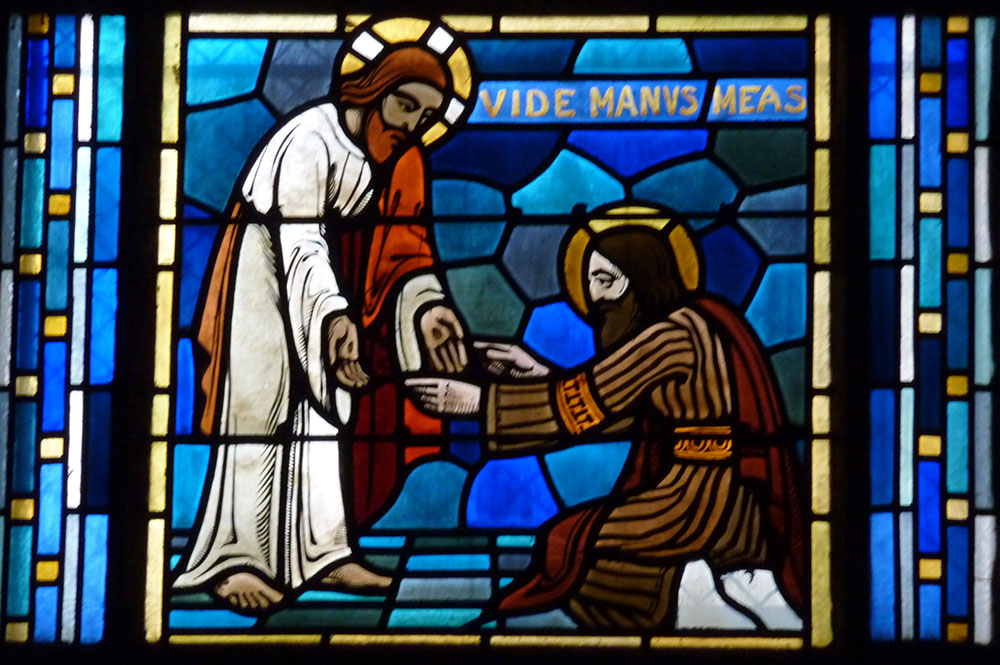
Jesus appears to Thomas with the Latin words, “See my hands,” in Notre-Dame-du-Rosaire Church, Saint-Ouen, France 

The Invitation

There’s no beating around the bush with Jesus. He immediately engaged Thomas and invited him to touch the wounds on his very real body. Christ knew Thomas’ hang-up, and went right to it. Thomas wanted evidence; Jesus offered it. If we get anything out of this encounter, it is that risen Christ honors honest doubt.

The evidence is here. Now believe it, and stop disbelieving. We have documentary evidence of the Old and New Testaments; the Church’s witness in Creeds, Confessions, and contemporary narratives of changed lives; and the internal testimony of the Holy Spirit. Therefore, look into them carefully and draw a sound conclusion.

The Confession

“My Lord and my God!” That’s the confession and the conclusion Thomas drew from the evidence – not only that Jesus is real, alive, existed, a good teacher; or other people’s Lord and God – but that he is my Lord and my God.

Jesus cared enough for Thomas to specifically meet him personally at his point of need. The grace of God keeps coming and never runs out. Jesus is filled up to the full in both grace and truth.

The Believer

Thomas had the physical evidence. But it doesn’t take that to truly believe. God blesses those who’ve never seen nor touched, but still believe. Jesus was thinking of you and me, and not only the people in front of him at the time. The Lord Jesus blesses us with the gift of peace, grace, and faith.

Though you have not seen him, you love him; and even though you do not see him now, you believe in him and are filled with an inexpressible and glorious joy, for you are receiving the end result of your faith, the salvation of your souls. (1 Peter 1:8-9, NIV)

The Conclusion

All this is for our benefit, so that we, too, may believe that Jesus is the Christ, the Son of the living God. Since Jesus is alive, he continues to bless us with his presence, power, and peace.

Jesus is with us:

  • through the Word of God, giving us his peace, showing up and meeting needs people.
  • at the Table in the sacrament of communion, bringing grace and forgiveness
  • in the person of the Holy Spirit, enabling and energizing us for mission and ministry to the world

It’s a life worth living, a Christ-centered life, full of God’s blessing.

O God and Father of our Lord Jesus Christ, in whom we receive the legacy of a living hope, born again not only from his death but also from his resurrection. May we who have received forgiveness of sins, set others free, until we enter the inheritance that is imperishable and unfading, where Christ lives and reigns with you and the Holy Spirit, one God, now and forever. Amen.