Visible Signs of Invisible Realities (Hebrews 9:15-24)

For this reason Christ is the mediator of a new covenant, that those who are called may receive the promised eternal inheritance—now that he has died as a ransom to set them free from the sins committed under the first covenant.

In the case of a will, it is necessary to prove the death of the one who made it, because a will is in force only when somebody has died; it never takes effect while the one who made it is living. This is why even the first covenant was not put into effect without blood. When Moses had proclaimed every command of the law to all the people, he took the blood of calves, together with water, scarlet wool and branches of hyssop, and sprinkled the scroll and all the people. He said, “This is the blood of the covenant, which God has commanded you to keep.” In the same way, he sprinkled with the blood both the tabernacle and everything used in its ceremonies. In fact, the law requires that nearly everything be cleansed with blood, and without the shedding of blood there is no forgiveness.

It was necessary, then, for the copies of the heavenly things to be purified with these sacrifices, but the heavenly things themselves with better sacrifices than these. For Christ did not enter a sanctuary made with human hands that was only a copy of the true one; he entered heaven itself, now to appear for us in God’s presence. (Hebrews 9:15-24)

The Hebrew Christians were tired. They had faced adverse circumstances, unjust imprisonments, persecution, prejudice, confiscation of their property, and public ridicule.

Most of all, they encountered rejection from their Jewish families of origin. There was precious little support for them, outside of their group.

The suffering went on long enough that the Christians began to experience a weakening of faith. In their distress, they started considering whether to return to Judaism, and renege on their commitment to Christ.

The author of Hebrews saw the struggle and spoke up, encouraging and exhorting the believers to keep going, to exercise faith and perseverance in the face of their ongoing troubles.

The author’s overall message to the discouraged believers was that Jesus Christ is superior over everything and everyone. Christ is better than the angels, Moses, and Aaron. Jesus is the ultimate high priest who offered himself as a sacrifice, once for all.

By means of the cross, Jesus became the mediator of a new and better covenant. There is, therefore, no more need of another high priest. Christ now occupies that office permanently.
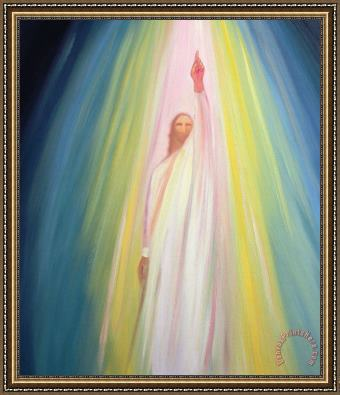
Jesus Christ Points us to God, by Elizabeth Wang

Christ’s death was efficacious for all. The sacrificial system with all of the officiating Levitical priests was the old order of things, meant to point us to Christ.

Offering sacrifices day after day, and engaging in prescribed liturgical rituals in order to access God, are no longer necessary. Perpetual anxiety exists wherever people keep wondering if they have done enough to satisfy their guilt and/or responsibility.

The answer of Christianity is yes, the work is finished; Jesus completed it, once and for all.

There is no longer anything that can distress us. Sin, death, and hell have been conquered through the death of Christ. His singular sacrifice has achieved victory over the sinful powers, and reconciliation and peace with God.

Blessed is the one
    whose sin the Lord does not count against them
    and in whose spirit is no deceit. (Psalm 32:2, NIV)

The covenant code’s sacrificial system was never designed to be a permanent way of doing things. All of the implements used in that system were symbols pointing to the real deal. They were a temporary means of leading people to Christ, who is the once for all sacrifice to end all sacrifices, the one who truly takes away our guilt and shame forever.

The picture is of Christ, as our high priest, who sprinkled us with his own blood and made us clean – not only today or for some temporary period of time – but for all time. We are not only made clean; we are made clean forever by the blood of Christ.

Cleanse me with hyssop, and I will be clean;
    wash me, and I will be whiter than snow. (Psalm 51:7, NIV)

The historical person of Jesus – his life, ministry, crucifixion, death, resurrection, ascension and glorification – was a visible image showing us the great importance of invisible realities.

The Ark of the Covenant was a visible sign of God’s invisible presence, and the need for a restoration of the divine/human connection.

The temple, the worship implements, and the whole sacrificial system was a visible sign of God’s invisible holiness, and the need for purity of heart amongst the people.

Jesus was a real person with a real body and real human needs, a visible reality which showed us the invisible God, and what God truly deems as right and good.

It is Jesus Christ, the Son of God and Son of Humanity, in whom we have redemption the forgiveness of sins. He is the image of the invisible God. (Colossians 1:14-15)

Christ is our Mediator, bridging the gap between heaven and earth.

Christ is our Savior, delivering us from our guilt and shame, our worry and anxiety, and our old enemy, death itself.

Christ is our Advocate, stepping in and acting on our behalf, and sending the Holy Spirit to be his continuing presence on this earth.

Christ is our champion, the pioneer of our salvation, securing redemption for us through his singular death.

Christ is our Intercessor, who even now lives to intercede for us, as we strive and struggle to live in humility, justice, and righteousness, as peacemakers in this world.

What this all means, from the vantage of Christianity, is that we need Jesus.

Without Christ, there is no hope. With Christ, all things are possible.

Jesus is the answer to every question, because Jesus is the center of all things. He is the fertile soil from which all of life sprouts; the first-fruit which provides life; and the continuing sustenance which saves us from a disconnected, fragmented, discouraging existence.

Along with the ancient Hebrew Christians, let us be encouraged with Christ, who is truly our everything.

Accept, O Lord, our thanks and praise for all that you have done for us. We thank you for the disappointments and failures that lead us to acknowledge our dependence on you alone.

Above all, we thank you for your Son Jesus Christ; for the truth of his Word, and the example of his life; for his steadfast obedience, by which he overcame temptation; for his dying, through which he overcame death; and for his rising to life again, in which we are raised to the life of your kingdom.

Grant us the gift of your Spirit; that we may know you and make you known; and through your Spirit, at all times and in all places, may give thanks to you in all things. Amen.

It’s In the Details (Exodus 28:29-38)

Aaron the High Priest

“Whenever Aaron enters the Holy Place, he will bear the names of the sons of Israel over his heart on the breast-piece of decision as a continuing memorial before the Lord. Also put the Urim and the Thummim in the breast-piece, so they may be over Aaron’s heart whenever he enters the presence of the Lord. Thus Aaron will always bear the means of making decisions for the Israelites over his heart before the Lord.

“Make the robe of the ephod entirely of blue cloth, with an opening for the head in its center. There shall be a woven edge like a collar around this opening, so that it will not tear. Make pomegranates of blue, purple and scarlet yarn around the hem of the robe, with gold bells between them. The gold bells and the pomegranates are to alternate around the hem of the robe. Aaron must wear it when he ministers. The sound of the bells will be heard when he enters the Holy Place before the Lord and when he comes out, so that he will not die.

“Make a plate of pure gold and engrave on it as on a seal: holy to the Lord. Fasten a blue cord to it to attach it to the turban; it is to be on the front of the turban. It will be on Aaron’s forehead, and he will bear the guilt involved in the sacred gifts the Israelites consecrate, whatever their gifts may be. It will be on Aaron’s forehead continually so that they will be acceptable to the Lord. (New International Version)

This area of Holy Scripture is likely not one of the more popular places to read. Frankly, it’s boring and pedantic. Yet, contained within the Bible it is, for us to examine.

After giving Moses the Ten Commandments in Exodus 20, the next several chapters, from Exodus 20-31 contain detailed instructions from God concerning the covenant code stipulations with the Israelites. Plans for liturgical and sacrificial worship are covered with a fine tooth comb. Instructions for building implements for worship are precise.

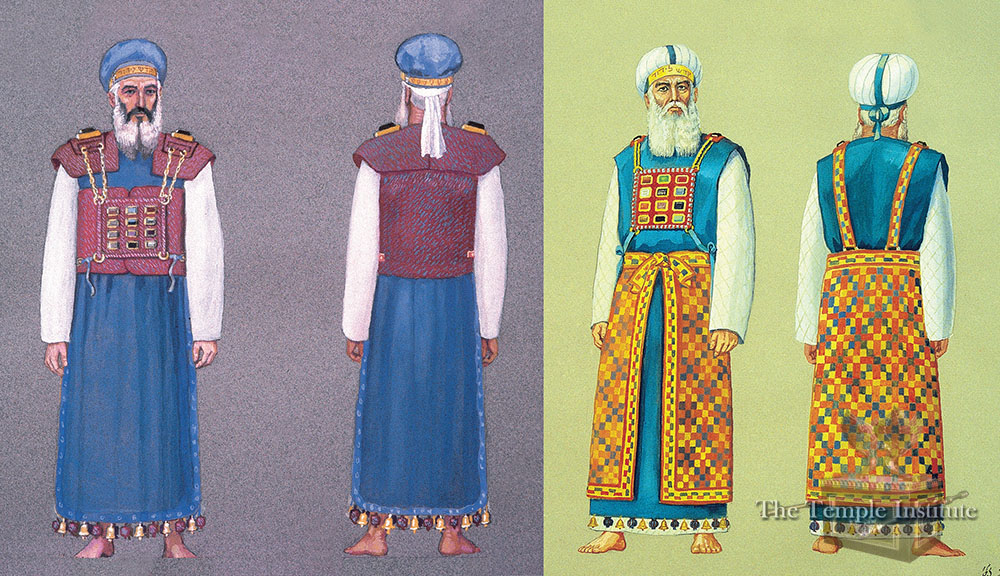
And the special garments of the priests’ clothing are described in detail, both as to their design and the material to be used. It’s as if we’re all sitting in a virtual meeting just trying to stay awake, let alone pay attention. Yet, the fact of the details lets us know that the plan is important.

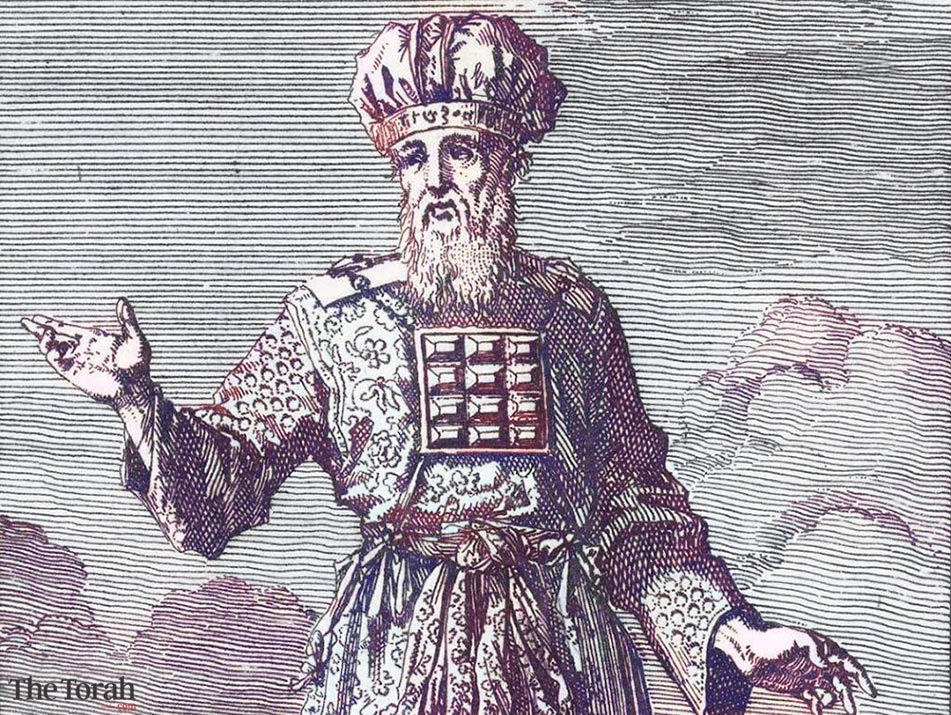
Aaron the High Priest, by Jan Luyken (1669-1712)

Today’s Old Testament lesson deals specifically with the vestments of Aaron, the first high priest of the covenant. An ephod was made – which is a richly embroidered, apron-like vestment having two shoulder straps and ornamental attachments for securing the breastplate, worn with a waistband. (Exodus 28:1-30)

The garment which Aaron was to wear, when he entered the sacred space, symbolically kept the nation of Israel in front of Yahweh, and also over the high priest’s heart.

There was a robe which covered the ephod, equipped with bells. As Aaron moved, the bells rang, signaling that he was coming into and out of the presence of God. Only the high priest was consecrated to enter the most holy place; and the high priest alone wore the special clothing for the unique service which was done.

The entire ritual of the high priest’s service was a visual display of God’s glory and of the reality that no one may enter God’s presence flippantly or carelessly. God is gracious and merciful; and God also has no tolerance for impurity, unrighteousness, and pride.

God expects divine laws, stipulations, and commands to be obeyed without prejudice. The Israelites could not pick and choose what directives from God they would do, or not do. And that is the core of what holiness before the Lord really is.

An interesting observation about this text of Scripture is that Aaron the high priest is given no instructions or commands about what to say when he entered and then left God’s presence. No mantras. No incantations or formulaic words. The inference is that Aaron was silent.

Instead, the garments spoke. “Holy to the Lord” on the plate affixed to the turban said a lot – along with the ephod and the robe, affirming that holiness is needed in order to make any sort of decisions before God.

We never get an explanation in Scripture about what the Urim and Thummim are – which is why, when translating the words from Hebrew, we merely have English transliterations of them. We only know that they were used when making decisions. Evidently, the high priest was an earthly source of God’s wisdom and direction.

Whatever we think about these verses in the book of Exodus, it seems that we are meant to understand that details matter; and how we go about our obedience, down to the last jot and tittle, matters.

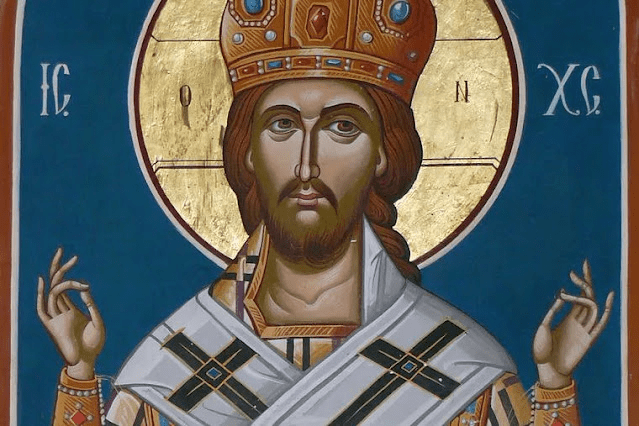
Orthodox icon of Jesus Christ, the High Priest of a New Covenant

In the ministry of Christ, there were people wondering if all of his talk was upending or replacing those detailed imperatives of God. Jesus responded:

“Do not think that I have come to abolish the Law or the Prophets; I have not come to abolish them but to fulfill them. For truly I tell you, until heaven and earth disappear, not the smallest letter, not the least stroke of a pen, will by any means disappear from the Law until everything is accomplished.” (Matthew 5:17-18, NIV)

Jesus furthermore upheld God’s expectation that divine commands be obeyed:

“Therefore anyone who sets aside one of the least of these commands and teaches others accordingly will be called least in the kingdom of heaven, but whoever practices and teaches these commands will be called great in the kingdom of heaven.” (Matthew 5:19, NIV)

At issue was the nature of righteousness – right relations with both God and others. Justice is imperative. Being humble, pure, merciful, and a peacemaker matters. The laws and directives of God are never to be used for walking around like a peacock to display what a wonderfully important and religious person you are.

In other words, the ornate garments of the high priest are not the person; they are special clothing used for a special purpose. Clothes may be important, yet it’s the heart that truly matters. And a heart devoted to God will seek to humbly obey God’s words down to the most minute detail.

O God, by whom the humble are guided, and light rises up in darkness for the godly: Grant us, in all our doubts and uncertainties about obedience, the grace to ask what you would have us to do, that the Spirit of wisdom may save us from all false choices, and that in your light we may see light, and in your straight path may not stumble; through Jesus Christ our Lord. Amen.

A New Covenant (Jeremiah 31:31-34)

The Lord says, “The time is coming when I will make a new covenant with the people of Israel and with the people of Judah. It will not be like the old covenant that I made with their ancestors when I took them by the hand and led them out of Egypt. Although I was like a husband to them, they did not keep that covenant. The new covenant that I will make with the people of Israel will be this:

I will put my law within them and write it on their hearts. I will be their God, and they will be my people. None of them will have to teach a neighbor to know the Lord, because all will know me, from the least to the greatest. I will forgive their sins and I will no longer remember their wrongs. I, the Lord, have spoken.” (Good News Translation)

It’s important to pass on the faith to future generations of believers. The key to embracing a life of faith is obeying God’s commands and decrees.

Yet, both within the Old Testament and within our own contemporary religious milieu, God’s people persist in going through significant times of unfaithfulness, infidelity, and disobedience.., Oftentimes, people cannot seem to keep their eyes off the glittering gods that surround them, as if they had some sort of spiritual A.D.H.D.

Also persistent is the God who possesses a faithful remnant of people devoted to observing the covenant and living into the divine promises given to them. Yet, the kingdom of Judah in the prophet Jeremiah’s day, floundered in their commitments and broke faith with the teaching provided for them.

Since God’s grace has the last word, the sins and shortcomings of backslidden people who failed to pass on the covenant teachings to their progeny will have a better ending than that of divine judgment. God’s answer to repeated human failings is to establish a new covenant, unprecedented in its audacious mercy.

Rather than rewriting commands on stone tablets (as with Moses on Mount Sinai) and having a remedial class on the divine covenant and promises for the people, God will instead do the extraordinary, by writing the law on human hearts. That way, people will know the Lord in a direct and immediate way.

And on top of that, it will be for everybody; it won’t only be for the remnant, nor for just the spiritual elite. From the least to the greatest, from young to old, even from Jew to Gentile, God will forgive sins and shortcoming, guilt and shame, once and for all with the new covenant.

If that’s not the most gracious act ever decreed, I’m not sure what is. This is a radical move of spiritual amnesty. It’s completely undeserved. And it’s definitely not something any other god from any other nation would ever do. It’s unthinkable – completely off everyone’s radar. Yet, that is exactly what grace does. Grace provides a way where there seems to be none.

From a New Testament (New Covenant) perspective, Jesus is the fulfillment of all God’s good covenant promises to the people. Furthermore, God’s Holy Spirit serves as the continuing presence of Jesus within us, teaching us and guiding us in the ways of God. 

Our only task, then, is to live into those promises – to know them, claim them, and bank on them. We are most obedient when we believe the promises of God and throw all our hope in them.

The implications of the divine decree of a new covenant are enormous. It means:

  • I cannot do a darn thing to earn God’s acceptance, because I already have it! (John 6:37; Colossians 1:21-22; Romans 8:33-39, 15:7-12)
  • I don’t need to be afraid of judgment because Jesus has already taken care of the sin issue, once for all! (Romans 6:5-10; Hebrews 7:27-28, 10:5-10; 1 John 4:17-18)
  • I lack nothing, because God has already given me everything I need for life and godliness in this present evil age! (Philippians 4:19; 2 Peter 1:3-4)
  • I can know God, right now, without jumping through spiritual hoops or over imposed hurdles, because Jesus leveled the way and made it clear! (John 14:6; Ephesians 2:8-9; Hebrews 2:9-18)
  • I can enjoy forgiveness and a clean heart because God has decreed it to be so! (Psalm 103:8-12; Ezekiel 36:25-27; Luke 22:20; Hebrews 8:7-13, 10:14-18)

If this were not enough, Jesus has sent the Spirit to be with us forever, to guide us and lead us into realizing the law written on our hearts. We are never alone. God is with us.

Jesus said, “The Companion, the Holy Spirit, whom the Father sends, will teach you everything and will remind you of everything I told you. Peace I leave with you. My peace I give you. I give to you not as the world gives. Do not be troubled or afraid.” (John 14:26-27, CEB)

In this world of trepidation, fear, uncertainty, and unrest, there is peace, grace, and love because the Father, Son, and Spirit, the one true God, the Blessed Holy Trinity, the Divine Warrior who fights our battles, the Lord of Hosts, has our backs. Yes, this God, and no other god, has the chutzpah to make promises to us and the power to back them up.

Our Father in heaven,
Reveal who you are.
Set the world right;
Do what’s best—as above, so below.
Keep us alive with three square meals.
Keep us forgiven with you and forgiving others.
Keep us safe from ourselves and the Devil.
You’re in charge!
You can do anything you want!
You’re ablaze in beauty!
Yes! Yes! Amen!

A Word of Faith (Genesis 15:1-20)

After this, the word of the Lord came to Abram in a vision:

“Do not be afraid, Abram.
    I am your shield,
    your very great reward.”

But Abram said, “Sovereign Lord, what can you give me since I remain childless and the one who will inherit my estate is Eliezer of Damascus?” And Abram said, “You have given me no children; so a servant in my household will be my heir.”

Then the word of the Lord came to him: “This man will not be your heir, but a son who is your own flesh and blood will be your heir.” He took him outside and said, “Look up at the sky and count the stars—if indeed you can count them.” Then he said to him, “So shall your offspring be.”

Abram believed the Lord, and he credited it to him as righteousness.

He also said to him, “I am the Lord, who brought you out of Ur of the Chaldeans to give you this land to take possession of it.”

But Abram said, “Sovereign Lord, how can I know that I will gain possession of it?”

So the Lord said to him, “Bring me a heifer, a goat and a ram, each three years old, along with a dove and a young pigeon.”

Abram brought all these to him, cut them in two and arranged the halves opposite each other; the birds, however, he did not cut them in half. Then birds of prey came down on the carcasses, but Abram drove them away.

As the sun was setting, Abram fell into a deep sleep, and a thick and dreadful darkness came over him. Then the Lord said to him, “Know for certain that for four hundred years your descendants will be strangers in a country not their own and that they will be enslaved and mistreated there. But I will punish the nation they serve as slaves, and afterward they will come out with great possessions. You, however, will go to your ancestors in peace and be buried at a good old age. In the fourth generation your descendants will come back here, for the sin of the Amorites has not yet reached its full measure.”

When the sun had set and darkness had fallen, a smoking firepot with a blazing torch appeared and passed between the pieces. On that day the Lord made a covenant with Abram and said, “To your descendants I give this land, from the Wadi of Egypt to the great river, the Euphrates—the land of the Kenites, Kenizzites, Kadmonites, Hittites, Perizzites, Rephaites, (New International Version)

Abrahamic Covenant II, by Wayne Forte, 2007

A Word about Abram and Sarai

We meet Abram and Sarai (later to be known as Abraham and Sarah) as a non-descript couple from a place called Ur of the Chaldees, a few chapters earlier in the opening biblical book of Genesis. It’s noted that Sarai is barren, or childless. (Genesis 11:30)

The Lord decided to choose a people for God’s own name, a singular people to become a kingdom of priest and a holy nation. The idea was that God would bless all the other nations through this one nation.

So, in what becomes something of a divine pattern, God chooses a most unlikely couple (old and childless) to become father and mother of this new nation to bless all other nations on earth. The Lord called them from their country of origin to leave and go to a new place. (Genesis 12:1-3)

Lo and behold, Abram and Sarai did just that. They left all they ever knew and journeyed to the new land, believing the promise of God, even though it didn’t make much sense. And there, they waited for a child, who would become the first of their many descendants, the child of promise.

And they waited. Time passed. They made a few sojourns into Egypt and back. But still no child. More time went by. Abram and Sarai were old when they came to the new land. Now, they’re really old! And still, no child. Then, finally, the Lord broke the silence.

The Word of the Lord

God’s initial words after all this time were, “Don’t be afraid.” We discover that anytime we hear that phrase spoken by the Lord, something good is about to happen. In fact, it’s great news.

But Abram seems discouraged, even with a fresh heart-to-heart with God. He and Sarai are still without a child. Instead of joy over God’s speech, Abram laments the ache of childlessness. Even though, by this time, Abram was wealthy, prosperous, and of good reputation, he feels the sting of a promise yet unfulfilled. God has still not granted him progeny for blessing the world.

A Word of Lament

Lament is, at its core, a complaint – an expression of grief in losing something or someone, or as in Abram’s case, of never having that something or someone to begin with.

It’s actually important for us to essentially make our problems into God’s problems. To tell God about our deepest hurts and unmet hopes is to implicate God in those hurts and hopes. It is to involve God in our disappointment.

In lament, we cry out to God in the belief that the Lord can and will respond to our painful cries and our deep desires. We believe God has the power and ability to respond. To complain to God is to have faith that God is faithful to divine promises—in spite of any nonsensical present circumstances.

Concerning matters about which God has made a promise, to complain is to remind the Lord of those unmet promises. In his lament, Abram was implying that God had not kept the promise, and had not yet proven faithful.

A Word of Response

Far from feeling perturbed that Abram laments instead of rejoices, God, in fact, responds by doubling-down on the original promise. Not only will there be a child, but that child’s descendants will be too many to even begin counting.

The Lord invited Abram to move his head from looking down at the bare ground to looking up at the magnificent stars. And in gazing upon the heavens, listening to the God whom he serves, Abram believed the Lord. And it was this faith which was credited to him as righteousness.

God is okay with being implicated in our problems. In fact, God welcomes it. Our deep grief, and our prayerful complaints, are a way of speaking which reminds God that God has promised to be faithful to divine promises. God doesn’t at all mind being held accountable to promises made.

Then, the Lord further responds by making a tangible expression of the intangible promise by means of a special sacrifice. God instructed Abram to involve some animal sacrifices and arrange them a certain way. When the sun had gone down and it was dark, a smoking fire pot and a flaming torch passed between the arranged pieces of the sacrifice.

A Covenant Word

On that day, through a ritual observance, God made a covenant with Abram.

To make a covenant in the ancient world, animals were cut in half, and then the persons making the covenantal commitment walked down the middle between the animals.

In Abram’s ritual, however, it was the Lord—in the form of a smoking pot and a flaming torch—who passed down the middle and thus was the one making the promise.

The symbolism of the covenant ritual is this: The one making the promise passes between dead animals as a ritual promise that, if they should be unfaithful to the terms of the covenant, they are to be cut in half just as the sacrificed animal.

In other words, when the Lord passed between the cleaved goat, sheep, ram and birds, God was pledging complete commitment to Abram.

A New Covenant Word

In Christianity, the gospel is a free promise by God that requires the death of God. The promise of God to Abram, Christians believe, ultimately led to the very death of the Son of God, Jesus.

In order to be faithful to the divine promise, to Abraham and Sarah and their descendants, and to David, God took on human flesh, walked between the pieces, and died so that we might have life.

Therefore, the promise comes by faith, so that it may be by grace and may be guaranteed to all Abraham’s offspring—not only to those who are of the law but also to those who have the faith of Abraham. He is the father of us all. As it is written: “I have made you a father of many nations.” He is our father in the sight of God, in whom he believed—the God who gives life to the dead and calls into being things that were not. (Romans 4:16-17, NIV)

Amen.