Beginnings and Endings

Forest Sunset, by James Naughton

I’ve always thought it strange that we have New Year’s celebrations on January 1 at midnight when the year begins. The year hasn’t even happened yet, and we’re celebrating it. I understand celebrating a live birth and all the possibilities of a new baby in a family; but having worldwide blowouts about an upcoming New Year just strikes me as weird.

For some reason, we don’t celebrate the year we’ve just lived. We “take a look back” at the significant events and happenings. But there’s certainly no party around it. I suppose it’s because a lot of terrible things happen in a year. Yet, a lot of good things happen, too, that we could center some joy around.

What I’m getting at, in a round about way, is that we humans don’t do well with endings. And then we quickly become discouraged with our new beginnings – likely because we put little to no thought and preparation into how important and necessary our endings really are.

This is yet another roundabout way of saying that I (and we together) are experiencing something of an ending. For the past 1,750 days, I have provided a daily reflection upon a text from Holy Scripture. And those reflections haven’t been just a few sentences of devotional drivel, nor a measly daily crumb. I’ve written thousand-word-posts which I believe have been thoughtful and truly reflective on the text and our human condition.

However, all things must end. And this is my last post – at least for a while. I won’t be posting every day, as I’ve done for nearly 5 years! Yet, in order for me to have a proper new beginning of my own (one that I neither wanted nor asked for) I must let go of my daily blog posts.

Although I have been blogging for the past 15 years, I started doing the daily reflections at the beginning of COVID, as a way of remaining connected with my then church congregation, and with others. My thought was to give up doing it every day, once things got back to some sort of normalcy – whatever the heck that is.

Yet, when the masks initially came off and we all began seeing one another again, I found that the daily routine of writing biblical reflections had gotten into my spiritual bones. I was no longer simply writing for others; I was writing for myself. It buoyed my own faith to rise early in the morning and put some intentional focus upon crafting some scriptural thoughts on the Bible.

But that is no longer possible. My life can no longer sustain the practice. I intend to keep up the occasional post of maybe once a week. I might not even be able to do that. It might be once or twice a month. I don’t yet know.

Yet, what I do know is that I want to take the opportunity to celebrate the reality that I spent 1,750 straight days writing and posting impactful blog posts! Many of you were gracious to send me private notes of appreciation and encouragement. I especially treasure the ways some of you explained your story of how your own relationship with God has been helped.

When you boil down life to its essence, all any of us really have is our stories. Behind every event, each encounter, and all of the numbers which get crunched and the stuff that gets done and achieved, there is a story.

Stories bring just as much healing to us as modern medicine and surgeries. And they encourage, inspire, and change us in ways we cannot imagine.

The Bible, at its core, is a collection of stories. It seems God has created us as story-driven people, and so, in order to reveal something of God’s personhood and nature, we were given a grand and unfolding story of redemption.

I love reading and meditating on Holy Scripture, mainly because I love the Holy God of whom I belong and gladly serve.

I’ll continue writing the occasional post, but I will miss the daily meetings I’ve had with the Lord and with you in these past few years. Thank you for your faith, and for listening to God’s Word. What’s more, you can always avail yourselves of the nearly 2,700 blog posts on the website.

I pray that we all may learn to end things well, so that we might begin new things with some needed wisdom, humility, and grace.

May you live this day compassionate of heart, gentle in word, gracious in awareness, courageous in thought, and generous in the love of God through Jesus Christ our Lord and in the strength of the Holy Spirit. Amen.

Holding Both Victory and Defeat (2 Samuel 19:1-18)

David mourns the death of Absalom, by Gustave Doré (1832-1883)

Joab was told, “The king is weeping and mourning for Absalom.” And for the whole army the victory that day was turned into mourning, because on that day the troops heard it said, “The king is grieving for his son.” The men stole into the city that day as men steal in who are ashamed when they flee from battle. The king covered his face and cried aloud, “O my son Absalom! O Absalom, my son, my son!”

Then Joab went into the house to the king and said, “Today you have humiliated all your men, who have just saved your life and the lives of your sons and daughters and the lives of your wives and concubines. You love those who hate you and hate those who love you. You have made it clear today that the commanders and their men mean nothing to you. I see that you would be pleased if Absalom were alive today and all of us were dead. Now go out and encourage your men. I swear by the Lord that if you don’t go out, not a man will be left with you by nightfall. This will be worse for you than all the calamities that have come on you from your youth till now.”

So the king got up and took his seat in the gateway. When the men were told, “The king is sitting in the gateway,” they all came before him.

Meanwhile, the Israelites had fled to their homes.

Throughout the tribes of Israel, all the people were arguing among themselves, saying, “The king delivered us from the hand of our enemies; he is the one who rescued us from the hand of the Philistines. But now he has fled the country to escape from Absalom; and Absalom, whom we anointed to rule over us, has died in battle. So why do you say nothing about bringing the king back?”

King David sent this message to Zadok and Abiathar, the priests: “Ask the elders of Judah, ‘Why should you be the last to bring the king back to his palace, since what is being said throughout Israel has reached the king at his quarters? You are my relatives, my own flesh and blood. So why should you be the last to bring back the king?’ And say to Amasa, ‘Are you not my own flesh and blood? May God deal with me, be it ever so severely, if you are not the commander of my army for life in place of Joab.’”

He won over the hearts of the men of Judah so that they were all of one mind. They sent word to the king, “Return, you and all your men.” Then the king returned and went as far as the Jordan.

Now the men of Judah had come to Gilgal to go out and meet the king and bring him across the Jordan. Shimei son of Gera, the Benjamite from Bahurim, hurried down with the men of Judah to meet King David. With him were a thousand Benjamites, along with Ziba, the steward of Saul’s household, and his fifteen sons and twenty servants. They rushed to the Jordan, where the king was. They crossed at the ford to take the king’s household over and to do whatever he wished. (New International Version)

King David learns of Absalom’s death, by Unknown artist, c.1590

King David’s son, Absalom had become a bitter and angry man, especially toward his father. He took his time to build a conspiracy against David, in order to replace him as king. Absalom succeeded in taking Jerusalem.

However, King David escaped with those loyal to him. Although Absalom had the upper hand and could have followed through with overtaking David, a monkey wrench in counsel led to David gaining a fighting chance. It all eventually led to the death of Absalom in battle.

And this is where King David showed yet again the sort of incongruence that, it seems, only a parent can do. His loyal men won the battle, yet Absalom was slain because of Joab, the commander. David’s grief over his son’s loss was palpable; he wept and lamented, despite the great victory that had been achieved against the odds.

Indeed, David experienced the dilemma of being both a father and a king – and it ripped his heart.

Throughout the narratives of David, Joab is presented as a no-nonsense business-like guy. He didn’t have much tolerance for the touchy-feely stuff, and let the king know it. Joab often had a right assessment of things, but conversely, he often spoke and acted in a wrong manner.

Joab essentially picked up a strange parental role of scolding David into facing his present circumstance. The troops needed assurance; and it could only come from the king, whom they were fighting for in the first place.

So, David acquiesced to Joab, and took his public seat, receiving the army as victors. Yet, King David had enough of Joab’s unfeeling shenanigans, and summarily replaced him as commander of the military.

With Absalom dead, and David acting more like a king again, it isn’t long before Israel and Judah receive him back as their king, and take him to Jerusalem to once again rule over the land. David had to discover, yet again, in a new situation what it means to hold both victory and defeat, joy and sorrow, together.

It’s typical for us as biblical readers to ask, “What’s the point of the story?” We tend to like our bottom lines and neat summaries of things. After all, we’re busy people with things to do and people to see. Just give it to me straight, and I’ll go on my merry way.

But Scripture reading doesn’t work like that. It’s not fast food. Scriptural narratives require us to slowly chew on them, to sit with them for a while, and to take the time for reflection, prayer, and listening.

In doing this, we will likely discover that we could read the same story at different times and at various seasons of our lives, and come away with a different “bottom line” in each fresh reading of the text.

This is why I am a committed Bible reader (and thinker!). In some cases, I’ve read the same story hundreds of times. Nearly always, I walk away from the encounter seeing something new or discovering an insight of the text (or myself!) that I had never seen before.

So, these daily Bible reflections are my thoughts of Scripture that I had at a particular time and place. Having said that, I wonder what stirs within you as you read and encounter the story of King David after the death of his son Absalom…

Feel free to share your thoughts.

O Lord, we call upon You in times of both sorrow and joy. Give us the strength and the will to bear our heavy burdens, as well as to wisely carry our manageable ones. In all things, help us feel the warmth and love of Your divine compassion. Amen.

Hang In There (1 Corinthians 7:17-24)

Nevertheless, each person should live as a believer in whatever situation the Lord has assigned to them, just as God has called them. This is the rule I lay down in all the churches. Was a man already circumcised when he was called? He should not become uncircumcised. Was a man uncircumcised when he was called? He should not be circumcised. Circumcision is nothing and uncircumcision is nothing. Keeping God’s commands is what counts. Each person should remain in the situation they were in when God called them.

Were you a slave when you were called? Don’t let it trouble you—although if you can gain your freedom, do so. For the one who was a slave when called to faith in the Lord is the Lord’s freed person; similarly, the one who was free when called is Christ’s slave. You were bought at a price; do not become slaves of human beings. Brothers and sisters, each person, as responsible to God, should remain in the situation they were in when God called them. (New International Version)

Whenever a person converts to Christianity and becomes a follower of Jesus, they experience new life. They don’t, however, experience reincarnation. They’re still the same person – not a different one altogether.

If the convert was married, it doesn’t matter if their spouse is a convert, or not; they’re still married and need to hang in there and remain married, albeit with a new way of being with them.

There is no magical wiping away of situations, circumstances, jobs, family, and relationships with becoming a Christian. Hopefully, a new orientation of grace, truth, and love begins to permeate it all. But all those people and situations are still there, and need to be dealt with.

So, the Apostle Paul gave some very practical social instruction to the Corinthian converts to Christ. He was rather pointed in communicating to them in not using the occasion of conversion to go someplace else and/or be with someone else. Nor is it proper to daydream of a reincarnated life; stick with the new redeemed life you have received.

The place where you became a Christian is the place to start living the Christian life. Obey God, follow the Lord’s words and ways, live out your redemption right there. Why? Because your new identity as belonging to God – not your marital status, vocation, or anything else – defines your life and determines how you are to live. And Paul was consistent on that instruction in all of the churches he established.

For the Jew in Paul’s day, circumcision was the defining mark of religion and identity. To marry an uncircumcised non-Jewish person was unthinkable; it defiled a relationship and made it impure. But the Apostle insisted that Jewishness (or non-Jewishness) isn’t actually the point of living the Christian life. What’s really important is obeying God’s call and following Christ’s commands, period.

Therefore, the convert ought to stay where they are – no matter what their marital status or social position is. Believing in Christ and following Jesus transcends all of it. Whether one is a slave, or not, faith obliterates any and all obstacles to God. If a person comes to faith and converts to Christianity, they still might be in human bondage; but they have freedom in Christ.

Hopefully, the slave’s spiritual freedom will work itself out in actual physical freedom. The point, however, is that – whether slave or free – the person belongs to God and neither bondage nor freedom will ever hinder the individual from realizing spiritual redemption.

In many different ways, we are all both slaves and free persons. The best situation is to be a bondservant of Christ and a slave to no one else. Yet, if circumstances are not ideal, the reality is that one’s union with Christ can never be severed by any human institution or authority.

Once we convert, and enter into a life-giving free relationship with God in Christ, Paul exhorts all believers to be vigilant: Don’t slip back into old ways of spiritual bondage and capitulate to a shameful society. After all, Christ – whom the convert serves – has paid the true ultimate sacrifice of himself on the cross for the sake of all humanity.

So, hang in there, stay in the place and position where you were called by God, and reorient your life with Christ in the middle of it. In doing this, every believer can persevere through adversity, hold onto the gift of faith, and make a difference in the society to which one belongs.

Blessed and holy God, grant us the Spirit of wisdom and discernment so that we may know Christ better and love you more. Give us an understanding heart so that we may be open to hear your divine voice, and the courage to walk in the way of your commands.

Use us, your people who belong to Christ, to be your hands and feet – your voice and heart, so that we may be a channel through which you pour out your grace to help others – may we decrease and Christ increase, so that Jesus is seen in our lives, through the power of the Holy Spirit. Amen.

Living Into a New Story (Deuteronomy 5:22-33)

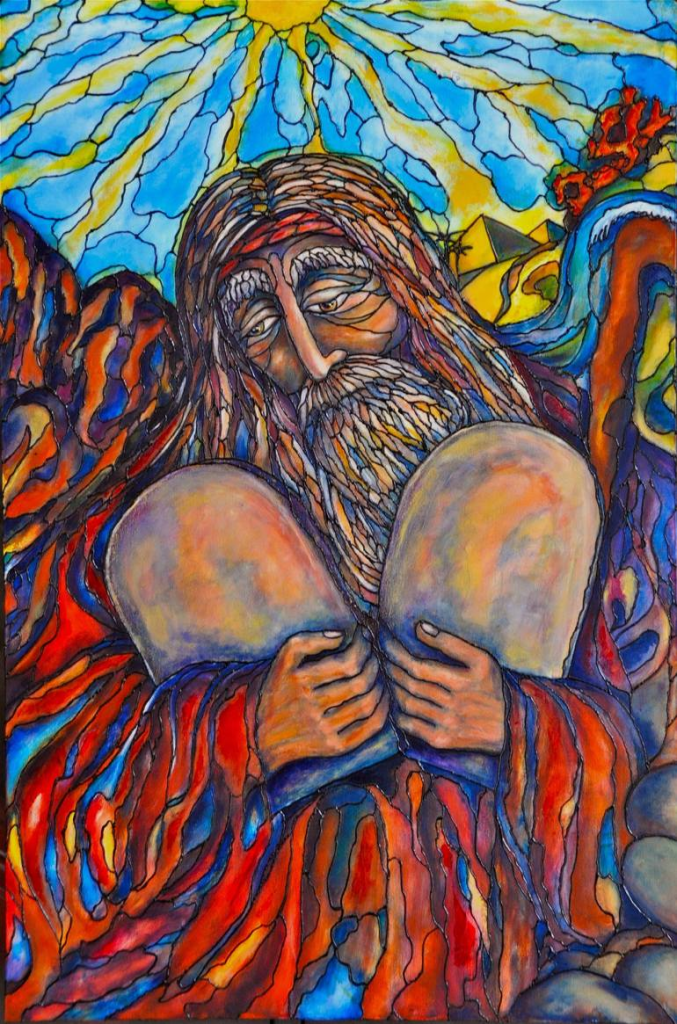
Moses, by Rae Chichilnitsky

“These are the commandments the Lord gave to all of you when you were gathered at the mountain. When he spoke with a mighty voice from the fire and from the thick clouds, he gave these commandments and no others. Then he wrote them on two stone tablets and gave them to me.

“When the whole mountain was on fire and you heard the voice from the darkness, your leaders and the chiefs of your tribes came to me and said, ‘The Lord our God showed us his greatness and his glory when we heard him speak from the fire! Today we have seen that it is possible for people to continue to live, even though God has spoken to them. But why should we risk death again? That terrible fire will destroy us. We are sure to die if we hear the Lord our God speak again. Has any human being ever lived after hearing the living God speak from a fire? Go back, Moses, and listen to everything that the Lord our God says. Then return and tell us what he said to you. We will listen and obey.’

“When the Lord heard this, he said to me, ‘I have heard what these people said, and they are right. If only they would always feel this way! If only they would always honor me and obey all my commands, so that everything would go well with them and their descendants forever. Go and tell them to return to their tents. But you, Moses, stay here with me, and I will give you all my laws and commands. Teach them to the people, so that they will obey them in the land that I am giving them.’

“People of Israel, be sure that you do everything that the Lord your God has commanded you. Do not disobey any of his laws. Obey them all, so that everything will go well with you and so that you will continue to live in the land that you are going to occupy. (Good News Translation)

The people were at the cusp of entering the Promised Land. They had experienced four hundred years of slavery; deliverance from Egyptian bondage; and forty years of wandering around the desert with no permanent home. Now, Moses gathers everyone together and restates God’s Law for a new generation about to realize God’s promise.

In today’s Old Testament lesson, Moses recalls his experience of receiving the two stone tablets, known to many as the Ten Commandments. Moses does this because he does not want this new generation of Israelites to be like their parents and grandparents – who experienced a failure of faith, resulting in their sojourn in the wilderness.

Obedience to God and all of God’s commands is central to a life of faith.

For that obedience to happen, all obstacles must be removed so that we can have an unhindered path in living the way we want to live. The Israelites were in slavery four hundred years. They needed a new story, which meant changing the old one. The people could participate with God by doing the following:

  1. Accept their wounded past of slavery. We cannot let something go and die without acknowledging it and having full acceptance that it happened.
  2. Don’t accept the limitations others put on us. The Israelites were slaves for so long that the Egyptians would have liked them to believe that’s all they could ever be. But the reality is that they are the people of God, meant for infinitely more than bondage.
  3. Trust the process of moving out of one story and into another. And it will take time. Forty years of wandering the desert helped the people wrap their minds and hearts around new possibilities.
  4. Take charge of your life by being a full participant in what the Lord is doing. Acting apart from God is pride. Failing to act is a lack of faith. But a divine/human participation knows what God does and what human responsibility is.
  5. Embrace all the emotions that go with what’s happening. Old ways often die hard. It didn’t take long after leaving Egypt for the people to long for the garlic and leeks of their former life. Holding and sitting with our feelings is an important piece of embracing a new story.
  6. Pay attention to constructing a soul which can serve you for a lifetime by taking initiative and action, reflecting on experiences, and living the insights gained.
  7. Discover new sources of growth and development for your new story and the next chapter of life. The same sources and resources which got you to this point may not be the same ones that will carry you on.

Moving through this liminal space enables us to obey God in new and fresh ways for the future. Obedience itself is not the hard thing; its ensuring a solid theological ground to stand on that is free of spiritual impediments that can hinder our faith.

Spiritual growth implies movement and change. This is necessary in order for the strengthening of faith. In allowing God’s commands and God’s sovereignty to have their way within us, we purposely engraft what’s needed for a lifetime of faith, hope, and love.

Glorious and sovereign God, give us your Spirit, so that we will be wise in how we live our lives. Help us to know you better through all of the experiences and learning we acquire in this life.

May our minds be opened to see your light, so that you will know the hope to which you have called us; and how rich are the wonderful blessings you promise us.

Grant us your strength so that we might remove every obstacle to faith. That spiritual power working in us is the same as the mighty strength which you used when raising Christ from death and exalting him above all things. Amen.