A Prayer of Confession and Contrition (Nehemiah 9:16-25)

But they—our own ancestors—acted arrogantly.
They became stubborn and wouldn’t obey your commands.
They refused to listen.
They forgot the miracles you performed for them.
They became stubborn and appointed a leader
to take them back to slavery in Egypt.
But you are a forgiving God,
one who is compassionate, merciful, patient,
and always ready to forgive.
You never abandoned them,
even when they made a metal statue of a calf for themselves
and said, ‘This is your god who took you out of Egypt.’
They committed outrageous sins.
But because of your endless compassion,
you didn’t abandon them in the desert.
The column of smoke didn’t leave them during the day,
but it led them on their way.
The column of fire didn’t leave them during the night,
but it gave them light to see the way they should go.
You gave them your good Spirit to teach them.
You didn’t keep your manna to yourself.
You gave them water to quench their thirst.
You provided for them in the desert for 40 years,
and they had everything they needed.
Their clothes didn’t wear out, and their feet didn’t swell.

You gave kingdoms and nations to the Israelites
and assigned them their boundaries.
So they took possession of the land of Sihon,
the land of the king of Heshbon,
and the land of King Og of Bashan.
You made their children as numerous as the stars in the sky.
You brought them into the land you told their parents to enter and possess.
Their children took possession of the land.
You defeated for them the Canaanites, who lived in the land.
You handed the Canaanite kings and their people over to them
to do whatever they wanted with the Canaanites.
The Israelites captured fortified cities and a rich land.
They took possession of houses filled with all sorts of good things,
cisterns, vineyards, olive trees,
and plenty of fruit trees.
So they ate and were satisfied and grew fat.
They enjoyed the vast supply of good things you gave them. (God’s Word Translation)

The Jewish people had experienced the Babylonian Captivity. The walls of Jerusalem had been torn down, and the Temple was ransacked and destroyed.

Years later, the Persians overthrew the Babylonians, and many of the Jewish captives were allowed to return to Judea. One of the returning groups was led by Nehemiah, who was a cupbearer to the king.

Nehemiah engaged in an ambitious project of rebuilding Jerusalem’s wall and securing the city. It was a large undertaking. Yet, even more daunting was restoring the Jewish people’s worship of Yahweh, and following the Torah, God’s law.

Today’s Old Testament lesson takes place in the fifth century B.C.E. Nehemiah, along with the religious leader Ezra the scribe, organized a public assembly. The people listened to the Torah being read, and were fasting, confessing, and repenting of the ways they had neglected God’s law.

A group of Levites (the priests) stood up and said a long prayer of confession. Our verses for today are a part of that extended time of confession of sin and profession of faith. The people’s past history was very much a part of their present circumstances.

The Levities emphasized that it is God’s nature to be full of faithfulness and steadfast love. So, the Lord preserved the Israelites and rescued them out of Egyptian slavery through a series of miraculous wonders.

While their ancestors were out in a desert sojourn, anticipating entry into the Promised Land, God was faithful to provide for the Israelites both physical and spiritual food – Torah and manna.

And yet, despite the incredible rescue from Egypt, and miraculously escaping through the Red Sea, the people were rebellious. Their disobedience to God in the golden calf experience prevented that generation from entering into the promised rest. (Hebrews 3:16-19)

Every generation has its “sinners,” those who seem to have a bent toward selfish behavior, and refuse to see the needs of the entire group. They only serve God if it serves their own self-centered purposes. And they stubbornly refuse to bend to anyone’s wishes, including God’s.

Unfortunately, that sin of pride and arrogance gets passed down to the next generations. It’s not only, in some ways, taught; this sort of stubbornness also appears to have a genetic component, as well. Whenever our minds and hearts are rewired with injustice toward others and disobedience toward God, that wacky wiring gets passed down to the next generations.

It is quite likely that past trauma has a lot to do with skewed minds and hearts.

Epigenetics is a scientific field which investigates how environment influences our genes. Trauma does not alter our actual DNA sequence; but it does impact how that sequence is read and utilized in our body.

When an individual experiences trauma, their body may adapt by adjusting gene expression, and some of these changes can be passed on to their children. It’s like passing on genetic notes to our progeny – which means that these notes can be rewritten (and rewired) by our own life experiences and actions.

I am not a genetic scientist, yet this may be something akin to the divine warning about generational sin, arising from a generation’s trauma experience, after being enslaved and mistreated for 400 years in Egypt. In giving the Law to Moses, God then said:

“The Lord, the Lord, the compassionate and gracious God, slow to anger, abounding in love and faithfulness, maintaining love to thousands, and forgiving wickedness, rebellion and sin. Yet he does not leave the guilty unpunished; he punishes the children and their children for the sin of the parents to the third and fourth generation.” (Exodus 34:6-7, NIV)

Whether any of us knows anything about genetics and epigenetics, or not, there yet remains the need for a prayer of confession. It is necessary to acknowledge our own sins, as well as the sins of our ancestors.

In their prayer of confession, the Levites in Nehemiah’s time acknowledged and confessed their own guilt, and the guilt of their ancestors, of being the following:

  1. Obstinate. They stubbornly presumed God would be with them, then obstinately did whatever the heck they wanted.
  2. Stubborn. They were “stiff-necked” and refused to obey God when they didn’t want to.
  3. Forgetful. Not an accidental forgetting, but a purposeful neglect to remember what God had done for the people.
  4. Idolatrous. It was the people’s impatience with waiting for Moses on Mount Sinai that led to the golden calf idol disaster. Failing to accept God’s timetable will always lead to a bevy of bad behavior.
  5. Disobedient. The most sinister form of this is obeying halfway, and believing that you have completely done your duty for God, i.e. the sin of one person, Achan, affecting the entire community. (Joshua 7:1, 10-12, 20-26)
  6. Complaining. Murmuring and grumbling is the dissatisfying attitude and speech of ingrates. When directed at God, it is a failure of faith, replaced with a belief that God is mean and/or capricious.

Confession and repentance are the remedies to both individual and communal guilt. And that is exactly what Ezra and Nehemiah organized the post-exilic Israelites to do, publicly.

Not only did they offer a prayer of confession and repentance, but they also acknowledged and believed God’s faithfulness and mercy to forgive, renew, and restore.

Indeed, God’s grace is greater than all of our sin.

The Levites were not simply offering a mechanical liturgical formula for corporate confession. They were crying out with heartfelt confession to the God they believed was listening and would respond.

As the Levites led the people in confession and repentance, they pointed to the following attributes and activities of God which they put all of their trust in:

God forgives.

He made known his ways to Moses,
    his deeds to the people of Israel:
The Lord is compassionate and gracious,
    slow to anger, abounding in love.
He will not always accuse,
    nor will he harbor his anger forever;
he does not treat us as our sins deserve
    or repay us according to our iniquities.
For as high as the heavens are above the earth,
    so great is his love for those who fear him;
as far as the east is from the west,
    so far has he removed our transgressions from us. (Psalm 103:7-12, NIV)

God guides.

He guides me along the right paths
    for his name’s sake. (Psalm 23:3, NIV)

God provides.

He has caused his wonders to be remembered;
    the Lord is gracious and compassionate.
He provides food for those who fear him;
    he remembers his covenant forever. (Psalm 111:4-5, NIV)

God sustains.

I lie down and sleep;
    I wake again, because the Lord sustains me. (Psalm 3:5, NIV)

When all is said and done, the centrality of God is humanity’s ballast. As we orient all of life around the Lord, this is what makes all the difference in coming to grips with our past, present, and future.

May it be so, to the glory of God.

Nehemiah 5:1-13 – Real Problem-Solving

Orthodox icon of Nehemiah

Now the men and their wives raised a great outcry against their fellow Jews. Some were saying, “We and our sons and daughters are numerous; in order for us to eat and stay alive, we must get grain.”

Others were saying, “We are mortgaging our fields, our vineyards and our homes to get grain during the famine.”

Still others were saying, “We have had to borrow money to pay the king’s tax on our fields and vineyards. Although we are of the same flesh and blood as our fellow Jews and though our children are as good as theirs, yet we have to subject our sons and daughters to slavery. Some of our daughters have already been enslaved, but we are powerless, because our fields and our vineyards belong to others.”

When I heard their outcry and these charges, I was very angry. I pondered them in my mind and then accused the nobles and officials. I told them, “You are charging your own people interest!” So, I called together a large meeting to deal with them and said: “As far as possible, we have bought back our fellow Jews who were sold to the Gentiles. Now you are selling your own people, only for them to be sold back to us!” They kept quiet because they could find nothing to say.

So, I continued, “What you are doing is not right. Shouldn’t you walk in the fear of our God to avoid the reproach of our Gentile enemies?I and my brothers and my men are also lending the people money and grain. But let us stop charging interest! Give back to them immediately their fields, vineyards, olive groves and houses, and also the interest you are charging them—one percent of the money, grain, new wine and olive oil.”

“We will give it back,” they said. “And we will not demand anything more from them. We will do as you say.”

Then I summoned the priests and made the nobles and officials take an oath to do what they had promised. I also shook out the folds of my robe and said, “In this way may God shake out of their house and possessions anyone who does not keep this promise. So may such a person be shaken out and emptied!”

At this the whole assembly said, “Amen,” and praised the Lord. And the people did as they had promised. (New International Version)

There is nothing pleasant about poverty – especially the circumstances and events which create it. Probably worse than being poor is feeling locked into poverty with no way out.

Nehemiah was a faithful follower of God. He was taken into exile, along with many of his fellow countrymen, when the Babylonians conquered Jerusalem and Judah. Yet, through his prayerful initiative, Nehemiah laid plans for a return to his homeland and rebuild the broken down wall which surrounded the city of Jerusalem. 

Once Nehemiah arrived and arranged for work teams to busy themselves on the wall, he discovered there was a whole lot more to rebuild than just a physical wall. A wall of separation existed between fellow Jews based on economics. There were some very real class differences. The poor were being taken advantage of. Their fellow Jews were exacting usury from them.

The response of Nehemiah to such a sticky situation is instructive for us. Notice how he handled it:

  • Nehemiah did not ignore the people problems and only focus on the physical wall. He firmly and squarely addressed what was happening and was downright angry about the circumstance of Jewish families essentially living in a state of slavery. 
  • Nehemiah was clear, concise, and direct about the nature of the problem. He threw himself into being part of the solution instead of only complaining about what was happening.
  • Nehemiah did not over-involve others in the process of handling the conflict but handled the issue by taking counsel with himself. 
  • Nehemiah attacked the problem without alienating others, while holding people accountable for their actions and their promises.

Today’s Old Testament lesson is something of a leadership case study in how to engage significant problems and conflict. So, it’s a lesson for us not to quickly skim over but to ponder, examine, and absorb Nehemiah’s dealing with the situation. 

We all need some guidance and direction when it comes to confronting the problems which surround us. Let this story serve us well in approaching issues with wisdom and sagacity.

Holy God, you have a special concern for those who are poor and needy. Enable us to live and speak wisely into the crucial needs which exist around us, so that justice is done, mercy is demonstrated, and humility is practiced, through Jesus Christ our Lord in the power of the Holy Spirit. Amen.

Nehemiah 9:26-31 – Judgment and Grace

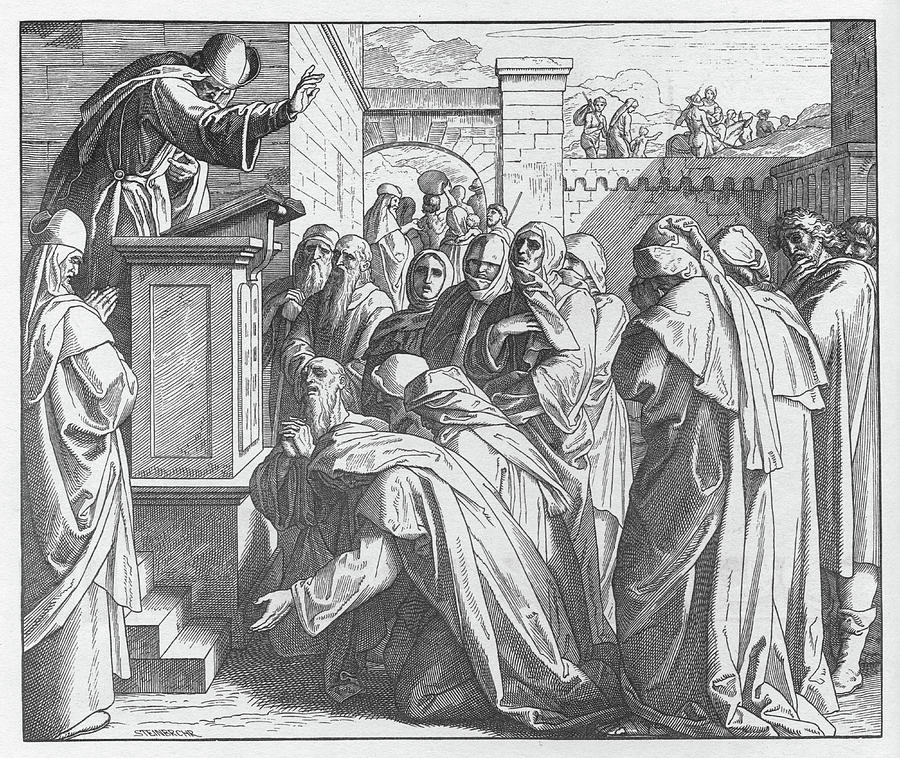
“Repentance of the People” by German painter Julius Schnoor von Carolsfeld (1794-1872)

But despite all this [God’s blessings] they were disobedient and rebelled against you. They turned their backs on your Law, they killed your prophets who warned them to return to you, and they committed terrible blasphemies. So, you handed them over to their enemies, who made them suffer. But in their time of trouble, they cried to you, and you heard them from heaven. In your great mercy, you sent them liberators who rescued them from their enemies.

But as soon as they were at peace, your people again committed evil in your sight, and once more you let their enemies conquer them. Yet whenever your people turned and cried to you again for help, you listened once more from heaven. In your wonderful mercy, you rescued them many times!

You warned them to return to your Law, but they became proud and obstinate and disobeyed your commands. They did not follow your regulations, by which people will find life if only they obey. They stubbornly turned their backs on you and refused to listen. In your love, you were patient with them for many years. You sent your Spirit, who warned them through the prophets. But still, they wouldn’t listen! So once again you allowed the peoples of the land to conquer them. But in your great mercy, you did not destroy them completely or abandon them forever. What a gracious and merciful God you are! (New Living Translation)

Much of the Old Testament is a rhythmic pattern of God’s judgment and grace. The storyline often goes something like this: 

God makes promises and gives commands. 

People get stubborn, refuse to listen, and disobey. 

God responds with judgment. 

People cry out in their distress.

God gives grace and fulfills divine promises. 

People enjoy, then get stubborn again…. 

The promise of God always involves judgment and grace. Proclaiming only a message of judgment without grace brings despair, death, and hell; there is no hope. Speaking only of grace apart from judgment is oxymoronic – it doesn’t exist because there is no need for grace if there is no judgment; grace is an undeserved mercy given freely by God in the face of our stubborn obstinate selves.

Nehemiah chapter nine is a beautiful prayer of confession. Having heard the Word of God proclaimed, the people released their obstinacy; they realized exile occurred because of their own stubborn refusal to listen to God. So, they repented. 

“Fallen man is not simply an imperfect creature who needs improvement: he is a rebel who must lay down his arms.”

C.S. Lewis

The ancient Jewish people acknowledged their checkered past of ignoring God’s prophets, and they bellied-up and took ownership of their past choices. And God was faithful. Even though the city of Jerusalem had been overtaken and the people sent into exile, God brought them back and the broken wall was rebuilt.

It’s never too late to turn from a past filled with poor decisions, broken relationships, and spiritual disobedience. The time of confession is available, and the time is now. God’s grace always overwhelms our dubious past. 

The appropriate response to today’s Old Testament lesson is to spend some time in confession to God. This chapter, along with Nehemiah chapter one, are good places to begin with understanding just what to say to God. 

For the Christian, confession ought always to conclude with accepting the grace available to us in Christ. 

Today is a new day and a new Christian Year. Let it be a life with the love of Jesus implanted in your heart. As we enter the Advent season, allow that love of Christ to gestate within your soul. Anticipate the birth. Look forward to the Nativity. Long for Christmas and the inbreaking of God to this earth.

Holy Lord, in this time of Advent, we confess we often are distracted by the season’s busyness, by the stress of commitment, and even by putting our own traditions ahead of the true meaning of Christmas. We confess we also often prefer being sentimental to being sacrificial.

Forgive us for all the times we have missed seeing You in our midst, for all the times we have doubted Your presence, and for all the times we have failed to hold the holidays as holy days. Pour peace into our lives and let us be bearers of Your peace to others. Remind us that this is a season of waiting and preparation for the greatest Gift of all. In the holy Name of our Savior, Jesus, we pray. Amen.

Nehemiah 1:1-11 – A Prayer of Solidarity and Confession

These are the memoirs of Nehemiah son of Hacaliah.

In late autumn, in the month of Kislev, in the twentieth year of King Artaxerxes’ reign, I was at the fortress of Susa. Hanani, one of my brothers, came to visit me with some other men who had just arrived from Judah. I asked them about the Jews who had returned there from captivity and about how things were going in Jerusalem.

They said to me, “Things are not going well for those who returned to the province of Judah. They are in great trouble and disgrace. The wall of Jerusalem has been torn down, and the gates have been destroyed by fire.”

When I heard this, I sat down and wept. In fact, for days I mourned, fasted, and prayed to the God of heaven. Then I said,

“O Lord, God of heaven, the great and awesome God who keeps his covenant of unfailing love with those who love him and obey his commands, listen to my prayer! Look down and see me praying night and day for your people Israel. I confess that we have sinned against you. Yes, even my own family and I have sinned! We have sinned terribly by not obeying the commands, decrees, and regulations that you gave us through your servant Moses.

“Please remember what you told your servant Moses: ‘If you are unfaithful to me, I will scatter you among the nations. But if you return to me and obey my commands and live by them, then even if you are exiled to the ends of the earth, I will bring you back to the place I have chosen for my name to be honored.’

“The people you rescued by your great power and strong hand are your servants.O Lord, please hear my prayer! Listen to the prayers of those of us who delight in honoring you. Please grant me success today by making the king favorable to me. Put it into his heart to be kind to me.”

In those days I was the king’s cup-bearer. (New Living Translation)

I believe that nothing of eternal significance happens apart from God. Jesus said it clearly: “Apart from me you can do nothing.” (John 15:5, NIV) 

There is simply no substitute for a close relationship with God. The will of God can only be accomplished through the spiritual practice of prayer. Prayer is not a passive activity. If done well, prayer takes time, a great deal of effort, and a sense of priority. It is quite possible that biblical praying can be the most challenging, exhausting, laborious, and rewarding thing we do.

Through prayer we can become filled with the Holy Spirit, gain wisdom to make godly decisions, and access spiritual power that can melt the hardest of hearts and change the minds of the most stubborn of people. 

In prayer we have the privilege of expressing our concerns and needs, as well as having God’s agenda revealed to us for what to do. Our personal and communal holiness is in direct proportion to the great task of prayer.

When faced with the reality that his hometown, Jerusalem, was in trouble, Nehemiah, the king’s wine steward, prayed. In prayer he owned the problems Jerusalem faced. He owned it through a prayer that emphasized and reminded God of the covenant with God’s people; he confessed the sins by which Israel violated that covenant; and he held onto the promise that God would lift the curse on the city if the people would only repent.

Nehemiah had a compassionate heart that was attentive to what was going on in his native land. Hearing the tragic news of the city’s condition, he immediately wept, mourned, fasted, and prayed.

Nehemiah was profoundly disturbed by the news that Jerusalem was in trouble. Rather than being preoccupied with himself and his own situation as an exile in Babylon, Nehemiah sought to do something about the security and spiritual health of his people.

In his prayer to God, Nehemiah was genuine, persistent, confident, humble, and submissive to God. He did not distance himself from the sins of the people, but clearly identified with them through a prayer of confession.  That confession was intense, honest, real, and urgent.

Sin always needs to be identified, acknowledged, and pardoned. If it isn’t, there is no hope for things to be different.

There is a season for everything. Hunting seasons may come and go, but it is always open season for prayer.  And Nehemiah’s prayer is a solid biblical model for us to emulate. We have our challenges. Like Nehemiah, let’s own those challenges through prayers which are biblically focused, compassionately offered, and spiritually curious to know and do God’s agenda for the church and the world.

Let us continually have a spirit of prayer to God in everything we say and do – prayerful spirits that above all seeks God’s will and implementing that will through God’s love.

Almighty and gracious God, we lower our heads before you and confess we too often forget that we are yours. Sometimes we carry on our lives as if there was no God and we fall short of being a credible witness to you and your incredible mercy. For these things we ask your forgiveness and strength. Give us clear minds and open hearts so we may witness to the love of Christ in our world. Remind us to be who you would have us to be regardless of what we are doing or who we are with. Hold us to closely and tightly in your good strong hands. Build our relationship with you and with those you have given us on earth, through Jesus Christ our Lord, in the power of your Holy Spirit. Amen.