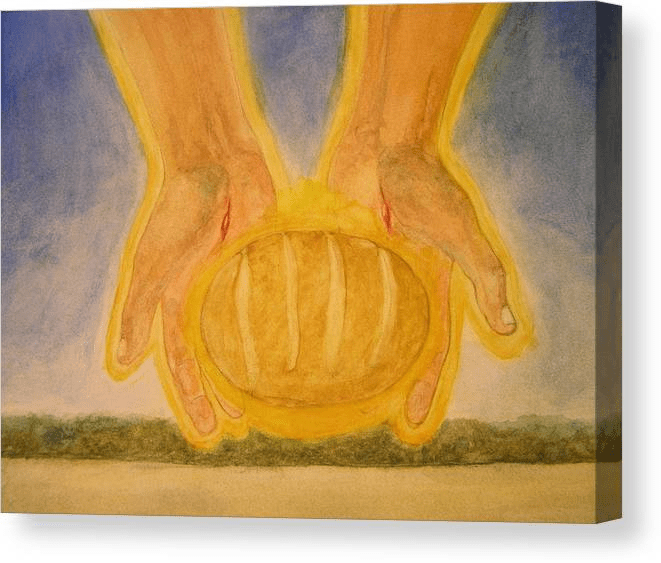
Bread from Heaven (Exodus 16:27-35)

Bread From Heaven, by Nigel Wynter

On the seventh day some people went out to gather food, but they didn’t find any. The Lord said to Moses, “How long will you refuse to do what I have commanded and instructed you to do? Remember: The Lord has given you this day of rest as a holy day. That’s why he gives you enough food on the sixth day for two days. On the seventh day stay in your place—no one is to go out. Everyone, stay where you are.” So the people never worked on the seventh day of the week.

The Israelites called the food manna. It was like coriander seeds. It was white and tasted like wafers made with honey.

Moses said, “This is what the Lord has commanded: Take two quarts of manna to be kept for your descendants. This way they will see the food that I gave you to eat in the desert when I brought you out of Egypt.”

Moses said to Aaron, “Take a jar, put two quarts of manna in it, and put it in the Lord’s presence to be kept for your descendants.” Aaron put the jar of manna in front of the words of God’s promise to be kept there, as the Lord commanded Moses.

The Israelites ate manna for 40 years until they came to a place to settle. They ate manna until they came to the border of Canaan. (God’s Word Translation)

“What is it?” is the quite literal meaning of the word manna. And the answer is: It is bread from heaven.

The manna was food for the Israelite people in their 40 years of sojourning through the desert. There is also an implicit question surrounding this bread: What to do with it? Well, of course, you eat it. But, before eating it, there are issues and instructions about the manna’s arrival and collection.

The special food, only graciously given to this particular group of cantankerous people, appeared in the mornings for six days a week, not seven, and only had a shelf life of one day, with the exception of the singular Sabbath day each week.

There is a time to go out and gather, and there is a time to stay put and eat; a time to work, and a time to rest. The lack of wisdom in timing could cost you not only a meal, but also your overall sense of paying attention to God’s commands.

It is the fool who spurns the relationship between events, that is, the space between when the Lord speaks and when humanity responds. Our human responsibility is dependent upon Divine sovereignty. Ignoring the voice of God, or simply failing to listen out of present anxieties or fears, will nearly always result in a skewed response-ability.

Yes, indeed, we all have very legitimate needs for cuisine, clothing, companionship, care, and compassion. If these vital needs go unmet, we are undone and shall die. Yet, there is also the question of how we will go about getting those very important and basic needs met – and many people, having not listened well to the instructions about life, will go about attempting to meet those needs in illegitimate ways.

Trying to satisfy legitimate needs through illegitimate means ends up eroding the soul, compromising character, and searing the conscience. It’s inevitable that such a person will grumble and complain, projecting on God the evil that is, in reality, residing within the human heart.

Whenever folks go out and try to gather what isn’t there, they have lost their way and their very real needs will not really be met, at all.

This is why humans need remembrances – to have reminders of what time it is and what’s important to do and not do, to seek the appropriate paths of living well, and to avoid the pitfalls of dead end trails.

One purpose of Sabbath is to remember – to recall the great story of deliverance and never forget where we came from, so that we will continually have before us where we are going.

I Am the Bread of Life, by Joseph Matar

The Christian remembers the saving and redemptive events of Jesus by coming to the Table. We gather together to ingest bread from heaven, to partake of the Bread of Life. For those who choose to carefully listen and pay attention, the words of Christ will not only speak life into our weary selves, but shall also shape how we go about getting our needs met and satisfied:

The people began to murmur in disagreement because he had said, “I am the bread that came down from heaven….”

But Jesus replied, “Stop complaining about what I said. For no one can come to me unless the Father who sent me draws them to me, and at the last day I will raise them up. As it is written in the Scriptures, ‘They will all be taught by God.’ Everyone who listens to the Father and learns from him comes to me….

“I tell you the truth, anyone who believes has eternal life. Yes, I am the bread of life! Your ancestors ate manna in the wilderness, but they all died. Anyone who eats the bread from heaven, however, will never die. I am the living bread that came down from heaven. Anyone who eats this bread will live forever; and this bread, which I will offer so the world may live, is my flesh.”

Then the people began arguing with each other about what he meant. “How can this man give us his flesh to eat?” they asked.

So Jesus said again, “I tell you the truth, unless you eat the flesh of the Son of Man and drink his blood, you cannot have eternal life within you. But anyone who eats my flesh and drinks my blood has eternal life, and I will raise that person at the last day. For my flesh is true food, and my blood is true drink. Anyone who eats my flesh and drinks my blood remains in me, and I in him. I live because of the living Father who sent me; in the same way, anyone who feeds on me will live because of me. I am the true bread that came down from heaven. Anyone who eats this bread will not die as your ancestors did (even though they ate the manna) but will live forever.” (John 6:41-58, NLT)

Consider well, then, where and how you will find the sustenance of the soul, love, and in what ways you will listen to the words of Jesus and gather them for your next meal. Will you hoard your heaven-sent food, or will you share?

O God, our Provider and Sustainer, we who are many are one body in Christ, for we all share in the one bread. Refresh, strengthen, and preserve us as we journey in this life, in the name of Jesus Christ. Amen.


The Divine Helper (Psalm 121)

I lift up my eyes to the mountains—
    where does my help come from?
My help comes from the Lord,
    the Maker of heaven and earth.

He will not let your foot slip—
    he who watches over you will not slumber;
indeed, he who watches over Israel
    will neither slumber nor sleep.

The Lord watches over you—
    the Lord is your shade at your right hand;
the sun will not harm you by day,
    nor the moon by night.

The Lord will keep you from all harm—
    he will watch over your life;
the Lord will watch over your coming and going
    both now and forevermore. (New International Version)

Not a one of us gets off this planet without needing help – a lot of help! Even people who are in helping professions or who identify themselves primarily as helpers need help themselves.

There is no such thing as complete, total, and irrevocable independence. We humans are hard-wired by our Creator for community. That means we can only find our greatest fulfillment within interdependent relationships; and, furthermore, discover our highest happiness in a dependent relationship to God.

To need others, and especially to need God, is not a weakness; it’s a sign of strength. To have an awareness that help is needed allows us to make wise and confident choices. Only the fool goes it alone, believing they can pull themselves up by their bootstraps. “God helps those who help themselves,” was originally said by Benjamin Franklin, not Holy Scripture.

So, the question becomes: To whom and to where do we go for help? Who do we consult? With whom do we collaborate?

The most important step any of us can make is to realize that our own personal resources, although important and necessary, are inadequate. Therefore, we must admit, “I need help with this.” The next step is to go to the right source for that help.

The psalmist insists that the Lord is our helper, our keeper. Keeping is a large part of helping. God as our Divine Keeper means that the Lord watches over us, guards our lives, and seeks to preserve us from harm, wrongdoing, injustice, and oppression.

The very identity of God is wrapped up in being a Protector, Guard, and Watchkeeper. The Lord shields and shelters us, much like a mother hen over her chicks. God watches over us, just as a watchman keeps guard over a city at night when the residents are sleeping. And since the Lord is everywhere present, there is a continual divine presence in all of our life journeys. The dangers of both the day and the night are no match for the God who is our Keeper.

The promises of safety in today’s psalm are not meant to suggest that those who walk in the shelter of God will never endure harm or that nothing ill will ever befall them. The Psalter knows all too well that the wicked are everywhere and that they thrive unjustly.

Rather, these divine promises are general promises—they are blessings God does for those who rely on the Lord, call upon God’s name, and seek divine help. We are to have a continual awareness of God’s presence in this world. Although we are not inoculated from pain, God is always with us in our hurt and bewilderment.

It can be hard to ask for help. Our pride, stubbornness, and independence might cause us to experience harm rather than seek assistance. Be specific about the help needed. The following are some “helpful” ways of approaching God by answering some basic newsgathering type questions. The goal isn’t to convince the Lord to help us, but rather to enable us in connecting with what we truly need and being specific about God’s assistance for us or for others:

Who needs help?

Be clear and specific if the help is for yourself, another, or a group of people.

When Jesus had entered Capernaum, a centurion came to him, asking for help. “Lord,” he said, “my servant lies at home paralyzed, suffering terribly.”

Jesus said to him, “Shall I come and heal him?”

The centurion replied, “Lord, I do not deserve to have you come under my roof. But just say the word, and my servant will be healed. (Matthew 8:5-8, NIV)

How will God’s intervention help?

God is an expert listener. Tell the story of what you have tried already and where you fall short.

Jesus asked the boy’s father, “How long has he been like this?”

“From childhood,” he answered. “It has often thrown him into fire or water to kill him. But if you can do anything, take pity on us and help us.”

“‘If you can’?” said Jesus. “Everything is possible for one who believes.”

Immediately the boy’s father exclaimed, “I do believe; help me overcome my unbelief!” (Mark 9:21-24, NIV)

Why are you asking for God’s help?

Explain what’s going on and the reasons why you believe the Lord is the One to help. Mention the divine attributes and actions of God, as well as your own personal connection.

Then Asa called to the Lord his God and said, “Lord, there is no one like you to help the powerless against the mighty. Help us, Lord our God, for we rely on you, and in your name we have come against this vast army. Lord, you are our God; do not let mere mortals prevail against you.” (2 Chronicles 14:11, NIV)

Where is the help needed?

Is it a geographical location, a specific spot in the human body, or a place such as a building or home?

Jesus left the synagogue and went to the home of Simon. Now Simon’s mother-in-law was suffering from a high fever, and they asked Jesus to help her. So, he bent over her and rebuked the fever, and it left her. She got up at once and began to wait on them. (Luke 4:37-39, NIV)

When do you need help?

Immediately? Tomorrow? At a specific time?

O Lord, God of my salvation,

    when, at night, I cry out in your presence,

let my prayer come before you;

    incline your ear to my cry.

For my soul is full of troubles,

    and my life draws near to Sheol. (Psalm 88:1-3, NRSV)

What, exactly, is the need?

Spell out what you want in detail, holding nothing back. Don’t be concerned about the words or saying it right. Speak in your own plain language.

Help, O Lord, for the godly are fast disappearing!

    The faithful have vanished from the earth!

Neighbors lie to each other,

    speaking with flattering lips and deceitful hearts.

May the Lord cut off their flattering lips

    and silence their boastful tongues. (Psalm 12:1-3, NLT)

The help you and I need is in the name of the Lord who made heaven and earth. We only need to ask, and it will be given; seek, and we will find; knock, and the answer will open to us.

I Cannot Do This Alone

A Prayer by Dietrich Bonhoeffer

O God, early in the morning I cry to you.
Help me to pray and to concentrate my thoughts on you;
I cannot do this alone.
In me there is darkness, but with you there is light;
I am lonely, but you do not leave me; I am feeble in heart, but with you there is help;
I am restless, but with you there is peace. In me there is bitterness, but with you there is patience;
I do not understand your ways, but you know the way for me….
Restore me to liberty, and enable me to live now, that I may answer before you and before men.
Lord whatever this day may bring, Your name be praised. Amen.

I Will Give You Rest (Exodus 33:7-23)

Now Moses used to take a tent and pitch it outside the camp some distance away, calling it the “tent of meeting.” Anyone inquiring of the Lord would go to the tent of meeting outside the camp. And whenever Moses went out to the tent, all the people rose and stood at the entrances to their tents, watching Moses until he entered the tent. As Moses went into the tent, the pillar of cloud would come down and stay at the entrance, while the Lord spoke with Moses. Whenever the people saw the pillar of cloud standing at the entrance to the tent, they all stood and worshiped, each at the entrance to their tent. The Lord would speak to Moses face to face, as one speaks to a friend. Then Moses would return to the camp, but his young aide Joshua son of Nun did not leave the tent.

Moses said to the Lord, “You have been telling me, ‘Lead these people,’ but you have not let me know whom you will send with me. You have said, ‘I know you by name and you have found favor with me.’ If you are pleased with me, teach me your ways so I may know you and continue to find favor with you. Remember that this nation is your people.”

The Lord replied, “My Presence will go with you, and I will give you rest.”

Then Moses said to him, “If your Presence does not go with us, do not send us up from here. How will anyone know that you are pleased with me and with your people unless you go with us? What else will distinguish me and your people from all the other people on the face of the earth?”

And the Lord said to Moses, “I will do the very thing you have asked, because I am pleased with you and I know you by name.”

Then Moses said, “Now show me your glory.”

And the Lord said, “I will cause all my goodness to pass in front of you, and I will proclaim my name, the Lord, in your presence. I will have mercy on whom I will have mercy, and I will have compassion on whom I will have compassion. But” he said, “you cannot see my face, for no one may see me and live.”

Then the Lord said, “There is a place near me where you may stand on a rock. When my glory passes by, I will put you in a cleft in the rock and cover you with my hand until I have passed by. Then I will remove my hand and you will see my back; but my face must not be seen.” (New International Version)

Moses was perhaps the most humble person who ever lived on the earth (Numbers 12:3), which is why he and God had such an intimate friendship together. But Moses was also a workaholic who tended to carry the world on his shoulders. (Exodus 18:1-27)

Good old Moses, bless his heavy heart, kept finding himself in over his head with all sorts of people problems and conflicts. And so, Moses almost seems perpetually stressed. It reminds me of an old episode of the original “Bob Newhart Show” in which Bob, a psychologist, becomes exasperated and blurts out, “Why do these people always have to come to me with their stupid problems!”

The Lord, infinitely patient with people, simply let Moses know that all he really needed was the divine presence, to rest fully in God being with him.

This is precisely what we all need to be reminded of almost every day. God is with us. The Lord’s presence is continually alongside us. And sometimes, we must get away from it all for a while, so that we can rest and gain some fresh perspective on life and who’s really in charge of everything.

Consider just a few of the many verses in Holy Scripture which reinforce God’s call to rest:

Observe the day of rest as a holy day. This is what the Lord your God has commanded you. (Deuteronomy 5:12, GW)

Only in God do I find rest;
    my salvation comes from him.
Only God is my rock and my salvation—
    my stronghold!—I won’t be shaken anymore. (Psalm 62:1-2, CEB)

The promise to enter the place of rest is still good, and we must take care that none of you miss out. (Hebrews 4:1, CEV)

Jesus said, “Come to me, all of you who are tired from carrying heavy loads, and I will give you rest.” (Matthew 11:28, GNT)

Scriptural rest is neither discretionary nor a luxury; a biblical sabbath rest is a vital necessity. It’s both lovingly encouraged and divinely commanded. 

And it is not simply a vacation in which we fill up our time with sightseeing and/or doing a lot of activities so that we end up needing a vacation from our vacation. Instead, the invitation to rest is initiated, given, and ordained by God. 

One morning I set aside a four-hour block to get away, rest, and pray. I’ll be honest that I came into it with a personal agenda of what I wanted God to do. I had my list of prayer items and my thoughts of how I believed God should work. Silly me.

It did not take long into my forceful striving toward God, that I was on a misguided adventure in missing the point. Somehow, in my desire to see all kinds of prayer requests answered, I lost sight of God’s presence and resting in it, enjoying it.

In our daily work-a-day world we poke and prod, we push, cajole, and finagle to move forward and get our way on all kinds of things. To separate ourselves from our typical routine takes something of a withdrawal, and it isn’t easy. This is likely why so many folks are tired, cranky, and negative – because they find all kinds of reasons to not rest.

Compulsions for performance and perfection are bandits, stealing our rest. We want to do everything right – to pray right, talk right, be right and live right – instead of coming to God like a little child. To rest means to relinquish all our plans and agendas to God for a time and connect to the reality of God’s presence.

Spiritual and biblical rest only “works” when we realize we don’t have it all together – that we are helpless and need to pull away and experience God’s glory. 

Maybe this old fallen world continues in its many dysfunctions because God’s people have not yet learned the necessity of faithful rest and trusting in the very presence of God, who is full of glory, now and forevermore. Amen.

How To Deal with Temptation (James 1:12-16)

Eve reaching for the forbidden fruit, by S.J. Grove, 1995

Blessed is the one who perseveres under trial because, having stood the test, that person will receive the crown of life that the Lord has promised to those who love him.

When tempted, no one should say, “God is tempting me.” For God cannot be tempted by evil, nor does he tempt anyone; but each person is tempted when they are dragged away by their own evil desire and enticed. Then, after desire has conceived, it gives birth to sin; and sin, when it is full-grown, gives birth to death.

Don’t be deceived, my dear brothers and sisters. (New International Version)

The slow slog of uphill adversity, at various times, is a common experience of us all. We must deal with circumstances we didn’t choose, and situations that are out of our control. Throw into the mix that many people have few resources, and you have a feeling of being totally overwhelmed.

In this state of being, it’s challenging to maintain solid decision-making, emotional stability, and spiritual support. We need both encouragement and warning so that we can be strengthened in faith.

The Apostle James sought to encourage and warn a small struggling church who were enduring difficult and unwanted situations. He reminded the believers that the person who perseveres under a time of trial and testing of faith is blessed. 

To be “blessed” is to have God’s stamp of approval. God approves of learning, enduring, and maturing through hardship. For such people, God has promised to give “the crown of life.” All the hard lessons we have under our belts, puts us in the position to connect with Jesus and enjoy God.

Don’t blame others

Sometimes, however, we face suffering not because of the circumstances which God brings in our lives, but because of our own unwise response to difficulty. 

Problems are compounded whenever we blame our troubles on others, and refuse to learn what God is trying to teach us. This sort of response has it’s origins in the Garden.  

Adam said to God, “The woman whom you gave to be with me, she gave me fruit of the tree, and I ate.” (Genesis 3:12) The implication of Adam is that he would have remained innocent, if God had not put Eve in the Garden with him. 

Ever since, blame-shifting has been a staple of human behavior. Our bruised hearts and damaged egos send us desperately looking for someone else to blame when we are confronted with our own trouble. 

“There are two eras in American history: the passing of the buffalo and the passing of the buck.”

Will Rogers

Some folks can be so desperate to justify themselves, they end up saying illogical things, such as: 

  • “I wouldn’t lose my temper if my co-workers were easier to get along with, my kids behaved better, and my spouse were more considerate.” 
  • “I would be a patient person if I didn’t have so many things to do, and if the people around me weren’t so slow and incompetent!” 
  • “I would have a pure mind if there were not so many sexual images in our culture.”
  • “I wouldn’t worry about the future if I had more money, and no health problems.”
  • “My spiritual life would be much better if the pastor did a better job.”
  • “I would follow if there were some decent leadership around here.”
  • “I could never forgive that person [or God].”
  • “My neighbor is an incredible cook; I can’t lose weight with such good food.”
  • “I’ll never be happy, as long as that person is in my life.”

So, I ask us, “What will it take?”…

  1. To stop making excuses? 
  2. To quit blame-shifting onto others? 
  3. To trust God and step out in faith?
  4. To cease worrying about what other people think and start doing what God thinks? 
  5. To look at faith as a dynamic relationship with the Lord, instead of just a static thing you possess? 
  6. To read Holy Scripture as if your life depended on it? 
  7. To minister with initiative and confidence? 
  8. To be humble, do justice, and act with mercy? 
  9. To spiritually grow?
  10. To truly enjoy life?

Don’t blame God

It seems that to err is human; to blame it on the divine is even more human.

God cannot be tempted; it’s not an option. God hates sin and disobedience; the Lord has no appeal for it, at all. It’s a moral impossibility for God to even consider attempting to do evil. Therefore, since God cannot be tempted by evil, God cannot tempt people toward evil.

Then why in the Sam Hill would we ever blame anything on God? Because it’s a cheap easy (and pathetic) way of absolving ourselves from responsibility for our own unwise choices, words, and actions. 

Certainly, God tests us, in order to improve our character, and to bring us toward greater spiritual maturity. Yet, God never forces us to make bad, immoral, or evil choices. God may have brought the trial and testing into our lives; but how we respond to it is up to us.

Take responsibility for yourself

The real culprit behind temptation is one’s own personal and strong desire. It’s the intense motive to have-to-do-it, have-to-say-it, and have-to-have-it, which are at the root of temptation. 

We all have legitimate needs, wants, and desires for love, security, companionship, and to make a difference in the world. Yet we may seek illegitimate means to satisfy those needs. We are lured to the hook by the enticing bait of temptation, and if we bite, that’s on us. Our own temptations lure us to satisfy our legitimate needs in illegitimate ways. 

And when we get ourselves in a pickle because of following our own temptations, the internal push to blame others and/or God becomes strong. It doesn’t help that blame-shifting feels good; it gets the monkey off my back – at least for a time. 

But like a bad addiction, blame-shifting needs to occur in a bigger dose, after a shorter duration of time. Before you know it, we’re caught in a destructive cycle. The temptation has enticed us and we have taken the bait.  Like a fish-eyed follower of evil, we succumb to the lust for ambition, revenge, sex, power, fame, or money.

Know the consequences of blaming others

Temptation, like a smooth operator, comes along and gives a slick pitch about how our troubles can be managed or taken away through blaming others, even God. Then, all of sudden, like a star-struck fan seeking to be satisfied, we take the bait and go to bed with the idea. 

We let sin’s temptation have its way with us. Now, it’s inside us. Like a fetus, the small sin grows within. Eventually, this pregnancy will come to full term. But instead of giving birth to life, there is the terrible agony of death.

Conclusion

Everyone struggles in some way with some sort of temptation. We don’t all wrestle with the same demons, but we’re all tempted in some manner. However, the cycle of guilt and separation from God can be broken. The glory of the gospel is that it breaks the power of sin.

So, hear the good news: 

Don’t let anyone fool you by using senseless arguments [blame-shifting]. These arguments may sound wise, but they are only human teachings. They come from the powers of this world and not from Christ… Christ has taken away your selfish desires… God let Christ make you alive when he forgave all our sins.

God wiped out the charges that were against us for disobeying. He took them away and nailed them to the cross. There Christ defeated all powers and forces… Now the forces of the universe don’t have any power over you….

Kill every selfish desire. Don’t be immoral or indecent or have evil thoughts. Don’t be greedy, which is the same as worshiping idols….  You must quit being angry, hateful, and evil. You must no longer say insulting or cruel things about others. And stop lying to each other. You have given up your old way of life with its habits….

God loves you and has chosen you as his own special people. So be gentle, kind, humble, meek, and patient. Put up with each other, and forgive anyone who does you wrong, just as Christ has forgiven you. Love is more important than anything else. It is what ties everything completely together.

Let the peace that comes from Christ control your thoughts. And be grateful. Let the message about Christ completely fill your lives, while you use all your wisdom to teach and instruct each other. With thankful hearts, sing psalms, hymns, and spiritual songs to God. Whatever you say or do should be done in the name of the Lord Jesus, as you give thanks to God the Father because of him. (Colossians 2:8-3:17, CEV)

Amen.