A Real Change of Life (Matthew 12:43-45)

“When an evil spirit leaves a person, it goes into the desert, seeking rest but finding none. Then it says, ‘I will return to the person I came from.’ So it returns and finds its former home empty, swept, and in order. Then the spirit finds seven other spirits more evil than itself, and they all enter the person and live there. And so that person is worse off than before. That will be the experience of this evil generation.” (New Living Translation)

Nature abhors a vacuum. A tilled plot of soil will be overtaken with weeds if nothing is planted and nurtured in the turned-over dirt. 

The pecking order of a brood of chickens cannot handle the death of the top hen without filling the position almost immediately. 

In the spiritual realm, the exorcising of a demon will not simply leave a person empty of evil – their life will be filled with something in its place.

Jesus told a story about a man who was delivered from an unclean (evil) spirit. It’s a powerful and simple narrative on the necessity of true repentance, that is, on what a real change of life is like. 

Genuine freedom is more than getting rid of something bad and destructive; the evil must be replaced with something good and useful. In other words, biblical repentance, a true transformation of a person, is both a turning away from ungodliness and an embrace of righteousness.

We are delivered from evil so that we can start living into right and peaceful relationships, as God intends for us.

For example, the Apostle Paul exhorted the Ephesian believers to not only stop stealing but also to get a job and start sharing with others. They were not only to stop lying and using their tongues for gossip and slander and start using their words to speak truth that builds up others. (Ephesians 4:25-32)

The spiritual principle is the same as the nature principle: A empty vacuum will always be filled. The man who did not fill his life with God ended up having a problem with evil seven times greater than when he started. If anything, or anyone, is emptied of its unhealthy elements and practices, it is imperative that the hole be immediately filled with healthy disciplines for life.

Whether dealing with addictions, bad habits, or any kind of evil influence, a two-pronged approach is needed for its eradication. We expel the evil by replacing it with godliness. 

For example, the man struggling with pornography or adultery must not only stop the behavior but take up the mantle of being a champion for women’s issues; or the woman who has no healthy boundaries and allows herself to be used and abused must not only separate from the problem or person but adopt her identity in Christ as a precious child of God and enforce righteous limitations. 

These examples are not meant to be simplistic answers to complex situations. Rather, they illustrate why so many people do not experience freedom and continue to have even greater enslavement to their passions and sufferings. Freedom is realized through replacing old practices with new disciplines that directly attack the old.

We all have needs. How we get those needs met is often a mixed bag of both legitimate and illegitimate ways. In a perfect world, everyone would be aware of their needs and be able to express them to one another without shame, anxiety, or anger. Since we live on a blemished fallen planet, we end up trying to meet our needs indirectly through hustling for love, hoarding resources, and controlling others – all harmful ways which destroys souls and relationships.

In order to focus on meeting our needs in a wise and healthy manner, we must take a step beyond ending a toxic relationship, cutting up a credit card, or saying “no” to another responsibility. We often get into our mess to begin with because we are out of touch with ourselves and our needs. We need affection and encouragement, and there is no shame in needing this. We need security and safety, and there is no problem in acquiring this. There are some things we need to control, and that is okay.

If we fail to address our needs, we might do the necessary work of deliverance, then turn right around and become worse off than before by filling the empty place of our lives with:

  • Being all things to all people, as if we were the Messiah.
  • Being successful so that we stay ahead of being needy.
  • Pulling inside ourselves and trusting nobody.
  • Distancing from our needs and pretending they are not there.
  • Being continually vigilant so that we are never hurt that way again.
  • Keeping a positive spin on everything, as if there is no negative stuff in the world.
  • Challenging other’s opinions and behaviors to keep the focus off our needs.
  • Becoming a wallflower so that we can never be the brunt of someone else’s vitriol or evil.

Instead, we can let Jesus fill the emptiness with love, purpose, peace, joy, attention, and grace. Christ is the Savior who delivers us from evil, and the Holy Spirit is the Sanctifier who carefully applies the work of salvation to our lives. When our hearts and minds are full of God, there is no place for the demons to get in.

True change and transformation equally forsakes evil and embraces righteousness; replaces the unhealthy with the healthy; jettisons the illegitimate and seeks the legitimate; and puts away unnecessary suffering and pursues peace and joy in the Spirit.

O God, I no longer want to live with saying I’m sorry and going right back to the old pig slop of sin. I cannot change on my own. I need Jesus to both take away the sin and give me a new life of living for him. Help me to make choices that put to death the old way of life, and the courage to live into my forgiveness in the power of the Holy Spirit. Amen.


The Redeemed and Responsive Soul (Psalm 107:1-7, 33-37)

O give thanks to the Lord, for he is good,
    for his steadfast love endures forever.
Let the redeemed of the Lord say so,
    those he redeemed from trouble
and gathered in from the lands,
    from the east and from the west,
    from the north and from the south.

Some wandered in desert wastes,
    finding no way to an inhabited town;
hungry and thirsty,
    their soul fainted within them.
Then they cried to the Lord in their trouble,
    and he delivered them from their distress;
he led them by a straight way,
    until they reached an inhabited town…

He turns rivers into a desert,
    springs of water into thirsty ground,
a fruitful land into a salty waste,
    because of the wickedness of its inhabitants.
He turns a desert into pools of water,
    a parched land into springs of water.
And there he lets the hungry live,
    and they establish a town to live in;
they sow fields and plant vineyards
    and get a fruitful yield. (New Revised Standard Version)

The responsive spirit

A soul full of spiritual abundance responds freely and organically to God with offerings of gratitude for divine rescue and redemption.

The spiritually responsive person is at peace, content, and able to love with a sensitivity to God because they have had their needs for safety, satisfaction, and relational connection fulfilled. So, as a result, they are able to:

  • worship joyfully and praise God
  • speak words of thanksgiving
  • be attentive to self-care and personal well-being
  • use their resources wisely, feeling capable and confident of making good decisions that bless both the church and the world
  • know they are secure in the loving hands of God

The reactive spirit

Conversely, a soul that is empty from spiritual deprivation reacts predictably and robotically to others with frustration and fear.

The spiritually reactive person seems perpetually upset and in chronic emotional pain, feeling rattled and worried most of the time. They do not reflexively look to the Lord. Their needs for safety, satisfaction, and relational connection have not been met. So, as a result, they are:

  • hypervigilant, on the lookout for the bad, which they are convinced is coming
  • focused narrowly with tunnel vision, having lost sight of the big picture
  • prone to overgeneralizing their negative experiences as being the only experiences they ever have
  • searching for continual stimulation, just to seem alive and feel something
  • insecure, wanting constant validation from others because they cannot give themselves any encouragement

So, what do you do when always feeling between a rock and a hard place, experiencing racing thoughts, being anxious more than not, feeling like an abandoned town in the Old West with nothing but tumbleweed moving down the street?

A redeemed soul

In your desperation, call out to God. The Lord can:

  • get you out in the nick of time and deliver you soul from trouble so that you can be grateful for divine love
  • put your feet walking on a wonderful road of grace that leads to a good place of transformation
  • meet your needs for freedom, contentment, and loving relational networks, so that your spirit is full of right relationships, purity, mercy, and peace

You can once again, or maybe for the first time, feel like:

  • A flowing river, instead of sunbaked mud
  • A fruitful orchard, instead of dry dead tree
  • A farmer with much grain and many animals, instead of a homeless person sitting on a pile of dung
  • A person loved and valued by God, instead of a waste of space, breathing air that others could have
  • A sheep who knows the shepherd is watching over them, instead of an insect that everyone steps on

Keep in mind, that the experience of blessing, the encounter of abundance, and the feeling of peace, is not like a simple math equation – as if God were a divine genie that you happened to find and got three wishes.

Rather, the fulfilling spiritual life involves a persistent faith, confident hope, and constant love. These come from God, and are accessed through humility. The proud person will not realize a life of faith, hope, and love, because they believe they already know what is best.

The humble admit their ignorance, their failings, their shame, their guilt, and their desperation.

Approaching God with humility doesn’t mean to heap deprecation and curses on oneself. It just means to be honest with where you are spiritually, emotionally, mentally, and physically. And to cry out for help, knowing you have nothing to offer in return.

In God’s economy, the currency is grace – and not some give-and-take, I’ll-scratch-your-back-if-you-scratch-mine sort of mentality. God’s steadfast love endures forever. God’s kingdom spins on the axis of grace.

The Lord is not a reactive God but a responsive God. The Lord responded to Israel’s cry for deliverance not just with food and drink, but with a city. God did not only meet the immediate needs of the ancient Israelites, for whom the psalmist is one, along with the original recipients; the Lord took care of their larger, long term needs. 

The people needed a place where they could settle down, raise their own crops and tend their own livestock, and have a dependable means of making a living. God satisfied this, and more, by giving them a city where they could settle, be safe, secure, and content.

God can do anything, you know—far more than you could ever imagine or guess or request in your wildest dreams. God does it not by pushing us around, but by working within us, the Spirit deeply and gently providing us with our deepest and greatest needs.

Blessed heavenly Father, you have filled the world with divine beauty: Open our eyes to behold your gracious hand in everything you have done, so that, rejoicing in all your creation, we may learn to serve you with gladness; for the sake of him through whom all things were made, your Son Jesus Christ, our Lord, who with you and the Holy Spirit are one God, now and forever. Amen.

What Do You Long For?

Indeed, what do you long for? Before anything ever came into being, it was dreamed for. Everything that exists, had a beginning in the possibility of longing for it. I think it is inappropriate for me to ask you such a question, without first telling you what it is I long for. And there are so many things that I long for! Yet, I offer just a few of them…

I am a hospital chaplain. I dream of a healthcare system that values its caregivers so much that it does away with hierarchical organization. I imagine and visualize such a system taking psychological safety as seriously as physical safety. I long for healthcare administrations to establish the individual employee’s care – not in cheap talk of self-care – but in actual establishing of policy and procedure to ensure that care is realized.

For only in the consummate care of the caregiver, can care seekers receive what they truly need.

Such caregiver care toward the care seeker will translate into taking all the time needed to listen to the patient, practicing patience themselves in seeking to truly understand. With the caring caregiver full of attentive love, they can and will step back in thoughtful reflection for a gracious and effective care plan for the patient.

And, what’s more, they will follow up with equal motivation and attention in order to provide skillful love, precisely where it is needed and wanted. For all caregivers shall know that a “bedside manner” is not optional, but is as important to healing as the actual care plan which is on paper.

I am a church pastor. I dream of good and effective change and reformation for the Body of Christ, as well as all faith communities everywhere. I imagine churches and church leaders who bathe all things in prayerful conversation with God and others. I long for a church that truly cares for those struggling to make sense of faith, and gives ample and adequate space for faith seekers to express their doubts, feelings, and questions in a safe and supportive environment.

Such pastors, elders, deacons, and denominational leaders will give scant attention to the more secular matters of building needs, budget finances, and butts in the pew (which, of course, often emit the most foul odor, because they originate in the person who is a tedious fart). They will have the sweet smelling incense of mentoring others in the faith, attending to the needs of the community at large, and lifting up emotional and mental needs with equal passion alongside the physical and spiritual needs of people.

For only in the consummate care of the pastors and leaders, attending to their foundational needs of bodily care and exercise, mental and emotional health, and spiritual disciplines, can parishioners receive the holistic care they truly need in order to grow and mature in faith.

Oh, how I dream, imagine, and long for a world that exalts the holistic person – body, mind, feelings, and soul – so that everyone in everyplace on the earth realizes their God-given potential as people gifted to serve the holistic well-being of others.

All of us are but temporary sojourners on this earth. And this world which we inhabit is fundamentally broken. Let us long for better days, imagine those days in our mind’s eye, and dream into existence that which originally had its origin in the heart of God.

Longing is only realized through belonging. If we remain emotionally lonely, bodily disconnected, mentally rootless, and spiritually adrift, we’ll never know the confident hope of belonging to God and community. Until we participate with ancient and universal rhythms of being in this world together, we will continue to experience the things which are nightmares to us.

So, what do you long for? It really is neither an esoteric nor impractical question. It is the vital question of our time.

Organizational Leadership (Exodus 18:13-27)

Jethro and Moses, by James Tissot, c.1898

The next day Moses took his seat to serve as judge for the people, and they stood around him from morning till evening. When his father-in-law saw all that Moses was doing for the people, he said, “What is this you are doing for the people? Why do you alone sit as judge, while all these people stand around you from morning till evening?”

Moses answered him, “Because the people come to me to seek God’s will. Whenever they have a dispute, it is brought to me, and I decide between the parties and inform them of God’s decrees and instructions.”

Moses’ father-in-law replied, “What you are doing is not good. You and these people who come to you will only wear yourselves out. The work is too heavy for you; you cannot handle it alone. Listen now to me and I will give you some advice, and may God be with you. You must be the people’s representative before God and bring their disputes to him. Teach them his decrees and instructions, and show them the way they are to live and how they are to behave. But select capable men from all the people—men who fear God, trustworthy men who hate dishonest gain—and appoint them as officials over thousands, hundreds, fifties and tens. Have them serve as judges for the people at all times, but have them bring every difficult case to you; the simple cases they can decide themselves. That will make your load lighter because they will share it with you.If you do this and God so commands, you will be able to stand the strain, and all these people will go home satisfied.”

Moses listened to his father-in-law and did everything he said. He chose capable men from all Israel and made them leaders of the people, officials over thousands, hundreds, fifties and tens. They served as judges for the people at all times. The difficult cases they brought to Moses, but the simple ones they decided themselves.

Then Moses sent his father-in-law on his way, and Jethro returned to his own country. (New International Version)

I’ll be the first to say that administration is not my gift – much like I think Moses would have said. So, wading out into the ocean of organizational theory might be a bit like a pastoral walking-the-plank for me. Yet, on the other hand, I have found myself time and again in leadership situations where significant organizational change is needed.  

Maybe God has a sense of humor, or maybe the Lord just wants to use somebody who recognizes he isn’t going to get anything done on the organizational level without a lot of divine intervention. Because of this, I like the K.I.S.S. approach to organizing a group of people (Keep It Simple Stupid). For me, that means sticking with a results-oriented organizational system as opposed to task-oriented organization.

In a task-oriented system, everything lives or dies with the “To Do” list. The focus is accomplishing a few core functions. For example, as a church pastor it might mean preparing sermons, visiting shut-ins, and attending meetings. As a hospital chaplain it could mean serving communion to patients, and listening to complaints from cranky staff persons. For an Administrator it might involve overseeing a sizable budget, leading several committee meetings, and keeping track of the organization’s numbers.

With task-oriented organization, church members feel good about attending worship services and putting money in the offering plate. The problem? People are unlikely to see a need for change and a transformation of the heart because these few tasks are simply what they do. It’s a sort of spiritual cruise-control, driving the car of mediocrity.  

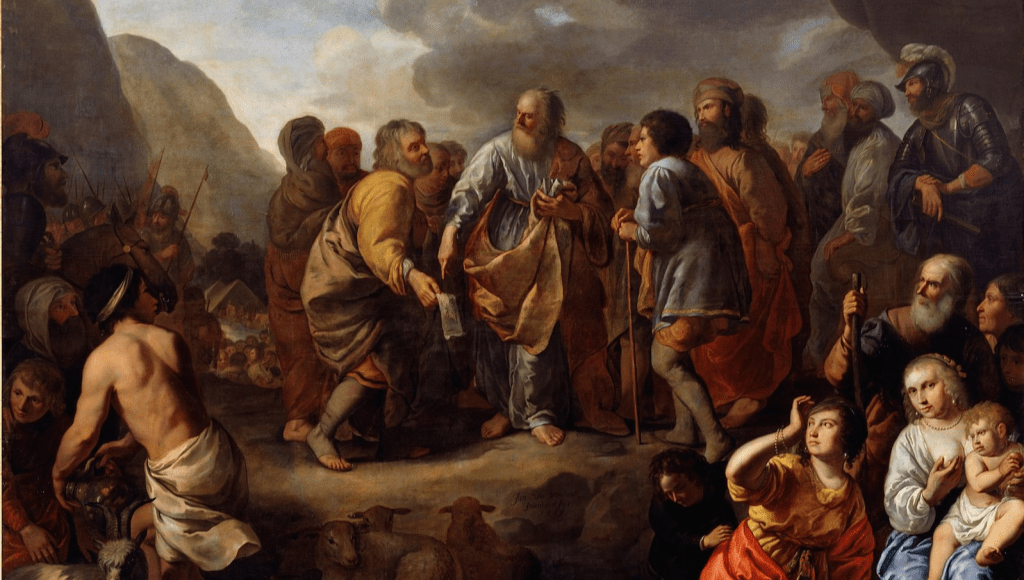
Jethro advising Moses, by Jan Gerritsz van Bronckhorst (1603-1661)

Meetings and church services within the task-oriented system tend to be ends in themselves (frustrating and boring!) because the meeting itself is just something that gets scratched off the to do list. Churches that have a hard time making decisions are probably stuck in the task-oriented mode, because there is no over-arching framework from which to decide anything.  

So, people entrench themselves in positions based in personal preferences. It’s the world of heated conversations and worship wars. If motivation and morale is dependent on people getting their way, no one is likely to be happy. The great need for a task-oriented church is a big picture vision that seeks results.

The results-oriented organization focuses on achieving some desired outcomes. This is the kind of organization that Jethro was thinking of when he observed Moses engaged in the endless task orientation of hearing people’s cases.

Tasks and functions are not ends in themselves, but will continually change in order to accomplish the results we want. This is a church or organization oriented around mission.  

Jesus came to this earth to accomplish the salvation of the world. He was on a mission of love – intent on extending grace to lost sinners. In this setting, decision-making becomes exciting. A group of people come up with ideas and tasks about loving people and reaching them with the grace we have received from God.  

A results orientation has personal preferences taking a back seat to the great needs of the community. There is freedom to experiment and imagine together, instead of guilt for not getting something crossed off the “To Do” list.

In truth, I like to create lists; it feels good when everything is scratched off the list at the end of the day. But I make sure that those things are a means to an end, and not the end itself.  

By orienting my ministry around mission (God’s, not mine) I am able to create tasks and functions that contribute to seeing the kingdom of God break into the church and the world. So, here are two K.I.S.S. questions for every leadership team:  

What result(s) would you like to see in your church?  

What kind of tasks will help you get the results you want?

Jesus is building his church, and the gates of hell will not overtake it. We can participate, change, grow, live, and learn, without fear of screwing up the church and making it more complicated than it is. Why? Because Jesus is the One building it.

All we need is a bit of grace with each other to step out by faith and make a difference by focusing and planning for some worthy, good, and just outcomes.

Almighty God, we pray for leaders everywhere in every place, that you will guide them in the ways of freedom, justice, and truth, so that all persons may live in peace. Lord, in your mercy, hear our prayer. Amen.