Be Careful about Your Decisions (2 Samuel 11:14-21)

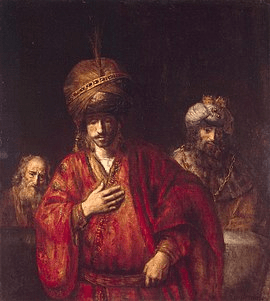
David and Uriah, by Rembrandt, c.1665

In the morning David wrote a letter to Joab and sent it with Uriah. In it he wrote, “Put Uriah out in front where the fighting is fiercest. Then withdraw from him so he will be struck down and die.”

So while Joab had the city under siege, he put Uriah at a place where he knew the strongest defenders were. When the men of the city came out and fought against Joab, some of the men in David’s army fell; moreover, Uriah the Hittite died.

Joab sent David a full account of the battle. He instructed the messenger: “When you have finished giving the king this account of the battle, the king’s anger may flare up, and he may ask you, ‘Why did you get so close to the city to fight? Didn’t you know they would shoot arrows from the wall? Who killed Abimelek son of Jerub-Besheth? Didn’t a woman drop an upper millstone on him from the wall, so that he died in Thebez? Why did you get so close to the wall?’ If he asks you this, then say to him, ‘Moreover, your servant Uriah the Hittite is dead.’” (New International Version)

Today we have a lesson in the middle of a story about King David’s greatest error in judgment and cover up of that decision. Indeed, bad decisions can often beget even more bad decisions.

It would be an understatement to say that David blew it. Our Old Testament books of 1 and 2 Samuel are arranged by the original editor in such a way that the chapter of 2 Samuel 11 is a hinge upon which the life of David moves.

All of the material before 2 Samuel 11 is generally positive, describing a man devoted to God in every way. But everything after this chapter is mostly tragic. The editor wanted readers and listeners to understand that God cares about morality and ethics by showing the consequences of both a life well-lived, as well as a life that is self-centered.

Before our verses for today, the story begins with David choosing adultery and taking another man’s wife. King David should have been doing the work of a king – protecting and serving Israel. But instead, he hung out in Jerusalem and avoided all the needed military stuff. (2 Samuel 11:1)

The editor wants us to see that King David was shirking his responsibility, which then brought a set up for moral failure. It appears David was resting on his laurels, content with his victories and successes. For the most part, at the time, the nation was happy and prosperous.

The king was walking around on the roof of his palace, instead of being in the trenches with his men, leading them in the defense of Israel.

Rather than giving proper orders as a king ought to do, David was sending people to do his personal bidding in satisfying his earthly wants. This is a significant reversal of what we see from earlier chapters in the story of David.

Up to this point we have observed David as a merciful king, seeking to use power for benevolent purposes in the common good of the nation. But in today’s chapter, David turns into the typical earthly king, ordering others around and using his authority to get what he wants.

The editor wants us to learn some lessons from David’s life. One of those lessons is that if the right and just King David can fall, then none of us are immune from falling into bad decisions which alter people’s lives forever.

The moment we think we are above falling, look out, because an arrogant nose dive into depravity is probably not far behind.

The stories of people who fall into immorality are mostly the same. Having some power or authority to wield, they use it to assert control over another person or group in order to get what they want – without being concerned for the needs and wants of others, and usually unconcerned for the negative consequences it brings upon other people.

It’s important that we call such behavior what it is: Evil. Awful. Selfish. Ungodly. A violation of ethics and morality. An offense against God.

David committed adultery, then lied, manipulated others, and covered up his actions. He murdered an innocent man, and was okay with an entire regiment of soldiers getting killed to ensure that an innocent man would be dead.

None of that icky nasty stuff was a mistake, or a lapse in judgment. It was pre-meditated sin.

And the way to deal with such sin is not to say something like “I did it, but it wasn’t really me; I’m not really like that!” Well, apparently, you are. Maybe David thought he was above it all, and believed it wasn’t really something he could ever do. But he did.
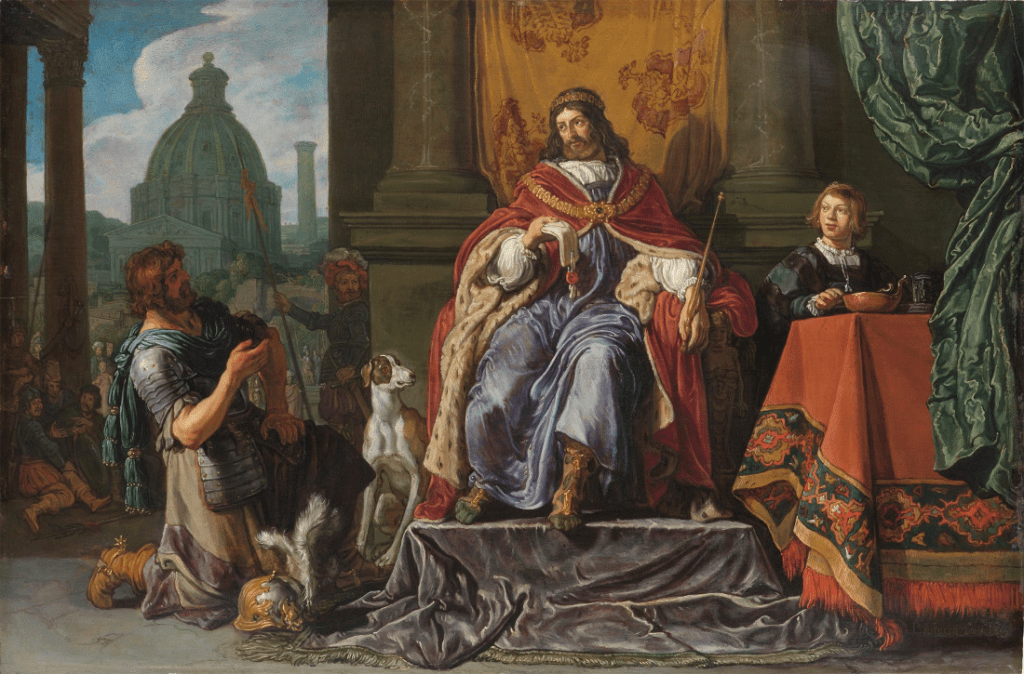
David gives Uriah a letter for Joab, by Pieter Lastman, 1619

Once we make an immoral and ungodly decision, it often causes us to start selling-out our principles and convictions. Sin only begets more sin, until we deal with it squarely.

Truth is a celebration of openness and honesty. Shame keeps to the shadows and prizes secrecy and remaining quiet. If one chooses not to go down the path of truth, then they will be continually encrusting their lives with lies so that no one ever knows.

In fact, much of religious legalism is nothing more than a person piling on the rules in order for others to not see the guilt and shame that hides deep within. Only through confession, repentance, and faith, will forgiveness, wholeness, and happiness ever occur.

Yet another lesson we can learn from this story of David is that the results which may satisfy our wants may not necessarily satisfy our needs, or God.

David accomplished what he wanted. He was successful in covering up his sin, and he got the woman he wanted. But God saw the whole thing, and was not okay with any of it. 

We must not assume that because we do something, and there was no immediate lightning strike, that it was okay. 

To only selfishly satisfy ourselves is to be a spiritual cannibal who eats other people alive.

So, how might we avoid falling into the same sorts of bad decisions which befell David?

  • Make prayers of confession a regular staple of your daily spiritual regimen. Had David engaged in prayer on the roof instead of being bored, we would likely have a very different story.
  • Maintain an active and engaged mind. An idle mind is the devil’s workshop. David was wandering around the palace instead of actively engaged in the government of his kingdom.
  • Keep the Sabbath. A day of rest helps the body to be in healthy rhythms of care, as well as enabling the spirit to connect meaningfully with God. Without adequate rest, we are like the little kid in a grocery store at 9pm throwing a fit and having a meltdown. David got out of a healthy rhythm as king, and it led to a fall.
  • Strengthen your family relationships. If you are married, live from the place of your marriage. Marriage is more than living with someone and having occasional fun; it is a one-flesh relationship that is meant to be a priority. Only from this relational place can a spouse effectively take on the world with all its needs and brokenness. 
  • Submit to accountable relationships. There are far too many lonely people with few friends in this world, even among people who are constantly around others. Everyone needs a small coterie of confidants with whom to share anything and everything with.  David’s close friends were all out with the army, and he was alone. Not a good thing.
  • Avoid stuffing all desire down as selfish and bad. Jettisoning desire only sets us up for a fall. But identifying godly desire enables us to make better decisions which engage the whole person.

Almighty God, you are the fountain of all wisdom and grace. You know our needs before we even ask, and our ignorance in not asking for the things we really need. Have compassion on our weakness, and mercifully give us those things that in our blindness we don’t know to ask for. 

Gracious Lord, we acknowledge and confess our sinful nature, prone to evil and slow to good.  You know our secret sins, and how often we have offended you and damaged others through wandering from your ways, wasting your gifts, and forgetting your love. Cleanse us from our hidden sins and forgive our faults for the sake of your Son, our Savior, Jesus Christ who loved us and gave himself for us. Amen.

A King Is Anointed (1 Samuel 10:1-8)

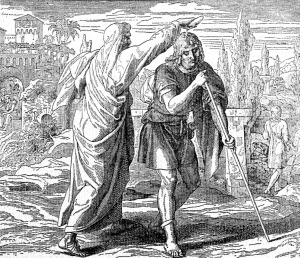
Samuel anoints Saul as king, by Unknown artist

Then Samuel took a flask of olive oil and poured it on Saul’s head and kissed him, saying, “Has not the Lord anointed you ruler over his inheritance? When you leave me today, you will meet two men near Rachel’s tomb, at Zelzah on the border of Benjamin. They will say to you, ‘The donkeys you set out to look for have been found. And now your father has stopped thinking about them and is worried about you. He is asking, “What shall I do about my son?”’

“Then you will go on from there until you reach the great tree of Tabor. Three men going up to worship God at Bethel will meet you there. One will be carrying three young goats, another three loaves of bread, and another a skin of wine. They will greet you and offer you two loaves of bread, which you will accept from them.

“After that you will go to Gibeah of God, where there is a Philistine outpost. As you approach the town, you will meet a procession of prophets coming down from the high place with lyres, timbrels, pipes and harps being played before them, and they will be prophesying. The Spirit of the Lord will come powerfully upon you, and you will prophesy with them; and you will be changed into a different person. Once these signs are fulfilled, do whatever your hand finds to do, for God is with you.

“Go down ahead of me to Gilgal. I will surely come down to you to sacrifice burnt offerings and fellowship offerings, but you must wait seven days until I come to you and tell you what you are to do.” (New International Version)

Events were in motion. The priest and prophet Samuel was quite aware of the happenings. But the would-be king Saul was not at all savvy to what was transpiring.

While out and about engaging in his regular circuit ministry as judge in Israel, Samuel presided over the sanctuary feast. Saul was the unbeknown guest of honor. He had been picked out and placed at the head of the table. Only Samuel knew what was going on.

Without calling any attention to it, God was at work behind the scenes. The Israelites had petitioned for a king. They were of an attitude that we might imagine them being a bunch of malcontent children who complained to God saying, “All the other nations have a king. Why don’t we? We need a king, too! Give us a king! We want a king!” Who knows but that there maybe was a bit of stomping the foot along with the demand.

Sometimes what we think we want is not what we need.

Despite the people’s frame of mind and heart, and refusal of Samuel’s warning to them, the Lord decided to grant them a king. And Saul was the one chosen by God.

The actual anointing of the king, and setting him apart for that service, happened in private between Samuel and Saul. The priest poured oil on the head of Saul – which was a symbolic way of installation, as well as a sign of God’s blessing on him for a special position of leadership. This is why kings were often referred to as “the Lord’s anointed.”

Samuel anointed Saul as king. Art by Sefira Lightstone

As contemporary readers of the Bible, and separated by thousands of years of ancient Israelite culture, we may fail to grasp how radical this event is in Jewish history. Israel went centuries without any king at all; and now, at this point with Samuel and Saul, they have their first one.

This was a moment that changed everything for Israel. Even though Saul becoming king in Israel, this would likely not be identified by anybody as a seminal event in the Bible. Yet, just because it originally came without any glitz or ornate ceremony, the establishment of a kingship was a watershed moment, nonetheless.

But that’s typically how many things in life shake-out. People pray in the privacy of a secret prayer closet, or decide to step out with obedient faith for a seemingly insignificant place in time. There are no paparazzi or reporters, no large crowds or anyone really paying attention.

We choose to do something in the obscurity of our mundane daily lives. But the Lord is directing us, moving us toward something we could never imagine was going to happen. Big consequences can come about through the smallest acts of humility and quiet obedience.

Hopefully, we are more like this, than like the people who whined and clamored for a king.

Saul was anointed king. The people needed to know it. And Saul needed to be prepared for being a new sort of leader. Israel had to realize that God was setting up the kingship; it wasn’t just a thing Samuel came up with.

Therefore, three signs were given for Saul to expect. Each sign became progressively bigger so that the public could see and know that Saul is the person for whom God anointed.

Up to this point, Saul was really nothing more than another person in Israel. He never went to King’s College and learned how to be royal, simply because there was no such thing. But that was no problem for God. The Lord has the power and authority to turn anyone into a different person – including a king who can lead the people.

The only thing Saul had to do is listen to Samuel and obey the Lord. That’s it. Nothing more. Samuel would keep doing what he’s always been doing; and God will do what God has always done. Saul only needed to hear and do.

However, we can anticipate what happens whenever we humans are left to do nothing but listen and obey; we far too often hear and get anxious. And in our anxiety, we think we heard something different than what we really heard.

Things get complicated pretty fast when anxiety gets in the mix. Yet, to listen and obey is really quite simple, at its core.

Whenever things get crazy and complicated for you, I wonder if its really more complicated in your head or your heart than it really is. Perhaps it might be a lot simpler and calmer if you and I just did what we need to do, when we need to do it, without overthinking things.

Part of the reason the new kingship changed everything so much, is that after Saul became king, things got complicated pretty fast. And I think you know why…

O God, the source of all health, well-being, and peace: So fill my heart with faith in your love and trust in your divine will, that with calm expectancy I may make room for your power to possess me, and gracefully accept your leading in my life. Amen.

Are You In Need? (John 7:37-39)

On the last day of the festival, the great day, while Jesus was standing there, he cried out, “Let anyone who is thirsty come to me, and let the one who believes in me drink. As the scripture has said, ‘Out of the believer’s heart shall flow rivers of living water.’ ” Now he said this about the Spirit, which believers in him were to receive, for as yet there was no Spirit because Jesus was not yet glorified. (New Revised Standard Version)

Let’s take Christ’s words at the end of the Jewish Festival of Booths (or Tabernacles) at face value. Jesus said that if anyone is thirsty, they could come to him and drink. This is an unconditional statement with no caveats, qualifications, or fine print to it.

Jesus did not say that if anyone is spiritual enough, strong enough, or committed enough that then they could come to him.

The only qualifications one must have in coming to Jesus is to be needy. To be thirsty and want a drink is it, period. No interviews. No jumping through any hoops. No red tape. No having to go through one of the disciples to get to Jesus. No obstacles whatsoever.

Sheer need and want gets anybody an audience with Jesus.

“Thirsty” is Christ’s simple metaphor for need. Whenever we long to have our needs met, there is always the opportunity and possibility of going to Jesus. And all of us are thirsty because every single person has needs that aren’t getting met. These important and vital words of Jesus are encouraging. They help us admit whatever is going on, and say to him, “I need you, Lord.”

The Lord’s response to such a humble expression of need is this: “Please come here to me and drink till you are full.” No judgment. No condemnation. No big sighs. No snarky comments. No disappointed looks. Our confession of need accesses divine compassion and help.

Who will help us? The Holy Spirit will help.

Christ ascended and gave us the Spirit. On this day before the Christian celebration of Pentecost, we are reminded that Jesus delivered on his promise to give help. There is no better assistance in all the world than having a permanent live-in Guide, Helper, and Advocate who is continually alongside us, even in us.

Ask. Seek. Knock. That’s it. Help is just a call away.

We have a popular commercial figure in my city, a lawyer, whose one-liner is, “One call. That’s all!” And help will come. All we need to do is express our needs and wants.

And yet, that is so awfully hard for so many people. It seems weak or selfish to come right out and say what we need and what we want. Yet, if we are to embrace any sort of Christian discipleship, straight forward asking will be involved.

Believers can state their needs simply. They are breathed on by the Spirit. Then, we have our thirst satiated. If we make it more complicated than that, we lose the incredible simplicity of the gospel – good news for needy people. Yet, we sometimes make it complicated by not coming out and saying what we need.

Why, in tarnation, is it so hard for people to ask for what they need and want?

For many, it’s because they have never been given permission to do so. They were never encouraged to express their needs and wants. However, it is perfectly acceptable to state what you want, and what you really need. Ask for what you want, and you may be surprised at how often you get it.

The lack of asking goes much deeper than this. Our fear of vulnerability and being judged by God (and others) prohibits us from asking for what we really want.

Therefore, we must see and understand that vulnerability is crucial to having our needs met. Only through being open enough to share what you need will relational connection happen. A relationship with Jesus is based on humility and vulnerability. Without it, there is no relationship.

We also might be afraid of not getting what we ask for; so we don’t ask, at all. Or, conversely, we may be afraid of receiving our asking! On some level, it’s more comfortable to stay in a familiar situation. We think we want something different, but we’re worried about the downside of getting it. We fret and wonder about it, not trusting ourselves. So, we become paralyzed, unable to say what we really want or need.

All of this overthinking comes down to our own image of self. It’s as if we don’t believe we deserve to be treated well. But the reality is: This isn’t about whether you deserve to have something; it’s about your needing or wanting it. Plain and simple. There’s no shame, being in want or need.

Some folk are so used to putting others first and meeting another’s need that they become stymied by their own inability to state what they need. So, they try and feel better by meeting everyone else’s need. When they become bitter about being emotionally depleted, and when they are thirsty for someone to meet their needs, they end up not asking for help – because they feel they can’t.

But you can, and you must. Jesus says so. We don’t always get what we want in life. But we won’t get it if we don’t ask. It’s good to focus on what you want or need in life, instead of questioning whether you’re worthy to receive it. Jesus said:

“Keep on asking, and you will receive what you ask for. Keep on seeking, and you will find. Keep on knocking, and the door will be opened to you. For everyone who asks, receives. Everyone who seeks, finds. And to everyone who knocks, the door will be opened.” (Matthew 7:7-8, NLT)

So, what are you waiting for!?

Acts 17:1-9 – Beware of Jealousy

When Paul and his companions had passed through Amphipolis and Apollonia, they came to Thessalonica, where there was a Jewish synagogue. As was his custom, Paul went into the synagogue, and on three Sabbath days he reasoned with them from the Scriptures, explaining and proving that the Messiah had to suffer and rise from the dead. “This Jesus I am proclaiming to you is the Messiah,” he said. Some of the Jews were persuaded and joined Paul and Silas, as did a large number of God-fearing Greeks and quite a few prominent women.

But other Jews were jealous; so, they rounded up some bad characters from the marketplace, formed a mob and started a riot in the city. They rushed to Jason’s house in search of Paul and Silas in order to bring them out to the crowd. But when they did not find them, they dragged Jason and some other believers before the city officials, shouting: “These men who have caused trouble all over the world have now come here, and Jason has welcomed them into his house. They are all defying Caesar’s decrees, saying that there is another king, one called Jesus.” When they heard this, the crowd and the city officials were thrown into turmoil. Then they made Jason and the others post bond and let them go. (New International Version)

Inevitably, whenever someone makes a splash and does something which receives a great deal of attention and/or kudos, there’s somebody else grumping in the background with jealousy.

A jealous person is a dangerous person. They seek to topple the object of their jealousy so that attention can be diverted on them.

It is an insidious game which the jealous play. Often, gaslighting is their major tool of choice – to spin circumstances in such a way that others will accept the jealous person’s view of events.

There is a difference between persuasion and gaslighting

Paul sought to persuade people that Jesus is the Messiah by understanding his audience, connecting their spiritual values with his, demonstrating competence and compassion, being clear and concise, and exemplifying a genuine spirit of integrity. Paul painted a compelling picture which was winsome and benefited the people.

Whereas his fellow Jews observed Paul’s success at persuasion and chose to gaslight the crowd by telling outright lies, playing on people’s fears, questioning motives, creating doubt, and withholding information. It is an emotionally abusive form of speaking which paints an awful picture of what will happen if the other person (Paul) has his way.

Paul had the people’s (and God’s) best interests at heart…

…the other Jews were looking out for themselves and had their own interests in mind.

Jealous persons often try to use gaslighting techniques to get their way. It’s what Satan tried to do with God, more than once.

We live in an age of envy

Jealousy is rife in our world, especially in the envy-laced West. Westerners have job-envy, food-envy, body-envy, house-envy, and a hundred other jealousies, mostly fueled by capitalist marketers who are, either knowingly or unknowingly, economic gaslighters – picturing for us a world of things we supposedly need.

And social media ups the ante by allowing millions of people to put forth a reality of themselves to others which isn’t real, at all – which ends up fomenting jealousy in others who believe they deserve this picture, as well.

If this all sounds weird and convoluted, well, it is. But that’s what jealousy does. It twists things to such a degree that we don’t even know what’s real anymore.

Jealousy survives and thrives through comparison – looking at another and deciding I need what they have. Then, unfortunately, the next logical step, for many, is to knock that other person down a few pegs so that I can get some of that attention and receive some of that stuff.

Jealousy and envy can take a very dark turn, at any time

Going beyond disparaging a person, there can be a malicious and underhanded bent to destroy what someone else has. Not just wanting it for yourself but wanting other people not to have it. This is a deep-seated resentment which breathes hatred and destruction. It’s the kind of jealousy the Jews had for Paul.

We all get jealous, at times; it’s part of the human condition. So, here’s a healthy way of dealing with it, instead of going dark and vengeful: Just as our hunger tells us we need to eat, the feeling of jealousy, if we will listen to it in the right way, can show us what is missing from our lives that really matters to us.

Acknowledging and naming the jealousy for what it is, then opens us to determine what my real need is, which perhaps, might not be getting met. We all have legitimate needs for love, belonging, and purpose. It’s just that we sometimes seek to meet those needs in illegitimate ways – like envy.

In a society where expressing needs may be looked upon as selfish or weak, many people opt to hustle for those needs through convincing a bunch of rabblerousers that another should get beat up and disparaged.

Let’s not do that… Let’s not start a riot.

It’s both okay and vital that we learn to ask for what we need and want – because the alternative isn’t going to end well.

Lord Jesus, fill us, your people, with charity, compassion, faith, gentleness, hope, humility, joy, kindness, light, love, mercy, modesty, patience, peace, purity, security, tranquility, trust, truth, understanding, and wisdom. Help us to walk in light and in truth, illuminated by the Holy Spirit so that together we may praise, honor, and glorify Our Father today and throughout all time. Amen.