John 16:16-24 – There Must Be Suffering Before Glory

Jesus went on to say, “In a little while you will see me no more, and then after a little while you will see me.”

At this, some of his disciples said to one another, “What does he mean by saying, ‘In a little while you will see me no more, and then after a little while you will see me,’ and ‘Because I am going to the Father’?” They kept asking, “What does he mean by ‘a little while’? We don’t understand what he is saying.”

Jesus saw that they wanted to ask him about this, so he said to them, “Are you asking one another what I meant when I said, ‘In a little while you will see me no more, and then after a little while you will see me’? Very truly I tell you, you will weep and mourn while the world rejoices. You will grieve, but your grief will turn to joy. A woman giving birth to a child has pain because her time has come; but when her baby is born, she forgets the anguish because of her joy that a child is born into the world. So, with you: Now is your time of grief, but I will see you again and you will rejoice, and no one will take away your joy. In that day you will no longer ask me anything. Very truly I tell you, my Father will give you whatever you ask in my name. Until now you have not asked for anything in my name. Ask and you will receive, and your joy will be complete. (New International Version)

“Even a happy life cannot be without a measure of darkness, and the word happy would lose its meaning if it were not balanced by sadness. It is far better to take things as they come with patience and equanimity.”

Carl Jung

An Unpopular Message

Jesus often said things that were neither expected nor wanted. Jesus consistently told his disciples there must be suffering before glory. The disciples either could not or would not hear of it. They didn’t sign up to follow Jesus into suffering! Trying to get people to pay attention to suffering is like trying to get a bunch of Baptists to put their names down on a sign-up sheet at church.

Christ was speaking to his disciples in the Upper Room, the last meal he had with them before his death. When they were called by Jesus three years earlier, the disciples were not expecting all the gibberish about leaving and grieving. To put this in contemporary terms, the disciples’ response was akin to saying, “I only think positive. I don’t listen to things that are negative.”

Suffering, death, and grief were far from the disciples’ expectations of how things would and should shake-out. They had such a hard time understanding what the heck Jesus was saying because his words were out of alignment with their assumptions. Yes, there would be glory and joy. First, however, there must be suffering and grief.

A Real Message

Just as a woman experiences terrible pain in childbirth, then ecstatic joy over seeing her child for the first time, so the Christian’s excruciating pain in this life points to the inevitable joy at the end of that suffering. In the scope of eternity, adversity and pain last only a moment. Glorious joy, however, will be forever.

In talking with his disciples about their disappointment, even depression, about Christ’s words of leaving and grieving, Jesus graciously gave them the gift of joy. Yes, there can be and is joy even in the mourning. Not every story has a happy ending.

I can say, however, that the grandest story of all – Jesus Christ’s suffering and death – has resulted in resurrection and ascension. It will all be complete when Christ returns to judge the living and the dead. Then, the grand narrative of redemption will realize its conclusion of no more crying, tears, or pain. There will be only unending joy.

For now, however, we still experience heartache along with the great joy of resurrection and new life. It can be confusing, living in the awkward state of simultaneous grief and joy. Yet, keep in mind, the grief is temporary. The despair will not last. Joy, on the other hand, has staying power and will be the permanent state of the believer. It is only the smaller stories which may or may not end well. The big story of redemption already has the ending written – joy without grief.

A Good Message

Christians serve a risen and ascended Lord. Therefore, we need not wait to be happy, and we need not expect everything must go our way. The good news is that there are always fresh opportunities to be happy through asking and receiving. Imagine a Partridge Family sort of bus coming around to all the bus stops of life. Happy times and music arrive around the clock. Chances are the opportunity to be happy has already arrived. Often, it is right in front of us; we just missed the bus because we were daydreaming about a future state of joy.

We are living days of constant change followed by ever new normal. Just as there was no going back to a three-year hiatus of walking with Jesus for the disciples, so we need to embrace new and different ways of life together here on planet earth. We have the gift of joy. Its just a matter of unpacking it.

Now to him who can do immeasurably more than all we ask or imagine, according to his power that is at work within us, to him be glory in the church and in Christ Jesus throughout all generations, for ever and ever! Amen.

Matthew 5:1-12 – The Beatitudes of Jesus

Sermon-on-the-Mount
A Bengali depiction of Christ’s Sermon on the Mount

Now when Jesus saw the crowds, he went up on a mountainside and sat down. His disciples came to him, and he began to teach them. He said: 

“Blessed are the poor in spirit, 
    for theirs is the kingdom of heaven. 
Blessed are those who mourn, 
    for they will be comforted. 
Blessed are the meek, 
    for they will inherit the earth. 
Blessed are those who hunger and thirst for righteousness, 
    for they will be filled. 
Blessed are the merciful, 
    for they will be shown mercy. 
Blessed are the pure in heart, 
    for they will see God. 
Blessed are the peacemakers, 
    for they will be called children of God. 
Blessed are those who are persecuted because of righteousness, 
    for theirs is the kingdom of heaven. 

“Blessed are you when people insult you, persecute you and falsely say all kinds of evil against you because of me. Rejoice and be glad, because great is your reward in heaven, for in the same way they persecuted the prophets who were before you. (NIV) 

Just as God’s Law was given on a mountain (The Ten Commandments) so the law was restated on a mountain by Jesus (Sermon on the Mount). I believe that arguably one of the most important and impacting portions of Holy Scripture are the Beatitudes of Jesus, which serve as the foundation to all of Christ’s teaching. These Beatitudes are not simply a random collection of pithy phrases from Jesus on what constitutes approval from God. They intentionally build upon each other and describe true righteousness.  

Blessed are the poor in spirit.   

This Beatitude is the spiritual base to the Christian life.  Most of the original crowd listening to Jesus thought they were on the outside of the kingdom, on the margins of true religion. Instead, Jesus told them they have a place as poor and pitiable people. To be “poor in spirit” means one is a spiritual beggar who recognizes they have nothing to offer God. It is seeing oneself, one’s sin, and one’s life as spiritually bankrupt apart from God. Beggars have no ability to strike deals; they have nothing to leverage with; and, realize they deserve nothing. Beggars do one thing continually: they beg. The proud person would never be caught begging for anything. Yet, the humble spiritual beggar constantly prays because they need God! They discern that without God there is no hope. The kingdom of heaven belongs to the penitent and not the proud. 

Blessed are those who mourn. 

This is the emotional response of acknowledging one’s spiritual poverty.  Grief and lament have a central place in Christian theology and life. To avoid it, work around it, or short-circuit its process is to refuse Christ because there is no righteousness apart from mourning over sin. Crying, weeping, and even intense tears are important and necessary. To experience personal grief over one’s sins and the sins of the church and the world is a Beatitude of Jesus. You neither need position, power, privilege, nor pedigree to be a mourner. All can mourn. This is the door by which we enter the kingdom of God. 

Blessed are the meek. 

A meek spirit is the result of realizing our poverty of spirit and practicing grief and lament. At the heart of what it means to be meek is a spirit of non-retaliation. When we are flat on our backs before God, there is no place to look but up. Thus, there is no ability to look down on others. To be meek is to be broken before God. A meek person takes personal responsibility for their attitudes and actions. The meek have no need to retaliate, even when egregiously wronged, because they fully entrust themselves to God alone who judges the living and the dead. Ironically, brokenness is the path to righteous wholeness. 

Blessed are those who hunger and thirst for righteousness. 

Only those who know their poverty of spirit, personally grieve over sin, and are truly humble/meek end up longing for righteousness. This is much more than just desire; this is the recognition that without God I will not make it. I cannot be righteous without Jesus. Simply put, righteousness is a right relationship with God and others. That is what happens when a person is meek. Such a person knows she cannot make things right by herself; she needs help, specifically, God’s help. If we ever have the thought that we can live most days of our lives without God, we do not yet know true righteousness. People who understand their great need for Jesus are easy to spot. They crave and devour God’s Word as their daily food; and they cannot stop blabbering on about Jesus. 

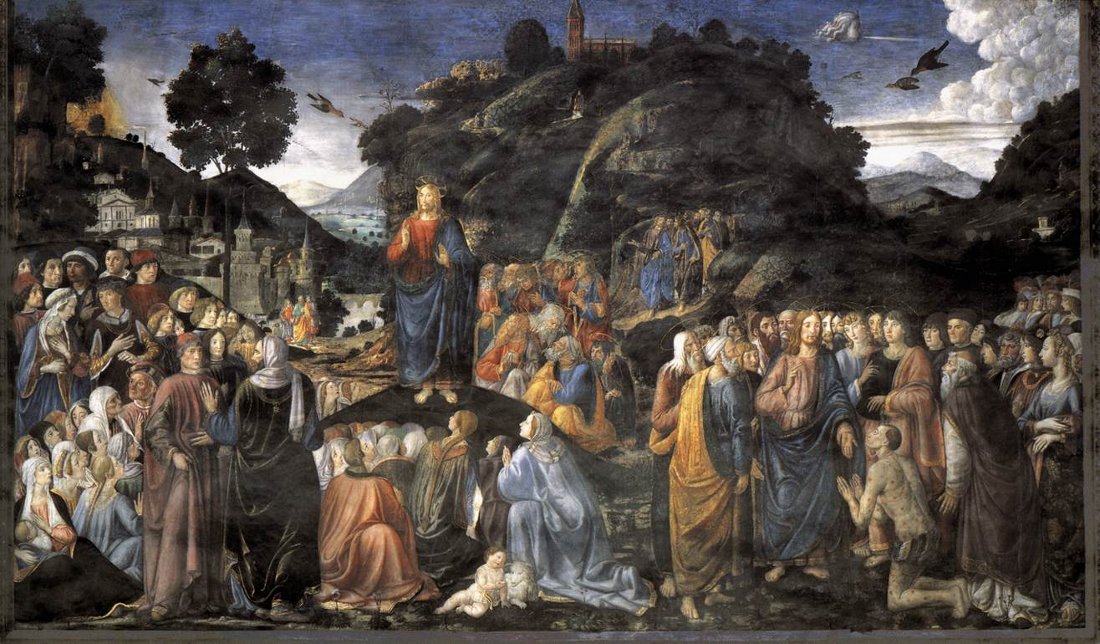
Sermon on the Mount
A fresco of the Sermon on the Mount on the northern wall of the Sistine Chapel.

There are three practices of living that arise from being filled with God’s righteousness.  They are the next three Beatitudes of mercy, purity, and peacemaking. These cannot be conjured up by our own will. They organically grow within us and are freely expressed because of what God is doing in our lives. You cannot force them any more than you can force a stalk of corn to grow on your terms. Instead, you work with the unforced rhythms of God’s grace and allow his righteousness to take root in you. Below the soil the activity of spiritual poverty, mourning, and humility takes place. Then, when the plant breaks the soil and flowers, it produces mercy, purity, and peace-making. 

Blessed are the merciful.  

Mercy begins with a disposition of the heart that seeks to be generous. Mercy is a loving response to someone or a group of people in misery. We accept them and help them because we ourselves have been there. Mercy looks for ways to come alongside others and help, rather than pile expectations and burdens on others without mentoring them in the ways of God. 

Blessed are the pure in heart. 

Purity also results from true righteousness. A stalk of corn might look good, but if you shuck it and it is filled with worms, it isn’t going to be worth much. Legalistic righteousness is concerned to look good, is obsessed with performance, perfection, and possessions. Conversely, the righteousness of God fills our hungry hearts and makes us pure and holy, set apart for his use. 

Blessed are the peacemakers.  

Peacemakers are people who find themselves caught in the middle and want to live righteously with the mercy and purity that God has provided for them. Peace is only realized through peacemakers. It seems we all desire peace, yet, peacemakers are hard to come by. It’s a tough gig. Peacemakers exist through being characterized by the earlier Beatitudes. To achieve peace, one must first be at peace with God and self – which is why we need the cross of Jesus Christ. 

Blessed are those who are persecuted because of righteousness.  

When a person lives in this righteousness as presented by Jesus, there will be persecution. Folks who are offended by even slight criticisms are usually the ones who are privileged and in power. They have not yet learned the ways of Jesus. Pettiness is nothing more than a sign of unrighteousness. Yoking up with Jesus, following him, and living into his words and ways has always been risky and dangerous. The Beatitudes of Jesus are not characteristics that lead to power, prestige, or possessions, but likely just the opposite. 

The former Pope Benedict XVI, explained Christ’s Beatitudes this way: “The Beatitudes, spoken with the community of Jesus’ disciples in view, are paradoxes – the standards of the world are turned upside down as soon as things are seen in their right perspective, which is to say, in terms of God’s values, so different from those of the world. It is precisely those who are poor in worldly terms, those thought of as lost souls, who are truly fortunate ones, the blessed, who have every reason to rejoice and exult in their suffering. The Beatitudes are promises resplendent with the new image of the world and humanity inaugurated by Jesus.” 

Those who are in Jesus Christ become living beatitudes, walking, talking blessings to the world.  Those who live with Jesus in his kingdom have a destiny to be witnesses to another subversive, yet wonderful, way of life, where the last are first and the greatest are the least. 

O Lamb of God, that takes away the sins of the world, have mercy upon me. 

O Lamb of God, that takes away the sins of the world, have mercy upon me. 

O Lamb of God, that takes away the sins of the world, grant me your peace. 

Genesis 6:5-22 – The God of Emotion

flood of tears

The Lord saw that the human beings on the earth were very wicked and that everything they thought about was evil. He was sorry he had made human beings on the earth, and his heart was filled with pain. Sothe Lord said, “I will destroy all human beings that I made on the earth. And I will destroy every animal and everything that crawls on the earth and the birds of the air, because I am sorry that I made them.” But Noah pleased the Lord. 

This is the family history of Noah. Noah was a good man, the most innocent man of his time, and he walked with God. He had three sons: Shem, Ham, and Japheth. 

People on earth did what God said was evil, and violence was everywhere. When God saw that everyone on the earth did only evil,he said to Noah, “Because people have made the earth full of violence, I will destroy all of them from the earth. Build a boat of cypress wood for yourself. Make rooms in it and cover it inside and outside with tar. This is how big I want you to build the boat: four hundred fifty feet long, seventy-five feet wide, and forty-five feet high. Make an opening around the top of the boat that is eighteen inches high from the edge of the roof down. Put a door in the side of the boat. Make an upper, middle, and lower deck in it. I will bring a flood of water on the earth to destroy all living things that live under the sky, including everything that has the breath of life. Everything on the earth will die. But I will make an agreement with you—you, your sons, your wife, and your sons’ wives will all go into the boat. Also, you must bring into the boat two of every living thing, male and female. Keep them alive with you. Two of every kind of bird, animal, and crawling thing will come to you to be kept alive. Also gather some of every kind of food and store it on the boat as food for you and the animals.” 

Noah did everything that God commanded him. (NCV) 

When I was a kid, the picture of God I had in my little head was of a white-bearded old guy sitting in the clouds looking bored and paying little attention to the humans below. Maybe, once-in-a-while, he would take his divine BB gun and shoot people in the backside, just for some fun. Although I have considerably moved on from that type of theological vision, it seems to be a common caricature of God that he is often indifferent – and even more so that God lacks emotions (except maybe anger). 

The Holy Bible says a lot about humanity. It says even more about God. In fact, Scripture is primarily about revealing who God is – the Lord’s character, attributes – and, yes, emotions. Much like my childhood misunderstandings of God, I am not sure why so many people tend to view God as lacking in feeling and emotion. Maybe the Enlightenment with its focus on reason, logic, and classification simply drained all emotion from God. It could be that contemporary humans project on God their own stoicism toward emotions. Perhaps we see emotions as unreliable and fickle, characteristics that God would not possess – and, so, we jettison any thought of God as feeling deeply about things. Whatever the reason, we will fail to know God as God unless we come to grips with a verse like this:  

The Lord saw that the human beings on the earth were very wicked and that everything they thought about was evil. He was sorry he had made human beings on the earth, and his heart was filled with pain.”(Genesis 6:6, emphasis mine) 

Broken Heart

Rather than our emotional human nature being a result of the Fall, it is instead a part of our original design of being in Paradise with God. As God’s image-bearers, we carry the mark of God with feeling deeply about things, just like our Creator. In those times when sadness seems as if it might swallow us whole, we just may be closer to God in that moment than any other. God has a heart, and that heart has been hurt and broken more times than we could ever imagine. God’s emotions moved him to action. God’s sorrow led to destroying injustice. 

The thoughts, attitudes, and actions of violent and unfeeling people very much trouble God – to the point of being heartsickIt is our emotional makeup which connects us and bonds us with the divine. The inability to feel is the ultimate disconnect from God. 

Jesus also felt deeply about a great many things – so much so that he died from a broken heart. Recall that ithe seminal Sermon on the Mount Christ’s first words to the large gathering of people were: 

“Blessed are those who mourn.” (Matthew 5:4)  

We underestimate the importance and the power of emotions to our peril. Biblical writers often purposefully contrast differing persons in their stories. In today’s Old Testament lesson, that contrast is most vivid between God and wicked humanity. Humanity had gotten to a point where they felt nothing. The violent behavior was a direct result of their emotional selves split-off from the rest of them. People were bifurcated, their humanity chopped as if a meat cleaver separated their feelings from themselves. Whenever we observe belligerent bullying, hate speech, meanness, and oppression – there you find a paucity of emotions. It is not the presence of feelings that brings about wickedness; it is the lack of emotional awareness and the absence of feelings which is the highway to a watery grave. 

We are in the “Last Days,” that is, the time before the final event in the Christian tradition’s understanding of historyChrist will return to judge the living and the dead. The righteous will enjoy God’s presence forever; the wicked, not really. These days are too often characterized by the kinds of behavior which lack the emotional depth of godly love and a heart of compassion: 

There will be terrible times in the last days. People will be lovers of themselves, lovers of money, boastful, proud, abusive, disobedient to their parents, ungrateful, unholy, without love, unforgiving, slanderous, without self-control, brutal, not lovers of the good, treacherous, rash, conceited, lovers of pleasure rather than lovers of God.” (2 Timothy 3:1-4, NIV) 

For me, learning to name my emotions and to observe where I carry those emotions in my body has been most helpful in connecting with my feelings – and connecting with my GodAnd, I must add, such an emotional awareness and kinship with feelings has brought personal wellness and compassionate ministry to others. 

So, receive this blessing today: 

The eyes of Jesus gaze upon you, stirring his heart with compassion. 

The gaze of Christ sees your heart, your joy and sorrow. 

The gaze of Christ sees your future, filled with the healing of emotions expressed. 

The eyes of Jesus gaze upon you, filling his heart with adoration. Amen. 

Allowing Your Pain to Make a Difference

Resized_20170617_114022

There’s a reason I do what I do, and am what I am.  Through nearly 33 years of marriage my wife and I have been through a lot – more than I could ever share with you.  One of our big challenges came from the year 2014.  In the space of nine months, Mary had three spine surgeries.  I went from not only having the role of husband, but that of caregiver, as well.  It took months of daily physical and occupational therapy, not to mention the endless doctor visits, for my wife to learn to walk again and do simple tasks that most of us take for granted.

The good news is that Mary is upright and walking.  She can mostly get around and do things on her own.  The bad news is that she lives with chronic pain every single day.  Some days aren’t too bad, and Mary can accomplish a fair amount of what she wants to do.  But there are other days when she can’t get out of bed; days when taking a shower and getting dressed is all she can get done; and, days when the pain becomes so problematic that discouragement and depression sandwiches her like two evil slices of bread.

Yet, even on the worst of days Mary is an amazing wife.  She is tough and resilient, as well as compassionate and caring.  I’ve learned most of what I know about caring ministry from her.  I don’t talk a lot about her on this website.  Yet, Mary is behind each word I craft and every phrase I smith.  She is always on my mind and in my heart.  Mary has taught me how to care through the example of her own life, and given me the opportunity to show how much I care for her.

Mary maintains a Facebook page about her journey with pain called “Joy in the Mourning.”  Because she lives with chronic pain, her posts come neither regularly nor easily.  It is a labor of love, some days being a whole lot more labor than love.  Recently, Mary was able to return to a job.  By no means able to hold a full-time job, she has found meaningful work doing what she does best: caring for people as a companion to folks with dementia.

The following is her most recent post.  I hope you are encouraged in your own journey of faith.  Whether you face chronic physical or emotional pain, care for someone who does, or just want to live-out your faith in ways that make sense, I trust you find some joy in your life through whatever circumstances you may face today:

Friends, I’ve got great news!  I have completed the first 90 days at my job!  It’s been a long time since I have been able to say that.  I’m sore today from working. Usually, I say that I hurt today due to getting dressed or showering, walking the dog, or getting out of bed.  It has taken over 3 years, post-surgeries, to be able commit to a regular schedule of working.  

In my healing journey, I had to commit /submit myself to physical therapy, yoga stretching, strength training, biofeedback, acupuncture, massage therapy, weekly counseling with a pain psychologist, daily prayer, journaling, meditation, and even sought out healing through the laying on of hands from godly healers, as well as nutrition, essential oils and music therapy.  All very helpful, but…

I have to admit a foundational piece to getting to where I am today: I mourned. 

I gave myself permission to mourn my loss.  I admitted my anger… no, I wrestled with my anger is a better phrase; and, I embraced my sadness, and let myself feel the loneliness of disability. I asked the hard questions: WHY!? How long? I cried… a lot. In my darkest times a little spark of light invaded my space.  A gentle and soft comfort hugged my heart. A warm sprinkle of hope powdered my soul.  I began to discover a new kind of joy.

No matter what your specific suffering is, I believe that mourning your loss, and allowing yourself to walk through the valley of the shadow will lead you to a path where you can experience comfort, hope and even joy.  For me, this part of the journey has been life-giving. Christ understands suffering. He will walk with us through this experience.  

I never told you what I’m doing now. I am a companion for those who suffer – mostly Alzheimer’s patients, and those who are suffering life-altering afflictions.  I’m working 2-6 hours each day, sharing some of the comfort I received, and being real and open while allowing my pain to make a difference.  May you be blessed, my friends.