

Cooperation: an act or instance of working or acting together for a common purpose or benefit; joint action.
Coercion: use of force or intimidation to obtain compliance.
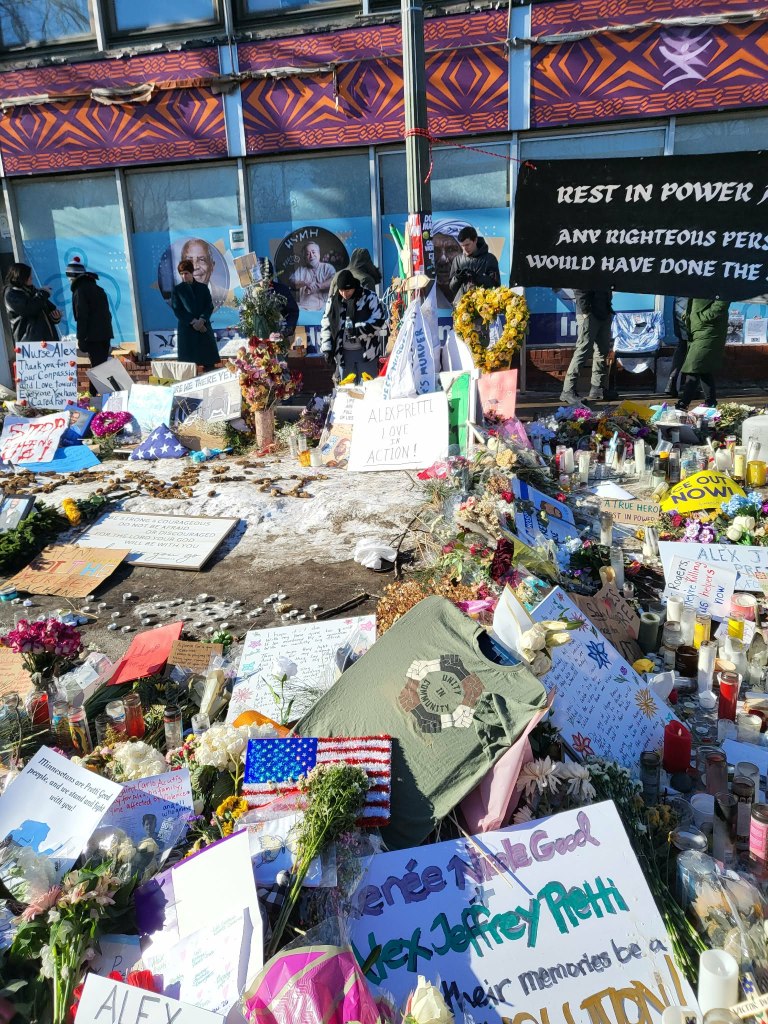
This week I was able to visit the site of Alex Pretti’s killing. With my clerical collar on, several persons came up and just hugged me, too traumatized to barely speak a word.
As I left the mournful scene, I understood that although we were all strangers, we had gathered together for a common purpose, seeking to work with one another for the benefit of justice and peace by means of a collective solidarity of humility and lamentation with a determined non-violent stance.
Right now, Minnesotans have an existential understanding about what it means to cooperate with each other. And they are equally clear about what non-cooperation is.
In recent weeks, in conversing with others not from Minnesota, some of them wrongly place the train of tragic events within the state at the feet of its leadership stating, “If they would just give some cooperation, then these killings and I.C.E. tactics wouldn’t have happened.”
Setting aside for now the bold-faced form of victim-blaming, there is here a very curious use of the word “cooperation.”
In December, when the Director of the Department of Homeland Security (DHS), Kristi Noem, came to the city of St. Paul, she did not come with an attitude or intention of cooperation but of coercion.
The Director unfortunately framed the concept of cooperation not as sitting down with Minnesota leadership as equals, working together and coordinating together in order to handle the “worst of the worst” when it came to immigrants.
Rather, Noem’s idea of cooperation is to have both the leadership and citizens of Minnesota keep out of the way of Immigration and Customs Enforcement (ICE) and leave them alone. She also made it clear that if anyone got in the way of ICE (which for her meant protesting) there would be consequences.
From the get-go, ICE had a mandate from the government not to cooperate with state and local officials, but to coerce them through whatever force they could leverage in order sweep those state officials aside, and then do whatever they wanted to do to the state’s immigrant population.
It is a sad reality that the present Trump administration seems not to care a wit about cooperation (even though they keep using the word). They evidence not understanding at all what cooperation really is. They’ve intentionally used coercive tactics from the beginning of their entrance to Minneapolis.
The approach of DHS and ICE has nothing to do with cooperation. Cooperation is built on mutual trust, whereas coercion’s base is always a use of raw power. And that what I and the rest of my fellow Minnesota residents are presently experiencing. It is literally impossible for us to cooperate with ICE because they have no concept of the term.
Why am I bringing up all of this? Because ICE and its federal government backing is not only oppressing and abusing power; they are also about as far as one can get from the words and the ways of Jesus Christ.
Interestingly, and sadly, when I mentioned this to a Christian who embraces the Trumpian “Make America Great Again” (MAGA) philosophy, his response was: “Funny you should bring Jesus into this,” as if the Lord Christ whom he claims to serve has nothing to do with any of the things happening to the residents of Minnesota.
Somewhere along the line, this person who confesses the name of Christ bought into the redefinition of the word “cooperation” to such a degree that he allowed Jesus to be purged away along with the state’s immigrant population.
Even the almighty and all-powerful God does not rely upon coercion in dealing with humanity. The Creator God, instead, invites human creatures to participate with him in a divine/human cooperative. There is no arm-twisting, no power plays, no threats. There’s only an invitation of participative commitment to love and good works in the world.
Wherever there is an incongruence between belief and action, and a reliance upon coercive power, there we find in Holy Scripture the encouragement and exhortation toward cooperation.
Therefore if you have any encouragement from being united with Christ, if any comfort from his love, if any common sharing in the Spirit, if any tenderness and compassion, then make my joy complete by being like-minded, having the same love, being one in spirit and of one mind. Do nothing out of selfish ambition or vain conceit. Rather, in humility value others above yourselves, not looking to your own interests but each of you to the interests of the others. (Philippians 2:1-4, NIV)
My experience in the Twin Cities has been, in may ways, difficult because I’ve seen the destructive and damaging power of coercion by the likes of DHS’s Kristi Noem and White House’s Stephen Miller, and ultimately of President Trump.
Yet, on the other hand, I’ve also experienced the beauty of vulnerable humanity coming together in a cooperative spirit of concern and love for one’s neighbor.
If it seems to the President that there is an organized effort in Minnesota with protesters, what he is actually observing is true community and neighborliness – something that, sadly, he nor anyone else on his senior staff seems to understand nor comprehend.
And that inability to see community when it is front of their faces is perhaps one of the greatest tragedies of all. Because without federal officials seeing this spirit of neighborliness and community cooperation, the hard tactics of ICE will continue, and the violence will not end.
Nobody here in the Cities is going to compromise or stand down from practicing loving cooperative community, nor should they have to.
Real cooperation and true beauty is not found in the halls of power; it is discovered in the places of weakness and powerlessness. And it is in this place of vulnerability that I choose to live and move and have my being in solidarity with the Lord Jesus.








 Rev. Tim Ehrhardt
