Access to God (Exodus 24:1-11)

Moses on Mount Sinai, by Jean-Leon Gerome, Moses on Mount Sinai, 1895

Then the Lord said to Moses, “Come up to the Lord, you and Aaron, Nadab and Abihu, and seventy of Israel’s elders, and worship from a distance. Only Moses may come near to the Lord. The others shouldn’t come near, while the people shouldn’t come up with him at all.”

Moses came and told the people all the Lord’s words and all the case laws. All the people answered in unison, “Everything that the Lord has said we will do.” Moses then wrote down all the Lord’s words. He got up early in the morning and built an altar at the foot of the mountain. He set up twelve sacred stone pillars for the twelve tribes of Israel. He appointed certain young Israelite men to offer entirely burned offerings and slaughter oxen as well-being sacrifices to the Lord. Moses took half of the blood and put it in large bowls. The other half of the blood he threw against the altar. Then he took the covenant scroll and read it out loud for the people to hear. They responded, “Everything that the Lord has said we will do, and we will obey.”

Moses then took the blood and threw it over the people. Moses said, “This is the blood of the covenant that the Lord now makes with you on the basis of all these words.”

Then Moses and Aaron, Nadab and Abihu, and seventy elders of Israel went up, and they saw Israel’s God. Under God’s feet there was what looked like a floor of lapis-lazuli tiles, dazzlingly pure like the sky. God didn’t harm the Israelite leaders, though they looked at God, and they ate and drank. (Common English Bible)

Mount Sinai, by Shlomo Katz (1937-1992)

We all know the experience of taking something for granted. Over time, we might fail to appreciate what we truly have and the privilege we enjoy – particularly when it comes to the spiritual life.

In Christianity, believers are invited to come boldly before God in order to receive grace and help in a time of need, because we have been granted access by means of Christ’s blood. (Hebrews 4:16)

What we may, however, lose sight of is that the ability to do this was achieved at a great cost.

For anyone to approach God, there are some things which need to be in place. Getting near to the Lord, without provision for it to happen, is like looking directly into the sun on a cloudless day and expecting to observe it. Some major filtering needs to occur if we’re going to gaze at the sun.

In today’s Old Testament lesson, God makes it possible for the ancient Israelites to come near and enjoy a special relationship with the divine by establishing a covenant. The Lord put everything in place which was needed for an ongoing divine/human connection.

There was a ratification ceremony of this covenant relationship, involving blood, pledges to obey the moral and ethical Law, and a singular devotion and commitment to God alone. It was all topped-off with a meal, eating and drinking in the presence of Yahweh their God. Every ritual was highly symbolic of establishing a tight link between God and God’s covenant people.

Who may ascend the mountain of the Lord?
    Who may stand in his holy place?
The one who has clean hands and a pure heart,
    who does not trust in an idol
    or swear by a false god. (Psalm 24:3-4, NIV)

The trouble is that we cannot make ourselves pure in order to approach a perfectly pure and holy Being. God comes to humanity in waves – over the years, centuries, and millennia – so that we might become ever more close and intimate, as in the original relationship in the Garden.

All of the Law, the sacrifices, and the experiences at the mountain, pointed forward to a much greater fulfillment of the divine/human relationship.

“The days are coming,” declares the Lord,
    “when I will make a new covenant
with the people of Israel
    and with the people of Judah.
It will not be like the covenant
    I made with their ancestors
when I took them by the hand
    to lead them out of Egypt,
because they broke my covenant,
    though I was a husband to them,”
declares the Lord.
“This is the covenant I will make with the people of Israel
    after that time,” declares the Lord.
“I will put my law in their minds
    and write it on their hearts.
I will be their God,
    and they will be my people.
No longer will they teach their neighbor,
    or say to one another, ‘Know the Lord,’
because they will all know me,
    from the least of them to the greatest,”
declares the Lord.
“For I will forgive their wickedness
    and will remember their sins no more.” (Jeremiah 31:31-34, NIV)

This new covenant finds its focus, according to the New Testament, in the person and work of Jesus Christ. Now, the ultimate access and approachability is accomplished by means of the suffering, death, burial, and resurrection of Christ.

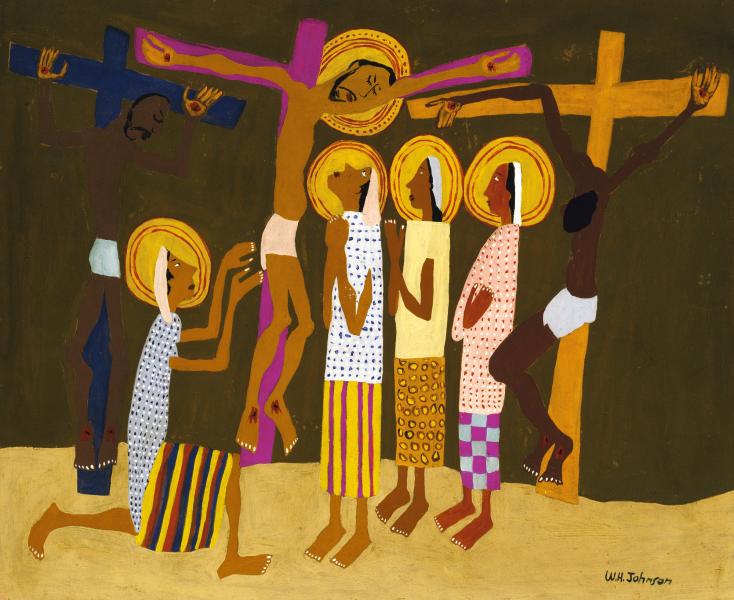
Mount Calvary, by William H. Johnson, 1944

Christ did not enter by means of the blood of goats and calves; but he entered the Most Holy Place once for all by his own blood, thus obtaining eternal redemption. The blood of goats and bulls and the ashes of a heifer sprinkled on those who are ceremonially unclean sanctify them so that they are outwardly clean. How much more, then, will the blood of Christ, who through the eternal Spirit offered himself unblemished to God, cleanse our consciences from acts that lead to death, so that we may serve the living God!

For this reason Christ is the mediator of a new covenant, that those who are called may receive the promised eternal inheritance—now that he has died as a ransom to set them free from the sins committed under the first covenant….

When Moses had proclaimed every command of the law to all the people, he took the blood of calves, together with water, scarlet wool and branches of hyssop, and sprinkled the scroll and all the people. He said, “This is the blood of the covenant, which God has commanded you to keep.” In the same way, he sprinkled with the blood both the tabernacle and everything used in its ceremonies. In fact, the law requires that nearly everything be cleansed with blood, and without the shedding of blood there is no forgiveness.

It was necessary, then, for the copies of the heavenly things to be purified with these sacrifices, but the heavenly things themselves with better sacrifices than these. For Christ did not enter a sanctuary made with human hands that was only a copy of the true one; he entered heaven itself, now to appear for us in God’s presence. Nor did he enter heaven to offer himself again and again, the way the high priest enters the Most Holy Place every year with blood that is not his own. Otherwise Christ would have had to suffer many times since the creation of the world. 

But he has appeared once, for all, at the culmination of the ages to do away with sin by the sacrifice of himself. Just as people are destined to die once, and after that to face judgment, so Christ was sacrificed once to take away the sins of many; and he will appear a second time, not to bear sin, but to bring salvation to those who are waiting for him. (Hebrews 9:12-15, 19-28, NIV)

Believers in Jesus remember this covenant each time they gather at the Table, partaking of bread and cup, imbibing deeply of the grace given us.

We have no hoops to jump through; there are no gymnastics we need to perform in order to approach God. The way has been opened. The curtain has been torn. Access to God is available.

I arise early each morning, but it’s not to offer a blood sacrifice. Rather, I have the wonderful privilege of drawing near to God, and offering a sacrifice of praise. Doing this daily routine helps me to remember, and not take for granted, the incredible privilege I have of entering the Lord’s presence.

Gracious and merciful God, forgive me in any way that I have taken you for granted. I thank you for salvation and the spiritual blessings of your presence and power in my life. Help me to always be aware and grateful for Jesus Christ, who with you and the Holy Spirit are one God, now and forever. Amen.


Isaiah 52:13-53:12 – Good Friday

Golgotha by Norwegian artist Edvard Munch (1863-1944)

The Lord says, “See, my servant will act wisely.
    People will greatly honor and respect him.
Many people were shocked when they saw him.
    His appearance was so damaged he did not look like a man;
    his form was so changed they could barely tell he was human.
But now he will surprise many nations.
    Kings will be amazed and shut their mouths.
They will see things they had not been told about him,

    and they will understand things they had not heard.”

Who would have believed what we heard?
    Who saw the Lord’s power in this?
He grew up like a small plant before the Lord,
    like a root growing in a dry land.
He had no special beauty or form to make us notice him;
    there was nothing in his appearance to make us desire him.
He was hated and rejected by people.
    He had much pain and suffering.
People would not even look at him.
    He was hated, and we didn’t even notice him.

But he took our suffering on him
    and felt our pain for us.
We saw his suffering
    and thought God was punishing him.
But he was wounded for the wrong we did;
    he was crushed for the evil we did.
The punishment, which made us well, was given to him,
    and we are healed because of his wounds.
We all have wandered away like sheep;
    each of us has gone his own way.
But the Lord has put on him the punishment
    for all the evil we have done.

He was beaten down and punished,
    but he didn’t say a word.
He was like a lamb being led to be killed.
    He was quiet, as a sheep is quiet while its wool is being cut;
    he never opened his mouth.
Men took him away roughly and unfairly.
    He died without children to continue his family.
He was put to death;
    he was punished for the sins of my people.
He was buried with wicked men,
    and he died with the rich.
He had done nothing wrong,
    and he had never lied.

But it was the Lord who decided
    to crush him and make him suffer.
    The Lord made his life a penalty offering,
but he will still see his descendants and live a long life.
    He will complete the things the Lord wants him to do.
“After his soul suffers many things,
    he will see life and be satisfied.
My good servant will make many people right with God;
    he will carry away their sins.
For this reason I will make him a great man among people,
    and he will share in all things with those who are strong.
He willingly gave his life
    and was treated like a criminal.
But he carried away the sins of many people
    and asked forgiveness for those who sinned.” (NCV)

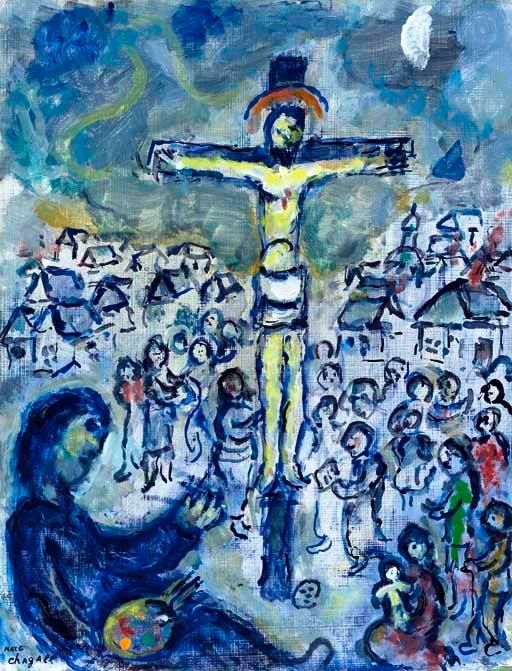
Le peintre et le Christ (The Painter and the Christ) by Marc Chagall (1887-1985)

With all the suffering in this world due to ongoing diseases, natural disasters, moral distress, and so much more, it might seem awkward that Christians everywhere would observe a day called “Good” Friday. 

Considering the hard circumstances of so many people, to call today “good” might appear cruel and out of touch with the world. Even for Christians, at first glance, “Good Friday” can seem a bit oxymoronic for a day observing the torture and death of an innocent man. 

Some would argue that Christ is no longer on the cross and we need to give all our focus on the resurrected Jesus and victory. No need for all this suffering stuff. Yet, the Resurrection only has meaning because of this very day, Good Friday. Without the Suffering Servant of Isaiah, there is no King Jesus. 

For Christians everywhere, this day is an incredibly good day because the crucifixion of Jesus Christ means the redemption of the world. On this day followers of Jesus remember and commemorate the events that led up to the cross; unpack those events and interpret them with profound meaning and significance; and worship Jesus with heartfelt gratitude because of the redeeming work of the cross.

The bulk of the New Testament Gospels of Matthew, Mark, Luke, and John are given over to the final week of Christ’s life, especially leading to the cross. Good Friday observances often take a somber form due to the brevity of Christ’s experience on the cross. 

On this day, Christians remember the last words of Christ, and recognize the significant impact his death had on the immediate persons around him. Believers also contemplate the lasting results of that singular death as an atoning sacrifice; perfect love; reconciliation between God and humanity; victory over evil; and the redemption of all creation.

Sadness, then, is far from the only emotive expression today. It is also appropriate to feel wonder, gratitude, and deep satisfaction for the accomplishment of deliverance from the power of sin. There is the recognition that something profound and meaningful has truly happened in the egregious suffering of Jesus. Thus, we not only remember the anguish of Christ, but what that horrible torment accomplished. In fact, the cross of Jesus is so significant that an eternity of considering its impact could never plumb the depths of its far-reaching effects.

Mount Calvary by William H. Johnson (1901-1970)

With such profound meaning, one would think that Good Friday is a hugely observed day on the Christian Calendar. Yet, for a chunk of churches and Christians, it is not. The cross is not a popular subject. Maybe it’s because neither Christian nor non-Christian wants to ponder something so bloody and sad.

Episcopal priest Fleming Rutledge has adroitly put her finger on the issue: “Religious people want visionary experiences and spiritual uplift; secular people want proofs, arguments, demonstrations, philosophy, and science. The striking fact is that neither one of these groups wants to hear about the cross.”  Indeed, as the Apostle Paul has said, the cross of Christ is “a stumbling block to Jews and folly to Gentiles” (1 Corinthians 1:23).

A personalized religion which leaves the cross out of the picture (too much violence and sacrifice) might seem appealing yet will only leave us bereft of the communion of the saints both past and present. Consider the ancient witness of the Church:

“I believe in Jesus Christ, his only Son, our Lord… he suffered under Pontius Pilate, was crucified, died, and was buried; he descended to hell.”

Apostles’ Creed

“For our sake he [Christ] was crucified under Pontius Pilate; he suffered death and was buried.”

Nicene creed

Christ suffered “in both body and soul – in such a way that when he sensed the horrible punishment required by our sins ‘his sweat became like great drops of blood falling down on the ground.’  He cried, ‘My God, my God, why have you forsaken me?’  And he endured all this for the forgiveness of our sins.  Therefore, we rightly say with the Apostle Paul that we know nothing ‘except Jesus Christ, and him crucified;’ we ‘regard everything as loss because of the surpassing value of knowing Christ Jesus our Lord.’ We find all comforts in his wounds and have no need to seek or invent any other means than this one and only sacrifice, once made, which renders believers perfect forever.” –Belgic Confession, Article 21

And let us consider further the New Testament witness:

“Jesus suffered outside the gate in order to sanctify the people through his own blood.  Therefore, let us go forth to him outside the camp, and bear the abuse he endured.” (Hebrews 13:12-13, NIV)

“May I never boast of anything except the cross of our Lord Jesus Christ, by which the world has been crucified to me, and I to the world.” (Galatians 6:14, NRSV)

The extent of Good Friday goes far beyond a day on the calendar; it is the fulcrum upon which all of Christianity hinges. Because Christ suffered, our suffering has meaning. Each situation of trauma; every case of disease; all suffering and wholesale hard circumstances only make sense, in the Christian tradition, when they are viewed in solidarity with cross of Jesus Christ.

So, today, let Christians everywhere contemplate the cross, observe the salvation accomplished through Christ’s death, and offer prayers and petitions for those who need deliverance from the power of evil. Let us worship God in Jesus Christ because of the suffering on the cross.