Learn To Do Good (Isaiah 1:1, 10-20)

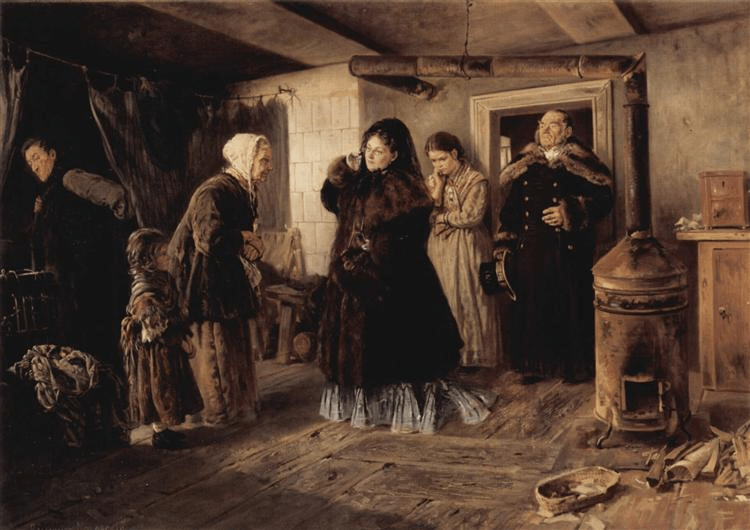
Visiting a Poor People, by Vladimir Makovsky, 1874

The vision of Isaiah son of Amoz, which he saw concerning Judah and Jerusalem in the days of Uzziah, Jotham, Ahaz, and Hezekiah, kings of Judah…

Hear the word of the Lord,
    you rulers of Sodom!
Listen to the teaching of our God,
    you people of Gomorrah!
What to me is the multitude of your sacrifices?
    says the Lord;
I have had enough of burnt offerings of rams
    and the fat of fed beasts;
I do not delight in the blood of bulls
    or of lambs or of goats.

When you come to appear before me,
    who asked this from your hand?
    Trample my courts no more!
Bringing offerings is futile;
    incense is an abomination to me.
New moon and Sabbath and calling of convocation—
    I cannot endure solemn assemblies with iniquity.
Your new moons and your appointed festivals
    my soul hates;
they have become a burden to me;
    I am weary of bearing them.
When you stretch out your hands,
    I will hide my eyes from you;
even though you make many prayers,
    I will not listen;
    your hands are full of blood.
Wash yourselves; make yourselves clean;
    remove your evil deeds
    from before my eyes;
cease to do evil;
    learn to do good;
seek justice;
    rescue the oppressed;
defend the orphan;
    plead for the widow.

Come now, let us argue it out,
    says the Lord:
If your sins are like scarlet,
    will they become like snow?
If they are red like crimson,
    will they become like wool?
If you are willing and obedient,
    you shall eat the good of the land,
but if you refuse and rebel,
    you shall be devoured by the sword,
    for the mouth of the Lord has spoken. (New Revised Standard Version)

Today’s Old Testament lesson is a stout and ancient warning against an age-old problem: Worshiping properly on a high holy day, yet living an evil and unjust life the rest of the days. It’s the mentality of “I give to God what’s required on the Sabbaths and festivals, so I can therefore do what I want the rest of the time, because that’s my stuff and my time.”

Just to be clear: That sort of evil thinking and behavior will raise the ire of the Lord every time. It’s dichotomous messed-up thinking. It’s the wrongheaded notion of believing that my financial and professional success is obviously a validation of God’s blessing upon me.

However, motives of gaining more wealth, rather than being motivated by humility, meekness, righteousness, purity, mercy, and peacemaking, will end badly, no matter who we are.

One of the problems here is an arrogant assumption that we’re right in what we are doing. We feel justified in living a duplicitous life. I have power, authority, and wealth; you do not. Thus, I’m right; you’re wrong; and I can do whatever the heck I want because God is on my side, not yours.

In terms of contemporary Christianity, this is the megachurch mentality: Since there are so many church attenders and money being placed in the offering plates, this is an unquestioned sanction from God of our rightness.

Then, when Sunday passes and Monday comes, both parishioner and pastor feel justified in using their wealth in ways that are inconsistent with the ways and words of Jesus.

Indeed, many times the name of Jesus is rarely (if ever) used in justifications of living the rich life. A blind eye is turned away from the poor and needy. When pressed, far too many parishioners admit to the belief that the poor are underprivileged because of their own personal sin.

Such “Christians” get away with their injustice before God, largely because there is a mass of churchgoers who honor the wealthy and give them places of authority and power.

They think God has shown favor by “blessing” particular people and communities with wealth (because God would never bless someone with poverty!). This can even go so far as to elect a leader of a nation because he is exorbitantly rich. Never mind his daily immorality, meanness, and lying; God has blessed him, right?

Wrong! So says the prophet Isaiah. Judah and Jerusalem, in their hubris, claimed special status. They are God’s people; others are not. They believed they had divine immunity from judgment. After all, only the Judeans worshiped the Lord; all other nations were pagan worshipers.

But their worship and sacrifices, in Isaiah’s day, were offered with no concern for justice and righteousness. So, God called them to repent; and gave them a chance to learn how to please the Lord.

And what pleases God is removing evil and learning to do good.

“Good” is defined by God as seeking to meet the needs of the common people; rescuing those who are oppressed; defending the cause of the orphan, and pleading the case of the widow. There’s no mention of wealth as a sign of divine blessing.

In reality, Judah’s situation before God was pitiful. They failed, even refused, to do justice, love mercy, and walk humbly. Therefore, the Lord called them to repentance and reformation.

Just because Jerusalem had the temple, this sacred space didn’t inoculate the people from judgment. The bald fact of the matter is that the people were living with self-destructive habits of stupidity. And God had enough of it.

In essence, the Lord said to Judah, “Let’s get serious about this.” Despite all the disobedience, God was willing to entertain the people’s change of heart and life – that is, if they themselves were willing to do so.

It’s important for all of us to “have it out with God,” to engage the Lord forthrightly, passionately, intelligently, and realistically.

There are really only two choices: Choose life or choose death. Choose to connect in meaningful, right, good, and just ways with God and neighbor; or choose to disconnect from others and do whatever the heck you want.

Each of our choices impacts what will happen tomorrow and into the future.

Decisions consistent with justice, righteousness, and goodness will ultimately go well for us. Decision-making borne of selfishness, a lack of mercy, and callousness toward others will create all sorts of problems.

Judah’s practical and existential decision came down to whether they wanted a just and productive society, or an invading Assyrian army. Which would you rather have?

To have a public daily life of disrespect and disregard for the needs of others (and of God!) is to invite being up a stinking creek without a paddle, and no one around to hear the yells for help.

Nothing can ever replace good old-fashioned turning away from hate, unforgiveness, bitterness, and pride; and turning toward what is good, right, just, and godly – and then ordering our collective public life around caring for the least and the lost among us.

May it be so, to the glory of God.

God of judgment and grace, you ask not for sacrifices but lives of trusting faith that acknowledge Your power and mercy. Give us a deep belief in Your sovereign goodness, so that we may follow You all the days of our lives, as did Jesus Christ our Savior and Lord. Amen.

Pillow Thoughts (Psalm 132:1-12)

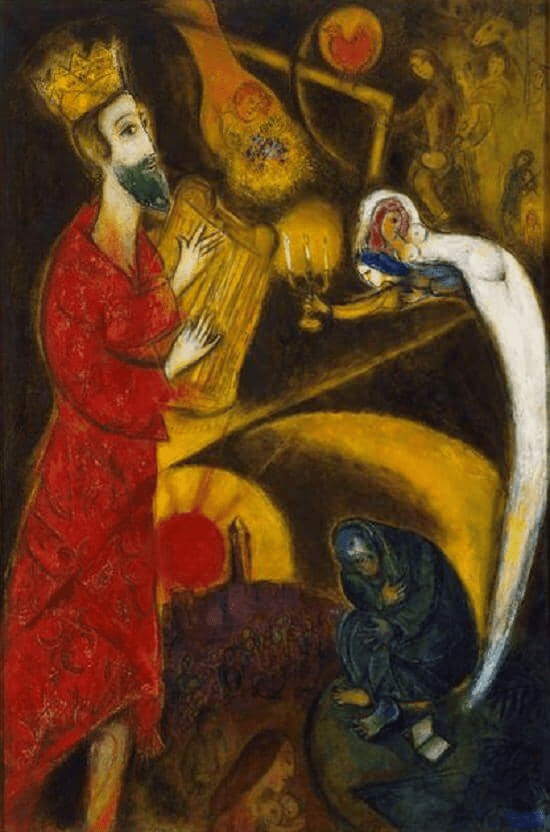
King David, by Marc Chagall, 1962

O Lord, remember in David’s favor
    all the hardships he endured;
how he swore to the Lord
    and vowed to the Mighty One of Jacob,
“I will not enter my house
    or get into my bed;
I will not give sleep to my eyes
    or slumber to my eyelids,
until I find a place for the Lord,
    a dwelling place for the Mighty One of Jacob.”

We heard of it in Ephrathah;
    we found it in the fields of Jaar.
“Let us go to his dwelling place;
    let us worship at his footstool.”

Rise up, O Lord, and go to your resting place,
    you and the ark of your might.
Let your priests be clothed with righteousness,
    and let your faithful shout for joy.
For your servant David’s sake
    do not turn away the face of your anointed one.

The Lord swore to David a sure oath
    from which he will not turn back:
“One of the sons of your body
    I will set on your throne.
If your sons keep my covenant
    and my decrees that I shall teach them,
their sons also, forevermore,
    shall sit on your throne.” (New Revised Standard Version)

King David took great pains in providing for the house of the Lord; and was very concerned about the worship of Yahweh. He went well out of his way to ensure that a temple would be built for his God.

David made as many preparations as he possibly could before his death, so that his son Solomon could follow through and build the temple. The editor of the Book of Chronicles commented on this:

David gave orders to gather together the aliens who were residing in the land of Israel, and he set stonecutters to prepare dressed stones for building the house of God. David also provided great stores of iron for nails for the doors of the gates and for clamps, as well as bronze in quantities beyond weighing, and cedar logs without number—for the Sidonians and Tyrians brought great quantities of cedar to David. 

For David said, “My son Solomon is young and inexperienced, and the house that is to be built for the Lord must be exceedingly magnificent, famous and glorified throughout all lands; I will therefore make preparation for it.” So David provided materials in great quantity before his death. (1 Chronicles 22:2-5, NRSV)

The king did all of this because God came to David and let him know that he would not be the one to build the temple; that job would fall to his son Solomon. (2 Samuel 7:4-13)

David’s final instruction to Solomon and the people had to do with the construction of a house for the Lord his God:

“Now set your mind and heart to seek the Lord your God. Go and build the sanctuary of the Lord God so that the ark of the covenant of the Lord and the holy vessels of God may be brought into the house built for the name of the Lord.” (1 Chronicles 22:19, NRSV)

The worship of God, for David, was to be the central feature of the Jewish people. All Israel and Judah were to encourage one another in worship at God’s house, the Lord’s Temple, in Jerusalem.

The priests of God wore special clothing, and handled the holy implements and the Ark of the Covenant of God. Yet, they were to be also clothed with righteousness, making sure that their outward ceremonial rituals reflected an inner moral purity and holiness before God.

David was bound and determined to not only worship the Lord himself, but to see that the entire nation of Israel had the opportunity to worship together in a central place.

Maybe a question arises for you about why David was so driven to construct a house for God. What is it that motivated King David to spend so much of his planning and energy on making sure that a temple would be constructed for the Lord?

Now when the king was settled in his house and the Lord had given him rest from all his enemies around him, the king said to the prophet Nathan, “See now, I am living in a house of cedar, but the ark of God stays in a tent.” Nathan said to the king, “Go, do all that you have in mind, for the Lord is with you.” (2 Samuel 7:1-3, NRSV)

A lot of events had transpired for David to be in the position of king, with peace all around him. The Lord had been with David, and brought him through the sort of adversities most of us will never know.

Once King David was at the pinnacle of peace and success, his thought were not about how to hold onto power, or to get more of it. He would lay his head on his pillow at night and wonder how he could give back to God for being so faithful.

And considering all that God had accomplished for him and for Israel, it seemed a travesty that he was luxuriating in a fine house, while the Ark of the Covenant – the objective presence of God among the people – was sitting in an old tent. So, David became determined to change that situation, because he could.

I wonder if when you and I are at a place in our lives where we feel safe and secure, prosperous and happy, our thoughts and dreams turn toward how we might give back to God in a worshipful way which will honor the Lord, as well as bless all the people of God.

I am curious what sort of things occupy your mind at night while your head is on your pillow, when you are feeling good about how your life is going.

Many, if not most, people will think about themselves, and what to do with what they have gained and/or accomplished. But what about you?

How will you respond to God’s grace, goodness, deliverance, and protection in your own life? What sort of ideas arise in your mind? What is in your heart to do for God and God’s people?

What are your pillow thoughts at night?

Presence itself is a great gift. The presence of God is incredibly gracious, good, and miraculous. And human presence, with each individual stamped with the image and likeness of God upon them, is also a wonderful gift from the Creator. And very much needed.

David enjoyed the presence of God, and longed for all the people to experience that divine presence. Although the Lord needed no temple to live in, David had in mind to provide one.

I imagine that King David understood that each person is a luminous icon of presence, reflecting God’s image, and needing the presence of God and others in order to have a nation who worships God as commanded in the Mosaic law.

Through communal worship at a designated site in Jerusalem, the Israelites could enjoy the beauty of God’s presence together, as well as the encouragement of one another.

Wherever there is presence and the acknowledgement of God and each other, there is freedom to offer affection, understanding, and respect.

It seems to me that these were the sort of thoughts that ran through King David’s mind, which made him determined to build a house for the Lord his God.

So, what will you do with your thoughts and your life?

Almighty God of all hope, of our thoughts and dreams: In humility, we give you thanks for all of creation; and for everything you give us. We praise you for forgiving us of our guilt and shame, even before we ask. You raise us from our broken state and make us whole. You give us the peace we yearn for.

Blessed God, fill us, your people, with your divine Spirit. Be our light in the darkness. Envelop us with your presence. Orient our hearts toward your justice; and help us always praise you. Let us ever be mindful of your power and grace in the world. Let us live as one with you in grace and in truth. Amen.

Work and Family (Psalm 127)

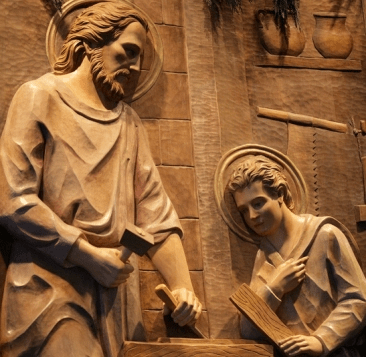
The Carpenter’s Son, Holy Cross Chapel, Houston, Texas

Unless the Lord builds the house,
    those who build it labor in vain.
Unless the Lord guards the city,
    the guard keeps watch in vain.
It is in vain that you rise up early
    and go late to rest,
eating the bread of anxious toil,
    for he gives sleep to his beloved.

Sons are indeed a heritage from the Lord,
    the fruit of the womb a reward.
Like arrows in the hand of a warrior
    are the sons of one’s youth.
Happy is the man who has
    his quiver full of them.
He shall not be put to shame
    when he speaks with his enemies in the gate. (New Revised Standard Version)

God is the Creator. We humans are creatures, created in the image and likeness of God. Therefore, we are inextricably tied to God, and quite dependent upon the Lord.

For the activities of our daily human life, we need God. When it comes to establishing a home, protecting our community, daily work, and raising children, we very much need God’s help to do all of this in a way that is successful and good.

Unless God is with us, in the center of all that we do, then our work in building a good life shall be in vain. How we go about living our lives with work and family, and who we look to as role models, makes a significant difference in the quality and effectiveness of our labor and relationships.

When my wife was growing up, her family had a prominent portrait of John Wayne in the living room above the television. That picture spoke volumes about the family ethos. They had horses and loved to ride and enjoy the outdoors. Hard work was a daily reality of life, as well as a rugged individualism that often suppressed all else in order to engage in work. 

Doing your best, striving for excellence, and learning responsibility are good things that mature people do every day. Yet, there is a fine line between hard work that provides and enriches, and lonely work that is frenetic and fueled by anxiety about the future.

The motives behind why we burn the candle at both ends are just as important to the Lord as the work itself. The psalm for today is a wake-up call for us to consider the frenetic pace of work and family life.

If we independently believe that our life is in our own hands, and we work with a worry that animates our every task, then we have lost touch with the understanding that it is God who ultimately provides us with every good thing in life. 

However, if we begin to relax and let go of our stubborn independent streak, then we work hard with the strength God gives. We let the Lord watch over us.

Trusting God in our work is connected to children being a heritage from the Lord. In the ancient world, children worked alongside their parents. Fathers and mothers did not go it alone – work was a family affair, as well as a community endeavor. 

Whenever we slip into a groove of worshiping individualism, rather than simply taking personal responsibility, then we must come back to the inter-dependence we were designed for as created human beings. 

The ethos the psalmist espoused is trust in God, reliance on others, and working together for the common good of all. 

Here are a few ways of working together and not carrying the load of work on our own:

Ask for what you want and need to accomplish the task. Whenever we don’t ask, we inevitably go the route of hustling for help through manipulation, guilt, and shaming others.

If someone says, “no,” simply ask another person or persons. Asking once just won’t do. And neither is commanding others to get things done. We have the ability to ask calmly, confidently, and compassionately. Accept the “no” which you might get, without retreating back to manipulation. This is especially needful when it comes to asking family members.

Ask God to help you in your work. Each day as I enter the hospital for which I am a Chaplain, I say a prayer, “God almighty, blessed Father, Son, and Spirit, please go before me, with me, and after me to each patient, their family members, and every team member I encounter today, with the love and compassion of Jesus Christ.”

Delegate, if possible. This is not the same thing as barking orders. Delegating is a realization that we are finite creatures with limitations of time, energy, and resources. It’s okay to share the load with others. In fact, most people are more than willing to help, if we but ask. It enables them to feel needed and important.

Be vulnerable and gracious. We all mess up our work, at times. And it’s important to own mistakes without heaping unnecessary criticism on ourselves, or others. Offering an apology, recognizing that you’ve bit off more than you can chew, and admitting your lack of energy are healthy, not sinful. Also, whenever others fall short of their responsibilities, it’s our job to handle it with grace – seeking to understand and help, rather than criticize and judge.

Working together, consulting, collaborating, and engaging in fellowship enable us to speak with those who may oppose, misunderstand, or misinterpret us. It’s also a more joyful way to live.

Sovereign God, you created all things and in you everything holds together. Preserve me with your mighty power that I may not fall into disconnection with you and others, nor be overcome by anxiety. In all I do direct me to the fulfilling of your purpose, through Jesus Christ my Lord. Amen.

What Is It You Are Trying To Do? (Mark 10:2-16)

Jesus blesses the children

Some, testing him, asked, “Is it lawful for a man to divorce his wife?” He answered them, “What did Moses command you?” They said, “Moses allowed a man to write a certificate of dismissal and to divorce her.” But Jesus said to them, “Because of your hardness of heart he wrote this commandment for you. But from the beginning of creation, ‘God made them male and female.’ ‘For this reason a man shall leave his father and mother and be joined to his wife, and the two shall become one flesh.’ So they are no longer two but one flesh. Therefore what God has joined together, let no one separate.”

Then in the house the disciples asked him again about this matter. He said to them, “Whoever divorces his wife and marries another commits adultery against her, and if she divorces her husband and marries another, she commits adultery.”

People were bringing children to him in order that he might touch them, and the disciples spoke sternly to them. But when Jesus saw this, he was indignant and said to them, “Let the children come to me; do not stop them, for it is to such as these that the kingdom of God belongs. Truly I tell you, whoever does not receive the kingdom of God as a little child will never enter it.” And he took them up in his arms, laid his hands on them, and blessed them. (New Revised Standard Version)

Trying To Parse the Law?

The topic of divorce has always been a hot button issue throughout human history. And there have continually been diverse views and opinions about it. This is also true of Holy Scripture. A variety of interpretations are offered by many about the Bible’s view of divorce, and Christ’s words concerning it.

Much like today, divorce in the first century was accepted as part of what happens in society, even among Jews, although it was more proliferate in other cultures. Most of the discussions about divorce centered in legal details, with some speaking against it as bad for society.

Among the Jewish religious leaders and experts in the law, it was generally recognized that divorce occurs, with Mosaic legislation proscribing how to carry out divorce (Deuteronomy 24:1-4). Yet, other scripture texts frame the existence of divorce as questionable for God’s people. (e.g. Genesis 2:24; Malachi 2:13-16)

Trying to Test Jesus?

Anyone who doesn’t like another, will often confront them on a hot button issue that has plenty of diverse opinion to it. This is why the Pharisees sought to get Christ’s take on the topic of divorce.

Essentially, Jesus reframed divorce so that it was no longer simply a legal topic, but involves real people. Christ talked about divorce in a way that upheld the dignity of persons, especially women; and lifted up the true sanctity of marriage.

In turning the discussion from a legalities to God’s design for humanity and marriage, Jesus cut to the heart of the matter, to God’s intent, and to human frailty. He focused on relationships, because they were inherent from the beginning.

Yes, divorce is a reality, and it is has its place in society. But no, it’s not supposed to be this way. The very word “divorce” means there is a separation, a breech, a disconnection of relationship. This is why Christ went to another topic: adultery.

Trying To Divorce Women?

Jesus said that a person initiating a divorce in order to marry another person commits adultery. In saying this, he was not offering a legal conversation of details. Rather, Christ was focusing on people; he was concerned for wives and women.

The conversation between Jesus and the Pharisees was a discussion between men, and presupposed a man’s point of view on divorce. Women did not have the ability to initiate divorce in the ancient society.

And Christ seems to have had no stomach for being drawn into abstract legal debates between a bunch of men. Instead, he cared about the people involved in an actual divorce, especially the women.

For all intents and purposes, women (and their sexuality) were the property of men – the father, and then later, the husband. In this social milieu, whenever a husband initiated a break in the relationship, it was important for a woman to have a certified document of divorce. Without that certification, a woman divorcee would be landlocked, unable to do much of anything, as well as be the brunt of societal gossip, slander, or worse.

Since Jesus was talking to the men, the Pharisees, he pointedly looked at them and let them know that, although they might initiate a divorce, it in no way justified their sneaking and creeping around. It didn’t cover their adulterous relationship(s) nor their adulterous hearts.

All this is to say that Christ very much opposed divorce on the grounds of putting a wife away out of a desire for a different spouse. He intended on empowering women. In a divorce situation, because a man was in control of the process, it was then the man who commits adultery against the woman.

Both logically and legally, a woman could never commit adultery because of divorce – only the man. What’s more, adultery is not primarily a violation of the law, but of the woman. Jesus believed it was high time for some accountability with the men.

Even though contemporary Western society is much different than the ancient social structure, Christ’s teaching is still relevant. The need to uphold not just the law, but the rights of women is a must for today, as well.

Unless we can observe Christ’s concern for women’s justice and rights, there will be men who continue to leverage their own gender over and against females and wives. And there will continue to be both husbands and wives who initiate divorce for their own adulterous motives, thus putting their spouse in moral, legal, emotional, and spiritual jeopardy.

Trying To Keep Children Away?

The overarching ethics of Jesus, and the law of God, is to provide justice and righteousness for the most vulnerable among us. And this is why the teaching about divorce is coupled with instruction about children.

In our contemporary society, children have rights and are accorded significant status. That was not true in the ancient world. Children were mostly viewed as potential adults. Until then, kids were to stay quiet unless spoken to, and to obey their parents with absolutely no talk-back.

Christ’s disciples did what any student following their teacher would do; they kept the kids at bay so that Jesus could do his important ministry work. But what the disciples discovered is that the kids were actually part of that important ministry work. As children, they were vulnerable, at the low end of the social scale, and had no personal rights other than being part of a family.

To become like a little child in order to enter the kingdom of God did not mean becoming innocent; it meant becoming humble and dependent, and embracing meekness, gentleness, and lowliness. It meant to become the last and the least among us. Because the last will be first, and the least will become great.

Trying To Get It Right?

It’s important for us to uphold the sanctity of human life, and the spirit of the law. The law is intended to preserve and protect life – and is not to be used to find loopholes or ways to get what you want.

Meeting the needs of all people – whether they be men, women, children, and whether they be rich or poor – is to be everyone’s concern. Why? Because justice and righteousness are at the heart of God’s concern for humanity.

Merciful God, who discerns each heart: We confess our family is most often like strangers to us. So, give to all parents and children the grace to see one another as they truly are, and as you have called them to be. In the name of Jesus Christ, our mediator and advocate, we pray. Amen.