Be Careful What You Ask For (Numbers 11:18-23, 31-32)

Now tell the people, ‘Purify yourselves for tomorrow; you will have meat to eat. The Lord has heard you whining and saying that you wished you had some meat and that you were better off in Egypt. Now the Lord will give you meat, and you will have to eat it. You will have to eat it not just for one or two days, or five, or ten, or even twenty days, but for a whole month, until it comes out of your ears, until you are sick of it. This will happen because you have rejected the Lord who is here among you and have complained to him that you should never have left Egypt.’”

Moses said to the Lord, “Here I am leading 600,000 people, and you say that you will give them enough meat for a month? Could enough cattle and sheep be killed to satisfy them? Are all the fish in the sea enough for them?”

“Is there a limit to my power?” the Lord answered. “You will soon see whether what I have said will happen or not!”…

Suddenly the Lord sent a wind that brought quails from the sea, flying three feet above the ground. They settled on the camp and all around it for miles and miles in every direction. So all that day, all night, and all the next day, the people worked catching quails; no one gathered less than fifty bushels. They spread them out to dry all around the camp. (Good News Translation)

I can just imaging the dialogue around the campfire at night with some of the ancient Israelites. Out in the middle of nowhere, delivered from Egyptian slavery, but not yet to the Promised Land, they were feeling the awkward space of being in-between those two places:

“Manna, again!? Geez, are we ever going to get anything else to eat?”

“Doesn’t look like it, does it? Every single day we get up, go out on the desert, collect the manna, eat it all day, go to bed, then get up and do it all over again.”

Do you remember back in Egypt, we had garlic and leeks and stew and meat? Oh, glorious meat! Sometimes I think we were better of there. Dang it, I want meat! Don’t you want meat, too!?”

“Yeah, I’m sick of this manna. Hey, there’s Moses. Get us some meat, Moses! Did you bring us out here to bore us to death with manna!? What are you doing about it? Where are you leading us? Where’s the meat?”…

And on and on it goes, the murmuring about food and conditions in the desert.

When life is topsy-turvy and upside-down, it is so amazingly easy to grumble and complain. The ancient Israelites sometimes didn’t have water to drink. They had a limited diet of manna. They were anxious, nervous, and scared, wondering if things would get better, or not. The people were in a life-and-death sort of situation.

How would you respond?

Complaining, unlike our emotions such as fear, is a volitional response. We choose to grumble. The problem with gripes and complaints is that it sets a person down a dark path. The criticisms and grievances begin easily and are seemingly harmless, that is, at first. They are, however, anything but innocuous or innocent.

The murmuring under the breath did not stop with getting meat to eat. If we look ahead in the story of God’s people in the exodus event, the moaning and complaining quickly returned. The people became so disillusioned with their circumstances that they began longing for the “good old days” back in Egypt when they had plenty to eat and drink, forgetting about their cruel bondage in slavery. (Exodus 16:1-3)

The psychological progression continued with beginning to blame their situation on God, as if the Lord were some mean malevolent deity. From that point, it was inevitable that the people would disobey God and eventually succumb to the idolatry of the golden calf. (Exodus 32:1-8)

Despite the grand celebration of leaving Egypt and experiencing a miraculous deliverance through the Red Sea, the people quickly forgot because of their present mundane circumstance of eating manna every day.

If they were spiritually healthy, they would realize that the mighty God who saved them with incredible acts of power would care for them in a desert. Yet, for many, there was no faith to be found in a new situation they had not faced before.

Failure of faith begins neither with ignorance nor an egregious sin. It begins with grumbling and complaining. And if allowed to run amok, complaints will bear the fruit of discouragement, disobedience, and finally, a disavowal of God.

Sometimes, if you want something bad enough, God will give it to you. And you won’t like it. That’s because the heart has already been attuned to grumbling and murmuring. The heart’s hunger will never be satiated; it’s sick. And it can become so sick that a heart transplant is needed – an altogether new heart. Yet God will even help with that:

And I will give you a new heart, and I will put a new spirit in you. I will take out your stony, stubborn heart and give you a tender, responsive heart. And I will put my Spirit in you so that you will follow my decrees and be careful to obey my regulations. (Ezekiel 36:26-27, NLT)

Acceptance means practicing a conscious effort to acknowledge and honor difficult situations and emotions. Fully accepting things as they are, instead of ignoring, avoiding, or wishing the situation were different, can be a critical step in moving through a difficult experience to experiencing more meaning.

Learning to be satisfied and content begins with accepting our current reality and present circumstances. The state of our minds and our hearts will determine whether we will ever be happy or not. When we discover how to synchronize ourselves with the groove of God’s Spirit, then we shall enjoy an abundant life of contentment – no matter the situation.

May we be able to say along with the psalmist:

I will bless the Lord who guides me;
    even at night my heart instructs me.
I know the Lord is always with me.
    I will not be shaken, for he is right beside me.

No wonder my heart is glad, and I rejoice.
    My body rests in safety.
For you will not leave my soul among the dead
    or allow your holy one to rot in the grave.
You will show me the way of life,
    granting me the joy of your presence
    and the pleasures of living with you forever. (Psalm 16:7-11, NLT)

Relying on the Presence (Exodus 13:17-22)

When Pharaoh let the people go, God did not lead them on the road through the Philistine country, though that was shorter. For God said, “If they face war, they might change their minds and return to Egypt.” So God led the people around by the desert road toward the Red Sea. The Israelites went up out of Egypt ready for battle.

Moses took the bones of Joseph with him because Joseph had made the Israelites swear an oath. He had said, “God will surely come to your aid, and then you must carry my bones up with you from this place.”

After leaving Sukkoth they camped at Etham on the edge of the desert. By day the Lord went ahead of them in a pillar of cloud to guide them on their way and by night in a pillar of fire to give them light, so that they could travel by day or night. Neither the pillar of cloud by day nor the pillar of fire by night left its place in front of the people. (New International Version)

From a human perspective, God makes some nonsensical decisions in the Bible such as telling Noah to build a big boat in a place with no water; Abraham to leave everything, and later, to sacrifice his son; Moses to stroll into Egypt and tell Pharaoh to let the people go; and, the people to walk through a body of water without getting wet. Indeed, it’s as if God has an odd predilection for making weird requests of people.

Although today’s Old Testament story gives us a glimpse into God’s thinking, the people were not privy to that information. Yes, God’s people were experiencing an unbelievable exodus out of Egypt. Their wildest dreams could not have imagined such a reality as strolling out of slavery having seen not one but a string of miraculous wonders. Yet, God was not done with the miracle thing.

Although many people would really like to see a miracle happen in their lives, rarely do we think about the circumstances we might need to face for that miracle to occur. God typically asks folks to do some outrageous-sounding things to set up the miracle.

An entire nation left Egypt with celebration only to be told to go in a misdirection toward the Promised Land, as if God were somehow geographically challenged. I can imagine that this decision had Moses raising a Spock-like eyebrow and the Israelites wondering if God was off his celestial rocker.

There is, however, a reason why folks like Noah, Abraham, and Moses obeyed instructions that didn’t make sense to them at the time: The Presence of God.

Pillar of Fire, Pillar of Cloud in the Desert, Congregation Beth Emeth, Herndon, VA

It is the personal Presence and power of God which makes all the difference. For God has not promised to create an existence with a zero factor of hardship. God, instead, has created a world that is full, vibrant, and alive with Presence – and a zero tolerance for bullies like Egypt. The uncertainty, doubt, and mystery of the future is thoroughly mitigated with the effusive Presence.

When sitting with patients in the hospital who struggle with the unknown of why they are there and what will become of them (and their families) the last thing I do is try to fabricate reasons so that it makes sense – because it doesn’t, and I’m not going pretend that it does.

Rather, I remind them of what I know: The Presence of God is here. Although God does not go out of the way to give us an easy life, God does, however, go far out of the way to communicate the glorious divine Presence with us.

God kept constant vigil over the ancient Israelites, powerfully seen with the pillar of cloud by day and pillar of fire by night. Nothing was going to happen to the Jewish people without first passing through the mighty hands of God.

Not only do I know God is with us, but I also know the Lord neither slumbers nor sleeps (Psalm 121). When God keeps vigil, God keeps vigil! No smoke or bathroom breaks with God. God’s vigilance is relentless and wondrous, giving assurance to the godly, and terrifying the ungodly.

Once we are out in the wilderness of uncertainty, there is no turning back. And that’s okay – because the Presence of God patrols the area and divinely guards our every move.

For the Christian, the Presence has found its fulfillment in the person of Jesus. Although Christians everywhere serve a risen and ascended Christ, the Divine Presence remains with glorious constancy through the Holy Spirit, the Paraclete, the One who is consistently alongside us, empowering us and advocating on our behalf.

The beautiful theological truth here is that God is both transcendent (far above us) and immanent (intimately close to us) at the same time, all the time. Armed with such a robust theological understanding, trust and confidence come to us without having to resort to ginning up positive thoughts.

Instructions and commands which seem like nonsense? No problem. The Transcendent and Immanent One has the Presence all around it. In between a rock-and-hard-place (or an Egyptian army and a Red Sea)? Not an issue. I willingly place myself there knowing that with the Presence, the miraculous is about to happen.

We need not buck the difficult circumstances. The Presence has got this.

So, then, let us pray for the Church and for the world, and let us thank God for the great Presence: In the power of the Spirit and in union with Christ, we pray to you, Almighty God, and Father. From the rising of the sun to its setting, we pray to you, ever-vigilant Lord, on behalf of those in despair and darkness, that they may find the hope and light of Christ; those in fear of death, that they may find faith through the resurrection of Jesus; prisoners and captives, widows and orphans, and all those who today need a blessed assurance of the Presence; through Jesus Christ, your Son, our Lord, who with you and the Holy Spirit are one God, now and forever. Amen.

There Are Consequences to Injustice (Exodus 12:29-42)

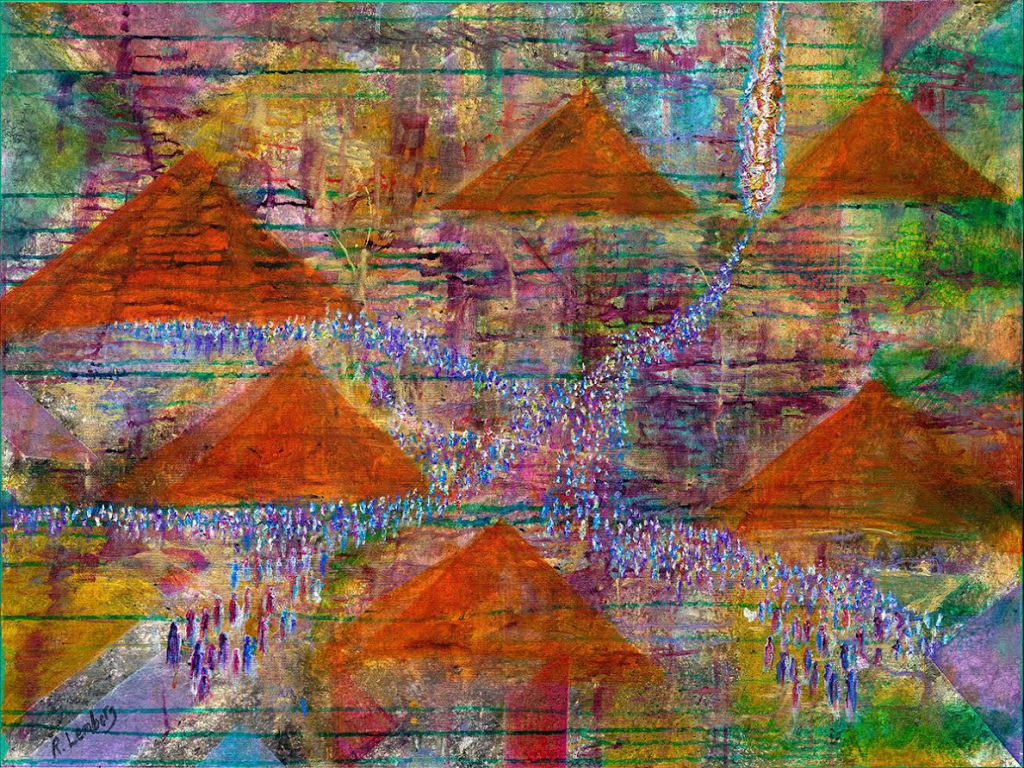
Exodus Out of Egypt, by Rivka Lemberg

At midnight the Lord struck down all the firstborn in Egypt, from the firstborn of Pharaoh, who sat on the throne, to the firstborn of the prisoner, who was in the dungeon, and the firstborn of all the livestock as well. Pharaoh and all his officials and all the Egyptians got up during the night, and there was loud wailing in Egypt, for there was not a house without someone dead.

During the night Pharaoh summoned Moses and Aaron and said, “Up! Leave my people, you and the Israelites! Go, worship the Lord as you have requested. Take your flocks and herds, as you have said, and go. And also bless me.”

The Egyptians urged the people to hurry and leave the country. “For otherwise,” they said, “we will all die!” So the people took their dough before the yeast was added, and carried it on their shoulders in kneading troughs wrapped in clothing. The Israelites did as Moses instructed and asked the Egyptians for articles of silver and gold and for clothing. The Lord had made the Egyptians favorably disposed toward the people, and they gave them what they asked for; so they plundered the Egyptians.

The Israelites journeyed from Rameses to Sukkoth. There were about six hundred thousand men on foot, besides women and children. Many other people went up with them, and also large droves of livestock, both flocks and herds. With the dough the Israelites had brought from Egypt, they baked loaves of unleavened bread. The dough was without yeast because they had been driven out of Egypt and did not have time to prepare food for themselves.

Now the length of time the Israelite people lived in Egypt was 430 years. At the end of the 430 years, to the very day, all the Lord’s divisions left Egypt. Because the Lord kept vigil that night to bring them out of Egypt, on this night all the Israelites are to keep vigil to honor the Lord for the generations to come. (New International Version)

“A horse may run quickly but it cannot escape its tail.”

Russian proverb

The ancient Israelites were in bondage to the Egyptians for hundreds of years. Their oppression finally came to and end with the Lord’s dramatic deliverance of them in the tenth and final plague directed against Egypt.

The actions of the Egyptians eventually and finally caught up with them. Their making slaves of the Israelites was not going to last forever. Even though it took a while, Egypt was held accountable and experienced divine judgment. The empire’s internal moral emptiness would not be able to hold up under the justice of God.

“Empty sacks will never stand upright.”

Italian proverb

Pharaoh was a hard man. The more Moses talked to him the more stubborn Pharaoh got. Eventually, Pharaoh’s heart became like stone; he and his empire fell because they were bent toward the way of injustice. Oppression had been Pharaoh’s proclivity by instructing the Jewish midwifes to kill firstborn sons of Israelite mothers. Now the Egyptians would fall into the very trouble they created for others.

The death of so many on one night, all at once, was too much for Pharaoh and the Egyptians. In such a grief, Pharaoh’s dogged resolve in holding onto Israelite slavery and ostracizing Moses was loosened. He summoned Moses in the middle of the night and commanded the Israelite slaves to be gone – without any conditions or strings attached to it.

The Egyptians wanted them gone, and so, urged them to leave in a hurry – just as God had predicted. All sorts of articles – including silver and gold – were willingly given to the fleeing Israelites by the lamenting Egyptians. No matter how hard and stubborn any earthly ruler is, the plans and purposes of a sovereign God cannot be thwarted.

Finally, the deliverance out of Egyptian bondage happened. The Israelites were free. It was a hasty departure. It was as if the Hebrew people had become so upsetting to the great Egyptian empire, that they vomited them out of their land, projecting the former slaves as far away as they could.

Sometimes people get the notion that if they do something bad, they will be struck by lightning or have some sort of tragedy occur. And when it doesn’t happen, they might reason further in their misguided notions by believing they can get away with bad behavior. So, they keep doing it. But, eventually, this all has a terrible effect.

“Those who lie down with the dogs, rise with the fleas.” English proverb

Actions and inactions have consequences. Those consequences may not happen immediately. However, all of us shall someday harvest the fruit of decisions that were made months, even years or decades, ago.

Make no mistake, God is not mocked. A person will harvest what they plant. Those who plant only for their own benefit will harvest devastation from their selfishness, but those who plant for the benefit of the Spirit will harvest eternal life from the Spirit. Let’s not get tired of doing good, because in time we’ll have a harvest if we don’t give up. (Galatians 6:7-9, CEB)

Almighty God, Creator and Preserver of all humanity, we humbly ask that you make your ways known to people everywhere, and bring saving help to all nations. We pray for Christ’s Church, and all faith communities across the earth, that they be guided and governed by your good, gracious, and benevolent Spirit; and that all who profess and call themselves Christians may be led into truth, and hold the faith in unity, peace, and righteousness.

Blessed Lord, we pray for all who are afflicted or distressed in mind, body, or spirit. May your divine mercy bring them comfort and relief, according to their need. Give them patience through their sufferings, and a joyful outcome from their distress. This we pray through Jesus Christ our Savior and Lord. Amen.

Let Go (Exodus 11:1-10)

Now the Lord had said to Moses, “I will bring one more plague on Pharaoh and on Egypt. After that, he will let you go from here, and when he does, he will drive you out completely. Tell the people that men and women alike are to ask their neighbors for articles of silver and gold.” (The Lord made the Egyptians favorably disposed toward the people, and Moses himself was highly regarded in Egypt by Pharaoh’s officials and by the people.)

So Moses said, “This is what the Lord says: ‘About midnight I will go throughout Egypt. Every firstborn son in Egypt will die, from the firstborn son of Pharaoh, who sits on the throne, to the firstborn son of the female slave, who is at her hand mill, and all the firstborn of the cattle as well. There will be loud wailing throughout Egypt—worse than there has ever been or ever will be again. But among the Israelites not a dog will bark at any person or animal.’ Then you will know that the Lord makes a distinction between Egypt and Israel. All these officials of yours will come to me, bowing down before me and saying, ‘Go, you and all the people who follow you!’ After that I will leave.” Then Moses, hot with anger, left Pharaoh.

The Lord had said to Moses, “Pharaoh will refuse to listen to you—so that my wonders may be multiplied in Egypt.” Moses and Aaron performed all these wonders before Pharaoh, but the Lord hardened Pharaoh’s heart, and he would not let the Israelites go out of his country. (New International Version)

It takes a lot for the status quo to die, to let go of something that has been relied on for centuries. In the case of ancient Egypt, it took the deaths of every Egyptian first born son.

The Israelites had been slaves in Egypt for 400 years. The vast Egyptian Empire was literally built on the backs of Jews. After so long, their cry about being in bondage was heard by God – who sent Moses to deliver them. But Pharaoh, the King of Egypt, was not about to let go of this large labor force.

So, a series of 10 plagues came upon the Egyptians from God. Today’s Old Testament lesson is the tenth and final plague – the one most devastating to Egypt. Although Pharaoh was determined to keep the Israelites in bondage, not even mighty Egypt could keep it’s grip on the people when God was determined to free them and bring them to the Promised Land.

God graciously informed Moses that this was the final plague. After nine others, and hearing Pharaoh say he would let the people go multiple times, it must have been a relief to hear that this would not keep going any longer.

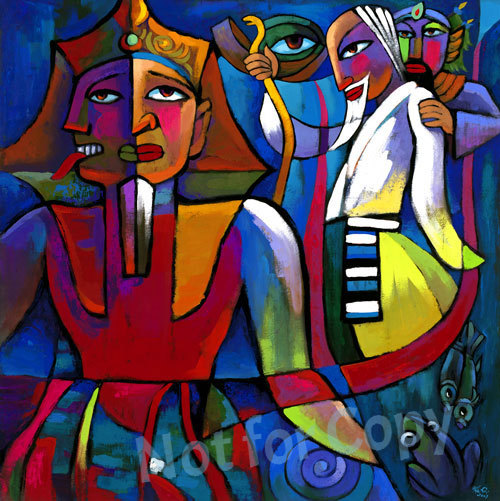
Moses and Aaron debating with Pharaoh, by He Qi

What’s more, the Lord added that not only would Pharaoh finally change and not hinder the people from leaving, but also that they should ask the Egyptians for what they needed when going. Indeed, the people of Egypt became so eager to have the Israelites away from them that they would give them anything to get them out.

The Israelites had worked hard and labored intensely for hundreds of years without any compensation. Now, they would leave the world of slavery and receive the riches of Egypt from which they were defrauded. Whereas Pharaoh’s heart became exceedingly hard, the Egyptians hearts became disposed to give – even though it was to be rid of the Israelites once and for all.

And so, God would deliver the Jews from their bondage and enrich them with many needed possessions, as if they were carrying away plunder from an enemy. The Lord both frees and empowers; God delivers from one situation and enables for another. When God closes a door, then another door is opened.

Indeed, the first will be last, and the last shall be first. In God’s upside-down kingdom, the oppressors eventually become the oppressed, and the poor become rich.

With this last and final plague, there would be no next generation to rise up and take back the Israelites into slavery again. A distinction was made between the first born of the Egyptians and the Israelites. Only the Egyptians experienced the awful deaths of so many.

After four centuries of keeping the Jews enslaved, maybe the Egyptians thought it would always be this way. Perhaps they even believed what they were doing was perfectly acceptable and right. So, when Moses comes along, speaking on behalf of God to Pharaoh, the great king of the empire thought things will not change; the Israelites ought to always be in subservience to Egyptians.

Why is it so hard to let go? Why do people keep holding on, even when it costs them nearly everything?

Whenever we cannot envision a different world or an alternative to what we are currently experiencing, then we hold on – even if it hurts to keep grasping it. Just because there was no divine judgment in hundreds of years, does not mean that God was okay with the situation in ancient Egypt. So, when the Egyptians experienced the judgment, it was absolutely devastating.

If ever we need to control other people in order to realize or maintain our own happiness or contentment, then we are in a very unhealthy place and need immediate help – before the providence of God steps in and pries that control from your clenched fists.

Conversely, if we have been in a place of oppression for a long time, it will not last forever. God sees the injustice. And God hears the cries which are uttered to heaven. A time is coming when all things will be made right.

Also, there are various sorts of traumas that people have endured. Sometimes, people don’t want to talk about any of it, and never do. But eventually, it overwhelms them. Without help, they will be in bondage. None of us can change on our own. We need others. Not everyone is going to harm us or shame us. There are people that God is ready to use in order to extend hope, healing, wholeness, and help. We should let them in, and keep the slave masters out.

Gracious and merciful God, help us to overcome the menace of evil in this world, and to be a part of freeing those weighed down with sinful oppression to realize a future of health and hope.

From famine and war, deliver us.

From hatred and from the demeaning of the dignity of others, deliver us.

From every kind of injustice in the life of society, both national and international, deliver us.

From the loss of awareness of good and evil, deliver us.

Accept our cry on behalf of the sufferings of all humanity, and of entire societies of people.

Empower us by your Spirit to resist evil in all its insidious manifestations.

May the saving grace and the redemption of Jesus put a stop to cruel bondage everywhere; and may hope be kindled in every heart. Amen.