Face Reality (Numbers 20:22-29)

Aaron’s Death, by David Roberts, 1842

The whole community of Israel left Kadesh and arrived at Mount Hor. There, on the border of the land of Edom, the Lord said to Moses and Aaron, “The time has come for Aaron to join his ancestors in death. He will not enter the land I am giving the people of Israel, because the two of you rebelled against my instructions concerning the water at Meribah. Now take Aaron and his son Eleazar up Mount Hor. There you will remove Aaron’s priestly garments and put them on Eleazar, his son. Aaron will die there and join his ancestors.”

So Moses did as the Lord commanded. The three of them went up Mount Hor together as the whole community watched. At the summit, Moses removed the priestly garments from Aaron and put them on Eleazar, Aaron’s son. Then Aaron died there on top of the mountain, and Moses and Eleazar went back down. When the people realized that Aaron had died, all Israel mourned for him thirty days. (New Living Translation)

There is a tendency for us “enlightened” humans to believe that we are far more advanced than our ancestors – who did not know all that we very smart people today know.

Such a mental stance only demonstrates that perhaps we are getting more stupid as the centuries and the millennia wear on.

Despite all of our accumulated knowledge and research, and incredible technical advances, we have (in my humble opinion) strayed rather far from a wise understanding of anthropology and theology. In other words, many people in this contemporary world have little to no idea about who they are, why they are here, and what to do when life and death happens.

The death of Aaron the priest happened over 3,500 years ago. Yet, here I am, referencing it. Why? Because there is meaning to it. The ancients have a great deal to teach us, that is, if we have the spiritual and emotional ears to hear, and eyes to see. Notice just some of the lessons they continue to teach us…

The Need to Accept Death

Just as we have all been born into this world, we shall all die someday. If we are such an enlightened people, it would seem to me that we all might have highly developed coping skills, strategies, and ways of honoring and accepting the inevitable death of another – not to mention having adequately prepared for our own demise.

And yet, we go on, day after day, as if we will live forever. Then, when someone we care about dies, it’s as if we cannot believe it has happened. But there is only one sure event in this life, and that is death. It is inexorably coming, whether we like it, or not.

It also seems to me that a great deal of contemporary religious piety is shallow, and does not plumb the depths of real spiritual substance. The irony of it, for many, is that they long for heaven, but ignore death. This is nothing but the denial of reality. Our very real lives here and now must be contended with, including the inevitable death to come.

Reality is the one substantial door that must be acknowledged, experienced with all of our senses and emotions, and passed through – not denied. Only through complete acceptance of this world can the greater reality of the world to come be truly known.

Fantasy and endless gospel songs about heaven can only lead us astray. We picture a future of our own imaginations, which deludes and dulls us of how to actually pass from one dimension to another.

Death was a daily reality amongst the Israelites in their forty years of desert wandering. They understood that each individual passing was inextricably connected to the whole of the community.

John Donne was an Anglican priest and poet in seventeenth century England. He was insistent that all humanity is connected, that whatever happens to one of us, happens to all of us. I take some liberties in contemporizing his Old English language written in 1627:

“No one is an island, entirely independent. Every person is a piece of the continent, a part of the main body of land. If a clod of dirt happens to be washed away by the sea, the whole land mass is the less, just as if an entire peninsula fell off into the water. Whether a friend dies, or anyone in the world dies, it diminishes me because I am involved in the whole of humanity. Therefore, never question to know for whom the bell of death tolls; it tolls for you.”

John Donne (1572-1631)

The Need for Bereavement

A story is told of an old Sufi mystic who visited a sheikh in Baghdad. He found the sheikh gazing into a bowl filled with water. So, he inquired about this odd practice. The sheikh replied that he was watching the moon in the basin. To which the Sufi mystic cried out:

“Unless you have a boil on the back of your neck, lift up your head and look at the sky! There you will see the moon as it is, and not in this basin. Why are you leaning over basins, when all you are really doing is depriving yourself of what you are really looking for?”

Sufi Master, 13th century

As a Pastor and Chaplain who engages in a lot of grief support for those who have lost loved ones to death, and who has dealt with hundreds of people with significant emotional issues, I can say that a lot of people’s grief goes unattended. A good many people go looking for comfort, all by themselves, in staring into a bowl of water.

Death is real. And when someone close to us dies, it hurts like hell. It’s as if somebody came along and pulled the rug out from underneath us. We are flat on our backs and unable to get up.

The only way we can get back up is with the help of others. When Aaron died, the entire community mourned for a full month. Perhaps nothing speaks more to the modern delusion of death and grief than of taking a day or two off work, then expecting to return as if nothing ever happened. No wonder so many people end up in significant depression and anxiety.

The Need for God

Ignoring God is what got the Israelites in their predicament of desert wandering in the first place. And it is also what got both Aaron and Moses a refusal by the Lord to enter the Promised Land.

God isn’t some genie in a bottle that we can control, or a divine Santa to receive presents from. Like death, God is a reality that must be contended with. To go your own way, and decide which commands and instructions you’d like to keep, and which one’s you’ll discard, will not end well – not to mention simply stating that there is no God at all.

Humans are creatures, formed by their Creator. Obedience to God is vital, not optional, because the Lord’s presence is much like the unseen and constant force of gravity. You ignore it at your own peril.

Although we have a lot of freedom in how we can live our lives, and the choices we can make, there yet remains a basic way of existence for everyone. And that way is meant for good, not evil; it has its foundation in the character of God. The Lord is pure love, justice, righteousness, and goodness.

Therefore, as people in God’s image and likeness, we too, are to live in a way that is just, right, good, and loving. To not live in this way would be like walking off the roof of your house because you don’t believe in gravity – then blaming God for your broken body (and soul).

The Need for Ritual in Transition

Israel was transitioning from desert wandering to entering the Promised Land. They were also transitioning leadership from Aaron to Eleazar. And it was all acknowledged with rituals to help people make those transitions.

The community did not simply get an email from Moses informing them of a new priest and welcoming Eleazar to the company. There was an extended time of mourning the loss of Aaron, and a meaningful ritual that demonstrated the change of leaders.

Transitions can be hard. But with every change there is a transition time that must be faced and walked through. Rituals can help us with that. If we ignore this reality, we will find ourselves unable to navigate changes that we personally never asked for. 

The following are some things that I have found helpful in handling change and dealing with the transition from one reality to another:

  1. Maintain personal spiritual rituals. If the change is one that I did not choose, then having regular times of silence and solitude, prayer and bible reading, fasting and journaling help me make sense of what is happening and put it in proper perspective.
  2. Maintain personal health rituals. Freaking out by burning the candles at both ends, forgetting to eat sensibly, and ignoring exercise only exacerbates the change and makes the transition time unbearable.  Instead, take the time necessary to remain healthy through proper sleep, nutrition, and activity.
  3. Grieve and ritualize your losses. Lament, I would argue, is a spiritual practice – a necessary one. It is also biblical.  To focus on next steps without acknowledging transition is to set oneself up for later emotional difficulty and/or trauma. Unpack the heart and allow yourself to feel the loss.
  4. Be patient. Rituals cannot be hurried. The Lord cares more about our spiritual growth and character development than avoiding painful transitions. Let God teach you all that you need to learn.

Institutions and faith communities are sometimes notorious for being inflexible and allergic to change. But, after all, they are made up of real flesh and blood people. To struggle with change is to be human.

Let’s first help ourselves to know how to cope with needed transitions so that we can do the important work of transitioning others from one spiritual place to another. 

It’s high time for us to face the reality that the ancients have much to teach us – including ancient literature such as the Bible.

The Transfiguration of Jesus (Mark 9:2-9)

The Transfiguration of Jesus, by Armando Alemdar Ara, 2004

After six days Jesus took Peter, James and John with him and led them up a high mountain, where they were all alone. There he was transfigured before them. His clothes became dazzling white, whiter than anyone in the world could bleach them. And there appeared before them Elijah and Moses, who were talking with Jesus.

Peter said to Jesus, “Rabbi, it is good for us to be here. Let us put up three shelters—one for you, one for Moses and one for Elijah.” (He did not know what to say, they were so frightened.)

Then a cloud appeared and covered them, and a voice came from the cloud: “This is my Son, whom I love. Listen to him!”

Suddenly, when they looked around, they no longer saw anyone with them except Jesus.

As they were coming down the mountain, Jesus gave them orders not to tell anyone what they had seen until the Son of Man had risen from the dead. (New International Version)

It may be that reading this account of Christ’s transfiguration (metamorphosis) seems a bit strange, even confusing. Perhaps you have no categories of thought to explain such an encounter.

In a Peanuts cartoon, Charlie Brown, Lucy, and Linus were lying on their backs looking at the sky. Lucy says, “If you use your imagination you can see lots of things in the cloud formations. What do you think you see, Linus?” 

Linus replied, “Well, those clouds up there look to me like the map of the British Honduras on the Caribbean… That cloud up there looks a little like the profile of Thomas Eakins, the famous painter and sculptor… And that group of clouds over there gives me the impression of the stoning of Stephen… I can see the Apostle Paul standing there to one side…” 

Lucy responds, “Uh huh… that’s very good… what do you see in the clouds, Charlie Brown?”

To which Charlie Brown replied, “Well, I was going to say a ducky and a horsy, but I changed my mind.”

Maybe your spiritual life seems more like Charlie Brown than Linus. Compared to the experiences of others, you have not had any defining moments of ecstasy; no shining Jesus in front of you; or no spectacular vision of Christ.

Perhaps your life seems rather mundane and ordinary in light of the many stories we have in the Gospels of Jesus doing the miraculous. 

Most of life is lived in the daily grind. In the monotony of life, we need some hope, an occasional mountain top experience that helps us glimpse into the future of what it will be like someday when the kingdom of God comes in its fullness.

Christ’s transfiguration came after a hard frank discussion Jesus had with the disciples about his impending death. Jesus was up front with them, saying that he must suffer, be rejected, and killed. But in three days he will rise again. The disciples did not want to hear that; Peter even rebuked Jesus for saying it. In response, Jesus said:

“If anyone would come after me, he must deny himself and take up his cross and follow me. For whoever wants to save his life will lose it, but whoever loses his life for me and for the gospel will save it.”

Jesus (Mark 8:34-35, NIV)

Jesus identified himself as the Suffering Servant, the One who must suffer and die. Yet, he is also the One to be glorified. For Jesus, there has to be suffering before glory. And it is the same for us.

The Christian life includes walking through the valley of the shadow of death. But it is also punctuated with mountain top experiences that give us hope. The nature of the Christian journey is up and down, with both the mountain and the valley as spiritual realities of great importance.

We may have a lot of questions about Christ’s transfiguration. Jesus had a metamorphosis smack in front of the disciples’ eyes. Why? What’s the significance of this? Was it just a demonstration to get their attention? Why are Moses and Elijah there? What’s really going on?

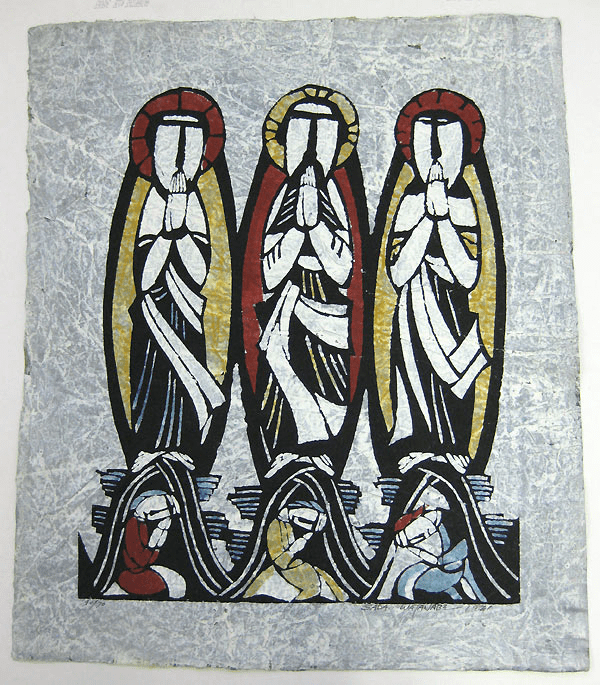
Transfiguration, by Sadao Watanabe, 1971

Jesus intentionally took Peter, James, and John up the mountain to have this experience. Up to that point, a lot of rumors were circulating about Jesus – that maybe he was Elijah come back, or some other prophet, perhaps even Moses himself. But Moses and Elijah showing up next to Jesus, meant that Jesus is not them. 

In the Old Testament, Moses was used by God to deliver the Israelites out of slavery in Egypt and to bring them to the Promised Land. Centuries later, Elijah was used by God to bring about a great repentance of the people from the false god Baal, and a mighty revival to the exclusive worship of the Lord.

As good as Moses and Elijah were, having them with Jesus on the mountain meant that it gets even better with Christ. Jesus is the Messiah, the True Deliverer, who saves people from their sins. What’s more, Jesus is the ultimate revivalist, bringing truth, grace, and the love of God to people, calling them from legalistic religion back to the true worship of God.

Deliverance and revival were integral to Christ’s earthly ministry. And Jesus expects his followers to do the same. In Christian ministry, there will be suffering, because we must take up our cross. There will also be glory, experiencing and seeing deliverance from sin that comes with revival. 

When I was in college, a group of us Christians met each week for encouragement and prayer. For a two year period, at least one person a week was added to our group, having had a dramatic conversion to Christ. That was an incredible time of being on the mountain with Jesus, seeing him manifested in all his glory through changing people’s lives.

Yet, inevitably, we descend to the valley. What goes up must come down. And how we handle the valley is crucial. On the mountain, things seemed effortless; but in the valley, it’s all different.

Coming off the mountain may lead to various temptations, like wishing you were back on the mountain – looking back to some Golden Age where everything seemed so great, and people were enthused and excited about God and the group you were in. Yet, there are times when the revival fires wane, and the glory departs. Then what?…

God’s Word to us today, given by God the Father, is: “This is my Son, whom I love. Listen to him!”

A 12th century Mosaic of Christ’s Transfiguration

Here is what Jesus has said to us, as recorded by the Evangelist Mark:

“The time has come. The kingdom of God is near. Repent and believe the good news!” (Mark 1:15)

“Come, follow me, and I will make you fishers of men.” (Mark 1:17)

“It is not the healthy who need a doctor, but the sick. I have not come to call the righteous, but sinners.” (Mark 2:17)

“Why are you so afraid? Do you still have no faith?” (Mark 4:40)

“Everything is possible for him who believes.” (Mark 9:23)

“If anyone wants to be first, he must be the very last, and the servant of all.” (Mark 9:35)

“I tell you the truth, anyone who will not receive the kingdom of God like a little child will never enter it.” (Mark 10:15)

“…the Son of Man will be betrayed to the chief priests and teachers of the law. They will condemn him to death and will hand him over to the Gentiles, who will mock him and spit on him, flog him and kill him….” (Mark 10:33-34)

“For even the Son of Man did not come to be served, but to serve, and to give his life as a ransom for many.” (Mark 10:45)

“I tell you, whatever you ask for in prayer, believe that you have received it, and it will be yours. And when you stand praying, if you hold anything against anyone, forgive him, so that your Father in heaven may forgive you your sins.” (Mark 11:24-25)

“My God, my God, why have you forsaken me?” (Mark 15:34)

“Go into all the world and preach the good news to all creation.” (Mark 16:15)

If you have had a mountain top experience with Jesus, let that encounter give you the drive and the hope to keep carrying the bucket through the valley, without living in the past.

If you have never been on the mountain, then today, listen to Jesus and follow what he says.

If you are vexed in your spirit, go to Jesus. Listen to him. Do what he says.

Know the word of the Lord, and bank on it. For our light and momentary sufferings will result in praise, honor, and glory when Jesus Christ is revealed. Amen.

Take Responsibility (Deuteronomy 3:23-29)

It was also at that same time that I begged the Lord: Please, Lord God! You have only begun to show your servant your greatness and your mighty hand. What god in heaven or on earth can act as you do or can perform your deeds and powerful acts? Please let me cross over the Jordan River so I can see the wonderful land that lies beyond it: those beautiful highlands, even the Lebanon region.

But the Lord was angry with me because of you! He wouldn’t listen to me. He said to me: That’s enough from you! Don’t ever ask me about this again! Go up to the top of Mount Pisgah. Look west, north, south, and east. Have a good look, but you will not cross the Jordan River. Instead, command Joshua, strengthen him, and encourage him because he’s the one who will cross the river before this people. He’s the one who will make sure they inherit the land you will see.

After that, we stayed in the valley across from Beth-peor. (Common English Bible)

I wonder if God ever feels like the parents of elementary aged children. “Please, please, puh-leeeze let me have it!” It’s a good thing God is spirit, because there may be some divine eye rolling happening with certain people’s requests.

When Moses pleaded God to allow him to cross the Jordan River into the Promised Land, the Lord forbade him to do so. The reason God gave is that Moses had to bear the brunt of the Lord’s anger on behalf of the community.

But you [Israel] had no faith in the Lord your God about this matter, even though he went ahead of you, scouting places where you should camp, in fire by night, so you could see the road you were taking, and in cloud during the daytime.

The Lord heard what you said. He was angry and he swore: Not even one of these people—this wicked generation!—will see the wonderful land that I promised to give to your ancestors… (The Lord was even angry with me [Moses] because of what you did. “You won’t enter the land either,” God said. “But Nun’s son Joshua, your assistant, will enter it. Strengthen him because he’s the one who will help Israel inherit the land.”) (Deuteronomy 1:32-38, CEB)

Not allowing Moses to enter the land may seem strange to us whose culture prizes individualism and self-reliance. But that was not the culture of ancient Israel. There was a common core belief in corporate responsibility. The leader acted as the representative of the people, and so, Moses was answerable for the community’s sins.

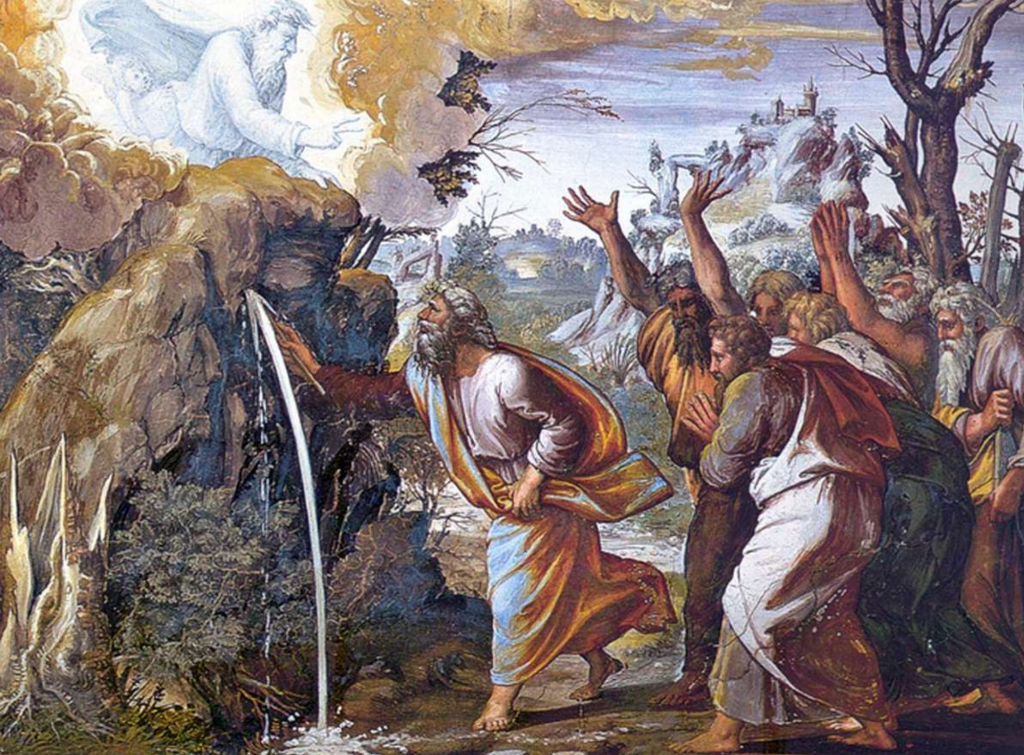
Fresco of Moses and water from the rock, by Raffaello Sanzio da Urbino (Raphael), 1519

Lest we still don’t like what’s going on here, elsewhere in scripture we get a perspective that it was also the lack of faith by Moses that caused him to lose privilege in entering the land:

Moses and Aaron gathered the assembly before the rock. He said to them, “Listen, you rebels! Should we produce water from the rock for you?” Then Moses raised his hand and struck the rock with his staff twice. Out flooded water so that the community and their animals could drink.

The Lord said to Moses and Aaron, “Because you didn’t trust me to show my holiness before the Israelites, you will not bring this assembly into the land that I am giving them.” These were the waters of Meribah, where the Israelites confronted the Lord with controversy and he showed his holiness to them. (Numbers 20:10-13, CEB)

The fact of the matter is that we are responsible for both our personal selves and the entire community of people we are a part of. Indeed, we truly are our brother’s and sister’s keeper.

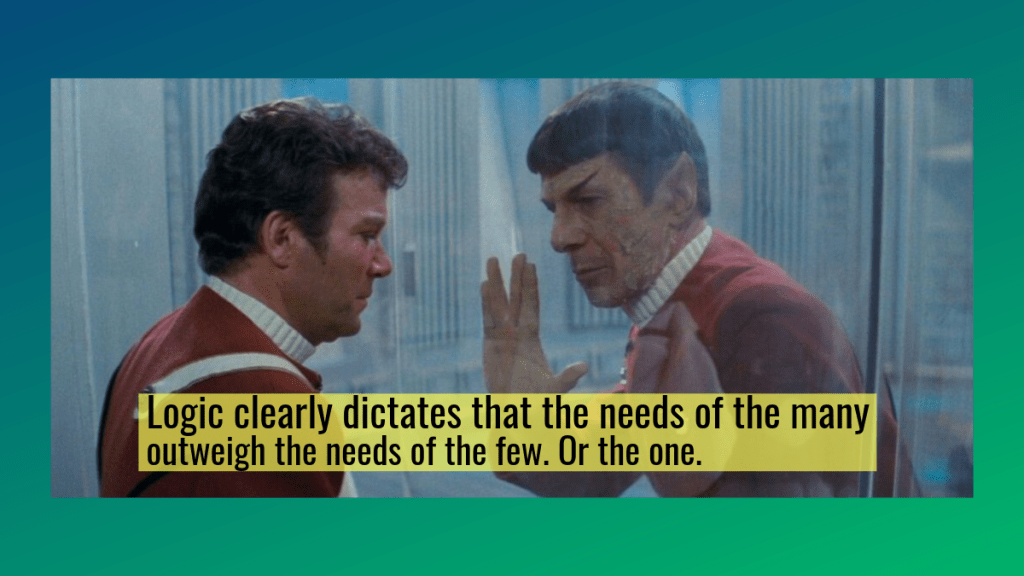
It’s important that everyone considers what the Lord’s will is – not only personally – but for the common good of all the people. Perhaps this idea is captured best in the fictitious Star Trek adage of the alien Vulcans who would logically examine a decision and say, “The needs of the many outweigh the needs of the few (or the one).”

What’s more, believers in God are meant to consider what is pleasing to the Lord, and not only to one’s personal or communal pleasure. The Lord is God and we are not. Sovereignty belongs to God. Servanthood belongs to us; and our ultimate service is to the Lord.

The bottom line for me is believing that the Lord God is good, all the time, and truly has our best interests at mind and at heart. Since God did not allow Moses into the land, I reason that it was for a greater good that transcended the individual request of Moses to enter.

Maybe that’s a difficult perspective to find whenever we are in the middle of strong desires for something, but it is one that we must struggle to find. Since the Lord is high and holy above everyone and everything, God is able to see the big picture and every angle of a situation.

We, however, only see a very small slice of the total view. So, it only makes sound spiritual sense that we learn to entrust ourselves to the One who sees all and acts according to what is right, just, and good.

Gracious and generous God, Creator and Giver of all that is good, we thank you for our many blessings. We acknowledge that all that we have is from you. We offer you thanks and praise for the beauty of the earth, our work, our family, our loved ones, and all the gifts we have been given.

You are with us always. In each dark hour, you are here. In each bright hour, you are here. Blessed by your grace, may we show gratitude by sharing what we have been given. For by serving our brothers and sisters, we serve you.

We remain ever grateful for your constant love, the gift of your Son Jesus, and the presence of your Holy Spirit with us. Protect and guide us on our personal and collective journeys, as we seek to be your faithful stewards. Amen.

God Will Make a Way (Exodus 2:1-10)

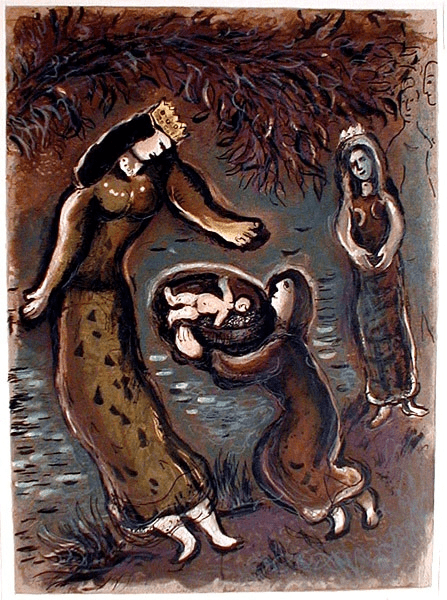
Moses is saved from the water by Pharaoh’s daughter, by Marc Chagall, 1966

Now a man from Levi’s household married a Levite woman. The woman became pregnant and gave birth to a son. She saw that the baby was healthy and beautiful, so she hid him for three months. When she couldn’t hide him any longer, she took a reed basket and sealed it up with black tar. She put the child in the basket and set the basket among the reeds at the riverbank. The baby’s older sister stood watch nearby to see what would happen to him.

Pharaoh’s daughter came down to bathe in the river, while her women servants walked along beside the river. She saw the basket among the reeds, and she sent one of her servants to bring it to her. When she opened it, she saw the child. The boy was crying, and she felt sorry for him. She said, “This must be one of the Hebrews’ children.”

Then the baby’s sister said to Pharaoh’s daughter, “Would you like me to go and find one of the Hebrew women to nurse the child for you?”

Pharaoh’s daughter agreed, “Yes, do that.” So the girl went and called the child’s mother. Pharaoh’s daughter said to her, “Take this child and nurse it for me, and I’ll pay you for your work.” So the woman took the child and nursed it. After the child had grown up, she brought him back to Pharaoh’s daughter, who adopted him as her son. She named him Moses, “because,” she said, “I pulled him out of the water.” (Common English Bible)

A new Pharaoh was enthroned in Egypt. Enough time had gone by that the legacy of Joseph as the administrator in saving many Egyptian people was lost. So, because the Israelites had grown to such large numbers, Pharaoh was afraid.

The politics of fear typically results in somebody getting oppressed. Indeed, fear became the driving force to a series of escalating oppressive policies initiated by Pharaoh, even to the point of planned infanticide. The Jewish midwives were instructed toward this end.

But the midwives did not fear the Egyptian Pharaoh. Instead they had a healthy fear of God (Exodus 1:17, 21). With such rightly ordered fear, the Jewish midwives defied the order of Pharaoh and openly disobeyed the royal command to murder Hebrew boys.

Here then, we have the setting for a special Hebrew baby to be born named Moses. He is the healthy child of two devout Levites. And although God’s name is not referenced in the verses for today, we can nonetheless see the providence and protection of the Lord within the narrative.

Through a complex chain of events, both the birth mother and the royal daughter care for this baby, protecting his life, with a divine provision for the needs of the infant Moses. Most stories in the Old Testament have contrasting characters within them, and today’s is no exception.

Pharaoh was the ruler over all of Egypt, and yet, he feared a loss of power and the status quo because of the Israelites – even though he reigned during a time of political peace, with hegemony reaching into the Middle East. As Pharaoh’s paranoid fear rose, so did God’s response of divine sovereignty over him, by providing protection against his diabolical intentions.

In contrast to Pharaoh, a powerless and non-descript Hebrew couple were married, conceived and bore a family of a daughter and two sons – Moses being the youngest. They had nothing, yet everything; whereas Pharaoh had everything, yet nothing. Thriving and flourishing has to do with a lot more than wealth and material resources.

Maternal care is powerful. And it finds a way to win the day and not only save a baby, but also to ensure that the baby grows, lives, and thrives. No royal edict can defeat the resilient strength of maternal compassion.

Despite Pharaoh’s increasing oppression, the compassion of several women ends up raising the very one who will lead the Israelites into liberation from this oppression.

With the Lord, a way will be found where there is no way. God + nothing = everything.

For us today, there is often a tendency to look back on the good old days when God did great things, and to look ahead when the Lord will return and make all things new and right. Yet we too often neglect to be mindful and live in the present moment, and know the God who is present with us right now.

We may remember the awesome deeds that God once did; and rejoice in biblical stories which demonstrate the Lord’s power, provision, and protection. We may look forward to the fulfillment of God’s promises in the person of Jesus when he returns, and gain hope from that.

Now, in this present evil age, and in this messed up world, we also have the God of the present tense. God will make a way, in this present time, where there seems to be no way. God is doing something new and amazing for us today.

And that way will be clear enough for us to know – and incredible enough for us to not predict or imagine. For God’s watch-care and deliverance can (and does) take many forms. When the Lord fulfills divine plans, it sometimes comes in the most creative and incredible way possible, so that we will have no doubt where it came from.

“God Will Make a Way” by Don Moen

God will make a way, Where there seems to be no way
He works in ways we cannot see, He will make a way for me
He will be my guide, Hold me closely to His side
With love and strength, For each new day
He will make a way He will make a way

By a roadway in the wilderness, He’ll lead me
And rivers in the desert will I see
Heaven and earth will fade
But His Word will still remain
He will do something new today