Exodus 2:11-15 – Time Out

A Time for Everything

In the course of time Moses grew up. Then he went to see his own people and watched them suffering under forced labor. He saw a Hebrew, one of his own people, being beaten by an Egyptian. He looked all around, and when he didn’t see anyone, he beat the Egyptian to death and hid the body in the sand.

When Moses went there the next day, he saw two Hebrew men fighting. He asked the one who started the fight, “Why are you beating another Hebrew?”

The man asked, “Who made you our ruler and judge? Are you going to kill me as you killed the Egyptian?” Then Moses was afraid and thought that everyone knew what he had done.

When Pharaoh heard what Moses had done, he tried to have him killed. But Moses fled from Pharaoh and settled in the land of Midian. (GW)

Faith is not a static phenomenon that one possesses, or not. Rather, faith is a dynamic movement which is continually either being strengthened or weakened through our life choices.  Moses needed to learn how to make healthy decisions of faith, just as much or more than the rest of us.  The fact that he was eighty years old before he became the human agent of God’s deliverance of the Israelites from the Egyptians, after a forty year stint in the backside of the desert, tells us that it took him awhile to mature.  Even though Moses may have had a sense that the Israelites needed freedom from slavery and acted on that sense by killing a ruthless Egyptian, his method and sense of timing were off.

There is a time for everything, said the writer of Ecclesiastes.  Wisdom, which is the ability to apply faith to concrete situations with appropriate forms, is often in the timing of things.  To know when to speak and when to listen, when to act and when to wait, is an important facet of faith.  The ancient Israelites were slaves in Egypt for a long time.  Moses knew they were suffering, and he acted in “good faith.” Yet, it was not yet time and it was a rash movement.  Eventually, the Jewish cry of suffering arose to God, and God heard them, remembering his covenant with them.  Why God did not act sooner, or use Moses earlier, is information that is only privy within God himself.

If we are to develop a strong and wise faith with an opportune sense of timing, we will need to rely on God.  Trusting in ourselves, our own efforts, and our own gauge of how things ought to proceed will usually not end well.  We may, like Moses, find ourselves taking a “time out” from God in obscurity until we learn to wait on him.

In the fullness of time, Paul said to the Galatians, Jesus came, born of a woman, born under law, to redeem those under the law (Galatians 4:4-5).  God knows what he is doing, even though it might seem like he is sometimes slow to act.  God sees.  God delivers.  And he does it in his timing – not ours.

Redeeming God, you control all things, including the clock.  Give me wisdom so that my sense of timing might reflect your will and your way, through Jesus Christ, your Son, who with you and the Holy Spirit reign supremely as one God, now and forever.  Amen.

Psalm 105:1-6, 16-22, 45 – On Divine Providence

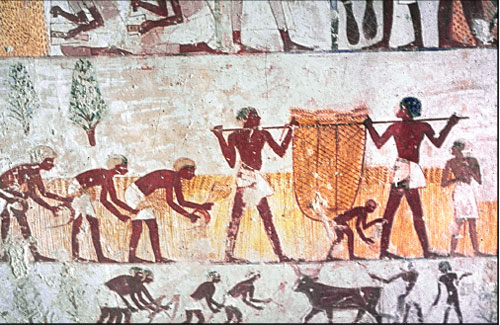
Egyptian workers harvesting grain c1420BCE
Egyptian workers harvesting grain. From the tomb of Mena in Thebes, c.1420 B.C.E.

Give thanks to the Lord and proclaim his greatness.
Let the whole world know what he has done.
Sing to him; yes, sing his praises.
Tell everyone about his wonderful deeds.
Exult in his holy name;
rejoice, you who worship the Lord.
Search for the Lord and for his strength;
continually seek him.
Remember the wonders he has performed,
his miracles, and the rulings he has given,
you children of his servant Abraham,
you descendants of Jacob, his chosen ones….

He called for a famine on the land of Canaan,
cutting off its food supply.
Then he sent someone to Egypt ahead of them—
Joseph, who was sold as a slave.
They bruised his feet with fetters
and placed his neck in an iron collar.
Until the time came to fulfill his dreams,
the Lord tested Joseph’s character.
Then Pharaoh sent for him and set him free;
the ruler of the nation opened his prison door.
Joseph was put in charge of all the king’s household;
he became ruler over all the king’s possessions.
He could instruct the king’s aides as he pleased
and teach the king’s advisers….

All this happened so they would follow his decrees
and obey his instructions.

Praise the Lord! (NLT)

Our spiritual and emotional vision can sometimes be myopic. It is precisely in those times when we have tunnel vision and neither look back to a past in which God acted with justice nor see ahead to a future with hope that we must remember God is supreme over everything, including time.

God’s providence and blessing is the animating force behind all events. The biblical character of Joseph is Exhibit A of God’s sovereign backstage orchestration of personal and world forces. Joseph’s story of brotherly betrayal, bondage, imprisonment, and rise to power include some lessons for us (Genesis 37-41):

  • Joseph is portrayed as a model of wisdom for us to follow.

Respect and obey the Lord! This is the beginning of knowledge. Only a fool rejects wisdom and good advice (Proverbs 1:7, CEV).  

Do not let mercy and truth leave you. Fasten them around your neck. Write them on the tablet of your heart. Then you will find favor and much success in the sight of God and humanity (Proverbs 3:3-4, GW).

  • Joseph did not know the end of the story while he was in the middle of it, languishing in prison. Little did he know that God was testing his character, training him to listen well, and preparing him for his eventual leadership in Egypt – all to save many lives from hunger and starvation.

Now faith is the assurance of things hoped for, the conviction of things not seen. (Hebrews 11:1, NRSV)

  • Joseph successfully negotiated and navigated a world which was vastly different from his own religion and ethics. He was determined not to give in to the seductions of women and power around him; and, he did not become bitter against his brothers, nor against the Egyptians.

Don’t love the world’s ways. Don’t love the world’s goods. Love of the world squeezes out love for the Father. Practically everything that goes on in the world—wanting your own way, wanting everything for yourself, wanting to appear important—has nothing to do with the Father. It just isolates you from him. The world and all its wanting, wanting, wanting is on the way out—but whoever does what God wants is set for eternity. (1 John 2:15-17, MSG)

Four-hundred years later, Moses also had to navigate the situation of being an Israelite in the world of Egypt, and walked in the footsteps of his forebear, Joseph:

By faith Moses, when he had grown up, refused to be known as the son of Pharaoh’s daughter.  He chose to be mistreated along with the people of God rather than to enjoy the pleasures of sin for a short time.  He regarded disgrace for the sake of Christ as of greater value than the treasures of Egypt because he was looking ahead to his reward. (Hebrews 11:24-26, NIV)

We understand, knowing the end of the story, that Joseph was in Egypt (in the world) to be a blessing and that God had him there for a purpose. This is no less true for the people of God. We do not exist merely for ourselves but to be a blessing to the world.  God, as he did for Joseph, shows us mercy while we are smack in the middle of hardship and not by taking us out of our worldly predicament.  Life must sometimes be lived at great risk amid the world and not apart from it.

Seen from a strictly worldly perspective, Joseph’s time in slavery and prison was an unnecessary injustice. However, from God’s vantage point, Joseph was learning to be mindful of God despite his circumstances. For the Lord is much more concerned about the process we undergo in spiritual formation, rather than simply producing a product at the end of the line. Most of life is lived in the mundane, and Joseph was faithful in all the workaday decisions and demands of life. This made him able to handle all the vicissitudes of others in their fickle and feckless ways and see God’s providential working.

Lord God, you hold both heaven and earth in a single peace. Let the design of your great love shine on the waste of our anger and sorrow, and give peace to your Church, peace among nations, peace in our homes, and peace in our hearts through Jesus Christ our Lord who with you and the Holy Spirit benevolently reign as one God, now and forever. Amen.

Exodus 19:16-25 – An Awesome God

Mount Sinai

On the morning of the third day, thunder roared, and lightning flashed, and a dense cloud came down on the mountain. There was a long, loud blast from a ram’s horn, and all the people trembled. Moses led them out from the camp to meet with God, and they stood at the foot of the mountain.  All of Mount Sinai was covered with smoke because the Lord had descended on it in the form of fire. The smoke billowed into the sky like smoke from a brick kiln, and the whole mountain shook violently. As the blast of the ram’s horn grew louder and louder, Moses spoke, and God thundered his reply. The Lord came down on the top of Mount Sinai and called Moses to the top of the mountain. So, Moses climbed the mountain.

Then the Lord told Moses, “Go back down and warn the people not to break through the boundaries to see the Lord, or they will die. Even the priests who regularly come near to the Lord must purify themselves so that the Lord does not break out and destroy them.”

“But Lord,” Moses protested, “the people cannot come up to Mount Sinai. You already warned us. You told me, ‘Mark off a boundary all around the mountain to set it apart as holy.’”

But the Lord said, “Go down and bring Aaron back up with you. In the meantime, do not let the priests or the people break through to approach the Lord, or he will break out and destroy them.”

So, Moses went down to the people and told them what the Lord had said. (NLT)

As Christians await the Day of Pentecost and the giving of the Spirit, the Revised Common Lectionary reminds us of another great anticipation from the Old Testament. The ancient Israelites were amazingly delivered from Egyptian slavery, miraculously walked through the Red Sea, and traveled with wondrous anticipation to Mount Sinai. Now, in today’s reading, they are about to meet with God!

The scene of this meeting is not exactly the romantic highland encounter of the Man from Snowy River (my wife’s all-time favorite movie). The landscape is much more akin to the dark and volcanic Mount Doom from The Lord of the Rings. The picture appears more foreboding than loving. The thing about mountain top experiences is that they are not all monolithic one-size-fits-all encounters with bright rainbows and happy skipping unicorns.

Holy Scripture is replete with mountain experiences. Mountains serve as symbols for significant encounters with a mighty God. Whether it is Christ’s transfiguration on a mountain; or, the giving of the law on a mountain; the awesome mountain serves as a tangible symbol of divine majesty, strength, and sovereignty. And, I might add, conversely, valleys in Scripture are symbolic of difficulty and suffering.  Our God is a God of both mountain and valley. That is, the God of the Bible is both transcendent and immanent; he rules with power and might high above us on his holy mountain; yet, he also comes near to us in the valley of the shadow of death.

Leading up to the giving of the Ten Words (Commandments) in Exodus 20, Exodus 19 portrays an awesome scene of God in his transcendent holiness and power. In fact, the experience was so otherworldly that the people were afraid to even come near the mountain. The Israelites needed limits placed on themselves because of God’s holy presence. Just like coming too near the immense power of the sun will destroy us, so getting near God can ruin us if we do not respect his holiness.

Respecting God’s power and transcendence brings the reality of his immanence into greater appreciation. God has gone to extreme lengths to reveal himself to his people. For the Christian, it all culminates through the incarnation of Christ, the sending of the Son. In Jesus, the transcendence and immanence of God meet perfectly to bridge the chasm between humanity and the divine.  Because of Jesus, the awesome sounds of thunder and trumpet do not lead to fear; they announce grace to those who approach God by faith.

You have not come to a mountain that can be touched and that is burning with fire; to darkness, gloom and storm; to a trumpet blast or to such a voice speaking words that those who heard it begged that no further word be spoken to them, because they could not bear what was commanded: “If even an animal touches the mountain, it must be stoned to death.” The sight was so terrifying that Moses said, “I am trembling with fear.” But you have come to Mount Zion, to the city of the living God, the heavenly Jerusalem. You have come to thousands upon thousands of angels in joyful assembly, to the church of the firstborn, whose names are written in heaven. You have come to God, the Judge of all, to the spirits of the righteous made perfect, to Jesus the mediator of a new covenant….

See to it that you do not refuse him who speaks. If they did not escape when they refused him who warned them on earth, how much less will we, if we turn away from him who warns us from heaven? At that time, his voice shook the earth, but now he has promised, “Once more I will shake not only the earth but also the heavens.” The words “once more” indicate the removing of what can be shaken—that is, created things—so that what cannot be shaken may remain.

Therefore, since we are receiving a kingdom that cannot be shaken, let us be thankful, and so worship God acceptably with reverence and awe, for our “God is a consuming fire.” (Hebrews 12:18-29, NIV)

Our God is an awesome God. As Christians anticipate Pentecost, we connect the consuming fire of Mount Sinai with the fire of the Spirit. The divine drama of both experiences has provided God’s people with spiritual power. Both the deliverance of the Israelites from Egyptian slavery by God and the deliverance secured on Mount Zion from spiritual slavery by Jesus are meant to free us to do the will of God. With God’s Word and God’s Spirit given to us, we are emancipated from an empty way of life to experience the fullness of Christ.

May the Spirit who hovered over the waters at creation breathe life into your spirit.

May the Spirit whose presence on the mountain was a consuming fire grant you a revived spirit.

May the Spirit who overshadowed the virgin Mary at the conception of our Lord overwhelm your spirit with joy.

May the Spirit who set the Church afire on Pentecost aflame every spirit on earth with the love of Christ.

And, may the Spirit who exhorts, encourages, helps, and comforts be your blessing and your life today and always. Amen.

Exodus 3:1-12 – God of the Impossible

Burning Bush by Yoram Raanan
The Burning Bush by Yoram Raanan

Now Moses was tending the flock of Jethro his father-in-law, the priest of Midian, and he led the flock to the far side of the wilderness and came to Horeb, the mountain of God. There the angel of the Lord appeared to him in flames of fire from within a bush. Moses saw that though the bush was on fire it did not burn up. So, Moses thought, “I will go over and see this strange sight—why the bush does not burn up.”

When the Lord saw that he had gone over to look, God called to him from within the bush, “Moses! Moses!”

And Moses said, “Here I am.”

“Do not come any closer,” God said. “Take off your sandals, for the place where you are standing is holy ground.” Then he said, “I am the God of your father, the God of Abraham, the God of Isaac and the God of Jacob.” At this, Moses hid his face, because he was afraid to look at God.

The Lord said, “I have indeed seen the misery of my people in Egypt. I have heard them crying out because of their slave drivers, and I am concerned about their suffering. So I have come down to rescue them from the hand of the Egyptians and to bring them up out of that land into a good and spacious land, a land flowing with milk and honey—the home of the Canaanites, Hittites, Amorites, Perizzites, Hivites and Jebusites. And now the cry of the Israelites has reached me, and I have seen the way the Egyptians are oppressing them. So now, go. I am sending you to Pharaoh to bring my people the Israelites out of Egypt.”

But Moses said to God, “Who am I that I should go to Pharaoh and bring the Israelites out of Egypt?”

And God said, “I will be with you. And this will be the sign to you that it is I who have sent you: When you have brought the people out of Egypt, you will worship God on this mountain.” (NIV)

The burning bush is one of those iconic objects and stories in Holy Scripture. The experience of Moses changed both his life and the lives of all the Israelites then and now. Having spent the first forty years of his life as a darling in the Egyptian court, then the next forty years far from that life on the backside of the desert with a bunch of sheep, it is an understatement to say Moses did not expect or ever envision encountering God in a burning bush.

The impossible has no possibility. Or, does it?

That incredible encounter engaged the senses of Moses: the paradoxical sight of seeing fire in a bush that isn’t burning up; the smells of sheep, the outdoors, and perhaps, even of fire; hearing the call of God from within the bush; spiritually and emotionally tasting the attentive justice of God; and, removing the sandals to touch and feel the grounding of sacred space.

The story comments on the senses of God, as well. Even though God is Spirit and is worshiped as such, God is alive with his own sensations: seeing the approach of Moses, and the misery of the Israelites; the smell of injustice wafting into God’s nostrils with a stench that brought a strong divine reaction; hearing the cries of suffering; anticipating the savory taste of showing mercy and justice together; touching Moses in such a profound way that he and the Israelites would never be the same.

Through it all, the close identification between God and God’s people is expressed. The Lord feels the humiliation and pain of the Israelites and vows to uproot them from the Egyptian factory farm of slavery and plant them firmly into rich Promised Land soil.

And what God promises to do, God has the authority and power to make good on.

An impossible situation, Moses thinks. How can hundreds of years of backbreaking bondage to a national force so mighty that nothing can be done about it be broken? Who am I, Moses, to face such odds? Ah, but God specializes in systems of oppression and miserable people. It is the Lord’s abilities which conquer the mightiest of foes and can extend mercy to the lowest and the least powerful. The entire situation is ripe for divine intervention and supernatural wonders to occur.

God will make a way where there seems to be no way. God works in ways which transcend our senses. Where we are blind, God gives sight. Where we are deaf, God opens our ears with the sound of justice. When our taste buds are shot with the gruel of poverty, God causes our tongues to dance with the zest of mercy. When our nerve endings are raw from cruel bondage, God touches us with freedom. Where our nostrils have become accustomed to the smell of death, God’s aroma of life awakens us to new hope.

My friend, I believe with all my heart that:

You already intuitively know deep in your spirit that the impossible is possible with God.

It is never a question of God’s ability, but of God’s timing. God is able – and the Lord works the impossible in its proper time so that justice and mercy will have their full effect.

God of the impossible: I believe. Help me in my unbelief.

God of mercy: I receive. Help me in my denial.

God of justice: I accept. Help me in my rejection.

God of all time: I endure. Help me in my impatience.

God of All: I submit. Help me in my rebellion.

God of power and of might: I trust. Help me in my distrust.

God of our Lord Jesus Christ: I follow. Help me in my wandering.

God of the nations: Yes, you know that I love you. Yes, Lord, you know I love you. Lord, you know all things, and you know that I love you. So, yes, I will answer your call to go. Help me in my sending. Amen.

Click God Will Make a Way by Don Moen as we believe together.