A Time of Woe (Isaiah 5:15-24)

The Prophet Isaiah, by Raphael, 1512

So people will be brought low
    and everyone humbled,
    the eyes of the arrogant humbled.
But the Lord Almighty will be exalted by his justice,
    and the holy God will be proved holy by his righteous acts.
Then sheep will graze as in their own pasture;
    lambs will feed among the ruins of the rich.

Woe to those who draw sin along with cords of deceit,
    and wickedness as with cart ropes,
to those who say, “Let God hurry;
    let him hasten his work
    so we may see it.
The plan of the Holy One of Israel—
    let it approach, let it come into view,
    so we may know it.”

Woe to those who call evil good
    and good evil,
who put darkness for light
    and light for darkness,
who put bitter for sweet
    and sweet for bitter.

Woe to those who are wise in their own eyes
    and clever in their own sight.

Woe to those who are heroes at drinking wine
    and champions at mixing drinks,
who acquit the guilty for a bribe,
    but deny justice to the innocent.
Therefore, as tongues of fire lick up straw
    and as dry grass sinks down in the flames,
so their roots will decay
    and their flowers blow away like dust;
for they have rejected the law of the Lord Almighty
    and spurned the word of the Holy One of Israel. (New International Version)

I’m willing to bet that you, like me, have had to contend with some rather annoying and obnoxious people from time to time in your life.

It’s the person whose head is so big, they can barely walk in and out of a room. And when they talk, it’s usually about themselves, the great things they’ve done, and what they think – not framed as opinions but as the truth.

Since this sort of person rarely listens to anyone, they have no clue about the real needs of people in front of them. Their self-inflated importance is to the degree that they don’t ask and are not curious; yet they demand of others. They see no problem with double-standards. It’s okay for them to bribe, even steal from another. But if you cross the self-important person, look out, because they’ll hunt you down like an animal.

Yes, such people exist. And there are typically some deep psychological reasons why they are so arrogant and difficult to be around. Yet the best thing to know about them is that the true Sovereign of the universe, God, is the rightful judge who will handle them.

If you see a path of destruction on the ground, you know a tornado has touched down and done its damage. And if you observe a bunch of people devastated and demoralized, you know that the haughty and self-important person has been through and laid waste to people’s lives.

The Lord almighty is not okay with such people moving about and hurting others with impunity; the wicked will have to contend with the One who knows what’s going on.

God looks and sees – and pronounces appropriate woes (curses) upon those who feign righteousness and holiness, yet in reality do anything but.

You can easily tell what God abhors by what sorts of behavior receives a disapproving woe upon it. God condemns self-indulgence and self-absorption. This shows itself in how one drinks and does business. The sheer accumulation of land, resources, and strong drink – without any sort of regard to one’s neighbor – is a foolish use of wealth.

The self-absorbed and self-important person becomes desensitized to the needs of others. They also become insensitive to God’s concerns and workings in the world. To disregard the poor and needy is to disregard God. Such injustice, resulting from only caring about oneself, is why the Lord levels divine woes upon them.

Actions and inactions both have consequences. Acting selfishly through wanton accumulation is an equal inaction against the community. As a result of so much economic disparity and carelessness in society, God displaces and deports the ones who arrogantly and smugly believed they are secure.

There is accountability in this world, even though it may not sometimes seem like it. There are ethical requirements and moral imperatives. The social laws contained in the covenant code between God and Israel were expected to be honored. So, when they were continually and habitually ignored, the Lord held the people accountable.

The selfishly proud and arrogant, who acquire all they can and become masters of small worlds, will eventually face ruin by means of divine judgment. It’s as if persons had so loaded their backpacks with sin, that it became heavy to the point of self-crushing.

Divine intervention is either a very good thing, or a very bad thing, depending upon who you are. People are expected to be self-aware enough to know the difference between right and wrong, bad and good, just and unjust. To not know this is to be self-addicted and unable to make proper discernments and decisions.

If you are reading or listening to this, you are likely a person who is concerned enough to care for others and is not lost in yourself. Yet, you likely have to contend with a few persons who are only in this life for themselves. So, watch out and do your best to avoid people who do the following:

  • Manipulate through deceptive language. There are some people in positions of authority or power who intentionally obscure, cover up, and confuse things. If you never know how things stand and are doing, then beware.
  • Independent without accountability. There is no interdependent relationships, and only obedience when it suits them. The constant caginess, and lack of vulnerability, is a warning. If you feel like you’re being micro-managed without much ability to ask specific questions and get straight answers, then look out.
  • Distort how things really are. I’m talking about gaslighting. Gaslighting is the attempt by another to accept the gaslighter’s view of reality as your own. And in the gaslighter’s quest, it seems to you as if there is continually chaos and you are off kilter. If you question it to them, then you will most likely be accused of having a problem. It’s not you. So, skedaddle the first chance you get.

The bottom line of it all is that God is rejected and there are people reneging on their commitments to the Lord. You need not be such a person, and you don’t need to live in such a way that another is in complete control of your life – other than God.

Take note of what the Lord dislikes and despises, and keep away from persons who set up themselves as being akin to God.

Grant us, Lord God, a vision of your world as your love would have it:
a world where the weak are protected, and none go hungry or poor;
a world where the riches of creation are shared, and everyone can enjoy them;
a world where different races and cultures live in harmony and mutual respect;
a world where peace is built with justice, and justice is guided by love.
Give us the inspiration and courage to build it, through Jesus Christ our Lord. Amen.

Deuteronomy 5:1-21 – Ten Basic Rules for Life

Invitation to the Decalogue by Romanian sculptor Liviu Mocan

Moses called out to all Israel, saying to them: “Israel! Listen to the regulations and the case laws that I’m recounting in your hearing right now. Learn them and carefully do them. The Lord our God made a covenant with us at Mount Horeb. The Lord didn’t make this covenant with our ancestors but with us—all of us who are here and alive right now. The Lord spoke with you face-to-face on the mountain from the very fire itself. At that time, I was standing between the Lord and you, declaring to you the Lord’s word, because you were terrified of the fire and didn’t go up on the mountain.”

The Lord said:

I am the Lord your God, who brought you out of Egypt, out of the house of slavery.

You must have no other gods before me. Do not make an idol for yourself—no form whatsoever—of anything in the sky above or on the earth below or in the waters under the earth. Do not bow down to them or worship them because I, the Lord your God, am a passionate God. I punish children for their parents’ sins—even to the third and fourth generations of those who hate me. But I am loyal and gracious to the thousandth generation of those who love me and keep my commandments.

Do not use the Lord your God’s name as if it were of no significance; the Lord won’t forgive anyone who uses his name that way.

Keep the Sabbath day and treat it as holy, exactly as the Lord your God commanded: Six days you may work and do all your tasks, but the seventh day is a Sabbath to the Lord your God. Don’t do any work on it—not you, your sons or daughters, your male or female servants, your oxen or donkeys or any of your animals, or the immigrant who is living among you—so that your male and female servants can rest just like you. Remember that you were a slave in Egypt, but the Lord your God brought you out of there with a strong hand and an outstretched arm. That’s why the Lord your God commands you to keep the Sabbath day.

Honor your father and your mother, exactly as the Lord your God requires, so that your life will be long and so that things will go well for you on the fertile land that the Lord your God is giving you.

Do not kill.

Do not commit adultery.

Do not steal.

Do not testify falsely against your neighbor.

Do not desire and try to take your neighbor’s wife.

Do not crave your neighbor’s house, field, male or female servant, ox, donkey, or anything else that belongs to your neighbor. (CEB)

Whenever I take my wife’s pooch to our local spacious dog park, he knows he will need to stick to just a few of my basic rules. Although he doesn’t need the leash and is free to roam, he understands not to bark at people or approach them and other dogs without my permission. Those few simple rules are for both his well-being, and others.

We as people are free to live our lives as creatures in God’s image. The Lord has just a few basic rules for us to live by to honor both divinity and humanity, as well as to protect others and ourselves. Most folks know them as “The Ten Commandments.”

The Ten Commandments (The Decalogue or The Ten Words) were given to the ancient Israelites nearly 3,500 years ago. These words have stood the test of time and continue to be understood as a universal standard of morality and relational interactions.

There are hundreds of commands in Holy Scripture – approximately 613 in the Old Testament, and 437 in the New Testament – a whopping 1,050 total commands throughout the entirety of the Bible. So, what, then, makes these Ten so special?  Why do we stick to The Ten Words?

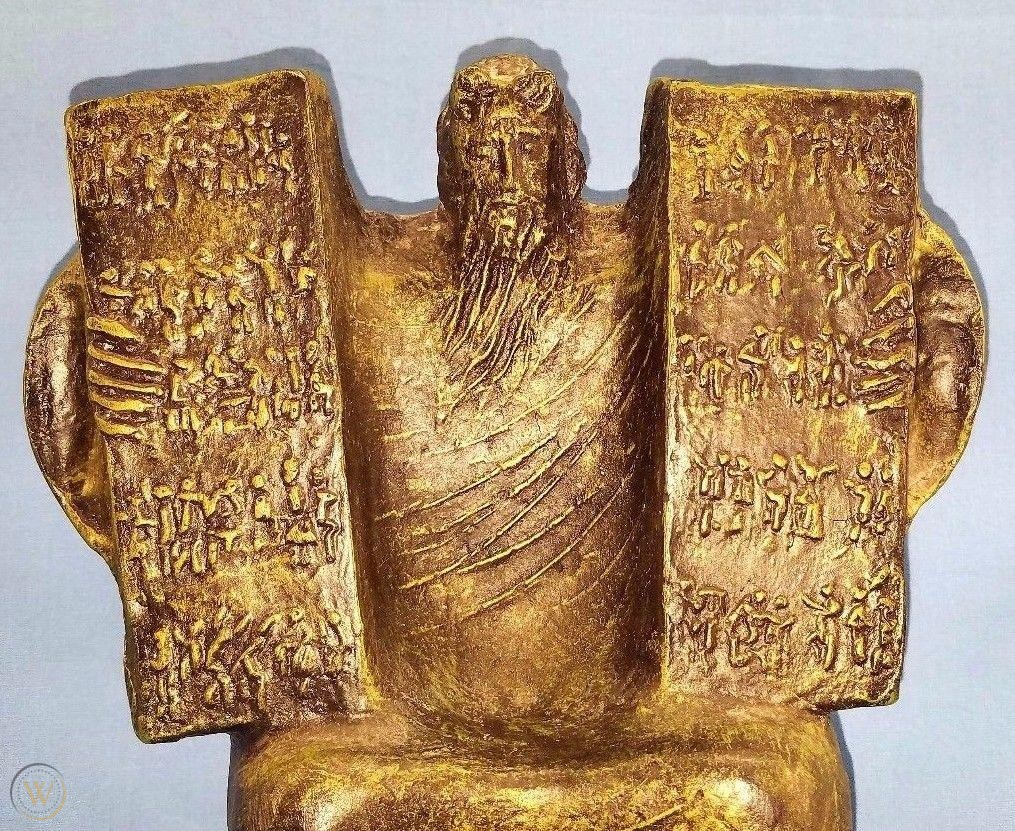
Moses and the Ten Commandments by Italian sculptor Giuseppe Macri (1913-1991)

The reason The Ten Commandments have endured and continue to be learned, spoken, and adhered is that they are foundational commands. Following the Ten Words in the Old Testament are a string of specific commands from God to Moses and then to the people (Exodus 21-23 and Deuteronomy 6-26). Those commands are all a fleshing-out of how to live the basic Decalogue in the Israelites’ context of entering and being in the Promised Land.

In short, every single command of Holy Scripture can be ethically and morally tied back to The Ten Commandments in some way. Whereas many Old Testament laws were given to the Israelites in their ancient Middle Eastern socio-economic culture, The Decalogue was designed to be universal and flexible for every culture and society everywhere, for any time, and every generation.

Therefore, we need to distinguish between The Law (capital “L”) and the law (little “l”). God’s fundamental and foundational ethical Law has always existed and continues to exist – and it is encapsulated in ten short and simple commands which everyone everywhere can obey, whether they are at their jobs, at home, church, or out having fun.

In fact, these ten basic commands are so important that Jesus restated them for us in his Sermon on the Mount (Matthew 5-7). Christ got down to the heart of the commands and let everyone know what it truly means to hold, keep, and obey The Ten Words. For example, Jesus said concerning the seventh command:

“You have heard that it was said to our people long ago, ‘You must not murder anyone. Anyone who murders another will be judged.’ But I tell you, if you are angry with a brother or sister, you will be judged. If you say bad things to a brother or sister, you will be judged by the council. And if you call someone a fool, you will be in danger of the fire of hell” (Matthew 5:21-22, NCV).

It had become easy over the centuries for people to think everything was jim-dandy if they didn’t physically kill anyone. Yet, Jesus knew that well before any person is murdered by another that anger has been nursed through bitter grudges toward another. 

The Ten Words are the very heart of God’s desire for all humanity, and this is precisely why it is important to know and obey them in their full intent. They contain how to relate to God (Commands 1-4); and, how to relate to one another (Commands 5-10).  Jesus would later say, in response to what is the greatest command of all:

“Love the Lord your God with all your heart, all your soul, and all your mind. This is the first and most important command. And the second command is like the first: ‘Love your neighbor as you love yourself.  All the law and the writings of the prophets depend on these two commands.” (Matthew 22:36-40, NCV)

Question and answer 115 of the Heidelberg Catechism, a Confession of Faith crafted by Protestant Reformers in the sixteenth century, addresses a significant issue:

Question: Since no one in this life can obey the Ten Commandments perfectly, why does God want them preached so pointedly? 
Answer: First, so that the longer we live the more we may come to know our sinfulness and the more eagerly look to Christ for forgiveness of sins and righteousness.

Second, so that we may never stop striving, and never stop praying to God for the grace of the Holy Spirit, to be renewed more and more after God’s image, until after this life we reach our goal: perfection.

When all is said and done, grace will have the last word. Yes, none of us will ever perfectly live-out and embody The Ten Words in their entirety all the time. Yet, the grace of God in Jesus Christ does for us what we cannot do for ourselves: deliver us from the realm of sin, death, and hell.

Stuff happens. We often fail to live-into the ways of God for our lives through The Decalogue. However, God, always the hound of heaven, will track us down and mercifully redeem us.

So, embrace The Ten Words. Know them, memorize them, and understand them. Post them on the wall of your office or in your house. Most of all, seek to practice them, obey them, and embody them so that you can enjoy all the freedom of God’s big world.

And you just gotta love it that Johnny Cash once sang about them…