Who Is On the Lord’s Side? (Exodus 32:15-35)

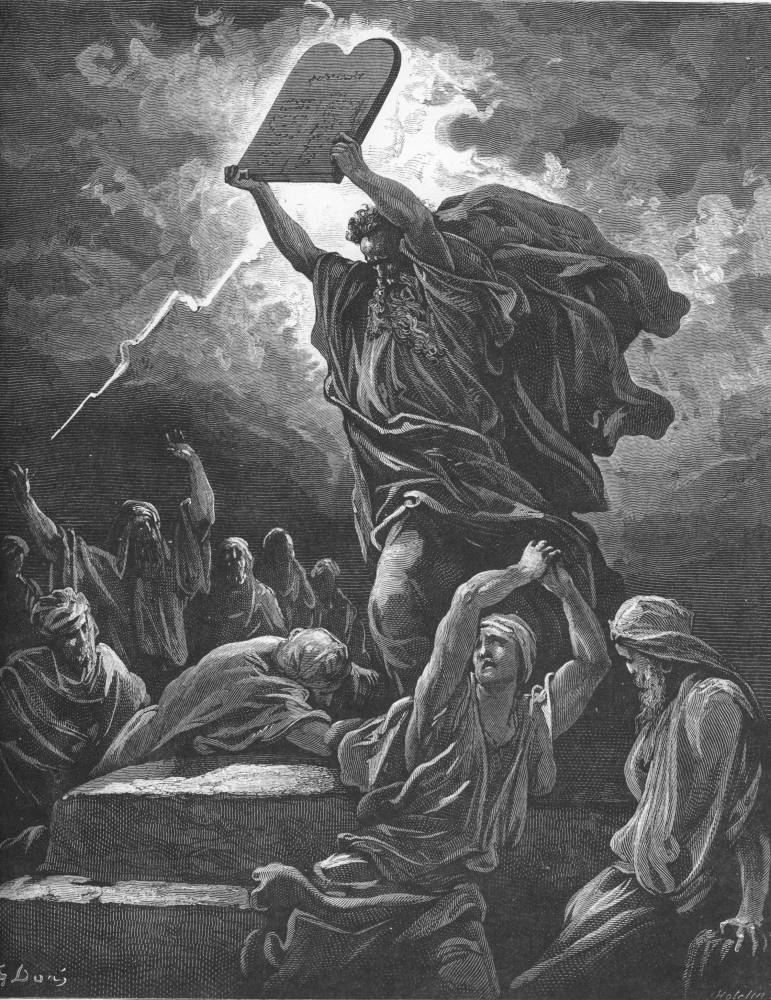
Moses breaks the tablets of the Law, by Gustave Doré (1832-1883)

Then Moses turned and went down from the mountain, carrying the two tablets of the covenant in his hands, tablets that were written on both sides, written on the front and on the back. The tablets were the work of God, and the writing was the writing of God, engraved upon the tablets. When Joshua heard the noise of the people as they shouted, he said to Moses, “There is a noise of war in the camp.” But he said,

“It is not the sound made by victors
or the sound made by losers;
it is the sound of singing that I hear.”

As soon as he came near the camp and saw the calf and the dancing, Moses’s anger burned hot, and he threw the tablets from his hands and broke them at the foot of the mountain.He took the calf that they had made, burned it with fire, ground it to powder, scattered it on the water, and made the Israelites drink it.

Moses said to Aaron, “What did this people do to you that you have brought so great a sin upon them?” And Aaron said, “Do not let the anger of my lord burn hot; you know the people, that they are wicked. They said to me, ‘Make gods for us, who shall go before us; as for this Moses, the man who brought us up out of the land of Egypt, we do not know what has become of him.’ So I said to them, ‘Whoever has gold, take it off’; so they gave it to me, and I threw it into the fire, and out came this calf!”

When Moses saw that the people were out of control (for Aaron had lost control of them, prompting derision among their enemies), then Moses stood in the gate of the camp and said, “Who is on the Lord’s side? Come to me!” And all the sons of Levi gathered around him.He said to them, “Thus says the Lord, the God of Israel: Put your sword on your side, each of you! Go back and forth from gate to gate throughout the camp, and each of you kill your brother, your friend, and your neighbor.” 

The sons of Levi did as Moses commanded, and about three thousand of the people fell on that day. Moses said, “Today you have been ordained for the service of the Lord, each one at the cost of a son or a brother, and so have brought a blessing on yourselves this day.”

On the next day Moses said to the people, “You have sinned a great sin. But now I will go up to the Lord; perhaps I can make atonement for your sin.” So Moses returned to the Lord and said, “Alas, this people has sinned a great sin; they have made for themselves gods of gold. But now, if you will only forgive their sin—but if not, please blot me out of the book that you have written.” 

But the Lord said to Moses, “Whoever has sinned against me I will blot out of my book. But now go, lead the people to the place about which I have spoken to you; see, my angel shall go in front of you. Nevertheless, when the day for punishment comes, I will punish them for their sin.”

Then the Lord sent a plague on the people because they made the calf—the one that Aaron had made. (New Revised Standard Version)

Honestly, this is just a sad story. The ancient Israelites were certainly not at their best. With Moses up on the mountain for about six weeks, there was a large leadership vacuum. Aaron, along with Hur, were to fill that space, keeping things on the straight and narrow while Moses was occupied receiving the commandments of God. That clearly didn’t happen.

Part of the reason for the people getting so out of hand with their sin was the absence of good solid leadership. There is a big contrast between Moses as leader and his brother Aaron as the interim leader.

Moses exhibited himself as a self-differentiated leader. That means, in short, that a leader cannot be overly identified with the group they lead; or else they will not have the needed perspective to make hard decisions. In other words, leaders need to have clearly defined boundaries.

Good leaders need to be in touch with the ideas and emotions of others but not dominated by them. The opposite of being a self-differentiated leader is one who tries to make everyone happy and has a hard time making unpopular decisions. Hence, the difference between the leadership of Moses and that of Aaron.

Who is on the Lord’s side? Which leader is following God’s words and ways? Notice the following distinctions between Moses the self-differentiated leader, and Aaron the leader without boundaries between himself and the people, as evidenced in today’s Old Testament lesson:

  • Moses maintained relational connections with the Levites and others who sought to uphold God’s covenant, when making decisions of conviction.
  • Aaron threw personal convictions aside in order to avoid conflict and keep everyone happy (which, by the way, isn’t even possible).
  • Moses avoided blame-shifting when dealing with the problem, but took ownership of what was going on when speaking with God.
  • Aaron just gave some lame excuses for why things went sideways.
  • Moses faced trouble and walked into the difficulty to make a difference and make things right.
  • Aaron put on a gas mask in the toxic culture and avoided dealing with the people’s sin.
  • Moses was a responsible leader who sought healthy honest relationships with God and others.
  • Aaron was an irresponsible leader who tried to create an unhealthy triangle in order to take the focus off of his poor decisions and actions.
  • Moses directly confronted the sinful situation when confronted with it.
  • Aaron procrastinated dealing with the people’s sin by simply giving them what they wanted.
  • Moses immediately acted when he saw there was a group of saboteurs in the camp.
  • Aaron hesitated in dealing with the unruly persons among the Israelites, with disastrous consequences.

By removing all the rabble rousers in the camp, Moses saved the people. Yet, even then, there was a devastating consequence from God; a divine plague was sent because of the golden calf which Aaron had made.

“Apis” was the most important and highly regarded bull deity of ancient Egypt. The Lord had judged the bull god – along with the other Egyptians gods – within the series of ten plagues which led to Israel’s deliverance. By making a detestable image that looked a lot like Apis, the Israelites, too, experienced a plague of divine judgment. The God who shows no favoritism deals with sin no matter who it is.

Maybe this awful scene could have been avoided – if there was some competent self-differentiated leadership in the absence of Moses. But we will, sadly, never know.

Holy God, forgive us for our idolatry, and help us to stop divinizing and revering creatures and created things in place of you, instead of your actual self and presence which is among us, through Jesus Christ our Lord in the power of the Holy Spirit. Amen.

The Question of Authority (Mark 11:27-33)

The Pharisees Question Jesus, by James Tissot (1836-1902)

Again they entered Jerusalem. As Jesus was walking through the Temple area, the leading priests, the teachers of religious law, and the elders came up to him. They demanded, “By what authority are you doing all these things? Who gave you the right to do them?”

“I’ll tell you by what authority I do these things if you answer one question,” Jesus replied. “Did John’s authority to baptize come from heaven, or was it merely human? Answer me!”

They talked it over among themselves. “If we say it was from heaven, he will ask why we didn’t believe John. But do we dare say it was merely human?” For they were afraid of what the people would do because everyone believed that John was a prophet. So they finally replied, “We don’t know.”

And Jesus responded, “Then I won’t tell you by what authority I do these things.” (New Living Translation)

Jesus was an outsider. During his earthly ministry, he was viewed, at best, as an avant-garde leader; and, at worst, a flat out heretic. It may be easy to overlook that reality, because we typically think of Christ as Lord and always on the inside of things.

Although Jesus was a teacher and a rabbi – and was neither a priest nor a member of any Jewish religious sect – he nevertheless walked around as if he owned the place (which he did). That gave the established religious leadership of the day no end of consternation and frustration.

Jesus made significant inroads into people’s lives, especially with outsiders like himself. And this situation created anger and jealousy with many of the religious ruling class. Since Jesus was not a card-carrying member, the leaders wanted to hear from him why he kept acting confidently and deliberately on their religious turf.

“What gives you the right? Who authorized you to act this way?” was their cry.

The established authorities are depicted in today’s Gospel lesson as a craven bunch who did not want to alienate the crowds, and yet were eager to get the upstart Jesus out the way. This appears to be an age-old situation of leaders putting their fingers to the wind to go with whatever will keep them popular and in power.

Since Jesus consistently refused to play such games, the authorities believed he needed to go. They, however, had no intention of risking an outright confrontation and showing their shadow motives.

Jesus clearly connected himself with John the Baptist, as both coming from the same authority. John was yet another figure for whom the established leaders could not control.

We ought never to underestimate both perceived and actual threats to status quo leadership. Such leaders have no inkling of being public servants when true moral authority comes along. The lack of conformity from John and Jesus would cost them both their very lives.

Speaking truth to power while not becoming defensive doing so is a tricky art. Yet, Jesus did it. Continual challenges to his authority left him unfazed as to his mission and purpose on this earth. Christ was assertive without becoming despotic; forward without taking the bait of useless arguments; confident with no hint of arrogance.

For me, the contrast between Jesus and the religious authorities is trenchant. The confident, wise, and calm authority of Christ is in direct opposition to the fear, anxiety, and worry of the ruling leaders. Whereas they kept anxiously ruminating about what to do about this threat to their established authority, Jesus exhibited a non-anxious presence which maintained a steadfast focus on God’s righteous, holy, and benevolent rule and reign.

Sometimes, continual fear is a big red flag that the leader is so worried about losing their place or position, that the will of God gets pushed aside as merely a secondary concern.

Questioning Christ’s credentials was the giveaway that the existing religious authorities were concerned about their power and privilege, and not the people. The wise person will see such queries for what they are.

Wherever we observe those who refuse to share power, have a xenophobic bent toward outsiders, and seem to do just about anything to maintain the status quo, there we will find the abuse of authority.

Conversely, where we observe a deep concern for equity, justice, and the common good of all persons, there we see compassionate leadership who will champion ethical leadership and espouse moral authority.

In any democratic society, we must choose our leaders wisely.

Great God of hope, in these times of change and uncertainty, unite your people and guide our leaders with your wisdom. Give us courage to overcome our fears and help us to build a future in which all may prosper and share together through Jesus Christ our Lord in the strength of your Holy Spirit. Amen.

Encouragement to Be Faithful (2 Timothy 1:3-7)

Orthodox icon of St. Timothy
Orthodox icon of St. Paul the Apostle

Timothy, I thank God for you—the God I serve with a clear conscience, just as my ancestors did. Night and day I constantly remember you in my prayers. I long to see you again, for I remember your tears as we parted. And I will be filled with joy when we are together again.

I remember your genuine faith, for you share the faith that first filled your grandmother Lois and your mother, Eunice. And I know that same faith continues strong in you. This is why I remind you to fan into flames the spiritual gift God gave you when I laid my hands on you. For God has not given us a spirit of fear and timidity, but of power, love, and self-discipline. (New Living Translation)

Every individual person I meet is interesting. Everyone has a story. Each person has values which are important to them.  

The Apostle Paul had quite the story of conversion to Christianity. And so, he understandably had a high value of passing on the faith to reliable and competent persons who would then do the same. Timothy was one of those persons, a protégé of his mentor Paul.

Paul reminded Timothy of his identity, rooted in a faithful family, and encouraged him to tap into that robust spirit which resides within him. The Apostle encouraged him to fully express that spirit without fear or timidity.

For example, I care about kids. Children are a high value to both me and my wife. When meeting and engaging a family for the first time, we will inevitably talk to the child before addressing the parents. We care about any issue in the world which has to do with children – and we have a strong sense of morality concerning children because we love kids.

Be faithful to your calling, and to the values and ethics which undergird it. Whatever is important to us is where our sense of morality and ministry lie.

“Wherever your treasure is, there the desires of your heart will also be.”

Jesus (Matthew 6:21, NLT)

Everyone is moralistic because everyone cares about something. And we will live and die by our code of ethics, grounded in the values we most cherish.

In Holy Scripture, although there are hundreds of laws in the Bible, the highest standard of ethics and morality is contained in just a few chapters: The Ten Words (Commandments) found in the Old Testament chapter of Exodus 20; and Christ’s Sermon on the Mount found in the New Testament chapters of Matthew 5-7. 

These few chapters can be distilled into a few short ethical phrases:

“Love God with all your heart, soul, mind, and strength.” And “Love your neighbor as yourself.” (Matthew 22:37-39)

This means that every teaching found in the Bible comes down to love. (Mark 12:30-31)

Throughout the history of the church, the highest ethical values have always had to do with knowing and loving the Creator, Sovereign, and triune God – Father, Son, and Spirit – and the majesty of people who are created in the divine image and likeness.

The movement and trajectory of Holy Scripture is that a good and benevolent God makes and keeps promises to people. Even when they fall and try to create small petty worlds of their own, a gracious God is active, wooing lost people to return to the spirit which resides within them.

Therefore, the Bible is an unfolding drama of redemption in which a loving God goes out of the way to bring back straying, hurting, helpless people. (Luke 15)

Which is why, for me, attending to the inner soul, teaching people the words and ways of Jesus, and providing spiritual care to others is a very high value. I love God, and I love people. It’s easy to understand, then, why I treasure the following:

  1. Practicing solitude, silence, and other spiritual disciplines.
  2. Connecting with God daily in contemplative prayer and meditative Bible reading.
  3. Paying attention to hurting people and bringing them grace, mercy, faith, hope, love, and gentleness.
  4. Seeking to act with civility and respect toward others I disagree with, or just don’t like very well.
  5. Engaging others who don’t share my values of faith in God.
  6. Praying and hoping for people to be healed and whole.
  7. Pursuing the common good of all people, no matter who they are.

My deep conviction is that the care of the soul is just as important as the care of the body; that attention to exercising the mind with Holy Scripture is just as important to overall health and well-being as cardio workouts and sensible eating; and that the hope of the world resides with knowing Jesus Christ (and not with a lesser hope that wishes things will work out in the end if I’m sincere to my personal ethical beliefs).

Paul wanted Christians to engage in the care of souls, to fan into flame the spiritual gifts which already lie within us, even if they may seem dormant or non-existent.

So, be faithful to who you are, to what you have been called to, and especially to the good news:

For there is one God and one Mediator who can reconcile God and humanity—the man Christ Jesus. He gave his life to purchase freedom for everyone. This is the message God gave to the world at just the right time. (1 Timothy 2:5-6, NLT)

Great God and Father of all, remember the multitudes who have been created in your image but have not known the redeeming work of our Savior Jesus Christ; and grant that, by the prayers and labors of your Church, they may be brought to know and worship you as you have been revealed in your Son, who lives and reigns with you and the Holy Spirit, one God, now and forever. Amen.

Leading Is Serving (Micah 3:1-4)

Then I said:

“Listen, leaders of Jacob, leaders of Israel:
    Don’t you know anything of justice?
Haters of good, lovers of evil:
    Isn’t justice in your job description?
But you skin my people alive.
    You rip the meat off their bones.
You break up the bones, chop the meat,
    and throw it in a pot for cannibal stew.”

The time’s coming, though, when these same leaders
    will cry out for help to God, but he won’t listen.
He’ll turn his face the other way
    because of their history of evil. (The Message)

The prophet Micah wasn’t speaking to the general population; he was specifically addressing leaders. Those in authority – whether religious, political, educational, or corporate – can be sometimes rather hard on the people they lead. Yet, most things rise or fall because of leadership, and not because of the people being led.

It’s one thing to be a Pastor and preach an angry sermon; a politician who spins the truth for their own advantage; a teacher who one day berates the students; or a boss who uncharitably chastises an employee; and it’s quite another thing for these behaviors to be habitual. A daily dose of leaders who view people as dumb sheep to fleece are eventually in for big trouble… from God!

Most leaders ascended to their position because they know what’s up and how to go about their business. They know the difference between right and wrong. But instead of viewing themselves as servants to the people, some leaders believe the people ought to be serving them. This sort of attitude comes out in snarky phrases, such as:

  • “If these idiots would only listen to me, and do what I tell them, we wouldn’t be in this mess!”
  • “How many times do I have to repeat myself!?”
  • “Excuses, excuses. That’s all I hear. They’re nothing but a bunch of lazy ungrateful people!”
  • “Leave your problems at home where they belong. We don’t talk about that stuff here!”
  • “What makes you think you can talk to me that way!?”
  • “It’s out of my hands. Not my responsibility.”
  • “It wasn’t like this in my generation. These young people just don’t want to do anything that’s hard. Back in my day I had to….”

The real problem, however, are the leaders themselves; they haven’t gotten out their own way to let the justice of God flow powerfully in them and through them to the benefit of everyone.

Having a leader who is attentive to basic human kindness, generous with words, and concerned for all under their authority is like a kiss on the lips. But a leader who only thinks of themselves is like a bad dream that won’t go away.

A society cannot survive without justice, that is, a concern for the common good of all persons – and coupled with systemic practices which reinforce that basic conviction. Some leaders have good hearts but bad organizational systems. Other leaders administrate well but have a hard time relating to people. We need both for justice to occur.

Once leaders get in a groove of justice, society flourishes. Yet, leaders need to be continually vigilant; their leadership can easily devolve into struggles to obtain and maintain power so that they can feel important and in control of things.

The Old Testament prophets, like Micah, used imaginative metaphors to make their case that injustice needed to be done away with. And they nearly always laid the burden of change on leaders. Leadership is meant to make things right, not wrong, and to help a group of people become better, not worse.

Justice is in every leader’s job description. It’s written on both the conscience and the heart in permanent marker.

When things go sideways, godly leaders first look at themselves, rather than reflexively blaming others. Typically, there is plenty of guilt to go around; yet the leader needs to bear the onus of the problem and begin addressing it by first looking within themselves.

It’s a leader’s responsibility to ensure that justice and freedom are established – and that there are no obstacles to all the people living successfully. Leaders are to be learners so that they may do good and create systems of good for everyone.

Stop doing wrong
    and learn to live right.
See that justice is done.
Defend widows and orphans
    and help the oppressed. (Isaiah 1:16-17, CEV)

Those who held authority in Micah’s day had gotten drunk on power and privilege; they openly used their authority to consume the poor and needy. Rather than empowering the underprivileged, the leaders snatched what little autonomy and resources the people possessed.

The good news is that there is a greater power operative in the universe than earthly leaders. A hard life caused by insensitive leadership will eventually give way to the Lord’s gracious and benevolent reign over all the earth.

Until that time comes, we are to grow as leaders by seeking to be true and genuine servants.

Politicians are to pursue public service without prejudice and with a keen eye toward all classes of people;

Educators are to commit themselves to ensuring that learning happens with a variety of approaches, all pillowed with loving support;

Employers are to provide whatever is needed to make their employees successful at their jobs, including a safe and caring environment;

Religious leaders are to offer spiritual care and not spiritual judgment to all within their bounds of responsibility.

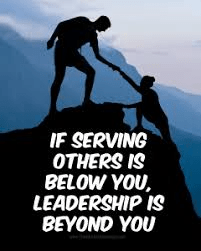
We all lead other people, whether or not we have the title or position as a leader. Therefore, we all must seek not to be served but to serve others. This is the way of justice and righteousness.

Gracious God and Leader of all: Help us to embrace the challenge and responsibility we have as leaders
to guide us to lead with integrity and common sense. Give us the wisdom to make intelligent decisions; the courage to make tough decisions; and the character to make right decisions. Embolden us to always be welcoming, inclusive, and open because of our Lord Jesus Christ, in whose name we pray. Amen.