
Seen by God (Genesis 16:7-15)

The angel of the Lord found Hagar near a spring in the desert; it was the spring that is beside the road to Shur. And he said, “Hagar, slave of Sarai, where have you come from, and where are you going?”

“I’m running away from my mistress Sarai,” she answered.

Then the angel of the Lord told her, “Go back to your mistress and submit to her.” The angel added, “I will increase your descendants so much that they will be too numerous to count.”

The angel of the Lord also said to her:

“You are now pregnant
    and you will give birth to a son.
You shall name him Ishmael,
    for the Lord has heard of your misery.
He will be a wild donkey of a man;
    his hand will be against everyone
    and everyone’s hand against him,
and he will live in hostility
    toward all his brothers.”

She gave this name to the Lord who spoke to her: “You are the God who sees me,” for she said, “I have now seen the One who sees me.” That is why the well was called Beer Lahai Roi; it is still there, between Kadesh and Bered.

So Hagar bore Abram a son, and Abram gave the name Ishmael to the son she had borne. (New International Version)

I’m blind as a bat without my glasses. They’re the first thing I put on when waking in the morning, and the last thing I take off before retiring at night. Without them I can’t distinguish anything very well, at all. I cannot see others unless they are inches from my face.

As bad as it would be if I didn’t have my glasses, it would be even worse if you were not seen by anyone. I believe that one of the great tragedies of modern Western civilization is that we can live among so many other people, yet not be seen by so many of them. The loneliness of not being seen is a terrible situation.

Hagar certainly felt that way. Perhaps even worse, she felt that God didn’t see her. It was as if God lost his glasses somewhere. 

Because a slave, Hagar’s body was not her own. Through a bunch of decisions out her control, she became pregnant with Abraham’s son. It was messy and complicated. Dysfunction was all around. A very pregnant Hagar ran away.

Having been abused by her mistress, we can feel Hagar’s despair… but there was someone watching, someone seeing the desperation on the face of a pregnant slave: God. 

The Lord saw everything – all the craziness, all the mistreatment – and stepped-in and acted on behalf of Hagar and her unborn son.

As a result, Hagar began to call God, “The God Who Sees Me.” She never again had to wonder or doubt whether she was seen. 

You might feel today that God doesn’t see your pain, is aloof and distant from your hurt, and is blind to your deep wounds. But God sees… all of it. The Lord may not be working on the same timetable as you and me, but nevertheless, you are seen with divine eyes.

You “see,” there is someone watching who specializes in hard cases. The Lord came alongside Hagar and spoke a promise to her that she could hold onto in her time of trouble. It was a promise way beyond what she could have dreamed of, far above her station in life.

Hagar gave a name to God. “El Roi” means “the God who sees.” At a low point in Hagar’s life when it seemed she was an unseen nobody, God showed up and let her know different.

I’m sure there have been times in your life, just like there have been situations in my life, where you wonder if anybody sees you, including God. You feel that if you stepped off the earth today, nobody would even notice or care.

Conversely, to be seen brings wonder, joy, and awe into life. To know the God who sees you is to be transported into the garden of paradise, enjoying divine presence and fellowship.

You are not alone. The Lord knows your every move. God watches because God loves and adores you. The almighty Lord is not a god who is aloof and distant. The One true God looks upon you and me with the kind of affection that a new parent has standing over the crib of their infant child. It’s a look of care, protection, joy, pride, and compassion.

One of the most fundamental theological statements we could say about God is: The Lord sees each individual person, and the Lord of all creation cares for each one.

Yes, terrible tragedies and gut-wrenching evil exist in this twisted mixed-up world. And God has anger and wrath, and is not okay with all the injustice throughout the earth. Yet, God’s wrath exists because of God’s love. The Lord will do something about it, and will do it in the proper time.

God is working out good purposes and plans. God will judge the living and the dead. The Lord has not forgotten you. God sees you, created in the divine image and likeness, and will act on your behalf.

Blessed are you, Sovereign God of all, to you be praise and glory forever. In your tender compassion the dawn from on high is breaking upon us to dispel the lingering shadows of night. As we look for your coming among us, open our eyes to behold your presence. Strengthen our hands to do your will, so that the world may rejoice and give you praise. Blessed be you, God almighty. Amen.

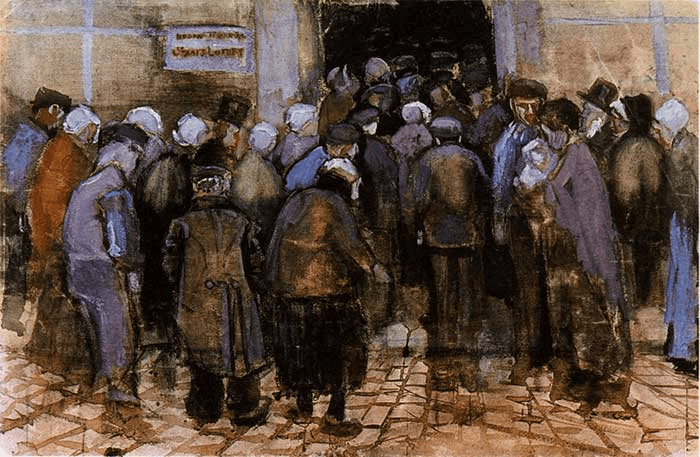
Amos 2:4-11 – Pay Attention to the Poor

The Poor and Money by Vincent van Gogh, 1882

This is what the Lord says:

“For three sins of Judah,
    even for four, I will not relent.
Because they have rejected the law of the Lord
    and have not kept his decrees,
because they have been led astray by false gods,
    the gods their ancestors followed,
I will send fire on Judah
    that will consume the fortresses of Jerusalem.”

This is what the Lord says:

“For three sins of Israel,
    even for four, I will not relent.
They sell the innocent for silver,
    and the needy for a pair of sandals.
They trample on the heads of the poor
    as on the dust of the ground
    and deny justice to the oppressed.
Father and son use the same girl
    and so profane my holy name.
They lie down beside every altar
    on garments taken in pledge.
In the house of their god
    they drink wine taken as fines.

“Yet I destroyed the Amorites before them,
    though they were tall as the cedars
    and strong as the oaks.
I destroyed their fruit above
    and their roots below.
I brought you up out of Egypt
    and led you forty years in the wilderness
    to give you the land of the Amorites.

“I also raised up prophets from among your children
    and Nazirites from among your youths.
Is this not true, people of Israel?”
declares the Lord. (New International Version)

It’s not a sin to be poor. It is a sin to oppress, take advantage of, or exploit the poor.

Social justice isn’t something fabricated in the minds of progressive Christians. Social justice is biblical and at the heart of all sixteen prophetic books of Holy Scripture’s Old Testament.

The reason the prophets address poverty so often is that God hates injustice. God is not okay with an entire group of disadvantaged people having needed resources beyond arm’s reach – and the Lord’s ire is especially roused whenever the wealthy and powerful extort what little the poor have to begin with.

Even if there are some who tend to believe the poor are poor because of laziness or an unwillingness to work hard, you will not find that idea amongst the biblical prophets. You will, in fact, find just the opposite: fat cats who lie around with their privileged lives, not lifting a finger to help the underprivileged.

The Church does have a role in combating systemic oppression of the poor and needy, and the prophet Amos wants those who claim the name of the Lord to know it.

Amos not only harangued the nations who surrounded Israel and Judah of their sinful stances toward the poor, he leveled the very same message at God’s people who did the same things. Although the Israelites enjoyed a special status with God, that did not mean the Lord had a different set of values or expectations for them when it came to basic human justice.

Mistreating one another is a universal sin and all nations everywhere will be held accountable by God for how they treat the least persons among them. There is such a thing as universal human rights – and the godly person will care about this, at the least, because God cares.

Amos almost exclusively hones-in on the economic sins of the wealthy: taking away needed clothing from those who default on loans; assessing unnecessary and exorbitant fines; taking levies of grain; and living a lavish lifestyle on the backs of the less fortunate.

It was these continually repeated sins against one another which eventually led to both Israel and Judah being conquered by pagan nations and carried into exile.

Today, you will still easily find people being used by others, as if they were mere inhuman machines, here on this earth to make money for those who already have plenty of it. They’d sell their own grandmother if they could get a good price on her. Extortion and oppression are like eating and drinking to them.

Yet, such persons, groups, even entire governments are only stockpiling judgment upon themselves for the God whom they must eventually give an account in how they lived their lives on this earth.

Instead, intentionally paying attention to the poor and treating them with equity will involve the following:

  1. Donating to charitable causes, such as church denominational relief funds, and respected international organizations who can make your contributions count.
  2. Agitating politicians for better policies toward the poor. Writing letters, sending emails, and making phone calls are simple ways of letting your voice be heard in a democratic society.
  3. Learning about worldwide and local poverty. It’s hard not to be involved whenever there is pertinent information. Putting names and faces to struggling people is a must, as well as understanding some of the dynamics that go into poverty.
  4. Raising awareness of significant issues related to poverty and how it impacts the poor. Find others who care about this and share insights and understanding about how to educate others.
  5. Volunteering at a local organization who works with the poor.

There are many more ways to make a difference. As biblically informed people, care of the poor and being concerned for issues of poverty is a must, because the Lord is a Just God with a heart of justice for the disadvantaged, underprivileged, and needy among us.

Now if there are some poor persons among you, say one of your fellow Israelites in one of your cities in the land that the Lord your God is giving you, don’t be hard-hearted or tightfisted toward your poor fellow Israelites. To the contrary! Open your hand wide to them. You must generously lend them whatever they need. (Deuteronomy 15:7-8, CEB)

Just and merciful God, you give honor to the least, the forgotten, the overlooked, and the misjudged.

You give first place to the last, the left behind, the misunderstood, and the undervalued.

You give a warm welcome to the lost, the orphaned, the abandoned, and the destitute.

Help us, your people, to be your ears in listening to their cries.

Help us to be your voice speaking words of encouragement, affirmation, and acceptance.

Help us to be your feet walking beside those in need; and your hands to clothe, feed and shelter them.

You came for the least, the lost and last of this world. Lord, in your mercy, hear our prayer. Amen.

Psalm 120 – Gaslighting Trouble

Ingrid Bergman and Charles Boyer in the 1944 film, “Gaslight”

I’m in trouble. I cry to God,
    desperate for an answer:
“Deliver me from the liars, God!
    They smile so sweetly but lie through their teeth.”

Do you know what’s next, can you see what’s coming,
    all you bold-faced liars?
Pointed arrows and burning coals
    will be your reward.

I’m doomed to live in Meshech,
    cursed with a home in Kedar,
My whole life lived camping
    among quarreling neighbors.
I’m all for peace, but the minute
    I tell them so, they go to war! (The Message)

I wish we lived in a world where people always speak and live the truth in love, without lying, pretense, or posturing. But we don’t. Not everyone embraces a life of encouraging others through truthful affirmation and selfless acts of service.

In reading today’s psalm, I immediately think of all the patients I’ve seen as a chaplain on my behavioral health unit who have been gaslighted.

“Gaslighting” is a recent term, yet the concept is as old as Satan’s interaction with Adam and Eve in the Garden. The word comes from the 1944 movie, “Gaslight,” starring Charles Boyer and Ingrid Bergman. In the attempt to drive his wife insane, the husband rigs the gaslights of the house so they will flicker at night. Whenever his wife comments on it, her husband flat-out lies and says the lights are not flickering at all. I’ll let you watch the film yourself to see what happens.

A person who “gaslights” uses psychological manipulation to gain and assert control over someone or some group. Gaslighters actively undermine others, using their words against them, plotting nefarious plans for them behind their backs, lying without so much of a blink of an eye, and turning family or friends against someone – all with the insidious agenda of increasing their power over that person and solidifying their dependence from the victim.

All of this gaslighting behavior is done with a smile, said with syrupy words to hook you, rather than help you. That, of course, makes it hard to spot – which is why it is so devilish. If the gaslighter can get you to doubt yourself, your abilities, or your perception of reality, then they can worm themselves into your life and plant their thoughts inside you.

Gaslighters don’t want peace. They want conflict. People at war give them an opportunity to gain more influence and power. Plus, they just plain like to watch others fight amongst themselves. It gives them a sense of control.

Today’s psalm is part of the psalms of ascent – songs used by the community as they walk their pilgrimage to Jerusalem and up the temple mount. The people collectively lament the gaslighting activity of those who oppose and hate them. And they turn to God, who abhors gaslighters, seeking solace and safety from their evil ways.

The gaslighter’s end is certain. They will have to contend with the God who will not be manipulated by anyone. Although it is not our job to punish sinners, it very much is our responsibility to see and avoid gaslighting as much as possible, as well as, God forbid, becoming a gaslighter ourselves. To that end, take note of some of the manipulative marks of gaslighters and patterns of gaslighting:

  • Pitting people against one another. This is done a variety of ways through gossip masked as trying to help, subtle slander, and carefully placed lies.
  • Avoiding responsibility. The gaslighter never owns their words and actions but are experts at blaming others for whatever goes awry.
  • Creating fights and conflicts. Gaslighters chronically avoid the dirty work. They get others riled-up at each other, then sit back and look for an opportunity to seize control over the warring parties.
  • Sucking-up to others. Flattery is a well-worn tool of gaslighters. They are masters at buttering-up people to get what they want.
  • Comparing people. This is just another way of driving a wedge between people. “Why can’t you be like ___?”
  • Mistreating the weak and powerless. The weak have no value for the gaslighter because the powerless have nothing to offer them. So, oppression becomes a means of getting the weak out of the way, like they’re some pesky insect to get rid of.
  • Bragging about accomplishments and stealing other’s. Gaslighters will always take the credit for an accomplishment and then boast about it, all the while badgering the victim.
  • Not keeping promises. Usually there’s a bait and switch where the gaslighter will promise something, then switch the rules or tell a bold-faced lie that they never promised that.

There is much more gaslighting behavior, but you get the drift. The best way to deal with a gaslighter? Get as far away from them as you can, find genuine supportive relationships, and leave them to God.

Today’s psalm can be your prayer to the Lord, offering a heartfelt plea to the Divine Being who does the opposite of gaslighting: strengthening you, giving you power, listening to your voice, and loving you with complete altruistic motives.

Eternal Father, you created us in your own image and likeness, but sin has warped the minds of humanity so that there is much injustice and much carelessness of the rights of other people in this fallen world. I pray you will right every wrong and vindicate those being treated unjustly. Keep us, your people, from trying to take matters into our own hands for vengeance. Give justice and peace to all those who have been cruelly and unfairly treated. May the injustice they have endured be the means to draw them into the saving arms of your grace, through Jesus Christ our Lord. Amen.