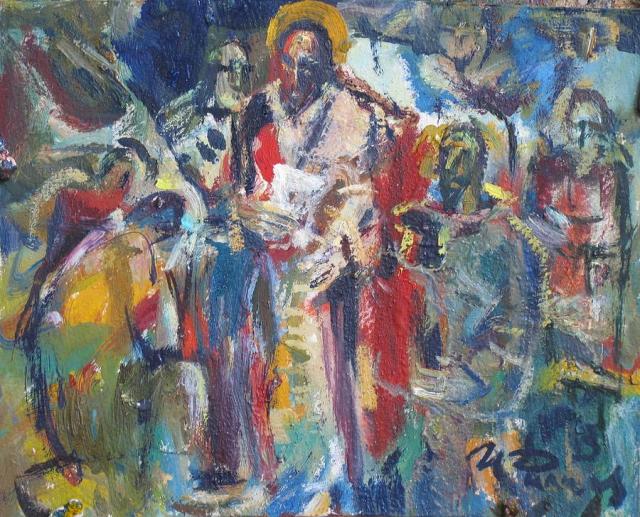
Matthew 28:18-20 – Where Will We Do Our Ministry?

Then Jesus came to them and said, “All authority in heaven and on earth has been given to me. Therefore, go and make disciples of all nations, baptizing them in the name of the Father and of the Son and of the Holy Spirit, and teaching them to obey everything I have commanded you. And surely I am with you always, to the very end of the age.” (New International Version)

We will do our ministry by going and jumping into the people’s lives who are in our neighborhood and community. To “go” doesn’t exclusively mean to travel to another place. It mostly involves the willingness to get up, go, and walk across the street, or even just across the room.

Tony Campolo is a Christian preacher, professor emeritus, and author. He tells of once being in a city doing some business and could not sleep. So, he found a greasy spoon diner that was open all night. He retells his experience this way:

“As I sat munching on my donut and sipping my coffee at 3:30 in the morning, the door of the diner suddenly swung open and, to my discomfort, in marched eight or nine boisterous prostitutes. It was a small place, and they sat on either side of me. Their talk was loud and crude. I felt completely out of place and was just about to make my getaway when I overheard the woman beside me say:

“Tomorrow’s my birthday. I’m going to be 39.”  Her “friend” responded in a nasty tone, “So what do you want from me, a birthday party?”

“I’ve never had a birthday party in my whole life. Why should I have one now?”

I sat and waited until the women had left. Then I called over the large man behind the counter named Harry, and I asked him, “Do they come in here every night?”

“Yeah!” he answered.

“The one right next to me, does she come here every night?”

“Yeah!” he said. “That’s Agnes. Yeah, she comes in here every night. Why do you want to know?”

“Because I heard her say that tomorrow is her birthday,” I told him. “What do you say you and I do something about that? What do you think about us throwing a birthday party for her—right here—tomorrow night?”

Calling to his wife, who did the cooking in the back room, Harry shouted, “Hey! Come out here! This guy’s got a great idea. Tomorrow’s Agnes’s birthday. This guy wants us to go in with him and throw a birthday party for her—right here—tomorrow night!”

His wife came out of the back room all bright and smiley. She said, “That’s wonderful! You know Agnes is one of those people who is really nice and kind, and nobody does anything nice and kind for her.”

“Look,” I told them, “if it’s okay with you, I’ll get back here tomorrow morning about 2:30 and decorate the place. I’ll even get a birthday cake!”

“No way,” said Harry. “The birthday cake’s my thing. I’ll make the cake.”

At 2:30 the next morning, I was back at the diner. I had picked up some crepe-paper decorations at the store and had made a sign out of big pieces of cardboard that read, “Happy Birthday, Agnes!” I decorated the diner from one end to the other.

The woman who did the cooking must have gotten the word out on the street, because by 3:15 every prostitute in the city was in the place. It was wall-to-wall prostitutes and me!

At 3:30 on the dot, the door of the diner swung open, and in came Agnes and her friend. I had everybody ready, and when they came in, we all screamed, “Happy birthday!”

Her mouth fell open. As she was led to sit on one of the stools along the counter, we all sang “Happy Birthday”‘ to her. As we came to the end of our singing with “happy birthday, dear Agnes, happy birthday to you,” her eyes moistened. Then, when the birthday cake with all the candles on it was carried out, she lost it and just openly cried.

Harry gruffly mumbled, “Blow out the candles, Agnes! Come on! Blow out the candles!”  Agnes looked down at the cake. Then without taking her eyes off it, she slowly and softly said, “Look, Harry, is it all right with you if I keep the cake a little while? I mean, is it all right if we don’t eat it right away?”

Harry shrugged and answered, “Sure! It’s O.K. If you want to keep the cake, keep the cake. Take it home if you want to.”

“Can I?” she asked. Then, looking at me, she said, “I live just down the street a couple of doors. I want to take the cake home, okay? I’ll be right back. Honest!”

She got off the stool, picked up the cake, and carrying it like it was the Holy Grail, walked slowly toward the door. As we all just stood there motionless, she left.

When the door closed, there was a stunned silence in the place. Not knowing what else to do, I broke the silence by saying, “What do you say we pray?”

I prayed for Agnes. I prayed for her salvation. I prayed that her life would be changed, and that God would be good to her.

When I finished, Harry leaned over the counter and with a trace of hostility in his voice, he said, “Hey! You never told me you were a preacher. What kind of church do you belong to?” In one of those moments when just the right words came, I answered:

“I belong to a church that throws birthday parties for prostitutes at 3:30 in the morning.”

Harry waited a moment and then almost sneered as he answered, “No you don’t. There’s no church like that. If there was, I’d join it. I’d join a church like that!”

My friends, that’s the kind of church Jesus came to create!  We may not know any prostitutes, but there are people around us who need basic human kindness expressed in basic caring actions, no matter who they are.

Many people want nothing to do with church or Christians because they believe they’ll be given judgment instead of justice.

Its important where we are located. God has sovereignly placed us there. So, we need to be attentive and listen to the people and the neighbors God put around us, no matter who they are. To ignore them is to treat the Great Commission of Jesus as if it were the Great Omission.

One of the best ways to be missionally rooted in the place we are planted is to walk the community, be in it, and hang out. Developing an understanding of what’s going on and being connected to the issues a neighborhood is facing, is key to building neighborhood credibility and demonstrating that we really do care about the people, whomever they are.

Photo by Maria Orlova on Pexels.com

Discovering what people care about doesn’t necessarily mean we need to do something for them but with them. To go most often involves going where the people are – getting to know them and being a friend.

Whenever a pastor or parishioner becomes someone the community knows, neighborhood residents will share their hopes and concerns. The church can be the center of community life, going out and opening up to the neighborhood.

Often, we might focus on what’s lacking, what’s not there, the deficits within a person, family, or community – instead of looking for the assets, what is there already, and what is going right. It’s wise to begin with the good things already happening, the potential which already exists, and the dreams people have for the future of their place.

In focusing on what’s already there, here are some things we begin to see:

  1. Each person having a contribution to make, no matter who they are.
  2. Relationships building the community.
  3. People being active participants in developing what is good, right, and just, rather than passive recipients.
  4. Everyone can get involved because everyone has a meaningful place in the community.
  5. People caring and not apathetic about the neighborhood.
  6. Making decisions with everyone’s voice being valued.
  7. Asking for ideas is better than giving solutions.
  8. Folks doing the work are given authority and power.
  9. People mentoring others and building into their lives.

All of this requires getting to know local businesses, neighborhood associations, healthcare institutions, places of worship, schools, and cultural groups, as well as the individual talents of those within them.

We are to serve others, rather than imposing our own agendas on them. This is how we begin making disciples, that is, developing people who follow the words and ways of Jesus.

And it all begins with the command by our Lord to go….

Lord Jesus Christ, let your presence fill our hearts and overflow through our actions so that we may proclaim the good news of your Kingdom. Fill us with your compassion and insight to respond to human need with loving service. Let the fire of your goodness and justice burn into us and through us so that we may seek to transform the unjust structures of society. Guide us to renew and sustain the life of your creation.

Almighty God, in our baptism you adopted us for your own. Renew us by your Spirit in body, soul, and mind so that we may worship you in sincerity and truth, through Jesus Christ our Lord, who lives and reigns with you and the Holy Spirit, one God, now and forever. Amen.

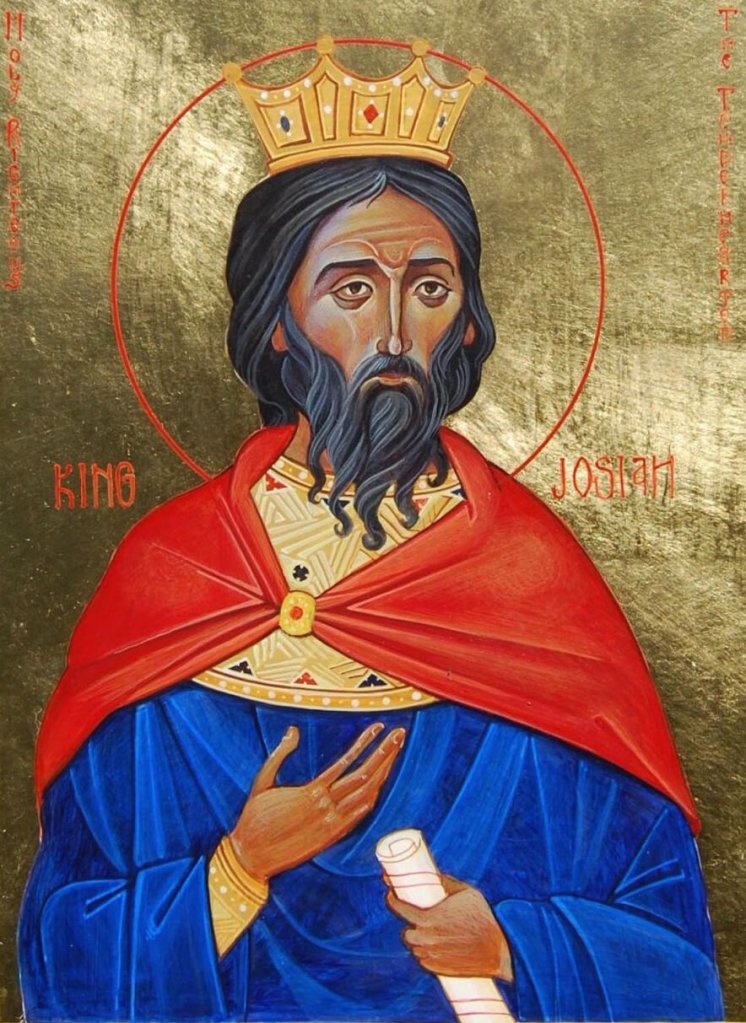
2 Chronicles 34:1-7 – Getting Rid of Idolatry

Russian Orthodox icon of Judah’s King Josiah (640-609 B.C.E.)

Josiah was eight years old when he became king of Judah, and he ruled thirty-one years from Jerusalem. He followed the example of his ancestor David and always obeyed the Lord.

When Josiah was only sixteen years old he began worshiping God, just as his ancestor David had done. Then, four years later, he decided to destroy the local shrines in Judah and Jerusalem, as well as the sacred poles for worshiping the goddess Asherah and the idols of foreign gods.He watched as the altars for the worship of the god Baal were torn down, and as the nearby incense altars were smashed. The Asherah poles, the idols, and the stone images were also smashed, and the pieces were scattered over the graves of their worshipers. Josiah then had the bones of the pagan priests burned on the altars.

And so, Josiah got rid of the worship of foreign gods in Judah and Jerusalem. He did the same things in the towns and ruined villages in the territories of West Manasseh, Ephraim, and Simeon, as far as the border of Naphtali. Everywhere in the northern kingdom of Israel, Josiah tore down pagan altars and Asherah poles; he crushed idols to dust and smashed incense altars.

Then Josiah went back to Jerusalem. (Contemporary English Version)

Josiah started out as a boy king. Evidently, he had some good training because by the time he became a teenager, Josiah was raring and ready to exercise his kingship in the best sense of leadership. 

After generations of kings before him who followed other gods and gave the stiff-arm to the Lord, as well as to justice and righteousness, Josiah committed himself fully to Israel’s one true God.  And, as a twenty-year old king, he showed the real muster of his reign.

Josiah took responsibility and initiative to do what was right in the eyes of God – no matter the consequences. 

King Josiah continually performed the dual action of worshiping God and aggressively taking active steps to rid the kingdom of all the ubiquitous false gods. 

The king did much more than simply stick his toe in the water to test what the response might be to removing a high place of Baal worship or an Asherah pole. Instead, Josiah jumped right in and put his entire kingship on the line. 

All of the power brokers who were dealing in false gods could not have been happy about this turn of events in Judah. But any kind of pushback did nothing to prevent Josiah from doing what was right in the eyes of the Lord by thoroughly eradicating idol worship.

“Let us all be the leaders we wish we had.”

Simon Sinek

Josiah had a clear sense of purpose. That sense of vocational direction ordered his kingly steps. It led him to do the things he did. Josiah was determined and devoted to leading the people back to God. 

This desire and determination for spiritual revival directed toward the worship of the Lord is not limited to the ancient world. God is still in the kingdom business of bringing all creation under a divine and benevolent rule. 

Therefore, there still remains an abiding purpose to lead others, caught in a web of unhealthy routines and habits of living through idolatrous practices, back to the one true God. 

Like the ancients before us, there is still a need to exercise courage and confidence in following the Lord by making disciples who will worship God with all their heart, soul, mind, and strength. 

So, reconnecting with our overarching purpose in life is imperative for taking bold steps of faith in this idolatrous world which worships at the altar of exorbitant eating, shopping, and drinking.

It is no wonder the current zeitgeist of so many of our communities is full of anxiety, discouragement, and anger. There is no justice in the public square. Competing voices, other than the merciful words and ways of Jesus, drown the divine regulations for living a good life of integrity, wholeness, peace, and joy in the Holy Spirit.

It is almost as if the collective efforts of idolatrous people have surgically removed the spiritual spine of society. We are now bereft of genuine support, spineless and unable to move toward a life of truth, justice, and a courageous concern for the common good of all persons.

King Josiah shows us a better way. We must radically remove all that is toxic and damaging to our souls. We need a clear purpose in life, to go hard after God and rediscover how the Divine fits into all of life and gives us meaning.

Any old fool can complain about how bad things are in the world. But the one determined to make a difference amidst all the surrounding crud and helps to make things better – that is the wise person who is in touch with their own spirit, who is able to see the spiritual within others.

So, how then will you live?

May your living be in a healthy spiritual groove of loving God and loving neighbor so that worshiping the banal becomes a thing of the past.

Holy God, you are the Sovereign of the universe. Expose the things in my life that I might be trusting in, other than you. Wean me away from evil and bend my heart and mind to truth, justice, and goodness. Help me to be aggressive in my Christian walk so that I steadfastly follow Jesus Christ in the power of the Holy Spirit, leading others to faith along the way. Amen.

Acts 28:23-31 – Focused on Mission

Apostle Paul by Ivan Filichev

They arranged to meet Paul on a certain day and came in even larger numbers to the place where he was staying. He witnessed to them from morning till evening, explaining about the kingdom of God, and from the Law of Moses and from the Prophets he tried to persuade them about Jesus. Some were convinced by what he said, but others would not believe. They disagreed among themselves and began to leave after Paul had made this final statement: “The Holy Spirit spoke the truth to your ancestors when he said through Isaiah the prophet:

“‘Go to this people and say,
“You will be ever hearing but never understanding;
    you will be ever seeing but never perceiving.”
For this people’s heart has become calloused;
    they hardly hear with their ears,
    and they have closed their eyes.
Otherwise they might see with their eyes,
    hear with their ears,
    understand with their hearts
and turn, and I would heal them.’

“Therefore, I want you to know that God’s salvation has been sent to the Gentiles, and they will listen!”

For two whole years Paul stayed there in his own rented house and welcomed all who came to see him. He proclaimed the kingdom of God and taught about the Lord Jesus Christ—with all boldness and without hindrance! (New International Version)

The Apostle Paul took quite a licking throughout his Christian life. Incredibly, Paul not only physically survived whippings, beatings, stoning, arrests, shipwreck, and imprisonment – he also came through it all with a robust spirit and a dogged determination to live his life with purpose and mission.

Acts 28 is the final chapter in the book. Paul is in Rome under house arrest. Even in this situation, he kept finding ways to engage others. Since he couldn’t go to them, he had others come to him – lots of them.

Paul described to the visitors his own experience of encountering the risen Christ. He reasoned with his fellow Jews and vigorously debated with them from the Scriptures. It was always the deep desire and hope of Paul that his own people come to faith in Christ, just as he had. Although some did, most didn’t.

Many decades ago, my grandfather was approached by one of his friends about investing in a new insurance company startup. For a lot of reasons, grandpa ended up not participating in his friend’s venture. So, the friend asked others. Eventually, the startup happened and steadily grew. Today, Nationwide Insurance has over 250 billion dollars of assets. Good old gramps just didn’t know what he was rejecting.

The good news of Jesus Christ, I believe, is worth infinitely more than an insurance company. Christian mission, I believe, is worth investing my life into. I’m glad the gospel was proclaimed to Gentiles because I am a recipient of such grace. And I’m grateful that Paul tenaciously kept interacting with people for the last two years of his life under arrest.

Despite, and even because of, Paul’s sufferings and his house arrest, the message of faith and forgiveness in Christ was confidently and consistently presented to a steady flow of people, including the highest heads of state. Difficulties are no problem for God. The Lord bends all circumstances to divine and good purposes, creating new avenues of faith, hope, and love that wouldn’t be possible under “normal” times.

“He is no fool who gives what he cannot keep to gain that which he cannot lose.”

Jim Eliot

In fact, Paul endured five years of imprisonment: two in a Caesarea jail; two under house arrest in Rome; and nearly a year in transport between the two cities. For a personality like Paul, we might imagine this would drive him nuts. Yet, several letters to the churches, now contained in the New Testament, were written during that time.

Whether we like it, or not, nothing proves, affirms, and grows our faith quite like our willingness to endure suffering for the gospel. Witness, suffering, and martyrdom are inextricably bundled together in God’s economy. When suffering is viewed as a necessary means to an altruistic and noble end, then, although the pain is no less real, there is the opportunity for both willing endurance and genuine joy.

Paul was willing to labor on behalf of people who were very different from himself. His concern was for all people everywhere – both his own people, the Jews, as well as Gentiles. Paul never gave in and never gave up. He had a magnanimous spirit and even greater spiritual gifts. He willingly and gladly used that spirit and gifts for the benefit of humanity.

In 64 C.E. Paul was condemned and executed. Before his death, he wrote that he had fought the good fight, finished the race, and kept the faith. Now, the next generations of new believers must follow in his footsteps and continue the work

This is precisely why the book of Acts ends so abruptly, with no resolution, no tidy conclusion – because the work is still being done and will carry on until Christ returns.

Gracious and loving God, you work everywhere reconciling, loving, and healing your people and your creation. In your Son Jesus, and through the power of your Holy Spirit, you invite each of us to join you in your work. We ask you to form us more and more in your image and likeness, through our prayer and worship of you and through the study of Holy Scripture so that our eyes will be fully opened to your mission in the world. Then, God, into our communities, our nation, and the world, send us to serve with Christ, taking risks to give life and hope to all people and all of your creation, through Jesus Christ our Lord.. Amen.

Philippians 1:3-11 – Better Together

I thank my God every time I remember you. In all my prayers for all of you, I always pray with joybecause of your partnership in the gospel from the first day until now, being confident of this, that he who began a good work in you will carry it on to completion until the day of Christ Jesus.

It is right for me to feel this way about all of you, since I have you in my heart and, whether I am in chains or defending and confirming the gospel, all of you share in God’s grace with me. God can testify how I long for all of you with the affection of Christ Jesus.

And this is my prayer: that your love may abound more and more in knowledge and depth of insight, so that you may be able to discern what is best and may be pure and blameless for the day of Christ, filled with the fruit of righteousness that comes through Jesus Christ—to the glory and praise of God. (New International Version)

The need for a medical intervention means there is ill health in the body. And the need for a spiritual intervention means there is ill health in the Body. Physical health does not just happen. Care of the body is necessary through eating well, exercising, and coping adequately with stress. Bodily sickness prevents us from doing normal activities. Illness causes us to need care and to have an inability in caregiving to others.

Spiritual health in the Body of Christ occurs when we put every effort into keeping the unity of the Spirit through the bond of peace (Ephesians 4:3). When spiritual health breaks down in the Body of Christ there is an inability for service and mission, a lack of unity, and an absence of joy. It was in such a situation that the Apostle Paul wrote his letter to the Philippians as a spiritual intervention meant to help restore their spiritual health.

In our New Testament lesson for today, the Apostle Paul begins his letter with emphasizing that the Body of Christ realizes unity, joy, and fellowship through a shared purpose of embracing the good news of Jesus Christ and proclaiming it to others. Paul emphasizes throughout his letter that the church is to be a common community, sharing life together, working on supporting one another and reaching out to others.

“We are only as strong as we are united, and as weak as we are divided.” 

J.K. Rowling

Every pronoun, “you,” used in these verses is not singular but plural. We are meant to establish our common life together around a shared mission of gospel proclamation: The kingdom of God is near. Through repentance and faith in the person and work of Jesus there is forgiveness of sins, new life, and participation in the life of God. The mission is not for larger church attendance, although that is nice and may happen; it isn’t to do more, or to get other people to stop swearing, avoid tattoos, or vote Republican.

The Apostle Paul knew without a focus on mission, on encouraging one another with the good news and sharing the gospel with others, the lack of purpose would create spiritual sickness. Apart from a deliberate focus on centering life and mission around the person and work of Christ, a group of people will nit-pick one another to death with their various opinions and wants. Wherever there is an absence of shared purpose, there you will find complaining, arguing, and a bunch of crotchety curmudgeons who nobody wants to be around.

Conversely, with a polestar on mission, the community of the redeemed work together in close fellowship with the result being joy. Happy people are a breath of fresh air to be around. A good healthy spirit is a delight to others. In fact, folks will find hope and healing through a common purpose of life together which imbibes liberally from the redemptive events of Jesus.

Good news is fun to share. It is joyful. The gospel of Jesus Christ is wonderful news, worthy of exuberant celebration. The Apostle Paul had fond memories of his partnership in the gospel with the Philippian believers. Although he had been jailed and beaten, Paul joyously sang in the prison – to the point where the jailer took notice and listened to the gospel of new life in Christ. The jailer and his entire family became followers of Jesus. (Acts 16:16-34)

“The celebration of Advent is possible only to those who are troubled in soul, who know themselves to be poor and imperfect, and who look forward to something greater to come.”

Dietrich Bonhoeffer

The Philippians were Paul’s spiritual children. They had sacrificed with Paul toward the shared vision of proclaiming good news. So, Paul wanted them to remember their own significant events of coming to faith, enjoying fellowship together, and working toward common objectives. In reminding the Philippian believers, Paul hoped to help get their heads screwed on straight again. He was confident this would happen, having an unshakable belief that God would continue the good work started within them.

This confidence was the basis of Paul’s prayers for the church. He beseeched God to unleash the Philippians’ collective love in a grand experiential knowledge of the divine so that they might discern well, making solid decisions which place the gospel as central to all of life.

There is an incredible depth to human need – a deep spiritual longing for what is good and beautiful. Relational unity brings out the beauty and majesty of humanity. Sometimes, when we are facing hard circumstances, we need to recall past days when this was true of us and remember why we were joyful.

In difficult times of injustice, we need a vision of humanity which locks arms in unity without vilifying one another. When we place priority on the good news, I believe we will again discover the joy of life, of knowing Christ. Perhaps, with a watching world observing basic human kindness and joyful relations, we will find ways of being better together and working toward the common good of all persons. And methinks, Jesus wants to help with this, if we will only let him.

May the hope of Advent and the anticipation of Christ’s coming, give us a way to understand our past and order our steps in the present so that the rule and reign of God is planted in our hearts and spread throughout the world.

O God, the Father of our Lord Jesus Christ, our only Savior, the Prince of Peace: Give us grace to set aside our cranky unhappiness and divisive spirits. Take away all hatred and prejudice, and everything which hinders us from godly union and connection: that, as there is but one Body, and one Spirit, and one hope of our calling, one Lord, one faith, one baptism, one God and Father of us all; so we may be all of one heart, and of one soul, united in one holy bond of truth and peace, of faith and love, and with one mind and one mouth to glorify you, through Jesus Christ our Lord, and in the strength of the Holy Spirit. Amen.