Job 8:1-22 – Face the Pain

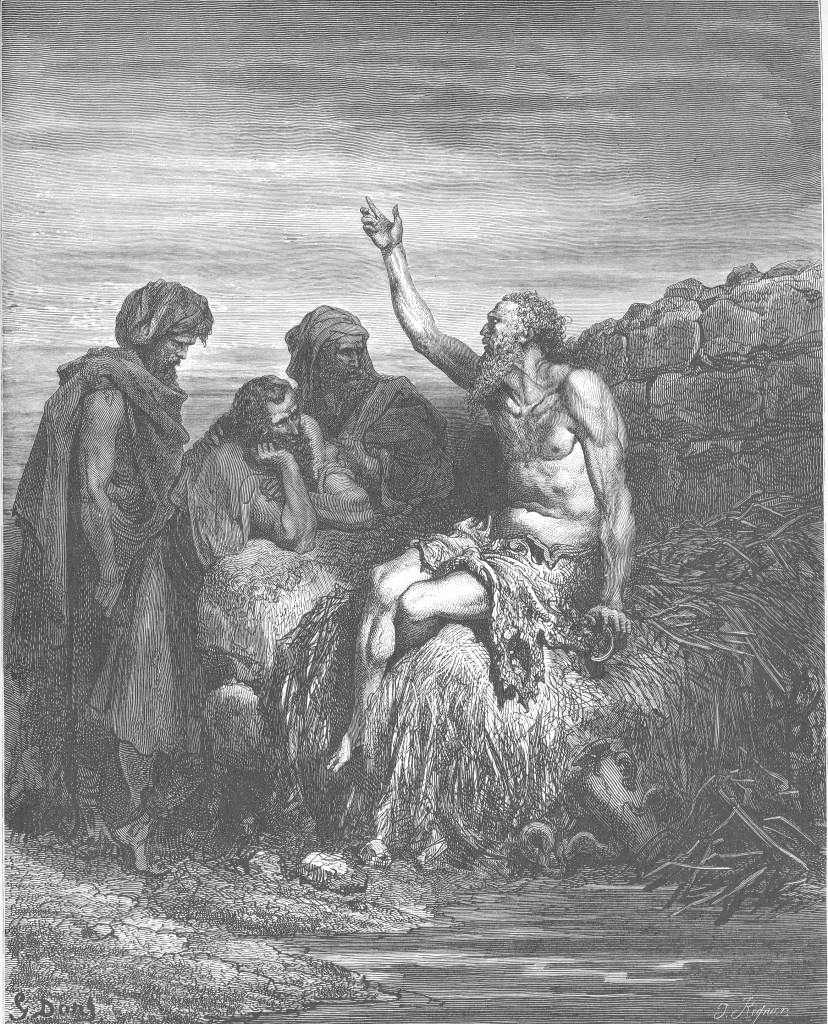
Job Speaks with His Friends by Gustave Doré (1832-1883)

Are you finally through with your windy speech?
God never twists justice;
    he never fails to do what is right.
Your children must have sinned against God,
    and so he punished them as they deserved.
But turn now and plead with Almighty God;
    if you are so honest and pure,
    then God will come and help you
    and restore your household as your reward.
All the wealth you lost will be nothing
    compared with what God will give you then.

Look for a moment at ancient wisdom;
    consider the truths our ancestors learned.
Our life is short; we know nothing at all;
    we pass like shadows across the earth.
But let the ancient wise people teach you;
    listen to what they had to say:

“Reeds can’t grow where there is no water;
    they are never found outside a swamp.
If the water dries up, they are the first to wither,
    while still too small to be cut and used.
Godless people are like those reeds;
    their hope is gone, once God is forgotten.
They trust a thread—a spider’s web.
    If they lean on a web, will it hold them up?
    If they grab for a thread, will it help them stand?”

Evil people sprout like weeds in the sun,
    like weeds that spread all through the garden.
Their roots wrap around the stones
    and hold fast to every rock.
But then pull them up—
    no one will ever know they were there.
Yes, that’s all the joy evil people have;
    others now come and take their places.

But God will never abandon the faithful
    or ever give help to evil people.
He will let you laugh and shout again,
    but he will bring disgrace on those who hate you,
    and the homes of the wicked will vanish. (Good News Translation)

These are the words of Bildad, a “friend” of Job. The guy just couldn’t take it anymore. As Job expressed his deep grief, Bildad grew perturbed. Whereas Job needed to be heard, to tell his story with others who would offer listening ears of empathy, Bildad was uncomfortable with all this grief junk and felt he needed to rebuke Job…. Oy vey.

There are various kinds of suffering, and the biblical character of Job experienced them all. One of the most severe kinds of hurt, and the one that gets far more attention than any other in the book of Job, are the short-sighted rebukes from Job’s “friends.” 

God had a severe mercy for Job. The friends, however, lived in a black and white world of either/or – either you confess your sin, or you don’t – as if all suffering is connected to personal sin. Bildad’s left-brained linear explanation was expressed this way: God will not reject a blameless man.

For Bildad, personal suffering equals personal sin and God’s disfavor. Bildad could only see a sequential connection, a direct line from sin to calamity. It was simply out of his equation to think otherwise. Since Bildad saw suffering as the direct result of sin, his remedy was to exhort toward confession of sin. 

The problem with this view is that we, as the readers, already know this to be a patently false understanding of Job’s suffering. Although Bildad saw the suffering, he did not discern the unseen dimension of good and evil contending behind-the-scenes between God and Satan.

It is only normal to wonder if we have sinned against God whenever finding ourselves in the crucible of suffering. But if we have done patient work to determine there is no personal reason for the pain, perhaps there is something going on that is much bigger than us. 

Our task, like Job’s, is to entrust ourselves to God. We might chafe at such counsel because we like to fix things that hurt. Suffering, however, will not last forever; it will eventually pass. And God’s way will always prevail, in the end. So, we must continually keep in mind that permanent faith transcends temporary pain.

There are four types of pain we experience in this life:

  1. Spiritual pain that arises from within us in our connection, or lack thereof, with the divine.
  2. Emotional pain that arises from our relationship with others.
  3. Physical pain that arises from our bodies and from natural forces on this earth.
  4. Mental pain that arises from cognitive disorders, childhood trauma, and all forms of abuse or neglect.

In all pain, the story we tell ourselves about the reason for the hurt is significant. We have a relationship with our pain. If the story we are telling ourselves is that the pain is all in my head, or that others have it worse than me, we are ignoring or stuffing our pain. If the story is that pain is bad and I must rid myself of it, then we will completely miss what our pain is trying to tell us.

Job was trying to come to grips with his pain. He was facing it, talking about it, expressing his wonderings concerning it, and allowing himself to completely feel all of it.

Conversely, Bildad so tightly held onto his own story about what pain and suffering is that he was unable to be the friend Job needed. And, I might add, at the end of the story, God didn’t look with favor on Bildad’s approach.

So, what will you do with your pain?

What is the story you are telling yourself about your pain?

Who do you trust so that you can talk about your pain?

Where is God in your pain?

How is your current relationship to the pain helping or hindering you?

Where will you turn, in the future, when pain comes upon you?

Loving God, take pity on my life as I seek to embrace you in both good times and bad. I belong to you; therefore, I will not forsake you, no matter how much I do not understand the suffering. Amen.

Hebrews 12:3-13 – Interpret Your Circumstances Wisely

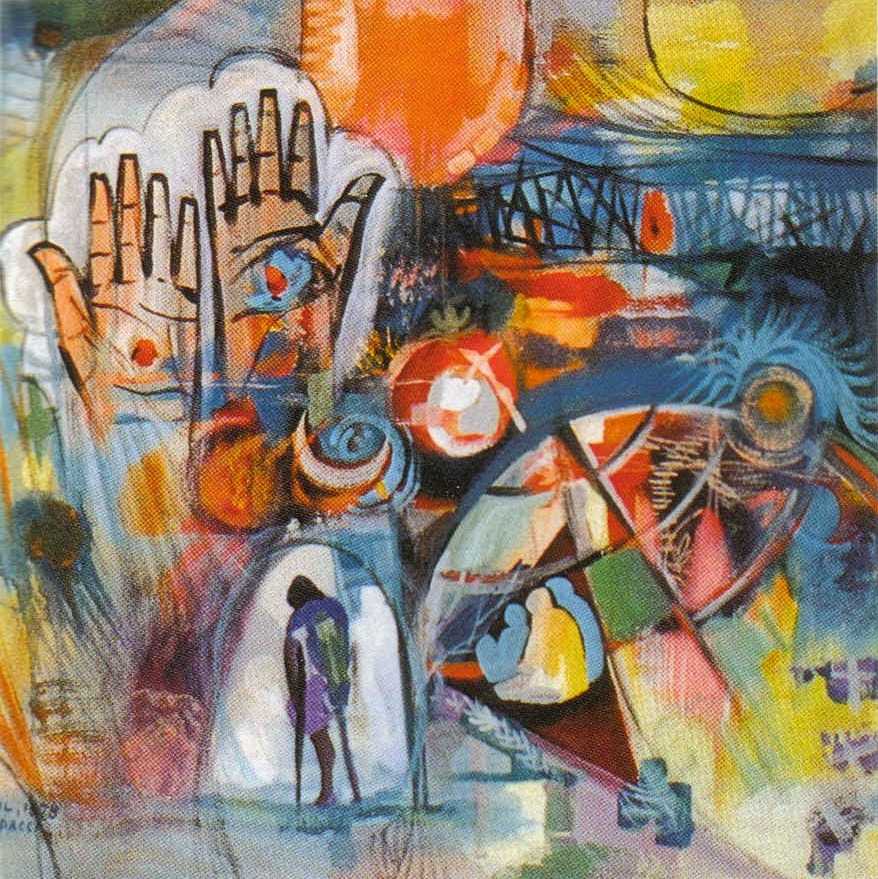
“The Kingdom Comes” by Bangladeshi artist Nikhil Halder, 1978

Consider him who endured such opposition from sinners, so that you will not grow weary and lose heart.

In your struggle against sin, you have not yet resisted to the point of shedding your blood. And have you completely forgotten this word of encouragement that addresses you as a father addresses his son? It says,

“My son, do not make light of the Lord’s discipline,
    and do not lose heart when he rebukes you,
because the Lord disciplines the one he loves,
    and he chastens everyone he accepts as his son.”

Endure hardship as discipline; God is treating you as his children. For what children are not disciplined by their father? If you are not disciplined—and everyone undergoes discipline—then you are not legitimate, not true sons and daughters at all. Moreover, we have all had human fathers who disciplined us, and we respected them for it. How much more should we submit to the Father of spirits and live! They disciplined us for a little while as they thought best; but God disciplines us for our good, in order that we may share in his holiness. No discipline seems pleasant at the time, but painful. Later on, however, it produces a harvest of righteousness and peace for those who have been trained by it.

Therefore, strengthen your feeble arms and weak knees. “Make level paths for your feet,” so that the lame may not be disabled, but rather healed. (New International Version)

Missed expectations often result in discouragement, even depression.

If we expect God to continually bless us with unending positive circumstances, we will, sooner or later, be confused and/or frustrated when life goes sideways.

The ancient Jewish Christians, for whom today’s New Testament lesson was addressed, faced opposition. Not only did they encounter the hardship of being Jews living in a Gentile world, but they also had to experience the difficulty of being Christians in a Jewish community.

Its one thing to put up with adversity for a few days or weeks. It is quite another thing altogether to deal with hard circumstances day after day, week after week, month after month, even year after year.

Where is God in all this negativity? When are the earthly blessings going to come? What the heck is going on here? Why are my prayers bouncing off the church ceiling?

Over time, the believers began to lose their joy. They started getting discouraged. The Jewish Christians, after beginning well in their faith, gradually slid into misinterpreting their circumstances as God being mean to them. Things got so bad, they even entertained the notion of returning to Judaism and leaving Christianity behind.

Their faith was shrinking.

However, their plight was very much seen by God. In fact, God was the One orchestrating the situations, as difficult as they were.

It is not our lack of resources, the disrespect, or the difficult people around us who are the problem. The issue is our interpretation of those events and persons.

The author of Hebrews invited the struggling believers to take a different interpretation of their hardship: They were experiencing divine discipline.

We are all responsible for our own children. As parents, we discipline them (ideally) for their own good. We know it will hurt temporarily. Yet, in the long run, the discipline will work out.

In fact, we understand this with all kinds of things. Everyday, people submit themselves to getting cut open, poked, prodded, and tested by doctors, surgeons, and healthcare workers because we know there needs to be temporary pain for permanent healing to occur.

It is the rare child who grows up without any discipline and becomes a productive citizen of society. It is the exceptional person who knows nothing of medical interventions for health and healing. And so, it is extremely unlikely that a Christian will experience holiness, righteousness, and live wisely in the world apart from some gut-wrenching, heart-breaking, and mind-bending circumstances for which they neither saw coming, nor ever asked for.

So, when the divine baseball bat whacks us upside the head, how will we interpret it?

Discipline is education by correction. God is the Father, treating us as family, as children who need to learn the ways of grace. God is the Divine Coach, exhorting us to work, run the laps, put in the reps, and reach beyond what we think we can do – knowing all along what our true capabilities are.

Godliness comes through discipline, training, and plain old fashioned hard work. Unless there is the suffering which comes through trials to our faith, Christianity is only a theory.

Before I suffered, I took the wrong way,
    but now I do what you say.
You are good and you do good.
    Teach me your statutes!
The arrogant cover me with their lies,
    but I guard your precepts with all my heart.
Their hearts are unfeeling, like blubber,
    but I rejoice in your Instruction.
My suffering was good for me,
    because through it I learned your statutes. (Psalm 119:67-71, CEB)

The appropriate response to difficult and adverse circumstances is to view them as God’s gracious guidance and correction. Rightly interpreting our life events gives us renewed resolve for the Christian marathon.

Endurance and perseverance are needed. Keeping good running form, consistent spiritual exercise, and maintaining liturgical rhythms, all help us face the adversity with energy, focus, and strength.

Christianity isn’t a matter of doing more. It is a way of life – a continuous evaluation of beliefs and thinking, addressing the shadows of the heart, and listening to the compassion deep in our gut.

Don’t give up. Keep going.

Be safe. Be strong. Be smart. Be spiritual. We are all in this together.

Thanks be to you, Lord Jesus Christ, for all the benefits which you have given us; for all the pain and insults you have borne for us. O most merciful redeemer, friend and brother, may we know you more clearly, love you more dearly, and follow you more nearly day by day. Amen.

2 Samuel 10:1-5 – Misunderstood

Sometime later, King Nahash of Ammon died, and his son Hanun became king. David said, “Nahash was kind to me, and I will be kind to his son.” So, he sent some officials to the country of Ammon to tell Hanun how sorry he was that his father had died.

But Hanun’s officials told him, “Do you really believe David is honoring your father by sending these people to comfort you? He probably sent them to spy on our city, so he can destroy it.” Hanun arrested David’s officials and had their beards shaved off on one side of their faces. He had their robes cut off just below the waist, and then he sent them away. They were terribly ashamed.

When David found out what had happened to his officials, he sent a message and told them, “Stay in Jericho until your beards grow back. Then you can come home.” (Contemporary English Version)

Showing mercy, grace, and good faith doesn’t always have a happy ending.

Sometimes people get burned for their genuine gracious overtures. Not only do some folks not return or reciprocate with grace. There are times when someone refuses it and even responds with criticism and judgment.

King David was at the pinnacle of his rule. All Israel and Judah were under his gracious authority. David acted as a godly sovereign when he sought to use his power to show kindness and grace to those in his kingdom, even to those who were related to his former enemy, Saul. (2 Samuel 9:1-12)

Yet when David kept up his gracious ways and sent a delegation to the Ammonites in order to bring compassion to a grieving nation, they not only spurned the kindness but attributed evil intent to it.

Why in the world would they do such a thing? Why did Hanun, the new ruler of Ammon, reject David’s kindness? Because he severely misinterpreted David’s motives, and completely misjudged David’s intentions.

It is important to make wise assessments of others, and not quick judgments about people or their situations.

Being misunderstood is downright difficult to swallow. Yet we can avoid sinful reactions and respond with grace, even if grace isn’t being shown to us:

  • We can be gracious by not always needing to have the last word. Any fool can get easily get sucked into an argument. Know when to stop talking.

Too much talk leads to sin. Be sensible and keep your mouth shut. (Proverbs 10:19, NLT)

Even fools may be thought wise and intelligent if they stay quiet and keep their mouths shut. (Proverbs 17:28, GNT)

  • We can be gracious through cultivating a humble spirit. Pride assumes that another can be silenced with the power of words. What’s more, wounded pride typically manifests itself by gossiping to others about our hurt.

Destructive people produce conflict; gossips alienate close friends. (Proverbs 16:28, CEB)

Pride leads to destruction; humility leads to honor. (Proverbs 18:12, CEV)

God opposes arrogant people, but he is kind to humble people. (James 4:6, GW)

  • We can be gracious by developing our capacity for civility and empathy. Often when someone spews their off-base judgments and criticisms upon us, they have a world of their own past personal hurt behind the angry diatribe. We can choose to be gently curious about this, discovering why there is such a visceral reaction to our kindness.

“I tell you, love your enemies and pray for those who persecute you, that you may be children of your Father in heaven. He causes his sun to rise on the evil and the good and sends rain on the righteous and the unrighteous.” (Matthew 5:44-45, NIV)

Show respect for all people. Love your brothers and sisters in God’s family. Respect God and honor the king. (1 Peter 2:17, ERV)

  • We can be gracious through tapping into an inner storehouse of wisdom. Knowledge puffs up. Love builds up. Wisdom is insight into reality. For the believer, it is the ability to take God’s Word and lovingly apply it to the lived experience we are enduring.

Hold on to wisdom, and it will take care of you. Love it, and it will keep you safe. Wisdom is the most important thing; so, get wisdom. If it costs everything you have, get understanding. (Proverbs 4:6-7, NCV)

It is true, of course, that “all of us have knowledge,” as they say. Such knowledge, however, puffs a person up with pride; but love builds up. (1 Corinthians, 8:1, GNT)

One of life’s hard lessons is that bestowing grace and mercy to others does not necessarily mean they will receive it and respond in kind. 

In fact, there are some individuals who refuse grace and give back only scorn and derision. Even the Lord Jesus experienced this like no other before or after him. Christ endured all the foulness and degradation of a cruel cross because there were people who refused to see that he was extending God’s grace to them. He turned scorn on its head by despising shame and enduring pain so that we would be spared of such ignominy. (Hebrews 12:2-3)

In those times when we, at best, scratch our heads, and, at worst, weep uncontrollably over having our genuine love paid back with harsh misunderstanding, it is a good reminder that we are imitating the life of our precious Lord Jesus who knows exactly what shame is and what a profound lack of mercy can do. 

It is in the seasons and events of life which produce frustration that we understand this: Perfect peace will not be found in this life. So, we more fully attach ourselves to Jesus and find genuine grace and the solidarity of faith and love.

Consider what Christ went through; how he put up with so much hatred from those misinterpreting and misjudging him. Do not let yourselves become discouraged and give up from gross misunderstanding.

Loving God, I give you thanks for sending your Son, the Lord Jesus. Christ is the pioneer of my faith. Just as he endured the cross, scorning its shame, and sat down at your right hand, so help me to live into the grace you offer through Christ’s redemptive events so that I might persevere with grace through all the unmerciful acts of this world. Amen.

Genesis 45:1-15 – The Big Reveal

Welcome, friends! Click the video below and let us gather together around the Word of God.

You may also view this video at TimEhrhardtYouTube

For the story of Joseph set to song, click Bend by Brandon Heath.

May the Lord bless you
    and keep you.
May the Lord smile down on you
    and show you his kindness.
May the Lord answer your prayers
    and give you peace. Amen.