Be Careful How You Judge (2 Samuel 10:6-12)

Hanun humiliates David’s ambassadors, c.1240 C.E.

When the Ammonites realized that they had become obnoxious to David, they hired twenty thousand Aramean foot soldiers from Beth Rehob and Zobah, as well as the king of Maakah with a thousand men, and also twelve thousand men from Tob.

On hearing this, David sent Joab out with the entire army of fighting men. The Ammonites came out and drew up in battle formation at the entrance of their city gate, while the Arameans of Zobah and Rehob and the men of Tob and Maakah were by themselves in the open country.

Joab saw that there were battle lines in front of him and behind him; so he selected some of the best troops in Israel and deployed them against the Arameans. He put the rest of the men under the command of Abishai his brother and deployed them against the Ammonites. 

Joab said, “If the Arameans are too strong for me, then you are to come to my rescue; but if the Ammonites are too strong for you, then I will come to rescue you. Be strong, and let us fight bravely for our people and the cities of our God. The Lord will do what is good in his sight.” (New International Version)

Cockiness can get you into a lot of trouble. It’s one thing to exude confidence; and it’s another thing to act like a puffed up peacock and do stupid stuff because of arrogance. The Israelite general Joab had the former; the Ammonites the latter.

King David had sent envoys to Ammon in the event of a new Ammonite king taking the throne after his father’s death. David was in the groove of extending kindness and establishing himself as the sort of ruler who has a heart, as well as a head.

However, Hanun the Ammonite king, viewed the Israelite delegation of people in a negative light, believing they had malevolent motives for coming. So, the king’s officials “seized David’s envoys, shaved off half of each man’s beard, cut off their garments at the buttocks, and sent them away.” (2 Samuel 10:4)

Not the smartest move on the planet. Humiliating a group of Israelites sent by David was a bad idea. The Ammonites, understandably, were put immediately on King David’s naughty list. And they then responded by recruiting mercenaries to their side, getting the clue that David wasn’t about to stand for the offense against Israel.

So, the Ammonites hired the Arameans to help fight Israel. But they were no match for the shrewd and seasoned Jewish general Joab. The mercenaries were soundly defeated, really because of God’s sovereign intervention over the much larger force put together by the Ammonites.

This ancient animosity and relational haggling tends to reflect the human condition, even to this day. It’s easy to fall into misinterpretations and misunderstandings that lead to conflict.

A lot of biblical interpreters read between the lines of the story, and see less than altruistic motives on David’s part. That may or may not be true. The story simply has David sending a delegation to Ammon in the event of the Ammonite king’s death – with the reason stated that David wanted to show kindness, just as the previous king had done with him.

It’s characteristic of judgmental spirits to look for people who agree with them – whether those people are Ammonite royalty or Bible interpreters. We tend to see what we are familiar with and know – which is why the interpretive process can and does vary widely amongst scholars and readers alike.

The Ammonite court bought into a perception of King David. And based upon that view, they believed a course of action which included humiliating others and finding mercenaries was the proper way to proceed.

But those sorts of methods themselves ought to raise a red flag with us, and cause us to question the perceptions and judgments behind them.

The king of Ammon believed he was acting in the right, and the Ammonites sought to justify themselves as legitimately acting with violence because of an Israelite threat.

By taking a Christian perspective, I believe we can be encouraged, rather than react with questionable tactics toward others who humiliate us and spout verbal violence upon us. A theological worldview discerns that righteousness will prevail. Justice and righteousness may not happen soon, and maybe not even in our lifetime; yet, it will eventually overcome any and all evil.

Jesus was unjustly judged by others who believed he was in league with the devil and was opposed to the law of Moses. Righteousness did prevail, but not after a great deal of suffering, which included a cross and a death.

King David himself did not withdraw from the situation, nor did he ignore it. David faced his accusers and entrusted himself and his nation to the God who is right and just.

We need not withdraw or ignore others in the face of judgmentalism. And we also need not resort to the same methods and tactics of judgmental people.

Showing kindness is important, and it must not be dependent upon whether one will respond favorably to us, or not. Sometimes you will experience judgmental spirits, no matter what.

Furthermore, be careful of the way you interpret another’s words and actions, and also how you respond to others. Jesus said:

“Do not judge, or you too will be judged. For in the same way you judge others, you will be judged, and with the measure you use, it will be measured to you.” (Matthew 7:1-2, NIV)

Those who love truth will tend to avoid snap judgments. God always makes a right judgment, and is the ultimate Judge of the universe. It is the Lord we need to please, and not any group of people.

A prayer of Thomas à Kempis (1380-1471):

Grant me, O Lord, to know what I ought to know,
To love what I ought to love,
To praise what delights You most,
To value what is precious in Your sight,
To hate what is offensive to You.
Do not suffer me to judge according to the sight of my eyes,
Nor to pass sentence according to the hearing of the ears of ignorant persons;
But to discern with a true judgment between things visible and spiritual,
And above all, always to inquire what is the good pleasure of Your will. Amen.

Misunderstanding Jesus (Mark 3:20-35)

By Jorge Cocco Santángelo

Then he went home, and the crowd came together again, so that they could not even eat. When his family heard it, they went out to restrain him, for people were saying, “He has gone out of his mind.” And the scribes who came down from Jerusalem said, “He has Beelzebul, and by the ruler of the demons he casts out demons.” 

And he called them to him and spoke to them in parables, “How can Satan cast out Satan? If a kingdom is divided against itself, that kingdom cannot stand. And if a house is divided against itself, that house will not be able to stand. And if Satan has risen up against himself and is divided, he cannot stand, but his end has come. But no one can enter a strong man’s house and plunder his property without first tying up the strong man; then indeed the house can be plundered.

“Truly I tell you, people will be forgiven for their sins and whatever blasphemies they utter, but whoever blasphemes against the Holy Spirit can never have forgiveness but is guilty of an eternal sin”—for they had said, “He has an unclean spirit.”

Then his mother and his brothers came, and standing outside they sent to him and called him. A crowd was sitting around him, and they said to him, “Your mother and your brothers are outside asking for you.” And he replied, “Who are my mother and my brothers?” And looking at those who sat around him, he said, “Here are my mother and my brothers! Whoever does the will of God is my brother and sister and mother.” (New Revised Standard Version)

Who exactly is Jesus? That’s a question which has been bantered around by people for the past two millennia. I suppose that is to be expected, since people contemporary to Christ misunderstood him, including his own family.

There were a couple of related charges against Jesus by the religious authorities of his day: he has a demon; and by the prince of demons he casts out demons. There was also a charge against Jesus from members of his family: he is out of his mind. All the accusations and misinterpretations were in response to the crowds Jesus was attracting.

Sometimes one’s own relatives will think one is crazy, just for doing God’s will. Yet, the good news is that the misunderstood and the misinterpreted folks can find a family within Christian community. Jesus stated that his family are not those who are related by blood, but those who share his purpose of doing the will of God.

Jesus teaching, by James Tissot (1836-1902)

When it came to the religious leaders accusations, they were essentially saying that Jesus was using dark magic and not God’s power. They thought of Jesus as having gained control of certain spirits to do his bidding, as if he were casting spells on people and making them do what he wanted.

Yet, it is illogical, as Christ pointed out, that Satan would cast out his own demons, thus undermining his own sinister work. It’s much more logical to discern Christ’s work as the power of God and the work of the Holy Spirit. To miss this completely, and accuse otherwise, is to commit an unpardonable sin.

The controversy and charges in this story are about who is truly in and who is really out. Because, in reality, the insiders are out and the outsiders are in. And it isn’t so clear cut as everyone seems to think.

Jesus was drawing in the crowd of people, while family members were becoming outsiders. Those on the inside are given insight and understanding about God’s kingdom, whereas those on the outside are scratching their heads, not knowing what Jesus is doing or talking about.

Since the family was mystified by their own relative, they misinterpreted Jesus as being off his rocker. And since the religious leaders were clueless to the parables and actions of Jesus, they misunderstood the source of his power as demonic.

To mistake the work and power of the Holy Spirit as satanic is to be guilty of an unforgivable sin, simply because the ones mistaking, misunderstanding, and misinterpreting never see a need for repentance and forgiveness. They believe they’re okay, and that Jesus is not.

You cannot be forgiven if you always think you’re right.

The bottom line for both the family and the religious leaders is that Jesus didn’t meet their expectations and act as they all think he should; so they make completely misguided conclusions about him.

But, in truth, all they’re actually doing is projecting their own stuff onto Jesus. The family is out of their mind for not recognizing who is actually in front of their face. And the religious authorities blasphemed God by saying hard things about the Lord of life, of whom they were observing.

If that’s how others are going to treat Jesus, then they’re going to be on the outside of God’s kingdom. It’s their own fault, because of their own chosen lack of awareness, and their refusal to take a good hard look at who Jesus is.

For myself, I want to investigate Jesus so closely that I’m like the crowd pressing in to see him and touch the hem of his garment – believing that my desperate desire can be fully met in him. And I want the continued assurance that I am claimed by Christ as his brother.

I am grateful that I no longer have to be an outsider looking in; but instead have become a keeper of kingdom truth because I am drawn into the mystery of God’s love in Jesus Christ through the enablement of the Holy Spirit. To which I say with flavor, “amen” and “amen.”

How Do You Interpret Suffering? (Job 5:8-27)

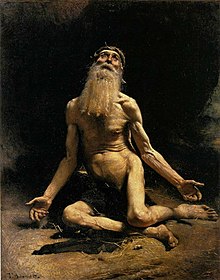
“Job,” by French painter Léon Bonnat, 1880

“But if I were you, I would appeal to God;
    I would lay my cause before him.
He performs wonders that cannot be fathomed,
    miracles that cannot be counted.
He provides rain for the earth;
    he sends water on the countryside.
The lowly he sets on high,
    and those who mourn are lifted to safety.
He thwarts the plans of the crafty,
    so that their hands achieve no success.
He catches the wise in their craftiness,
    and the schemes of the wily are swept away.
Darkness comes upon them in the daytime;
    at noon they grope as in the night.
He saves the needy from the sword in their mouth;
    he saves them from the clutches of the powerful.
So the poor have hope,
    and injustice shuts its mouth.

“Blessed is the one whom God corrects;
    so do not despise the discipline of the Almighty.
For he wounds, but he also binds up;
    he injures, but his hands also heal.
From six calamities he will rescue you;
    in seven no harm will touch you.
In famine he will deliver you from death,
    and in battle from the stroke of the sword.
You will be protected from the lash of the tongue,
    and need not fear when destruction comes.
You will laugh at destruction and famine,
    and need not fear the wild animals.
For you will have a covenant with the stones of the field,
    and the wild animals will be at peace with you.
You will know that your tent is secure;
    you will take stock of your property and find nothing missing.
You will know that your children will be many,
    and your descendants like the grass of the earth.
You will come to the grave in full vigor,
    like sheaves gathered in season.

“We have examined this, and it is true.
    So hear it and apply it to yourself.” (New International Version)

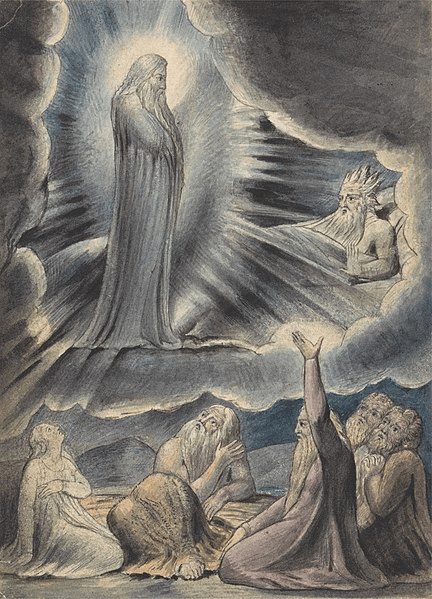
“The Vision of Eliphaz,” by John Linnell (1792-1882)

I personally find it rather annoying whenever someone gives me unsolicited advice. It is especially loathsome when it comes with a lot of useless verbiage which is offered as gospel truth.

Eliphaz was a “friend” of Job – which brings to mind the old adage, “With a friend like that, you don’t need any enemies!” Eliphaz was also full of himself, believing that he had all the answers to Job’s terrible suffering.

The unhelpful speech of Eliphaz became harmful words that cut into Job’s spirit. You see, Job knew with a settled confidence that his personal integrity was intact. Yet, his trouble abounded. We need not, like Eliphaz, rush to the conclusion that something is wrong with the suffering person. It may be the Spirit of God thrusting us into a desert experience to test and approve our faith.

Eliphaz offered one of those tired age-old arguments that bad things only happen to bad people. He came at Job with the inexperience and absurdity of making misguided assumptions. He rhetorically asked if there were ever innocent people who were trashed with trouble, or upright folks who ever got cut off from God? 

The concluding judgment of Eliphaz was bound to be off the mark – believing that some sort of secret sin must surely be the culprit behind Job’s awful misfortune. Certainly, Eliphaz thinks, Job cannot possibly go through such terrible suffering without having done something to anger God.

Times change, but the basic nature of people, not so much. In today’s church and world, the same notions still endure. If I had a quarter for every time I heard crazy comments, like the following, I would be a rich man: 

  • “He’s poor because he is lazy and doesn’t want to work.”
  • “She keeps having chronic health issues. God is punishing her.”
  • “The pandemic is God’s judgment on us for not having the Ten Commandments in our courthouses.”
  • “If you just confess your sin and have faith, you’ll be healed.”
  • “They’re in big trouble. They obviously did something evil.”

On and on the wrong-headed statements continue, ad nauseum.

The Apostle Peter understood how to view trouble in a healthy way. He said we all suffer – both the good person and the wicked. It’s just a matter of whether we will suffer for doing the good and right thing, or suffer because of saying shallow, illogical, and stupid comments that offend God and hurt others. (1 Peter 3:17-18)

Even Christ suffered. And it wasn’t because of his own sin. It was because of ours. Jesus suffered once for sins, the righteous for the unrighteous, that he might bring us to God. 

Since Jesus suffered, the follower of Jesus will suffer. There is a big picture only God sees. Whenever we suffer, there is something going on behind the spiritual scene. We must allow God to do divine work, and then, trust that the Lord bends all human suffering for good and redemptive purposes.

“Where there is no love, pour love in, and you will draw love out.”

St. John of the Cross

So, let’s change the rhetoric. Instead of jumping to judgment, reflexively hop to grace with comments like these:

  • “He has poverty of spirit. He’s blessed and will inherit the kingdom of God.”
  • “She’s in chronic pain. God has allowed her the privilege of suffering in solidarity with her Lord.”
  • “We’re in a pandemic. Here’s a chance for us to live out the Ten Commandments.”
  • “If we confess the world’s sins of pride, hate, and injustice, perhaps God’s mercy will deliver us.”
  • “We’re in a big pickle. No better time than now to grow in grace.”

Where is God? Beside you, quietly and confidently holding you up in your suffering. For me, that’s one of the best ways to interpret hard suffering.

Lord God, I entrust myself to you because you know what you are doing. Thank you for the trials of life which humbles my heart to pray. Do your work in me so that my faith is fortified for a lifetime of service in the church and the world, through Jesus Christ, my Lord. Amen.

Exodus 6:1-13 – Our Own Worst Enemy

Moses and the Burning Bush by Marc Chagall

Then the Lord told Moses, “Now you will see what I will do to Pharaoh. When he feels the force of my strong hand, he will let the people go. In fact, he will force them to leave his land!”

And God said to Moses, “I am Yahweh— ‘the Lord.’I appeared to Abraham, to Isaac, and to Jacob as El-Shaddai—‘God Almighty’—but I did not reveal my name, Yahweh, to them. And I reaffirmed my covenant with them. Under its terms, I promised to give them the land of Canaan, where they were living as foreigners. You can be sure that I have heard the groans of the people of Israel, who are now slaves to the Egyptians. And I am well aware of my covenant with them.

“Therefore, say to the people of Israel: ‘I am the Lord. I will free you from your oppression and will rescue you from your slavery in Egypt. I will redeem you with a powerful arm and great acts of judgment.I will claim you as my own people, and I will be your God. Then you will know that I am the Lord your God who has freed you from your oppression in Egypt. I will bring you into the land I swore to give to Abraham, Isaac, and Jacob. I will give it to you as your very own possession. I am the Lord!’”

So, Moses told the people of Israel what the Lord had said, but they refused to listen anymore. They had become too discouraged by the brutality of their slavery.

Then the Lord said to Moses, “Go back to Pharaoh, the king of Egypt, and tell him to let the people of Israel leave his country.”

“But Lord!” Moses objected. “My own people won’t listen to me anymore. How can I expect Pharaoh to listen? I’m such a clumsy speaker!”

But the Lord spoke to Moses and Aaron and gave them orders for the Israelites and for Pharaoh, the king of Egypt. The Lord commanded Moses and Aaron to lead the people of Israel out of Egypt. (New Living Translation)

We can become our own worst enemy.

In Lodi, California, in March of 2006, a city dump truck backed into a car belonging to a man named Curtis Gokey. The car was damaged badly. So, Gokey sued the city of Lodi for $3,600. There is, however, a catch to the story: Curtis Gokey was driving the city dump truck that crunched his personal car. And he admitted it was his fault. The city dropped the lawsuit, stating that Gokey could not sue himself. 

Like Curtis Gokey, we are often our own worst enemies. We might get down on ourselves or on God. There are times when it’s easy for us to either justify ourselves or blame ourselves, while wondering why God and/or others keep doing things we don’t like. 

When life is not going so well, it’s possible to slide into a private belief system that thinks God is not good for his promises (James 1:16-17). At worst, one can start to think that God is the problem and the source of the trouble. 

To be self-deceived is to go astray and slowly drift from the truth…. It can happen to anybody. The first step is having expectations that go unmet. An expected answer to prayer goes unanswered. Somebody lashes out and there seems to be no protection from it. Some anticipated blessing does not come to pass….

Moses was downright confused. He was confident and convinced God had called him to free the Israelites from their cruel bondage in Egypt. But nothing was going right. And the people were upset with Moses for making things worse, not better.

Trusting God and not becoming discouraged when we don’t understand everything that’s happening can be a big challenge. We might wonder if we really have what it takes to do anything well. We may wonder if God is even listening, or if God is paying any attention, at all, to our terrible plight….

  • “Why, God, did you let my son or daughter die? How in the hell am I supposed to keep going!?” 
  • “Why, God, did you give me a gaslighting boss to deal with? I get tongue-tied around her. How is she ever going to listen to me?”
  • “Why won’t people get vaccinated for COVID-19? How am I supposed to talk to the anti-vaxers?”
  • “Why, God, is everything changing? How am I going to speak up?”

Questioning can help us make sense of our situations. However, questioning may also cause us to doubt that God is there and will act on our behalf. In such times, it might be tempting to blame God for a broken relationship, a terrible event, a dysfunctional family, or an adverse situation. 

Yet, God has chosen to give us birth through the word of truth (not a word of deception and lies) so that we might have new life with fresh eyes of faith to see our situations as God sees them (James 1:18).  That is what wisdom is – the ability to see all of life from God’s perspective. 

If any of us lacks wisdom, we should ask God, who gives generously without finding fault, and it will be given to us (James 1:5).  This is a promise from a good God who knows how to give good gifts.

None of us are above falling into misinterpretations that lead to the self-deceptions of questioning God’s goodness and our own God-given personhood. We need to be vigilant in watching for the false stories we might tell ourselves such as: 

  • “This wouldn’t have happened, if I just would’ve been better.”
  • “There’s nothing I can do about it.”
  • “I’m just a big screw-up. I can’t do anything right.”
  • “God messed-up when he made me.” 
  • “I don’t know what to say. I’m not good with words.”

We are all to take charge of our lives through having a robust theology of God that discerns the Lord is always good, all the time, without exception; and that we are called by a good God to do good work.

The good news is that a good God has taken care of the sin issue once for all through the cross of Christ. The Lord has brought us the good gifts of forgiveness and grace. God has given us the Holy Spirit to help us and guide us into all truth so that we will have wisdom and humility to live the Christian life as it is meant to be lived. 

For the Christian, the key to it all is faith – genuine authentic faith that places head, heart, and hands completely in Jesus Christ so that we have right belief, right motives, and right actions all rightly working together in a full-orbed Christianity that glorifies the triune God, encourages Christ’s church, and blesses God’s big world. 

Don’t be your own worst enemy by sabotaging your thoughts with the double-mindedness of wondering about the true nature of God. 

Explore the depths of God in Christ and discover the goodness that can result even in life’s most difficult experiences.

Lord God almighty, Creator of heaven and earth:

When evil darkens our world, give us light.

When despair numbs our souls, give us hope.

When we stumble and fall, lift us up.

When doubts assail us, give us faith.

When nothing seems sure, give us trust.

When ideals fade, give us vision.

When we lose our way, be our guide!

That we may find serenity in Your presence, and purpose in doing Your will.

Through Jesus Christ, our Savior, Lord, Brother, and Friend. Amen.