2 Kings 4:32-37 – But That Is Not the End of the Story

Elisha and the Shunammite woman by Dutch painter Gerbrand van den Eeckhout (1621-1674)

Elisha entered the house and found the boy stretched out on the bed dead. He went into the room and locked the door—just the two of them in the room—and prayed to God. He then got into bed with the boy and covered him with his body, mouth on mouth, eyes on eyes, hands on hands. As he was stretched out over him like that, the boy’s body became warm. Elisha got up and paced back and forth in the room. Then he went back and stretched himself upon the boy again. The boy started sneezing—seven times he sneezed!—and opened his eyes.

He called Gehazi and said, “Get the Shunammite woman in here!” He called her and she came in.

Elisha said, “Embrace your son!”

She fell at Elisha’s feet, face to the ground in reverent awe. Then she embraced her son and went out with him. (The Message)

Life sometimes feels like a roller coaster. Our emotions go up and down alongside the circumstances which bring them forth.

Elisha was one of the all-time great prophets in ancient Israel. He developed an ongoing friendship with a woman from the town of Shunem. It was her simple hospitality to a stranger that brought about the enduring relationship.

Whenever Elisha passed through on his prophetic business, he would stop in and have a meal or spend the night in a special room set aside just for him.

But that is not the end of the story….

The woman was about to have a big change of life, a life she could not have ever seen coming and only dreamed of.

The Shunammite woman had no children and was not able to conceive. Yet, on one of his visits, Elisha promised her she would hold her very own infant child… which she eventually did. A year after Elisha’s pronouncement, the woman and her husband had a son.

The woman went from discouraged to elated. The child grew. The Shunammite and her family were content and living well.

But that is not the end of the story….

In today’s Old Testament lesson, we pick up the narrative as the child is a small boy, the family happy and healthy… until they weren’t.

One day the boy was playing, as he did every day. Whatever happened, he developed such a terrible headache that his dear mother rocked him for hours, trying to comfort him. The worst case scenario happened. The boy died.

The woman went from joy to despair in a matter of hours.

But that is not the end of the story….

The grieving mother refused to let death have the last word on her son. She saddled her donkey and went directly to Elisha. The Shunammite lamented to him about her son, and in her grief, cried out how Elisha had gotten her hopes up, only to be dashed by that dark enemy of death.

The prophet responded to the woman’s plea and set off  post haste to her home, which had now become a sort of funeral parlor. Elisha went into the room by himself with the dead boy. In an odd process similar to what Jesus would do centuries later, Elisha did some physical actions in bringing about a miraculous resurrection.

The boy sneezed, got up, and was given back to his mother. Her lowest of the low grinding sadness of distress and despair now turned to the highest of the high elation of joy and gratitude.

But that is not the end of the story….

The story continues because the larger overarching story of God’s gracious intervention into this world to bring about the redemption of all creation.

Along the way, across the millennia, the Lord continues to use faithful people to bring about renewal, restoration, and redemption. In the Christian tradition, the apex of this merciful work is fulfilled in the person of Jesus Christ.

God himself was pleased
    to live fully in his Son.
And God was pleased
    for him to make peace
by sacrificing his blood
    on the cross,
so that all beings in heaven
    and on earth
would be brought back to God. (Colossians 1:19-20, CEV)

The resurrection of the boy, and all risings from death before Jesus, prefigured and foretold the ultimate resurrection of Christ. And because Christ is risen, we too, shall rise from death – both spiritually and bodily.

Therefore, we have been buried with him through baptism into death, in order that just as Christ was raised from the dead through the glory of the Father, so we too may live a new life. For if we have become united with him in the likeness of his death, we will certainly also be united in the likeness of his resurrection. (Romans 6:4-5, NET)

The end of the grand narrative story is moving to a climax. Jesus is coming again to judge the living and the dead. All things shall be restored. All will be made right. We may sorrow in the night, but joy comes in the morning.

Then I saw a new heaven and a new earth, for the first heaven and the first earth had passed away, and the sea was no more. And I saw the holy city, the new Jerusalem, coming down out of heaven from God, prepared as a bride adorned for her husband. And I heard a loud voice from the throne saying,

“See, the home of God is among mortals.
He will dwell with them;
they will be his peoples,
and God himself will be with them and be their God;
he will wipe every tear from their eyes.
Death will be no more;
mourning and crying and pain will be no more,
for the first things have passed away.”

And the one who was seated on the throne said, “See, I am making all things new.” Also, he said, “Write this, for these words are trustworthy and true.” Then he said to me, “It is done! I am the Alpha and the Omega, the Beginning and the End. To the thirsty I will give water as a gift from the spring of the water of life. (Revelation 21:1-6, NRSV)

Our past grief and our present troubles will give way to a future hope – an ending to the story we can barely imagine, a glorious existence with our God which will have no end.

May the Lord come soon.

I pray the Lord Jesus will be kind to you.

May faith, hope, and love surround everyone who belongs to Christ Jesus. Amen.

Matthew 9:27-34 – How To Use Your Faith

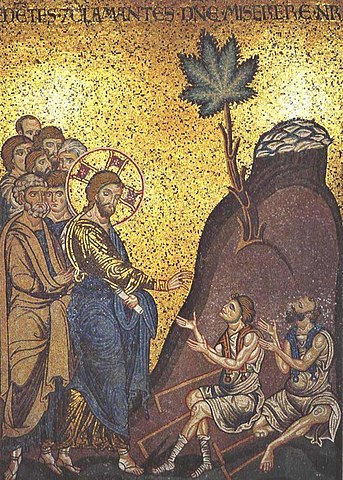
Jesus healing two blind men, 11th century mosaic, Sicily

As Jesus went on from there, two blind men followed him, calling out, “Have mercy on us, Son of David!”

When he had gone indoors, the blind men came to him, and he asked them, “Do you believe that I am able to do this?”

“Yes, Lord,” they replied.

Then he touched their eyes and said, “According to your faith let it be done to you”; and their sight was restored. Jesus warned them sternly, “See that no one knows about this.” But they went out and spread the news about him all over that region.

While they were going out, a man who was demon-possessed and could not talk was brought to Jesus. And when the demon was driven out, the man who had been mute spoke. The crowd was amazed and said, “Nothing like this has ever been seen in Israel.”

But the Pharisees said, “It is by the prince of demons that he drives out demons.” (New International Version)

Every day the news is a steady stream of disease, death, war, and outright human suffering. It’s as if the phrase, “slow news cycle,” is a thing of the past.

As we stare into the face of trouble, I find myself uttering the ancient prayer of the Church: “Lord have mercy.  Christ, have mercy.  Lord have mercy and grant us your peace.” 

We collectively feel the weight of the world’s suffering, experience the heaviness of concern for family and friends, and perhaps wonder how much more people can take.

It’s in the topsy-turvy times that I come back again and again to the deep spiritual convictions which inform what I do each day. One of those underlying creeds and affirmations is this:

Jesus is trustworthy, no matter whether my faith or the faith of others is small or great.

In our Gospel lesson for today, two blind men were healed according to their faith in Jesus. The diverse healing accounts of Jesus in the New Testament, whether the faith was large or small in those healed, leads me to the conclusion that:

It isn’t faith itself that heals, saves, or transforms – it is Jesus.

All the healing accounts in the New Testament Gospels have something in common: They all directly point to Jesus as the object of faith. 

It isn’t about the level or amount of faith, but about where the faith is placed. 

For the Christian, faith itself doesn’t mean much if it isn’t in Jesus.

If I place a large and sincere faith in an inanimate object such as money; in a position of power; or, even in my own independence, my faith isn’t worth much. 

If I have a huge faith in a doctor or a psychiatrist to heal my body or my mind, I will quickly discover there are limits to their abilities. 

If I have a confident faith that my family will meet all my needs, my faith will eventually run into failure when they let me down. That’s because the ultimate object of faith is Jesus. 

If all my faith eggs are in the church basket, my faith will eventually face a crisis because it is a misplaced faith.  Furthermore, the answer I provide for others is not simply getting them to attend church or to adopt my moral code.

There should be a consistency that runs through us all. For Jesus doesn’t change—yesterday, today, tomorrow, he’s always totally himself.

Hebrews 13:8, MSG

We know with certainty that circumstances change, as everyday seems to bring new levels and permutations of unprecedented alterations to our lives – and through it all, Jesus remains as the ever-present Savior, seated at the right hand of God ceaselessly interceding on behalf of those who offer even the slightest mustard seed of faith.

“For truly I tell you, if you have faith the size of a mustard seed, you will say to this mountain, ‘Move from here to there,’ and it will move, and nothing will be impossible for you.”

Jesus (Matthew 17:20-21, NRSV)

It says something about our modern Western society that whenever we hear the words of Jesus on faith that we interpret the mountain moving as an immediate event that happens almost instantaneous, like a snap of the finger. Yet, there is nothing in those words that says that. There is also nothing that says an individual necessarily does it.

The fact of the matter is this: Jesus heals, transforms, and delivers people from sickness, sin, trouble, and overwhelming circumstances in his own good time, not ours.

Just because we pray without ceasing for days, weeks, months, and even years for something doesn’t mean we lack faith if the prayer isn’t answered immediately. It could be that God wants others involved, maybe even across generations, for the impossible mountain to be moved.

It is misplaced faith which expects microwave results. Faith placed appropriately in Jesus as the object of belief discerns that faithful prayer is consistently prayed until there is an answer.

Healing and restoration will happen – just maybe not always how or when we think it will.

Almighty God, you know that we have no power in ourselves to help ourselves: Keep me both outwardly in my body and inwardly in my soul, that I may be defended from all adversities which may happen to the body, and from all evil thoughts which may assault and hurt the soul; through Jesus Christ our Lord, who lives and reigns with you and the Holy Spirit, one God, forever and ever. Amen.

Luke 1:26-38 – The Holy Spirit Will Come on You

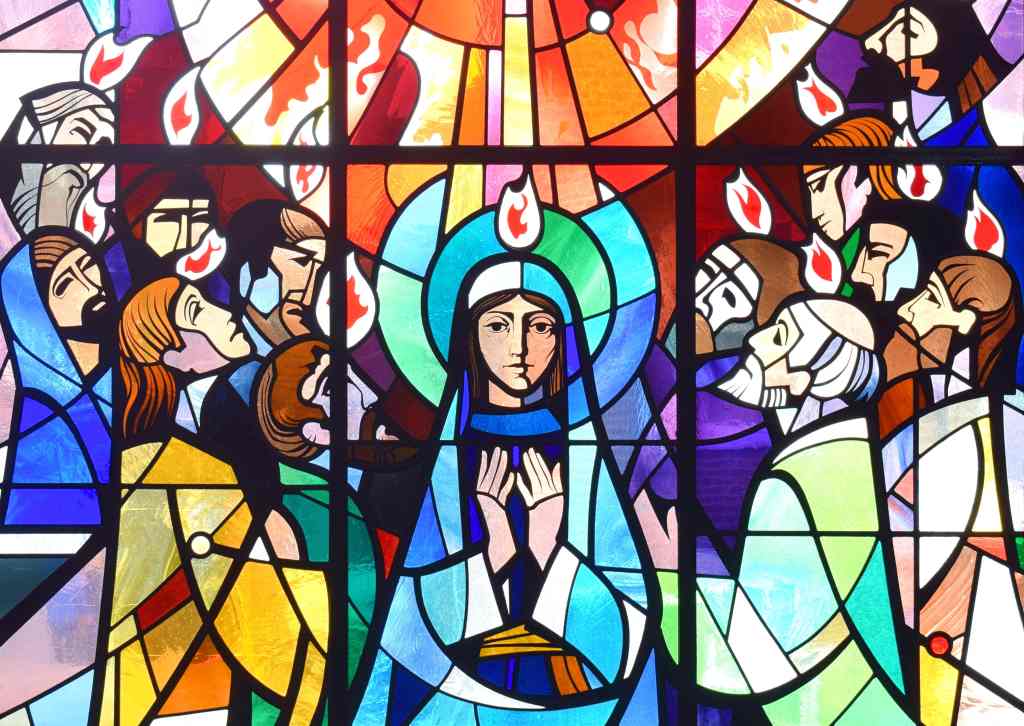
Pentecost by Jen Norton

In the sixth month of Elizabeth’s pregnancy, God sent the angel Gabriel to Nazareth, a town in Galilee, to a virgin pledged to be married to a man named Joseph, a descendant of David. The virgin’s name was Mary. The angel went to her and said, “Greetings, you who are highly favored! The Lord is with you.”

Mary was greatly troubled at his words and wondered what kind of greeting this might be.But the angel said to her, “Do not be afraid, Mary; you have found favor with God. You will conceive and give birth to a son, and you are to call him Jesus. He will be great and will be called the Son of the Most High. The Lord God will give him the throne of his father David,and he will reign over Jacob’s descendants forever; his kingdom will never end.”

“How will this be,” Mary asked the angel, “since I am a virgin?”

The angel answered, “The Holy Spirit will come on you, and the power of the Most High will overshadow you. So, the holy one to be born will be called the Son of God. Even Elizabeth your relative is going to have a child in her old age, and she who was said to be unable to conceive is in her sixth month. For no word from God will ever fail.”

“I am the Lord’s servant,” Mary answered. “May your word to me be fulfilled.” Then the angel left her. (New International Version)

It is good that the Daily Lectionary has us considering these verses of Scripture outside of the Advent season. In this time of year, in which we focus on the Spirit, we need to remember that these stories, and our faith, are meant to be held throughout the entire year.

Most of life is lived in the mundane, even in times of uncertainty. For the most part, our everyday lives involve going about our business and dealing with the daily grind. That’s because we are common ordinary people. So, we can especially relate to Mary because she is rather plain. 

To put Mary’s life in our contemporary vernacular, at the time of this encounter with the angel, she is of junior high age but has never attended school. She wears mostly clothes from Goodwill, and occasionally can get some from Wal-Mart. She cannot read because girls of her day rarely did.

Her parents make all the decisions that affect her life, including the one that she should be married to an older man named Joseph. We don’t know if she even liked him. Mary lives in a small town that most people cannot even point to on a map. 

One night, into the bedroom of this young girl comes the brightly beaming divine messenger Gabriel whose name means, “God has shown himself mighty.” Mary stands there in her ratty old flannel nightgown, her life very quickly moving from the ordinary to the extraordinary.

The juxtaposition could not be more pronounced: a mighty angel and a plain teen-ager; a messenger of the Most High God and a girl barely past puberty; a holy angelic light which beams in a simple candlelit bedroom; an awesome power encountering complete vulnerability.

Mary, compared to Gabriel, is defenseless, fragile, and overwhelmed. She’s in way over her head. That’s why we can relate to her. We can get our human arms around Mary. She is like us. She has faced life with little power to make it turn out the way she planned. Forces beyond her have rearranged her life and altered it forever.

Descent of the Holy Spirit by John Lawson

Mary is the Matron Saint of the Ordinary. We can totally understand why Mary responds the way she does. Mary’s initial reaction to the angel Gabriel was to be greatly troubled. She was disturbed and shaking in her hand-me-down slippers.

The angel confidently told Mary that she had found favor with God. This scenario didn’t happen because Mary had some extreme spirituality. Instead, God simply chose her to be the mother of Jesus.

Mary needed to come to grips with what was happening to her. This was well beyond anything she could have expected.  Becoming pregnant with the Savior of the world was not even remotely on her radar. 

She immediately sensed the crazy disconnect between what was being told to her and who she was. After all, she was a plain ordinary girl from the hick town of Nazareth and was being told that she would raise a king.  Maybe somebody in heaven screwed up. Maybe Gabriel got the wrong girl. Maybe his Google map sent Gabriel on a wild goose chase.

Relating to Mary, we can totally understand that she would question how in the world all this was going to happen. Not only is Mary ordinary and far from royalty, but she is also very much a virgin. Nothing about any of this made any sense.

But, then again, this is the very sort of thing that the wild and seemingly reckless Holy Spirit would do.

The angel let Mary know that God specializes in the impossible. There is nothing outside of God’s power. There’s nowhere we can go, no place on earth, no situation whatsoever, that is beyond God’s ability and reach to affect divine power.

We very rarely get straightforward answers to our questions about God. Yet, Mary asked a question and got a straight answer: She really can be pregnant with Jesus because the Holy Spirit will come upon her, will overshadow her with power.

If the story were to end there it would be a great story. However, the Spirit’s work goes well beyond effecting the miraculous. The Spirit also brings about faith.

God has poured out his love into our hearts by means of the Holy Spirit, who is God’s gift to us.

Romans 5:5, GNT

Mary believed the message and submitted herself completely to God’s will. We may completely understand if Mary simply said in her plain ordinary way that she was not prepared for this. We would totally “get it” if Mary pushed back on what the angel said to her. We could relate if Mary just dismissed the angel’s presence as a hallucination from using some bad chickpeas to make the hummus.

Yet, Mary not only believed; she also humbly submitted herself to what was happening. And this is what I believe we need to relate to most about Mary – not her being just a plain ordinary person in a non-descript village but stepping up to the calling she received.

We, too, have received a calling in our lives. We, too, have been given the power of the Holy Spirit. We, too, are ordinary people who have been given a very extraordinary task. 

Our response today can be the same as Mary all those centuries earlier: “I am the Lord’s servant; may it be to me as you have said.”

The Church is pregnant with possibilities because of the Holy Spirit.

We know the end of Mary’s story. She gave birth to Jesus and raised him in her plain ordinary way. She watched him grow up and embark on a ministry to proclaim that the kingdom of God is near. Mary didn’t always understand what Jesus said or what he was doing. And she experienced every mother’s nightmare in seeing her beloved son killed in a terribly gruesome manner right in front of her eyes. 

Yet, just as the Holy Spirit was with the birth of Jesus, so the Spirit was with Jesus at his resurrection from the dead. Jesus lived an ordinary life in a very extraordinary way. Furthermore, today Jesus invites us to do the same.

“You will receive power when the Holy Spirit has come upon you, and you will be my witnesses in Jerusalem, in all Judea and Samaria, and to the end of the earth.”

Jesus (Acts 1:8, CEB)

Because Christ accomplished his mission of saving people from their sins and establishing a kingdom that will never end, he has given us the same Holy Spirit to follow him forever and call other people to follow him, too. 

To trust and obey is God’s only way to live into the life of Jesus. The Christian life may often be difficult, but it isn’t complicated. It’s rather simple, just like Mary.

Mary responded to God’s revelation with faith, choosing to fully participate in what God was doing. “I am the Lord’s servant” is our confession, as well. Along with Mary we declare, “May it be to me as you have said.”

Good and gracious God, thank you for giving us your Son, the Lord Jesus. Draw us into the mystery of your love. Join our voices with the heavenly host, that we may sing your glory on high. Give us a place amongst all of your saints so that we may experience your Word made flesh, who lives and reigns with you in the unity of the Holy Spirit, in the splendor of eternal light, God forever and ever. Amen.

Acts 9:32-35 – Healed

St. Peter heals Aeneas, 12th century mosaic in Palermo, Italy

As Peter traveled about the country, he went to visit the Lord’s people who lived in Lydda. There he found a man named Aeneas, who was paralyzed and had been bedridden for eight years. “Aeneas,” Peter said to him, “Jesus Christ heals you. Get up and roll up your mat.” Immediately Aeneas got up. All those who lived in Lydda and Sharon, saw him and turned to the Lord. (New International Version)

The early church was growing. Both in numbers and in faith, the new believers following the words and ways of Jesus could be found everywhere in Judea. The Apostle Peter, therefore, decided to get out of Jerusalem and visit some of these folks in the town of Lydda, on the Mediterranean coast.

Back when Peter was following Jesus around in his earthly ministry, the Lord told the disciples that they will do the works he did, and, what’s more, they will do even greater things than Jesus himself. (John 14:12-14)

Peter emulated the example of his Lord. He simply stated that Christ is the one who heals you, Aeneas, so get up, take your mat, and go on home. (Mark 2:10-12; John 5:1-8)

The act of healing the paralyzed man, Aeneas, was a sign that the merciful saving ministry of Jesus was in effect, even when Jesus isn’t bodily present. Christ made it clear that the Holy Spirit would be the continuing presence of God on this earth. (John 16:1-15)

We, too, have this same Spirit.

The work of ministry is always done to the glory of God. People hear the good news, see the miracle, and believe in Jesus.

There are some who examine today’s New Testament lesson and expect that they (and all other believers) ought to be able to do exactly what Peter did: heal another miraculously.

Then, there are others who look at the same account and relegate it to some bygone era in which only the original apostles, like Peter, could do that sort of thing – if it even happened like that, at all.

To expect a dramatic physical healing, every time, all the time, is not consistent with healing narratives in Holy Scripture. And to never expect a miraculous healing is equally inconsistent with the biblical data.

It seems to me we need to reject both extremes. That’s because healing comes in all sorts of different forms.

An event which causes the need for healing and health, or a condition which prevents good health, isn’t limited to the body. A person’s mind, emotions, and spirit can also be damaged and need healing, as well. In fact, whenever there is trauma to the physical body, it profoundly effects the person’s thinking, feeling, and praying.

We need to beware of desiring the fast solution of dramatic and miraculous healing because of not wanting to deal with our emotions.

Perhaps you, like me, have had the experience of going to work or church when experiencing a difficult time in life. There is an emotional heaviness because of a strained, broken, or lost relationship. Or maybe there is emotional pain from an unexpected or unwanted situation.

Yet, when someone asks how you are doing, the response “Oh, fine!” tumbles automatically out of your mouth. But you are anything but fine. Inside, down in your heart, or painfully present in your head, the hurt dominates your thoughts and feelings.

Healing is for people. Fixing is for things and machines. It would be weird if I said I was going to heal a tractor. It is equally strange to try and fix people. To heal is to straighten what is broken. We cannot fix our emotions because, when hurt or damaged, they need healing – a process of restoration – and it usually doesn’t happen overnight.

Our emotional healing is like walking a slow journey. Along that path, our emotions are crying out for us to pay attention to three things:

  1. Grief. Grieving is the normal emotional reaction to any significant change or loss. To grieve our painful situations, whatever they may be, is necessary to healing our emotions. Putting a lid on our grief and sucking it up in a delusional show of strength at best prolongs our healing, and, at worst, brings further damage.
  2. Grace. Grace is an act of bestowing honor or forgiveness to a person. It is not dependent upon whether one deserves it, or not. Grace is the opposite of being judgmental. It chooses not to hold something over or against another, even oneself.
  3. Gratitude. Gratitude is a deliberate act of thankfulness for a specific act. It is both an attitude and an emotion. Gratitude comes from a heart of appreciation. Habits of gratitude creates new ways of being with others. And creating new experiences is one of the best ways of helping to heal the bad experience we just went through.

Embracing those three elements of grief, grace, and gratitude sets us on a healing path. Also, there are practices which we can utilize with each of those three which promote their healing work in our lives. For me, some of those practices include humor and laughter; meditation and other spiritual practices; walking the dog; watching cartoons; and journaling.

Healing is an art. It takes time, lots of practice, and plenty of love. Healing comes from God, which is a good thing, because the Lord knows exactly the kind of healing we need.

God of all comfort and healing, our help in time of need: We humbly ask you to relieve the suffering of your sick servants everywhere. Look upon them with the eyes of your mercy; comfort them with a sense of your goodness; preserve them from the temptations of the enemy; and give them patience in their afflictions. In your good time, restore them to health, and enable them to glorify your most holy name and dwell with you forever in the land of the living, through Jesus Christ our Lord. Amen.