The Healing of the Demoniac (Luke 8:26-39)

Mosaic of the exorcism of the Gerasene demoniac from the Basilica of Sant’Apollinare Nuovo, 6th century C.E.

Then they arrived at the region of the Gerasenes, which is opposite Galilee. As he stepped out on shore, a man from the city who had demons met him. For a long time he had not worn any clothes, and he did not live in a house but in the tombs. 

When he saw Jesus, he cried out and fell down before him, shouting, “What have you to do with me, Jesus, Son of the Most High God? I beg you, do not torment me,” for Jesus had commanded the unclean spirit to come out of the man. (For many times it had seized him; he was kept under guard and bound with chains and shackles, but he would break the bonds and be driven by the demon into the wilds.) 

Jesus then asked him, “What is your name?” He said, “Legion,” for many demons had entered him. They begged him not to order them to go back into the abyss.

Now there on the hillside a large herd of swine was feeding, and the demons begged Jesus to let them enter these. So he gave them permission. Then the demons came out of the man and entered the swine, and the herd stampeded down the steep bank into the lake and was drowned.

When the swineherds saw what had happened, they ran off and told it in the city and in the country. Then people came out to see what had happened, and when they came to Jesus, they found the man from whom the demons had gone sitting at the feet of Jesus, clothed and in his right mind. And they became frightened. Those who had seen it told them how the one who had been possessed by demons had been healed. Then the whole throng of people of the surrounding region of the Gerasenes asked Jesus to leave them, for they were seized with great fear. So he got into the boat and returned. 

The man from whom the demons had gone out begged that he might be with him, but Jesus sent him away, saying, “Return to your home, and declare how much God has done for you.” So he went away, proclaiming throughout the city how much Jesus had done for him. (New Revised Standard Version)

Jesus exorcising the Gerasene demoniac, from the Hitda Codex

Jesus came to this earth to deliver people from all obstacles that gets in the way between us and God, so that humanity may freely connect with the divine, each other, and creation.

Whether it was in the synagogue, in public, in private, in a Jewish community, or in Gentile territory, Christ’s ministry was marked by healing people. He did this so that people could (re)attach themselves to the neighborhood, to God, and even to themselves.

Today’s Gospel story has Jesus take an unexpected trip across the Sea of Galilee to a foreign place full of non-Jewish persons. It was a place marked by all sorts of ritual impurity, and sorts of Gentile practices which a good Jew would have nothing to do with.

So, it’s no surprise, in a heathen setting, that Christ encountered the demonic in the form of a man riddled with demons to the point of being named “Legion.” This confrontation became a type of wild west shootout between the superhuman tortured man and the divinely filled Son of God.

The confrontation was intense. The atmosphere was charged with anticipation that someone wasn’t going to walk away from this shootout. But Jesus knew what he was doing: Christ was about to breakout a man from a demonic prison; and it would not go well for the demons.

In this remote western town, Jesus ended up performing a most extraordinary miracle. It would take a miracle to free this demonized person from his satanic jailcell. The legion of demons, however, were no match for the singular Son of God. Christ had no problem using his authority to exorcise the demons from the victimized man.

The demons exited the man and entered an entire herd of pigs. The herd then proceeded to destroy themselves in a powerful scene of what the demonic is all about. Yet, rather than acknowledging a divine miracle, those who were tending the pigs went and told the people in the area of how this interloper came along and upset the status quo. Instead of seeing a delivered man, the pig herders could only see dead swine.

As a result of the pig herders report, the folks in nearby towns wanted nothing to do with Jesus. The people begged him to get out of town. Christ purged the region of a significant presence of bad guys, and all the townspeople could do was fear for what might happen.

But despite the townspeople’s and pig herders’ disturbing lack of faith, there was one man who became a committed disciple of Jesus on the spot. The demoniac, now turned new citizen of God’s kingdom, saw Christ for who he was, and immediately discerned to whom he belonged – not the demonic world but the kingdom of heaven.

Although the newly delivered man begged to remain with Jesus, the Lord had another plan for the new disciple. Christ sent him back to his home to proclaim what God had done for him. In doing so, the man would become a powerful witness to God’s power. And, important for the man, old broken familial and community relations could be renewed and restored. The healing would come full circle.

If we bear witness to the works of God, where we are, it will bear fruit – even if it is among folks who may be in opposition to it.

Not even a legion of demons could keep Christ from restoring a tortured person to himself, his family, and his community. And it all happened on the demons’ turf. Nothing can stop the kingdom of God from expanding it’s good reach over all that is evil.

The good news of Christianity is that Jesus has the power to bring life from death. Christ has the ability to put us in a position where we can reconnect with both the human community and the divine realm.

The satanic in this world is not nearly as powerful as God; and the demons are under Christ’s authority. In fact, there is no power on earth (or under the earth) that can overcome the strength of the almighty God. This can be a comforting thought for every Christian.

Anyone afraid of Jesus has not yet discerned that he is inherently good. Ultimate power needs to be seen in the light of ultimate good. Otherwise, a person will walk around much like the demoniac, oppressed in their soul.

Instead, deliverance from the evil which vexes us is possible. For nothing is impossible with God. Whenever and wherever the healed person becomes a healer to others, then we know that the kingdom of heaven is among us.

Hear our prayers, God of power and might. Through the ministry of your Son, free us from the grip of the tomb, so that we may desire you as the fullness of life, and proclaim your saving deeds to all the world in the strength of the Holy Spirit. Amen.

The Feeding of the Four Thousand (Mark 8:1-8)

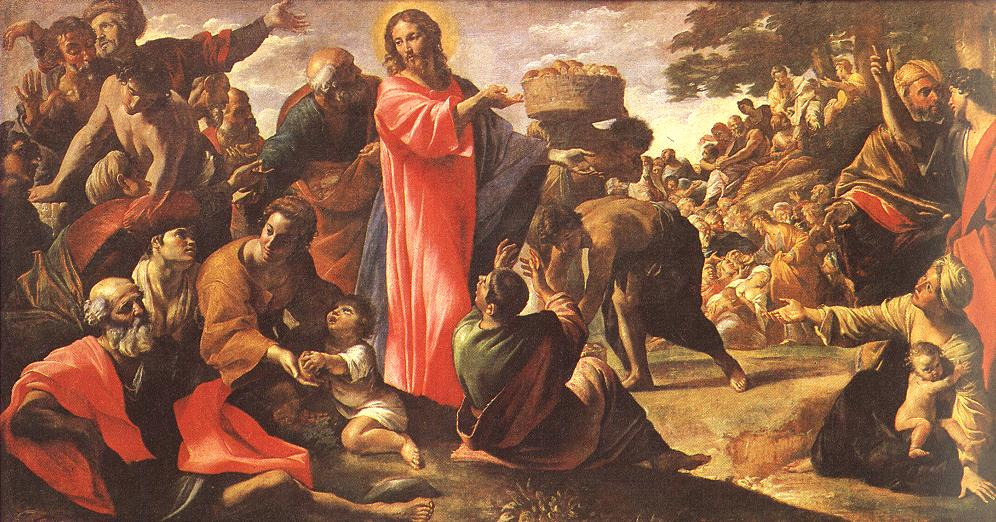
Miracle of the Loaves and Fishes, by Giovanni Lanfranco, c.1620

In those days when there was again a great crowd without anything to eat, he called his disciples and said to them, “I have compassion for the crowd because they have been with me now for three days and have nothing to eat. If I send them away hungry to their homes, they will faint on the way—and some of them have come from a great distance.” 

His disciples replied, “How can one feed these people with bread here in the desert?” He asked them, “How many loaves do you have?” They said, “Seven.” 

Then he ordered the crowd to sit down on the ground, and he took the seven loaves, and after giving thanks he broke them and gave them to his disciples to distribute, and they distributed them to the crowd. They had also a few small fish, and after blessing them he ordered that these, too, should be distributed. 

They ate and were filled, and they took up the broken pieces left over, seven baskets full. Now there were about four thousand people. And he sent them away. And immediately he got into the boat with his disciples and went to the district of Dalmanutha. (New Revised Standard Version)

This was an incredible miracle by Jesus. And it was also an incredible lack of faith on the part of his disciples. Christ had already taught them an important faith lesson by feeding 5,000 people earlier. You’d think they would have gotten it right this time.

It appears that the disciples were anxious about the situation. After all, whenever we are given to anxiety within a stressful circumstance, we typically are not thinking wisely about what to do.

There simply was no evidence that the disciples were tapping into their wise minds – even though they could have. And there’s where the rub is: Do we have the wherewithal to pause, in order to connect with what and who we know?

Let’s notice in the story that Jesus did not seem at all perturbed by the disciples’ small faith. And he certainly was not hindered in any way by the meager supply of food which was on hand. So, a remedial lesson was provided.

All the food the disciples pulled together was given to Jesus. It wasn’t much for thousands of people. Seven loaves of bread and a few fish. Yet, Christ transformed it into enough to feed the entire crowd of mostly Gentiles, without depriving the disciples of their share. They collected enough to fill seven baskets large enough to hold a man.

So there’s the lesson redone and restated, but with a different twist. Whereas the earlier miracle of food was provided for mostly Jews, the feeding of the four thousand consisted of nearly all Gentiles.

Perhaps the disciples did not really want a miracle to begin with. Maybe they believed their ministry ought to be with Israel, and not the heathen nations around them. It could be that Christ’s disciples simply did not want to be in Gentile territory at all, let alone have to engage in ministry to them, up close and personal.

So, we may be dealing with something more than an issue of faith; we might be looking at plain old fashioned prejudice against another group of people. Discriminatory behavior shrinks one’s faith and makes it small – whereas including others, and seeing their inherent worth as God’s image-bearing creatures, increases our faith and helps it grow large.

Jesus had a heart big enough, a mind open enough, and more than enough ability to make the miracle of food happen. In other words, Christ wanted to do it. He had compassion on the people, regardless of the fact that they were not like him.

It could be that a lesson in prejudice was the teaching he wanted them to get a hold of.

We see in today’s story a trajectory of inclusion, that the kingdom of God is meant to be full of diverse people from every nation, race, and background. Jesus purposely went to the Decapolis, a geographical region with a lot of different people – mostly non-Jews.

The Decapolis (which means “Ten Cities”) was a group of ten Hellenistic cities. It was a center of Greek and Roman culture, in a region mostly populated by Jews and Arameans. Each city functioned as a sort of city-state which was dependent upon Rome. There was enough diversity within the Decapolis itself which seemed to prevent them from working together as an organized region.

When it comes to Christian ministry, there are often two issues going on, namely because ministry is all about working with people. One is that we may have a problem, like the disciples of old, in going to a place we’ve never been before – and really don’t ever want to go. We have particular ideas about the people who live there and what they’re like – and we’d rather not have to deal with them.

The second issue is that we may have a problem with ourselves. Unlike the first issue in which we wonder why Jesus would care about those people, the second is wondering if Jesus really cares about me.

In this, you have no problem believing that Jesus would go to the Decapolis and have compassion on the Gentiles. But you struggle with God caring for you, and that Jesus could ever use you in ministry to people like those in the Decapolis. You can think of all sorts of other people who could do the job much better than yourself.

Since you know yourself pretty well, you understand your own doubts, weaknesses, and sins; and have a hard time trusting that the Lord could or would want to involve you in any ministry.

We, of course, could read today’s Gospel lesson from either of the two issues. Yet, we probably need not make it an either/or issue; it may be more of a both/and issue.

That is, Christ’s disciples – including those past and present – likely struggle with both: We continually keep finding that we have personal prejudices which prevent us from reaching out to particular people; and we also have personal insecurities and inhibitions about God truly loving us enough to use us in effective ministry.

Within the story of Jesus feeding the four thousand, both issues can find their resolution. The fact of the matter is that Jesus cared about the people in the region of the Decapolis, and created a miracle in order to take care of them; and, Jesus used a group of men who probably were likely prejudiced, and also insecure about being used for such a ministry.

May you know that you are infinitely loved by God – and loved alongside all sorts of other people, as well, from everywhere in every place. And may you understand that God has you on this earth to be a blessing to all kinds of persons.

May it be so, to the glory of God. Amen.

For the Life of the World (John 6:1-21)

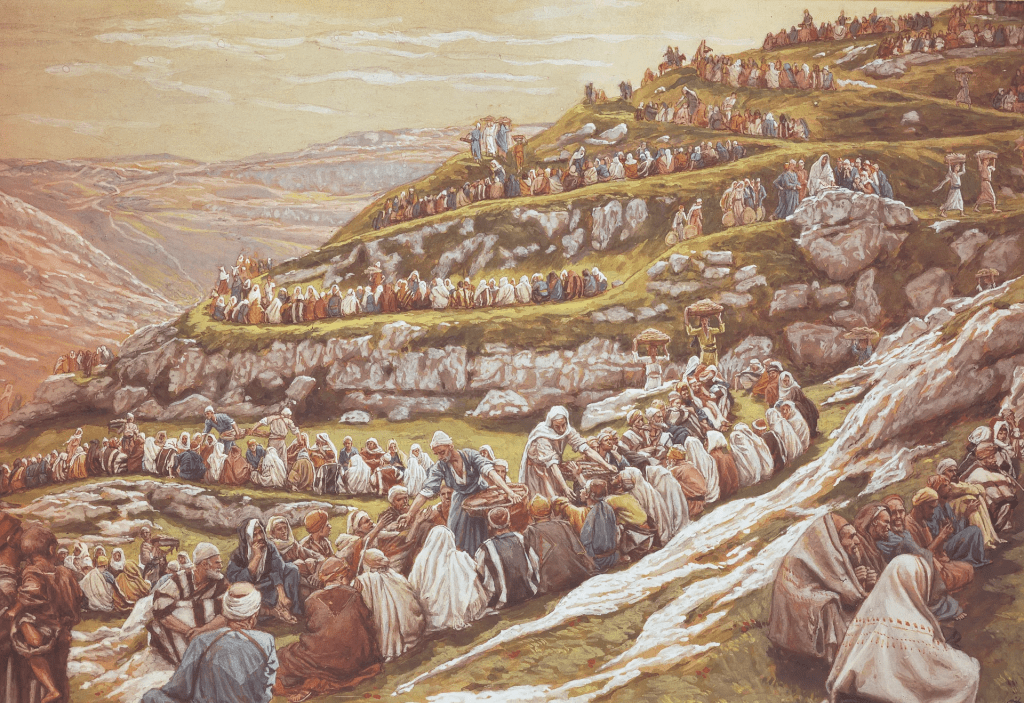
The Miracle of the Loaves and Fishes, by James Tissot, 1886

After this Jesus went to the other side of the Sea of Galilee, also called the Sea of Tiberias. A large crowd kept following him because they saw the signs that he was doing for the sick. Jesus went up the mountain and sat down there with his disciples. 

Now the Passover, the festival of the Jews, was near. When he looked up and saw a large crowd coming toward him, Jesus said to Philip, “Where are we to buy bread for these people to eat?” He said this to test him, for he himself knew what he was going to do. 

Philip answered him, “Two hundred denarii would not buy enough bread for each of them to get a little.” One of his disciples, Andrew, Simon Peter’s brother, said to him, “There is a boy here who has five barley loaves and two fish. But what are they among so many people?” 

Jesus said, “Make the people sit down.” Now there was a great deal of grass in the place, so they sat down, about five thousand in all. Then Jesus took the loaves, and when he had given thanks he distributed them to those who were seated; so also the fish, as much as they wanted. 

When they were satisfied, he told his disciples, “Gather up the fragments left over, so that nothing may be lost.” So they gathered them up, and from the fragments of the five barley loaves, left by those who had eaten, they filled twelve baskets. When the people saw the sign that he had done, they began to say, “This is indeed the prophet who is to come into the world.”

When Jesus realized that they were about to come and take him by force to make him king, he withdrew again to the mountain by himself.

When evening came, his disciples went down to the sea, got into a boat, and started across the sea to Capernaum. It was now dark, and Jesus had not yet come to them. The sea became rough because a strong wind was blowing. When they had rowed about three or four miles, they saw Jesus walking on the sea and coming near the boat, and they were terrified. But he said to them, “It is I; do not be afraid.” Then they wanted to take him into the boat, and immediately the boat reached the land toward which they were going. (New Revised Standard Version)

Christ Walking on the Waters, by Julius Sergius Von Klever, c.1880

The Deliverers Moses and Jesus

The Apostle John intended us to see the link between Moses and Jesus. God used Moses to bring deliverance of the people from slavery through a miracle at the Red Sea. The Lord also used him for a divine provision of manna in the wilderness.

And the Lord Jesus brought about a deliverance of the disciples from anxiety through a miracle on the Sea of Galilee. Christ also brought a divine provision of food in the middle of nowhere for thousands of people.

The miraculous displays by Jesus happened at the time of Passover, the very time that Jews celebrate the deliverance from Egypt. Just as divine power was exerted at the time of Moses in the original Passover, so also divine power likewise showed itself with Jesus in the supply of food and control of the sea.

What’s more, today Christians everywhere around the world remember God’s saving events with the elements of bread and cup, recalling divine deliverance and provision, and finding relief from their fears and anxieties.

A Miraculous Provision and Distribution of Food

It’s no coincidence that Jesus is pictured as sitting on a mountain – reminiscent of Moses on a mountain receiving the divine law and wisdom. The gathering of people around Christ was so great (thousands of them) and the need for food equally as great, that Jesus questioned his disciples concerning resources for such a large crowd.

Christ, of course, could have circumvented his disciples and simply provided the needed foodstuffs without them. Yet, he didn’t, on purpose. Always the rabbi and teacher, Jesus intended to give the disciples a lesson they wouldn’t forget.

After ascertaining that the only food available was a boy’s five barley loaves and two dried fish, Jesus knew that this was plenty, in order to feed up to 5,000 people. It was enough, because Jesus is enough. Only a small amount is needed to fill the bellies of thousands.

Sacramental Living, by Charissa Jaeger-Sanders

And, what is more, for those with the faith to see it, a little communion wafer and a small swallow from a cup is more than enough to satisfy and satiate the hungriest of faithful and penitent people.

Not only did the people eat as much as they needed and wanted, but there was also so much remaining food that the twelve disciples collected twelve baskets of bread. They could keep on ministering, providing, and distributing for people because little is much when God is in it. Long after Christ’s death and resurrection, his followers continued to give with the divine largess from Jesus.

Walking on Water

It had been a full day of teaching and miraculous ministry, in the full light for all to see. Christ’s power, however, is also operative at night. The darkness is not able to subdue continued miracles from Jesus.

For the Apostle John’s writings, darkness is almost always a theological statement, denoting that there are dark forces operative on this earth. And those powers definitely did not like Christ’s effective day of ministry.

The actual physical storm symbolized the chaotic and angry response of the sinister elements in the world. But despite the terrible conditions, Jesus calmly walked on the sea as the new Moses who takes charge of the water.

The disciples abject fear turned on a dime into exuberant joy, as they realized it was indeed Jesus who entered the boat. In addition, they experienced an immediate place of safe harbor.

Christ was standing in the divine tradition of bringing people from stormy circumstances and evil situations to the safe haven of God’s presence.

Jesus saves people from their fears and anxieties, their travails and ills, and their guilt and shame. Christ also provides everything we need, both material and immaterial. And he does it for the life of the world, for everyone who comes by faith.

Gracious Lord, you are the Sustainer of the hungry. Like a mother, you long to feed your children until each is satisfied. Turn our eyes to you alone, so that, aware of our own deepest longings, we will reach out with Christ to feed others with the miracle of your love. Amen.

Jesus Stills the Storm (Mark 4:35-41)

Calming the Storm #1, by Tigran Ghulyan

On that day, when evening had come, he said to them, “Let us go across to the other side.” And leaving the crowd behind, they took him with them in the boat, just as he was. Other boats were with him. 

A great windstorm arose, and the waves beat into the boat, so that the boat was already being swamped. But he was in the stern, asleep on the cushion, and they woke him up and said to him, “Teacher, do you not care that we are perishing?” 

And waking up, he rebuked the wind and said to the sea, “Be silent! Be still!” Then the wind ceased, and there was a dead calm. He said to them, “Why are you afraid? Have you still no faith?” And they were filled with great fear and said to one another, “Who then is this, that even the wind and the sea obey him?” (New Revised Standard Version)

Jesus taught the people all day beside the sea. So many of them crowded around that he ended up getting into a boat and speaking from the water to the folks on land. It was an eventful day of telling memorable parables.

Then, evening came. Jesus told his disciples they were crossing over to the other side of the Sea of Galilee. In doing this, they were also crossing boundaries from Jewish to Gentile territory.

Christ’s disciples had not yet gotten used to Jesus crossing over to places they’ve never been to before. For them, it might as well be an ancient version of Star Trek, going boldly where no Jew had gone before. Following Jesus was like a science fiction trip into the unknown in which they had already seen things beyond their imagination.

Although Jesus respected people’s personal boundaries, he continually crossed both social and spiritual boundaries galore. Christ ate with the wrong kind of people; broke Sabbath laws and healed people at the wrong time; and was leading his motley band of disciples to the wrong sort of place.

Jesus kept going to where the religious establishment had firm boundaries not to cross. Hanging out with Christ meant taking risks at unpredictable times in unknown places.

The disciples were not quite ready for crossing a weather boundary, and they were understandably scared. Although they evidenced a certain lack of faith, conversely, it took some faith to even listen to Jesus and do what he told them to do and get in a boat to cross the sea.

There’s really nothing safe about being a follower of Jesus Christ, at least from a human existential perspective. Jesus put his disciples in all sorts of different situations that were downright dangerous. So, I’m not sure why any Christian would be surprised whenever they face trouble and danger in their lives; it’s part of following Jesus.

Christ Asleep During the Tempest, by Eugene Delacroix, 1853

A big windstorm popped up as the ship crossed the sea at night. A lot of people I know get scared and anxious when a thunderstorm hits; and they’re in a safe place within their own house. So, to be in a wooden ship with old school sails and oars at night, and a storm strikes, we can see that panic quickly set into the disciples. They, of course, cried out in their fear and distress.

But where is Jesus? Lo and behold, it turns out he was asleep, down in the hold of the ship, without a worry in the world. That struck the disciples the wrong way (much like talking to the wrong people and going to the wrong places and doing the wrong things). They interpreted this event of a peaceful sleeping Christ as calloused and insensitive to their collective plight.

How many times have we thought the same thing, and uttered along with the disciples, “Don’t you care that we are perishing!?” O you of little hermeneutic.

The truth is, those who wish to save their life will lose it – it will perish, be destroyed. But those who lose their life and let it perish for Christ’s sake, and for the sake of the gospel, will save it.

Yes, the dangers of death and destruction are very real; but taking up our cross and following Jesus turns out to be the safest option we have. It’s the deliberate choice of walking by faith, not sight.

Jesus, awakened by his disciples, proceeded to rebuke the wind and told the sea to settle down. That’s the same sort of language Jesus used when doing an exorcism.

Just as crowds marveled that the demonic realm obeyed Jesus when he healed persons of bad spirits, so Christ’s disciples were amazed at the authority which calmed a wild storm. Yet, no matter the situation or the reality, Jesus can and does bring orderly calm from disruptive chaos.

The eerie resemblance to exorcism in calming the storm let’s us know that Christ has power and authority over all evil in this world. Therefore, the teaching and ministry of Jesus is authoritative. Christ rules with a great power of benevolence and mercy over everything.

This understanding of Christ’s power and authority is the believer’s basis for faith and not fear. The lack of courage points to the lack of faith. To be both a coward and a Christian is incompatible and nonsensical.

We all become afraid, at times, because of various things. And some of that fear is warranted; it’s part of being human. Cowardice, however, is a different thing. Both the courageous and cowardly are fearful – the difference is that the former acts despite the fear, and the latter does not act because of the fear.

What matters is what the person of faith does in the face of a fearful situation, and not because they are afraid. There is no sin in the actual emotion of fear; it’s what we do with being afraid that makes the difference.

Following Jesus is no guarantee of a fear-free or a storm-free life. We may, especially in times of high stress, find ourselves blurting out to Jesus to wake up and help us because we feel he isn’t paying attention or doesn’t care.

The reality is that the power and authority of Jesus is needed most in fearful places. So, the Christian (and especially Christ’s Church) better get used to having courageous encounters and conversations with others.

Wherever there is pain, suffering, and neediness, that’s where the words and touch of Jesus are found. So then, if we are looking for Jesus, we ought to know where to find him.

Christianity is a religion which will send us where we’ve never been before – both externally and internally – into the violent storms. Entering the fray takes faith. And feeling afraid is expected. But this is where real needs are met, as well as the place of genuine spiritual development.

No matter what or who we face, we have the confidence that Jesus is with us. And even if he is sleeping during a storm, we are in a good place of peace.

Almighty and everlasting God, preserve us from faithless fears and worldly anxieties, and grant that no clouds of this mortal life may hide from us the light of that love which is immortal, and which you have manifested to us in your Son, Jesus Christ our Lord. Amen.