1 Corinthians 9:1-16 – Showing Tolerance

Tolerance, statue by Spanish artist Jaume Plensa

Am I not free? Am I not an apostle? Have I not seen Jesus our Lord? Are you not the result of my work in the Lord? Even though I may not be an apostle to others, surely, I am to you! For you are the seal of my apostleship in the Lord.

This is my defense to those who sit in judgment on me. Don’t we have the right to food and drink? Don’t we have the right to take a believing wife along with us, as do the other apostles and the Lord’s brothers and Cephas? Or is it only I and Barnabas who lack the right to not work for a living?

Who serves as a soldier at his own expense? Who plants a vineyard and does not eat its grapes? Who tends a flock and does not drink the milk? Do I say this merely on human authority? Doesn’t the Law say the same thing? For it is written in the Law of Moses: “Do not muzzle an ox while it is treading out the grain.” Is it about oxen that God is concerned? Surely, he says this for us, doesn’t he? Yes, this was written for us, because whoever plows and threshes should be able to do so in the hope of sharing in the harvest. If we have sown spiritual seed among you, is it too much if we reap a material harvest from you? If others have this right of support from you, shouldn’t we have it even more?

But we did not use this right. On the contrary, we put up with anything rather than hinder the gospel of Christ.

Don’t you know that those who serve in the temple get their food from the temple, and that those who serve at the altar share in what is offered on the altar? In the same way, the Lord has commanded that those who preach the gospel should receive their living from the gospel.

But I have not used any of these rights. And I am not writing this in the hope that you will do such things for me, for I would rather die than allow anyone to deprive me of this boast. For when I preach the gospel, I cannot boast, since I am compelled to preach. Woe to me if I do not preach the gospel! (NIV)

A person who cannot tolerate small misfortunes can never accomplish great things.

Chinese Proverb

There is a reason for tolerance. You and I employ it in all kinds of ways and contexts so that we might achieve an important purpose.

Parents of newborn babies put up with a lot from the little one. As a father myself, who has raised three daughters with my wife, I can testify that over the course of many years I have been puked-on, peed-on, poked in the eye, and kicked in places I would rather not discuss. I have patiently helped with homework, taken time out to play with dolls, and stayed up late waiting for teenagers to come home. None of those things ever showed-up on my bucket list.  So, why did I do them?

Yes, you already know that was a rhetorical question with a decisive answer. It is because I love my girls. I would do anything for them. I was committed to doing whatever it took to raise virtuous, fun-loving, well-adjusted, God-seeking, responsible persons. I was willing to put up with a lot to see that happen.

The Apostle Paul was passionate and committed about reaching lost people and raising them in the Christian faith.  He was willing to put up with a lot to see that purpose come to fruition. Paul was determined not to put any obstacle in the way of gospel proclamation.

Paul was motivated by seeing the good news of Jesus Christ take root in people. He did all that he could to communicate the message. Paul had a committed personal conviction to not let his personal rights stand in the way of what was most important.

“Toleration is the greatest gift of the mind; it requires the same effort of the brain that it takes to balance oneself on a bicycle.”

helen keller

Mature faith in Christ patiently, lovingly, and deliberately helps others know Jesus Christ better. Mature people will put up with a lot to raise godly disciples. They refuse to let themselves or anything else stand in the way of a young Christian’s spiritual growth. They willingly set aside personal agendas and even rights and needs to see them grow up in faith. They protect and serve, teach, and nurture, all while enduring all kinds of unpleasant stuff.

Tolerance for tolerance sake means nothing. But tolerance purposely used to spiritually form others in Jesus Christ is part of being a devoted follower of God.

Patient God, you know all about enduring humanity’s failings, immaturity, weaknesses, and sins.  Yet, you put up with a lot to see us born again, grow in faith, and become productive Christians.  Enable me to persevere for the grand purpose of seeing others come to discover you, know Christ, and experience the power of the Holy Spirit.  Amen.

Jeremiah 20:14-18 – Overwhelmed with Grief

By Unknown artist

Cursed be the day I was born!
    May the day my mother bore me not be blessed!
Cursed be the man who brought my father the news,
    who made him very glad, saying,
    “A child is born to you—a son!”
May that man be like the towns
    the Lord overthrew without pity.
May he hear wailing in the morning,
    a battle cry at noon.
For he did not kill me in the womb,
    with my mother as my grave,
    her womb enlarged forever.
Why did I ever come out of the womb
    to see trouble and sorrow
    and to end my days in shame? (NIV)

Perhaps you feel as though you must put on a good face, a decent front for others to see. You don’t like other people seeing you upset or cry because it can be embarrassing. Maybe you believe others don’t need to be burdened with your sadness. The last thing you want is to be a killjoy.

Sometimes you might even put up a front with God.  Maybe you think God wants everyone to be perpetually happy and always sing with the birds in blissful joy and gladness, or whistle while you work. However, that would not be an accurate view of God.

One of the most faithful people in Holy Scripture, Jeremiah, freely and unabashedly lamented before God – to the point of wishing he were dead. Jeremiah, the incredible prophet of God, closer to the Lord than anyone of his generation, was so despondent and ashamed that he wished he were never even born. The suffering and the shame were just too overwhelming.

To say that Jeremiah had a difficult ministry is a gross understatement. He literally had the ministry from hell, prophesying to people who neither liked him, nor his message to them. In the middle of it all, Jeremiah threw up his hands and let out his complaint to God. Jeremiah was in such ministerial misery that he wished he had been a stillborn baby.

Lest you think Jeremiah was sinfully depressed or just cuckoo, he is far from alone in the Bible. King David had no scruples about letting God know how he felt about his dire circumstances. Job, likely the most famous sufferer of all, spent time doing nothing but lamenting his terrible losses for months. What all three of them have in common is that they openly grieved with great tears, yet neither cursed God nor forsook the Lord.

Lamentation is the sacred space between intense grieving to God without blaming the Lord for our significant changes and losses in life. I would even argue that lamenting and grieving before God is a necessary spiritual practice which needs full recognition in the Body of Christ. Please sit with that last statement for a bit and consider how it might become a reality in your own life and context.

Grief can and does attach itself to any change or loss. It is the normal emotional, spiritual, physical, and relational reaction to that injury of the heart. There is only one way through grief. We must tell our story to another. It is both biblical and quite necessary.

Share each other’s burdens, and in this way obey the law of Christ.”

galatians 6:2, NLT

We need our spirituality to support us in such times – not drive us away through a misguided theology of believing you must keep a stiff upper lip. It is critical to have safe and supportive people in our lives when going through overwhelming circumstances.

“Spirituality is recognizing and celebrating that we are all inextricably connected to each other by a power greater than all of us, and that our connection to that power and to one another is grounded in love and compassion.”

Brené Brown

Our tears are holy. They are not the mark of weakness, but of power. The prophet Jeremiah was doing a very godly thing in expressing his grief. And Jeremiah’s lament is what helped steel him for the several attempts on his life that he faced.

Let the tears do their intended work in your life.

God of all, you feel deeply about a great many things.  As your people, we also feel a great depth of emotion when our lives go horribly awry from our dreams and expectations.  Hear our lament as we pour out our grief before you, through Jesus, our Savior, with the presence of the Holy Spirit.  Amen.

The Compassion of Jesus

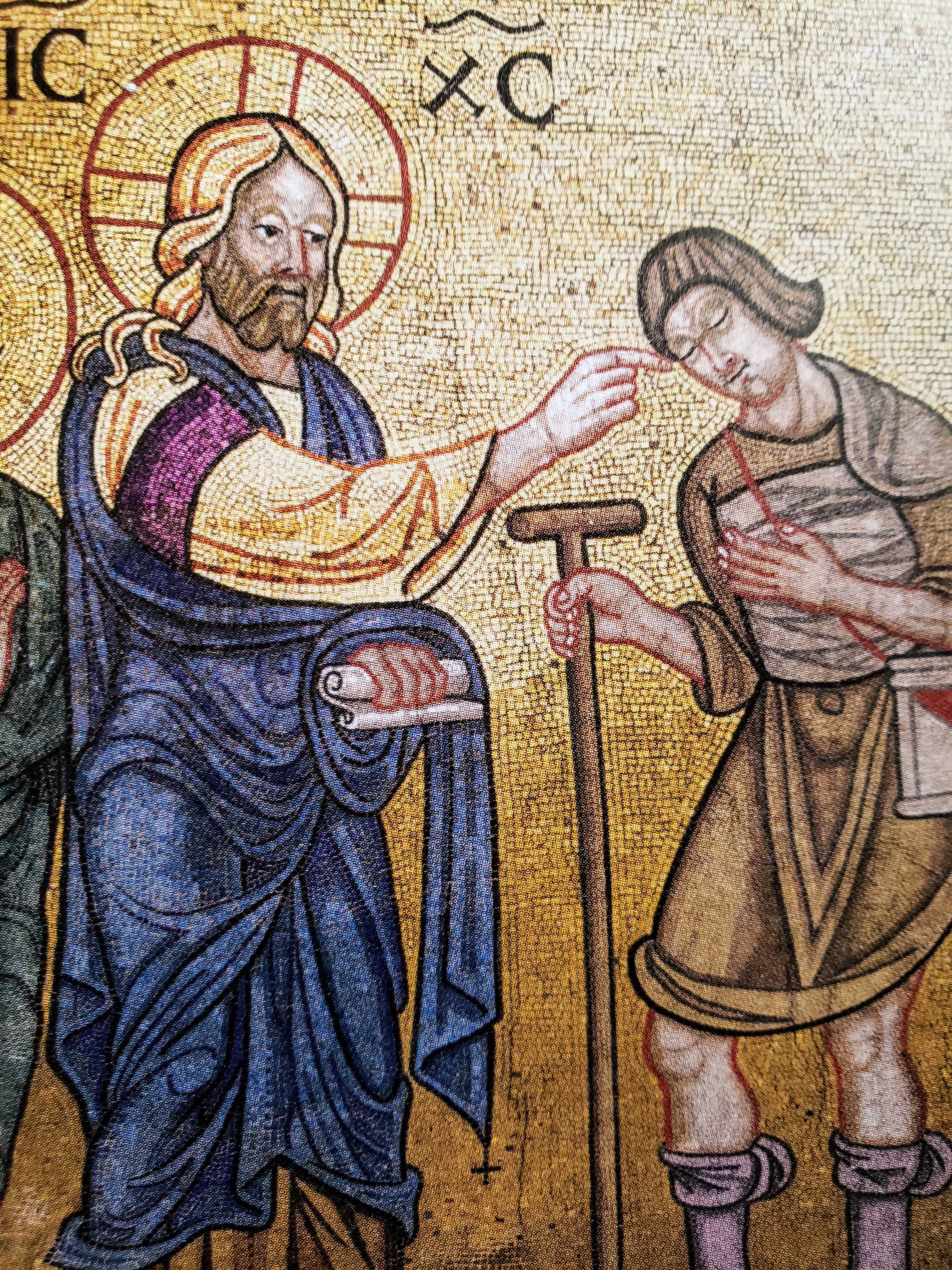
Jesus healing - 13th century
Jesus and his ministry of healing, from a 13th century church mosaic.

Compassion is a concern for the well-being of others. It is the basis for altruism and the most virtuous motive one can possess. Compassion is activated within the human heart when witnessing another person’s suffering. Compassion spurs us to help. It is through compassion that people feel seen and known. Compassion brings care, empathy, and sympathy together as a bridge to connect with another person or group of people in need. Without compassion, there is no life.

While on this earth, I believe Jesus was the very embodiment of compassion. To reflect on Christ’s compassion helps us to raise our own compassion quotient and avoid succumbing to the whims of indifference to human need.

When Jesus saw the crowds, he had compassion on them, because they were harassed and helpless, like sheep without a shepherd. (Matthew 9:36)

The compassion of Jesus responds to human need. In his earthly ministry of preaching, teaching, and healing, Jesus went through all the towns and villages. He neither waited for people to come to him nor wanted anyone to fall through the cracks. During this work, Jesus was moved by the depth of people’s needs. The word for “compassion” in the Bible means “to be moved in the pit of your gut.” It is to be filled with pity and heart-broken over the unmet needs of people.

What moves and stirs compassion deep down in your gut? Jesus went about the towns and was brokenhearted over people who were harassed and helpless, locked into patterns of life that were harmful and damaging.  Jesus came to this earth to seek and save people, offering forgiveness of sins and a new life. Jesus willingly offered compassion – his motivation was neither from duty nor guilt. Compassion is the proper motivation for all things.

Jesus went out and ministered, then was moved by what he saw.  Compassion comes upon us as we go out and enter people’s lives, seeing first-hand the depth of need represented.  Show me a person with compassion, and I will show you a person who takes the time and effort to know another.

“Pray earnestly to the Lord of the harvest to send out laborers into his harvest,” implored Jesus. (Matthew 9:38)

The compassion of Jesus issues in a call to pray. Christ saw the masses of people and told his disciples to ask God to send workers because the harvest is plentiful.  Jesus knows there are large numbers of people waiting to hear the good news of the kingdom of God. So, he said to pray earnestly and compassionately.

Compassion is the motive which brings us to prayer. Compassion impels us to pray that workers be sent to people who are ripe for hearing good news. We must not listen to the hellish lie: That certain people don’t really want the good news of the kingdom of God; that my neighbor, or co-worker, or family member is not spiritual and doesn’t care about forgiveness of sins, or grace – that there is nothing within them to respond to compassion. The devil does not want us to have merciful compassion for them, to be moved to intercede for them in prayer, nor to become a harvester in the field of people.  Jesus said the harvest is plentiful, and it is through compassionate prayer that the work will be done.

Jesus called his twelve followers together and gave them authority to drive out evil spirits and to heal every kind of disease and sickness. (Matthew 10:1)

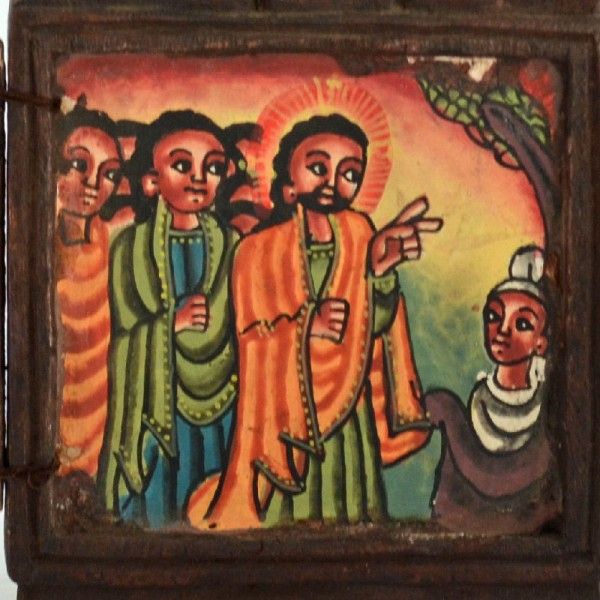
Ethiopian Jesus the Healer
Ethiopian Orthodox depiction of Jesus the Healer

The compassion of Jesus caused him to send out his disciples. The call to prayer is central; it is also not everything. As faith without works is dead, so prayer without mission is empty. The people Jesus authorized for ministry were the twelve, and they were a motley crew, indeed!  For example, having Matthew the tax collector and Simon the Zealot on the same team together would be like sending Joe Biden and Donald Trump as a pair out for ministry. Yet, the compassion of Jesus changes lives and brings people together from diverse backgrounds and viewpoints.

The disciples were told, in their initial mission as followers of Jesus, to go only to the house of Israel – Israel’s house needed to be put in order first before they could ever think of going to Gentiles. There were Jews all around them, and Jesus goes after them first.  Remember Christ’s final instructions: You will be my witnesses first in Jerusalem, then Judea, and Samaria, and the rest of the world (Acts 1:8). We begin by reaching out to people in our own backyard.

Jesus told the disciples to do exactly what he had been doing: preaching and healing, proclaiming the message that “the kingdom of God is near.”  The kingdom is not only something in the future; the kingdom of God has already broken into the present time, and the evidence of it is the transformation of people’s lives now. The blessings and promises of kingdom life are presently available.

Jesus sent the disciples out and told them not to take anything with them.  They were to leave all their baggage behind. The disciples were to be stripped of everything so that they had the ability to see people and their needs and be moved with compassion as Jesus was. The kingdom of God was near to them, so they did not need to add anything for the mission (Matthew 10:1-15). Jesus did not want his disciples assuming they already knew what people needed. Instead, they must be present to people and discover their needs without bias. As compassion is freely received, it is to be freely given.

Compassion is the appropriate response to human need.  Yet, we do not always react with compassion. The following are a few approaches which prevent us from becoming compassionate, and some ways of cultivating a compassionate life:

  1. A defeating and discouraging environment. Contempt breeds contempt. Anger produces more anger. Hatred feeds hatred. Abuse drives out compassion. The environment around us makes a difference. If we find we must check our hearts at the door and avoid compassion to just make it, then we need a change of environment. Life is too short and the world too compassion-starved to maintain a situation that drags us down and hinders the kingdom of God within us.
  2. An unhealthy pace of life. A person cannot have a compassionate heart if they are running too fast to see other people’s needs. When spare moments are used to try and figure out how to keep all the balls in the air and all the plates spinning, there is no way to dole out compassion to others. Slow down. No one comes to the end of life and wishes they had logged more hours of work at their job. Develop a plan on how to slow down enough to tune into the needs of others and have emotional energy for them.
  3. Excessive caregiving. Compassion fatigue is a real thing. Resentment can build toward the very people we care for because of constant giving without receiving. When the emotional gas tank is empty, it is possible to become cold-hearted. Yet, some keep going anyway – and ruin their engine. Caring for others must be meticulously balanced with caring for self. There is a time for everything, including rest and recuperation.  Jesus regularly practiced the disciplines of solitude and silence. If he needed those restorative practices, so do we.
  4. Objectifying people. Whenever we put adjectives in front of people, it is a clue that compassion is lacking. Referring to “those” people; “lesbian” neighbors; “black” folks at work; my “obnoxious” relative; or, the “poor” family down the street; are all examples of objectifying people and putting them at a distance from ourselves. Your neighbors are your neighbors, your family is your family, and the people in your life are just people, period. Compassion arises as we look for what is common among us, not different. Compassion brings solidarity with others, not separation and division.

May you allow God the time to form a compassionate heart within through being with Jesus. May compassion toward others be the defining characteristic of your life.

Tractor Time with Pastor Tim

Steel Mule tractor

A tractor is an engineering vehicle specifically designed to deliver at a high tractive effort (torque) at slow speeds for the purposes of hauling mechanized implements used in agriculture.  The word “tractor” comes from a Latin word, trahere, which means “to pull.”  Tractors, like people, come in all sizes, shapes, and colors – exuding both resilience and strength in their existence.

The Bates Steel Mule tractor was one of the most unique and oddest-looking farm machines ever built.  First built in 1913, it was like a cross between a steam boiler, a garden tractor and a Harley-Davidson motorcycle.  Bates Machine Company had the following advertisement for their Steel Mule tractor: “The only machine in the world which you can hitch up to any horse-drawn implement you now have and operate it from the same position you would your horses.”  In other words, you could operate the tractor by sitting in the implement seat, not the tractor seat.  The Steel Mule survived until they became one of the many victims of the Great Depression in 1937.

My grandfather (whom I never knew – he died when I was a year old) owned and operated a Steel Mule tractor (not the particular model shown above).  There was once a picture of him in the local paper using his tractor (I have it packed away somewhere and am still looking for it).  Grandpa was known for being the guy who would try new things and buy unique machinery – all in the quest for better farming methods.

The Steel Mule seems to represent my current state of ministry.  Like Grandpa, I have a drive and a desire for improving my pastoral craft.  I am open to trying new things and entering into a new way of being with the hospital patients I serve as a chaplain, as well as my peers, other staff, and really everyone I encounter throughout a day.  Yet, at the same time, I stubbornly hold to the past – sitting on the implement and not quite ready to fully embrace the new era of machinery instead of horses.  Which brings me to the whole point of this circuitous rambling of Tim’s Tractor Time:  What holds me back?  And, in so asking this question of myself, I also as it of you: What holds you back?

Yes, what does hold you and I back from taking the initiative to be vulnerable and open with our lives, instead of fearful, anxious, and hesitant?  What holds us back from collaborating with others?  Consulting before acting?  Consulting after acting?  Divulging our emotions and not just our thoughts? Speaking without always measuring and analyzing each word before we say it (or write it)?  As a seasoned minister, I can plow deep furrows with my Steel Mule into others’ lives – so, why not let others do the same in my field?  What is it I’m really pulling in that field?

Perhaps it is fear.  When Charlie Brown came to Lucy for a bit of practical psychosocial help, Lucy spouted a litany of various fears which she wondered Charlie Brown might possess.  Finally, she expressed that maybe he has “pantophobia.”  “What is ‘pantophobia’?” Charlie Brown asks.  Lucy responds, “The fear of everything.”  To which Charlie Brown demonstratively pronounces, “That’s it!”

A-Charlie-Brown-Christmas-image

Could be.  Could also be anger.  After all, anger often lurks in the shadows our hearts with a combination of it getting expressed in an unhealthy way or becoming twisted into depression.  There’s plenty of anger under the surface of the topsoil ready to get turned over and exposed.  Too much of it turned inward.  Certainly, it needs some plowing and cultivating, that is, processing outwardly with others… maybe… if we’re brave enough.

Then there’s this thing called liminal space – the space in-between where we can’t go back to the way things were ever again, yet, we aren’t quite where we want/need to be. It’s awkward being caught in the nexus between the past and the future.  Does this hold us back?  Or maybe it’s the fear of imperfection, of not doing something with utmost excellence?  Are we apprehensive about opening up because we don’t understand ourselves fully, so, therefore, I won’t (like a stubborn old Steel Mule) utter half-baked ideas or fragments of thoughts or, God forbid, emotional musings?  Like the Steel Mule, perhaps we are crossing over into a new era with the past very much there with it.

So, perhaps the greater question is: What are you and I really feeling, in this moment?  Figures it would take me all this thinking type verbiage to get to the emotional universe of feelings.  If we’re honest, we all are a diverse jumble of emotions – presently feeling overwhelmed; sad; happy; angry; hopeful; confident; scared; hungry; tired….  Oh, well, let’s just say we’re feeling everything.

Like the interlocutor in the book of Ecclesiastes, the conclusion of the matter is this: “Fear God and keep his commandments; for that is whole duty of everyone.” (Ecclesiastes 12:13).  I hold back because of me.  You are hesitant because of you.  Nobody is twisting my arm.  That old enemy of our souls, the Adversary, would like nothing more than to keep us feeling weak and insecure so that he can keep us under his evil thumb.

No one is forcing you to use the Steel Mule tractor.  Quite the opposite.  In truth, there is nothing holding us back.  Nothing is stopping us from pulling our emotions out and discovering new ways to express them with confidence in healthy redemptive ways.  Nothing outside of our power to act is preventing us from the courage to do what we already know deep in our hearts we need to do…. Nothing.  So, then, I’ll look for you in the next tractor advertisement doing your unique, wonderful, and amazing work which comes from the depths of your love for God and others.