Luke 9:18-27 – Jesus Makes All the Difference

Christ the Redeemer, Rio De Janeiro, Brazil

Once when Jesus was praying in private and his disciples were with him, he asked them, “Who do the crowds say I am?”

They replied, “Some say John the Baptist; others say Elijah; and still others, that one of the prophets of long ago has come back to life.”

“But what about you?” he asked. “Who do you say I am?”

Peter answered, “God’s Messiah.”

Jesus strictly warned them not to tell this to anyone. And he said, “The Son of Man must suffer many things and be rejected by the elders, the chief priests and the teachers of the law, and he must be killed and on the third day be raised to life.”

Then he said to them all: “Whoever wants to be my disciple must deny themselves and take up their cross daily and follow me. For whoever wants to save their life will lose it, but whoever loses their life for me will save it. What good is it for someone to gain the whole world, and yet lose or forfeit their very self? Whoever is ashamed of me and my words, the Son of Man will be ashamed of them when he comes in his glory and in the glory of the Father and of the holy angels.

“Truly I tell you, some who are standing here will not taste death before they see the kingdom of God.” (New International Version)

In my work as both a church pastor and hospital chaplain, not to mention just being a regular guy, I rarely encounter people who characterize Christians as setting self-interest aside to follow Jesus completely with humble ministry which is willing to suffer on behalf of others.

Instead, I daily interact with folks who have long left the Church with stories of Christians squelching genuine questions about God and faith; being judgmental toward others who are not like them; having a hypocritical double-standard approach to most issues; and verbally abusing individuals who don’t conform to their cultural ideas and biblical interpretations.

We need Christians who make a difference in this world. We need Jesus.   

A right and real confession of Jesus by his Church speaks a relevant word into the culture; proclaims the gospel of grace (not judgment); and consistently and lives what it believes.

Confessing Jesus as Lord makes all the difference.

After interacting with a lot of people on their ministry journeys, Jesus asked two questions of his disciples: “Who do people say I am?” and “Who do you say I am?” Out of all the questions we can ask people, these are two good ones: “Who do others say Jesus is?” and “Who do you say Jesus is?”  

The disciples gave a variety of answers, which is to be expected. Today, you will also get variegated answers, such as, Jesus is a good teacher, a model humanitarian, a myth or a legend. A few times I’ve been told that Jesus was an alien from another planet. My all-time personal favorite response is that Jesus was a nudist and that if we all just took off our clothes, there would be peace in the world.

Although the disciples are sometimes clueless, Peter as the spokesperson, gave an insightful answer: “You are God’s Messiah.” 

Messiah or Christ literally means, “The Answer.”  Peter confessed Jesus as being The Answer, the person for whom it all comes down to. Peter may not have fully understood what he was saying, but he said it, nevertheless.

Being called by God makes all the difference.

“The Answer” was revealed to Peter by the heavenly Father. Faith in Jesus Christ is a gift given to us by God.

“My Father has entrusted everything to me. No one truly knows the Son except the Father, and no one truly knows the Father except the Son and those to whom the Son chooses to reveal him.” (Matthew 11:27, NLT)

Peter was blessed – not because he did anything to deserve it – but because of sheer grace. It was revealed to Peter who Jesus really is, The Answer. We know who God is and who Jesus is by revelation, by God’s gracious self-revealing to people. Scripture is God’s revelation, a self-disclosure. It is through Scripture that we know. 

Revelation isn’t just a matter of waiting for some spiritual zap to occur, in which God bonks me in the brain and deposits the knowledge and understanding of who Jesus is. 

Peter put himself in a position to know by obeying the voice of Jesus to follow him. Then, Peter got to know Jesus over time.

Since it took years of being with Jesus for Peter and the other disciples to make a right confession of faith, then we need to have a great deal of patience for others, as well as ourselves. Others need time to get to know us, they need some time in the Scriptures, and they need some time with Jesus, too.

People do not typically come to a right confession of Jesus without having spent a good deal of time around us and within Holy Scripture.

Denying self, taking up our cross, and following Jesus makes all the difference.

God chooses to use you and me. The Lord only knows why. We are most certainly an imperfect people. Yet, it seems that our imperfections are the very thing God keeps using to reveal Jesus to others. Another way to put the matter is this: Genuine openness and vulnerability is needed, and not perfection or keeping up a tidy appearance.

Most people aren’t crazy about the word “vulnerable.”  We might expect openness in others yet have no intention of being vulnerable ourselves. If you have ever poured out your heart to someone or a group of people and only got blank stares in return; sincerely loved someone and they did not love you back; shared your genuine thoughts on something important to you and received only criticism; well then, we may believe vulnerability is a bad thing and not worth the emotional effort.

However, Jesus became vulnerable – descending from heaven, submitting to the machinations of evil persons, and exposed on a cruel cross. (Philippians 2:5-11)

In the Gospel of John, Mary displayed vulnerability in pouring expensive perfume on Jesus’ feet and wiping them with her hair, all the while exposing her true feelings for her Lord. In return, Mary got pushback and criticism from Judas. But Jesus upheld Mary’s actions and told Judas to leave her alone. (John 12:1-8).

In the Psalms, even a cursory reading reveals a boatload of vulnerability on the part of the psalmists. They were unafraid to explore the depth of human emotion, misery, joy, and praise of God.

Maybe we need the person who will stand up and say they are finally learning patience by being among a group of really annoying co-workers. Perhaps instead of laboring so hard to keep our thoughts and emotions in check, we need a church environment that lends itself to a person bawling their eyes out, while others just sit and cry with them.

That kind of vulnerability won’t happen unless we ourselves are real with God, who is never fooled by our deceitful hearts. Our evil-radar might be carefully attuned to others’ sin, but we are woefully inept at identifying the blackness within ourselves.

Jesus became completely exposed, naked, abandoned, alone and vulnerable on a cruel cross. Yet, instead of being shamed by the whole thing, Jesus scorned the shaming power of his crucifixion and embraced the suffering as the means of victory for our salvation. 

Vulnerability might seem ugly, but it turns whatever it touches into beauty. God can change our weakest, worst, and most shameful places into incredible strength and newfound love.

The broken and despised, the struggling and the lost, are the ones worthy of God’s kingdom. 

Whenever we are too afraid to walk into the mud of people’s lives, including our own, and are enamored instead with every spiritual shiny thing that comes along, we may have lost sight of our Lord, whom we are to imitate in his vulnerability. 

Christians don’t  have all the answers. But we do know the One who knows all things.

Methinks people will be drawn to Jesus when they observe Christians forsaking the path of the self-righteous prick, in favor of the humble servant who loses their life, only to find it.


Micah 5:2-5a – He Will Be Our Peace

“But you, Bethlehem Ephrathah,
    though you are small among the clans of Judah,
out of you will come for me
    one who will be ruler over Israel,
whose origins are from of old,
    from ancient times.”

Therefore, Israel will be abandoned
    until the time when she who is in labor bears a son,
and the rest of his brothers return
    to join the Israelites.

He will stand and shepherd his flock
    in the strength of the Lord,
    in the majesty of the name of the Lord his God.
And they will live securely, for then his greatness
    will reach to the ends of the earth.

 And he will be our peace. (New International Version)

An Awful Situation

In the prophet Micah’s day, there was no “peace on earth, goodwill to all.” After the reign of King Solomon, Israel was divided between north and south. Samaria was the capital of the northern kingdom of Israel. Jerusalem was the capital of the southern kingdom of Judah. 

In the eighth-century B.C.E. the Assyrian Empire conquered the northern kingdom of Israel. They deported many of the Israelites and re-populated the cities with their own people.  This is why the Jews in Christ’s day looked down on Samaritans. They pejoratively viewed them as “half-breeds,” a mix of Jewish and Assyrian descent.

The Assyrian takeover of Israel not only left the northern kingdom in shambles; it had a huge impact on the southern kingdom of Judah. Even though Judah had not been conquered, they were still forced to pay tribute to the Assyrians. 

The problem was exacerbated with the leadership of Judah seeking to maintain their power and lifestyle. They did not look to God for help and ignored the needs of the people. Judah’s leaders expected the poor common folk to shoulder the burden of the tribute to the Assyrians. In addition, thousands of refugees from Israel were flooding into Judah and Jerusalem. They had lost their homes, their land, and had nothing but their lives. So, the already scant resources in Judah were pushed to the brink.

Those in authority and power, the ones with resources to make a difference, didn’t. Instead, they took advantage of the situation by buying fields and land at a fraction of its worth because people were just trying to survive. In some cases, the leadership leveraged their power by simply pushing people off their own land and taking it over.

There Is Hope

Into this awful situation, Micah prophesied judgment to the leaders oppressing the people – and hope for the poor and the displaced. Micah said a new kind of leader will come – one with humble origins, like the common oppressed people of Judah. The refugees, the displaced farmers, and the poor will have a champion. He will feed them and shepherd them, leading them to green pastures. This leader will serve the people.

Christians discern Micah’s prophecy as speaking of Jesus – which is why we look at Scriptures like this one during the season of Advent. Just as the ancient Jews needed hope and the promise of a different ruler, so today we, too, need hope and the anticipation of security, peace, and goodwill.

Christ’s leadership and power is different than earthly politicians and officials. Over the centuries, Israel and Judah were so filled with bad kings and self-serving leadership, that Christ’s disciples could barely conceive of anything different. So, Jesus said to them: 

“You know that those who are regarded as rulers of the Gentiles lord it over them, and their high officials exercise authority over them. Not so with you. Instead, whoever wants to become great among you must be your servant, and whoever wants to be first must be slave of all. For even the Son of Man did not come to be served, but to serve, and to give his life as a ransom for many.” (Mark 10:42-45, NIV)

A Shepherd Leader Is Coming  

The people of Micah’s day needed to see beyond their terrible circumstances and to realize hope – better days ahead with food, peace, and protection. We, too, feel the insecurity and the anxiety of living in today’s world. We want leaders to be wise and just toward the vulnerable, the poor, and the displaced. Yet, while we look to elections and politicians for hope, the prophet Micah is jumping up and down, pointing us to a different leader – a shepherd leader.

Micah says the shepherd leader will come from Bethlehem. When Micah gave his message, King David had been dead for nearly three-hundred years. The nation had strayed far from those days when David led the people with God’s covenant love and kindness. Yet, another shepherd leader is coming and will bring restoration, renewal, revival, and hope!

“Bethlehem” is two Hebrew words put together: beth is “house,” and, lechem is “bread.” Bethlehem means “house of bread.” God communicated to the people that the coming shepherd leader will provide food and care for them.

The Bread of Life

Jesus is the Bread of Life. He generously feeds us so that we will offer both physical and spiritual bread to others. Jesus satisfies all our hungers and cravings in this life. We may not wonder where our next meal is coming from, nor struggle with going to bed hungry. Yet, we hunger for security in our world, satisfaction in our daily activities, loved ones to know Jesus, and for peace. Our spiritual stomachs growl, hungering for spiritual food. Many are spiritually starving because they are searching for peace and goodwill in everyplace but Jesus.

“I am the bread of life. Whoever comes to me will never go hungry, and whoever believes in me will never be thirsty…. All those the Father gives me will come to me, and whoever comes to me I will never drive away. For I have come down from heaven not to do my will but to do the will of him who sent me. And this is the will of him who sent me, that I shall lose none of all those he has given me but raise them up at the last day. For my Father’s will is that everyone who looks to the Son and believes in him shall have eternal life, and I will raise them up at the last day.” (John 6:35-40, NIV)

Satisfaction, contentment, and peace have come from the most unlikely sources: Bethlehem and Nazareth. Can anything good come from villages in Judea that don’t even show up on most maps in the ancient world?  Peace, hope, and goodwill can and do come from the least expected places and people. 

Joni Eareckson Tada and Corrie Ten Boom are two women that changed their worlds, despite being ordinary people with weakness. The two of them once met many years ago. Joni remembers the encounter: 

“I relive each moment of my visit with Corrie after she was paralyzed by a stroke. Helpless, and for the most part dependent, I felt our mutual weakness. Yet I am certain neither of us had ever felt stronger. It makes me think of the Cross of Christ–a symbol of weakness and humiliation, yet at the same time, a symbol of victory and strength….  A wheelchair may confine a body that is wasting away. But no wheelchair can confine the soul that is inwardly renewed day by day. For paralyzed people can walk with the Lord. Speechless people can talk with the Almighty. Sightless people can see Jesus. Deaf people can hear the Word of God. And those like Corrie, their minds shadowy and obscure, can have the very mind of Christ.”

The Good Shepherd

Jesus Christ is our peace. He was not born in the halls of power, did not attend the best schools, or make lots of money. Nothing on his earthly resume was remarkable enough for anyone to seek him for any leadership position. And yet, Jesus stands and shepherds the flock in the strength of the Lord, providing everything we need. 

“I am the good shepherd; I know my sheep and my sheep know me—just as the Father knows me and I know the Father—and I lay down my life for the sheep. I have other sheep that are not of this sheep pen. I must bring them also. They too will listen to my voice, and there shall be one flock and one shepherd. The reason my Father loves me is that I lay down my life—only to take it up again.” (John 10:14-17, NIV)

Through Jesus there is peace – financial peace, emotional peace, relational peace, social peace, and spiritual peace. Jesus is the One who brings a full-orbed wholeness and wellness to our lives, no matter the situation. Jesus is the shepherd leader who brings peace amidst any and every situation this world throws at us.

He tends his flock like a shepherd:
    He gathers the lambs in his arms
and carries them close to his heart;
    he gently leads those that have young. (Isaiah 40:11, NIV)

The prophet Ezekiel prophesied in a similar situation as Micah:

For this is what the Sovereign Lord says: “I myself will search for my sheep and look after them. As a shepherd looks after his scattered flock when he is with them, so will I look after my sheep. I will rescue them from all the places where they were scattered…. They will lie down in good grazing land, and there they will feed in a rich pasture on the mountains of Israel. I myself will tend my sheep and have them lie down. I will search for the lost and bring back the strays. I will bind up the injured and strengthen the weak, but the sleek and the strong I will destroy. I will shepherd the flock with justice.” (Ezekiel 34:11-16, NIV)

Conclusion

There is something yet we must do. Jesus said:

“The work of God is this: to believe in the one he has sent…. I am the living bread that came down from heaven. If anyone eats of this bread, he will live forever.  This bread is my flesh, which I will give for the life of the world…. Unless you eat the flesh of the Son of Man and drink his blood, you have no life in you…. Whoever eats my flesh and drinks my blood remains in me, and I in him…. The person who feeds on this bread will live forever.” (John 6:29, 51-59, NIV)

We are to ingest Jesus. We must be filled with him. Jesus comes into the very depths of our lives to nourish us. Jesus is our food and drink, our peace, our shepherd, and our king. Believing in Jesus is not simply a matter of agreeing with him or being his fan. Faith in Christ means to give our lives to him. The greatest Christmas gift we can give this season is the gift of our lives to Jesus Christ, the promised Messiah.

Blessed Lord Jesus, many have strayed far from your flock – taking matters into their own hands and doing things their own way. Many have let their love grow cold and have chosen to feed in pastures that will never satiate their hunger. May they believe that you died on the cross for all the messed up things done, and good things left undone without you.  You rose from death to give them life. Please forgive us all, change our lives, and show us how to know you. Amen.

Acts 5:33-42 – Worthy to Suffer Disgrace

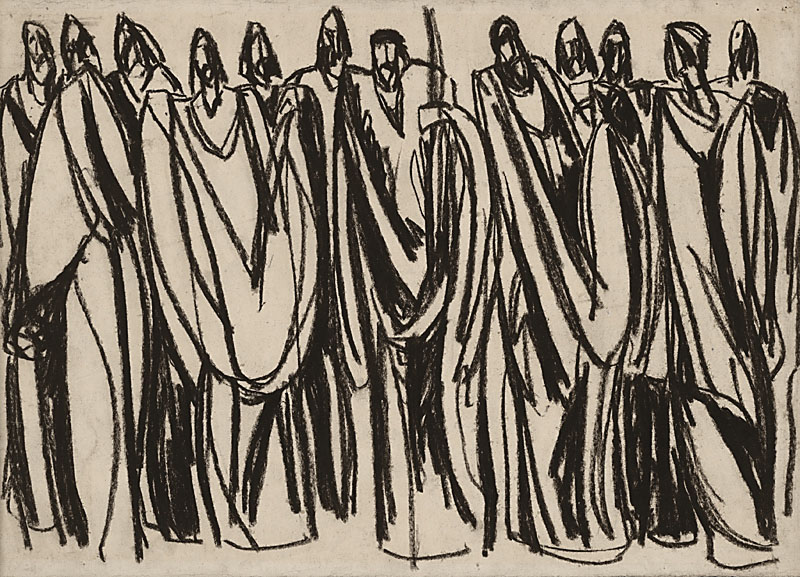
The Apostles by Russian artist Peter Gorban (1923-1995)

When the council members heard this [God raised Jesus from the dead—whom you killed by hanging him on a tree] they became furious and wanted to kill the apostles. One council member, a Pharisee and teacher of the Law named Gamaliel, well-respected by all the people, stood up and ordered that the men be taken outside for a few moments. He said, “Fellow Israelites, consider carefully what you intend to do to these people. Some time ago, Theudas appeared, claiming to be somebody, and some four hundred men joined him. After he was killed, all his followers scattered, and nothing came of that. Afterward, at the time of the census, Judas the Galilean appeared and got some people to follow him in a revolt. He was killed too, and all his followers scattered far and wide. Here is my recommendation in this case: Distance yourselves from these men. Let them go! If their plan or activity is of human origin, it will end in ruin. If it originates with God, you will not be able to stop them. Instead, you would actually find yourselves fighting God!” The council was convinced by his reasoning. After calling the apostles back, they had them beaten. They ordered them not to speak in the name of Jesus, then let them go. The apostles left the council rejoicing because they had been regarded as worthy to suffer disgrace for the sake of the name. Every day they continued to teach and proclaim the good news that Jesus is the Christ, both in the temple and in houses. (CEB)

People talk about things which are important to them. Even quiet and introverted individuals will speak at length, barely taking a breath, if you get them on a topic for which they are passionate about. 

Today’s New Testament lesson has the Apostles speaking incessantly about someone they love to talk about.  In fact, the original disciples of Jesus chattered so much about who they loved, Jesus, that the Jewish ruling council (the Sanhedrin) wanted to shut them up by killing them. But a wise member of the council saw the foolishness of this approach and persuaded the Sanhedrin against it. Instead, the council gave the Apostles a thorough whipping, warned them to stop talking all the time about Jesus, and let them go.

There is a time to listen, and there is a time to speak.  The Apostles could not keep silent.  They considered their beating an act of solidarity with their Lord Jesus and went right on talking. Every day they spent time in the temple and in one home after another. They never stopped teaching and telling the good news that Jesus is the Messiah.

The joy of knowing Jesus – crucified, risen, ascended, and coming again – is such a rich experience that one cannot help but be a chatterbox with joy about him. Even in the face of persecution, the ecstasy of knowing Christ transcends physical pain and suffering.

Today, there are places throughout the world where the scenario of continual discourse about Jesus is taking place with joy, despite the presence of persecution.  There are also places, mainly in America, where talking about Jesus does not even take place in the church building where believers gather to worship, let alone out in the public square.

One of the great tragedies of the contemporary Western church is that one can talk freely and openly about the weather, the latest sports, political happenings, and get away with never speaking or dialoging about Jesus.

The Apostle Peter, having learned the hard way, exhorted believers in his epistle that suffering is inevitable. So, the real issue is whether one suffers because of Christ or because of their own wrongheaded decisions. If others reject us, let it be for holiness, love, and hospitality – and not for babbling a bunch of unbiblical nonsense. Peter said:

Since Christ suffered in his body, arm yourselves also with the same attitude… Dear friends, do not be surprised at the fiery ordeal that has come on you to test you, as though something strange were happening to you. But rejoice because you participate in the sufferings of Christ, so that you may be overjoyed when his glory is revealed. If you are insulted because of the name of Christ, you are blessed, for the Spirit of glory and of God rests on you. If you suffer, it should not be as a murderer or thief or any other kind of criminal, or even as a meddler. However, if you suffer as a Christian, do not be ashamed, but praise God that you bear that name. (1 Peter 5:1, 12-16, NIV)

Today, allow two different emotions to arise and sway your prayers and speech.  First, allow the joy of the Lord Jesus to fill you and give you freedom to speak his Name and the grace he gives.  Second, allow a sorrowful lament to come forth from your heart, and speak it out loud before God concerning the great silence of the church in the West.

Loving Lord Jesus, you save completely those who come to you by faith.  Thank you for the work of forgiveness and healing that takes place in your Name everyday in the world.  Yet, I also lament the many confessing believers in your Name who never speak of the good news in their everyday conversations, even within the church.  Lord, have mercy. Christ, have mercy. Lord, have mercy and grant us peace.  Amen.

Psalm 110 – The Priest King

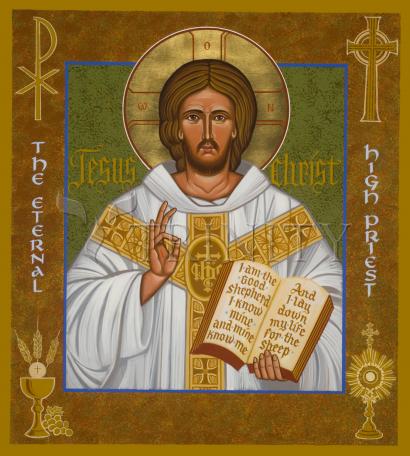
Jesus Christ – Eternal High Priest by American painter Joan Cole

The Lord says to my lord:

“Sit at my right hand
    until I make your enemies
    a footstool for your feet.”

The Lord will extend your mighty scepter from Zion, saying,
    “Rule in the midst of your enemies!”
Your troops will be willing
    on your day of battle.
Arrayed in holy splendor,
    your young men will come to you
    like dew from the morning’s womb.

The Lord has sworn
    and will not change his mind:
“You are a priest forever,
    in the order of Melchizedek.”

The Lord is at your right hand;
    he will crush kings on the day of his wrath.
He will judge the nations, heaping up the dead
    and crushing the rulers of the whole earth.
He will drink from a brook along the way,
    and so he will lift his head high. (NIV)

Today’s reading is the most quoted psalm in the New Testament (twenty-four times) and is mentioned in the Apostle’s Creed. The reason for this is, of course, because Christ’s apostles discerned Jesus as the messianic ruler of the psalm. The writer of Hebrews had the purpose of emphasizing the superiority of Jesus Christ over all others, and so, lifted this psalm, along with other psalms, and placed it in the beginning of his argument:

In the past God spoke to our ancestors through the prophets at many times and in various ways, but in these last days he has spoken to us by his Son, whom he appointed heir of all things, and through whom also he made the universe. The Son is the radiance of God’s glory and the exact representation of his being, sustaining all things by his powerful word. After he had provided purification for sins, he sat down at the right hand of the Majesty in heaven. So, he became as much superior to the angels as the name he has inherited is superior to theirs….

But about the Son he says,

“Your throne, O God, will last for ever and ever;
    a scepter of justice will be the scepter of your kingdom.
You have loved righteousness and hated wickedness;
    therefore God, your God, has set you above your companions
    by anointing you with the oil of joy.”

He also says,

“In the beginning, Lord, you laid the foundations of the earth,
    and the heavens are the work of your hands.
They will perish, but you remain;
    they will all wear out like a garment.
You will roll them up like a robe;
    like a garment they will be changed.
But you remain the same,
    and your years will never end.”

To which of the angels did God ever say,

“Sit at my right hand
    until I make your enemies
    a footstool for your feet”? (Hebrews 1:1-13, NIV)

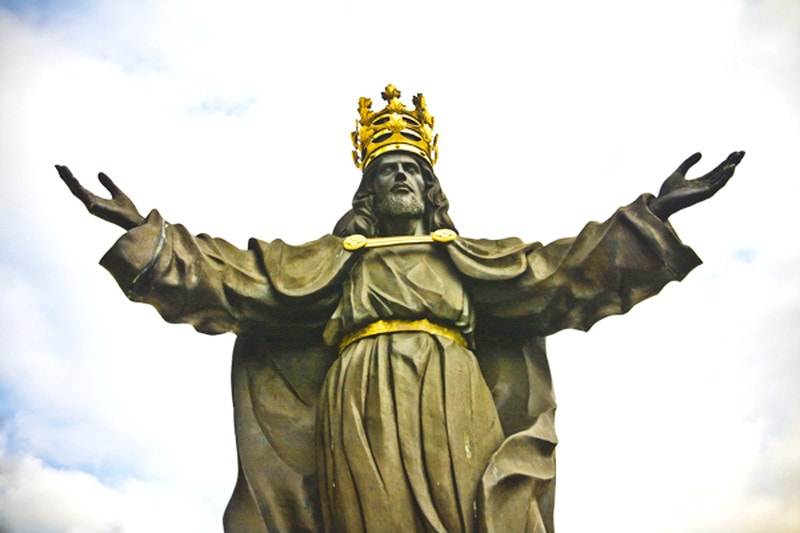
Jesus the King of the World in Czestochowa, Poland

In Christianity, Jesus is the ultimate Mediator between God and people. Neither angel nor any human can fill such a role. The author of Hebrews wanted to make it clear that Jesus is the rightful Ruler of all creation. Christ’s authority is far and above all others. So, Christians are never defenseless in this world. Believers have a sovereign Mediator and King to willingly submit to, knowing that Jesus has the power and authority to back up his words of love and assurance.

Jesus has the unique combination of being both King and Priest, the One who intercedes for us and leads us with compassionate leadership. Again, the author of Hebrews uses Psalm 110 to emphasize this:

Every high priest is selected from among the people and is appointed to represent the people in matters related to God, to offer gifts and sacrifices for sins. He can deal gently with those who are ignorant and are going astray, since he himself is subject to weakness. Therefore, he has to offer sacrifices for his own sins, as well as for the sins of the people. And no one takes this honor on himself, but he receives it when called by God, just as Aaron was.

In the same way, Christ did not take on himself the glory of becoming a high priest. But God said to him,

“You are my Son;
    today I have become your Father.”

And he says in another place,

“You are a priest forever,
    in the order of Melchizedek.”

During the days of Jesus’ life on earth, he offered up prayers and petitions with fervent cries and tears to the one who could save him from death, and he was heard because of his reverent submission. Son though he was, he learned obedience from what he suffered and once made perfect, he became the source of eternal salvation for all who obey him and was designated by God to be high priest in the order of Melchizedek. (Hebrews 5:1-10, NIV)

Jesus Christ demonstrated and proved he is qualified to be the rightful Priest and King through obedient suffering. That means he is perfectly suited and able to help us. Christ is no detached and aloof King and Priest. He knows exactly what it is like to be a human in this broken and fallen world. Such divine empathy translates into solid emotional and spiritual support because, as the Christian tradition holds, Jesus has taken care of the sin issue once for all through the Cross.

The Messiah’s enemies, whose final defeat is certain, are not Gentile kingdoms or human institutions. The ultimate foes are the hostile and evil principalities and powers of this dark world, including death itself. The universal reign of Jesus, the exalted Son of David, brings deliverance from guilt, shame, and injustice as the unique God-Man.

In this unabashed Christian view of Psalm 110, Jesus is our perfected high priest who is able for all time to save those who approach God, since he always lives to make intercession for us. (Hebrews 7:25)

The appropriate response to such a great King and Priest is submissive loyalty and eternal praise.

May it be so to the glory of God.

O Lord our God: Reign in power over us, through your Son, Jesus Christ – for he is exalted over all governments and authorities, all ideologies and creeds, and all human hearts and souls. King Jesus: Be enthroned in our lives, in all people everywhere, as our mediator and atoning sacrifice. Spirit of God: Reign in power over us through Jesus Christ and give us the victory over all the enemies of our souls, within and without, for the glory of your Name. Amen.