The Holy Name of Jesus (Luke 2:15-21)

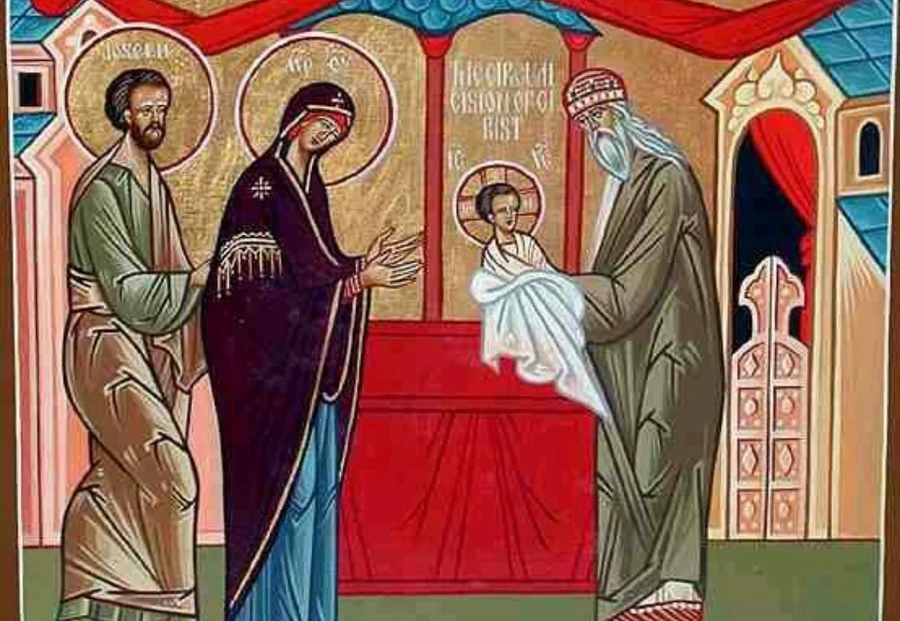
Orthodox depiction of the circumcision and naming of Jesus

When the angels had left them and gone into heaven, the shepherds said to one another, “Let us go now to Bethlehem and see this thing that has taken place, which the Lord has made known to us.” So they went with haste and found Mary and Joseph and the child lying in the manger. When they saw this, they made known what had been told them about this child, and all who heard it were amazed at what the shepherds told them, and Mary treasured all these words and pondered them in her heart. The shepherds returned, glorifying and praising God for all they had heard and seen, just as it had been told them.

When the eighth day came, it was time to circumcise the child, and he was called Jesus, the name given by the angel before he was conceived in the womb. (New Revised Standard Version)

“The Holy Name of Jesus” is a celebration, observed by some Christian traditions, each year on January 1 – which is the eighth day after the birth of Jesus, when he was named and circumcised at the temple in Jerusalem.

An angel of the Lord appeared to him in a dream and said, “Joseph, son of David, do not be afraid to take Mary as your wife, for the child conceived in her is from the Holy Spirit. She will bear a son, and you are to name him Jesus, for he will save his people from their sins.” (Matthew 1:20-21, NRSV)

In the Law of Moses, all male infants are to be circumcised on the eighth day after their birth (Leviticus 12:3). Throughout most of the history of the Christian Church, January 1 has been celebrated as a feast day devoted to the naming of Jesus.

The name “Jesus” comes from the Hebrew Yeshuah (Joshua) which means “Yahweh will save.” It is a name fitting for the person and work of Christ.

Therefore God exalted him even more highly
    and gave him the name
    that is above every other name,
so that at the name given to Jesus
    every knee should bend,
    in heaven and on earth and under the earth,
and every tongue should confess
    that Jesus Christ is Lord,
    to the glory of God the Father. (Philippians 2:9-11, NRSV)

Faith is always followed by obedience. So, the faith of Joseph and Mary in believing the words of the angel Gabriel, translated into the obedient naming of their son as “Jesus.” (Luke 1:31-32)

Jesus, bearing the name of savior, is holy in every way. Not only does the name of Jesus point to his divinity – because of his miraculous conception by the Holy Spirit – but it also directs us toward the special mission for which he entered this world.

Jesus Christ, the Son of God, and Son of Humanity, is God’s agent of deliverance for both Israel and the whole world.

“Do not be afraid, for see, I am bringing you good news of great joy for all the people: to you is born this day in the city of David a Savior, who is the Messiah, the Lord….” (Luke 2:10-11, NRSV)

The Gospel writer Luke provides us with a birth narrative “pregnant” with theological information and importance:

  • Jesus has divine sonship, and possesses the status of king (Luke 1:31-35)
  • Jesus comes from the city of David, which is Bethlehem, not Jerusalem (Luke 2:4, 11)
  • Jesus is described by the angel Gabriel as Son of the Most High, Son of God, Savior, Messiah, and Lord; each of these titles direct us to his identity and mission (Luke 1:32, 35; 2:11)

I like the collective response of the shepherds, after they received heavenly good news from a group of angels.

They could have dismissed the entire thing as having drunk too much brandy on a brisk winter night. They could have kept the whole affair to themselves, reasoning that nobody would believe a bunch of stinky shepherds.

Instead, much like Mary who hurried off to Elizabeth after receiving the angelic message, the shepherds dropped everything to go and see the feeding trough with a newborn baby wrapped in swaddling cloth.

In other words, the shepherds belief in what they heard and experienced, quickly translated into action. It was only appropriate that it was shepherds who discovered the newborn king, the Son of David, himself a shepherd who was anointed by God.

The shepherds went and followed the signs given to them by the angel. And they believed. A motley group of shepherds returned to their fields, kicking up their heels, praising and glorifying God. They knew that things would never be the same again.

The name of Jesus is holy, simply because the Lord Jesus Christ is the Holy One. Christians recognize Jesus as Savior, the fulfillment of all God’s promises. His singular birth, life, death, resurrection, and ascension is exactly, I believe, what this old fallen world is most in need of.

It is never too late to resolve knowing Jesus. At the beginning of this year, there is perhaps no better resolution to make, again and again, of knowing Jesus Christ and honoring his holy name.

Eternal Father, you gave to your incarnate Son the holy name of Jesus to be the sign of our salvation. Plant in our hearts the love of Jesus, truly God and truly human, and grant that we may praise and bless your Holy Name with our whole mind, heart, body, and spirit, that we may know your boundless compassion and mercy. In Christ’s name, we pray. Amen.

First Sunday after Christmas Day – Where Is Jesus? (Luke 2:41-52)

The Boy Jesus In the Temple, by He Qi

Now every year his parents went to Jerusalem for the festival of the Passover. And when he was twelve years old, they went up as usual for the festival. When the festival was ended and they started to return, the boy Jesus stayed behind in Jerusalem, but his parents were unaware of this. Assuming that he was in the group of travelers, they went a day’s journey.

Then they started to look for him among their relatives and friends. When they did not find him, they returned to Jerusalem to search for him. After three days they found him in the temple, sitting among the teachers, listening to them and asking them questions. And all who heard him were amazed at his understanding and his answers. 

When his parents saw him they were astonished, and his mother said to him, “Child, why have you treated us like this? Your father and I have been anxiously looking for you.” 

He said to them, “Why were you searching for me? Did you not know that I must be in my Father’s house?” But they did not understand what he said to them. 

Then he went down with them and came to Nazareth and was obedient to them, and his mother treasured all these things in her heart.

And Jesus increased in wisdom and in years and in divine and human favor. (New Revised Standard Version)

Luke is the only New Testament Evangelist who included a story of Jesus’s childhood. It provides us some interesting biographical information. Yet, more importantly, the story gives us a sense of Christ’s destiny, of why Jesus grew up to  engage in his unique earthly ministry.

In many ways, Jesus was a typical Jewish boy, in a non-descript pious Jewish family. The family was careful to be observant, and annually made their pilgrimage to Jerusalem for Passover.

Joseph and his family traveled in a large caravan of people, which was common for that day. They were on their camels an entire day before they discovered Jesus was missing.

Mary likely assumed Jesus was riding on the other camel with Uncle Zechariah and his cousin John. 

But Jesus was neither with them nor with Aunt Elizabeth. So, the second day, Joseph and Mary backtracked to Jerusalem, hoping and praying they wouldn’t find Jesus in the ditch, like in the story of the Good Samaritan.

Having not found their son along the road, Joseph and Mary spent the third day scouring Jerusalem in search of Jesus. 

It seems to me that far too many people go about their daily lives without realizing Jesus is even missing. They simply assume he’s here. But he isn’t.

So, let’s search for him. And in finding him, may we see Jesus as we have never seen him before, so that our faith in God might be strengthened, and so that we do not end up losing him yet again.

Turns out, the entire time, Jesus was at the temple. As a parent and grandparent myself, I’m not a bit surprised that a twelve-year-old stayed behind and thought nothing of it. 

Jesus was curious and inquisitive with the rabbis at the temple. Those ancient teachers taught in a different way than Christians preachers today. They gave instruction more like a modern day counselor or therapist.

The rabbis didn’t just impart information; they asked questions to help people discover truth for themselves. And the rabbis were amazed at Jesus’s ability to discover truth.

Keep in mind that Jesus was not a thirty-year-old adult in a twelve-year-old body. Christ was sinless, indeed; but still immature.

The human experience involves growth and maturation. Jesus shared fully in our humanity, not partially. When Christ was born, he was not a fully aware adult looking through the eyes of a baby.

Because Jesus is fully human, he had to grow up just like us and learn in every way, just like us. (Hebrews 4:15; 5:8)

Staying in Jerusalem was not a rebellious act by Jesus. It was typical. Twelve-year-old’s do all kinds of things without saying anything to their parents.

There’s a world of difference between defiant rebellion, and just plain old garden variety immaturity. It’s unwise for adults to expect adult behavior from adolescent kids.

Jesus felt a deep need to stay and talk with the rabbis. As a human boy, he had to go through the process of self-discovery… of finding out that he was the Son of God… of reading the scriptures for himself and learning… and finding that he was reading about himself! 

To say that Jesus simply knew everything because he was God is to fall into a heresy the early church condemned at the Council of Nicaea called Docetism – a belief that Jesus is fully God and only appeared to be human.

No, the Nicaean Council said, Jesus is really a human being and did not simply appear to be one. He is like us, in every way, except sin.

Well, of course, Joseph and Mary finally found Jesus. And Jesus got the third degree from his mother: “What do you mean putting your father and I through this? I gave you birth, and you treat us like this?  What were you thinking?  What part of meeting at the two-humped camel at 9:00 don’t you understand!?”

Since Jesus grew in wisdom and stature and in favor with God and others, how much more do we need to put ourselves in a position to grow and learn and develop and mature? 

There is no spiritual machine in which God miraculously zaps into our brains all the wisdom and knowledge we need.

Rather, emulating our Lord, we must learn, grow, read, pray, ask questions, struggle, and dialogue about the good news of Jesus Christ with each other. In short, we must discover the truth of God.

Perhaps Jesus is asking us, as he did to Mary and Joseph, “Why were you searching for me?  Didn’t you know that I had to be in my Father’s house?” 

The answer of Jesus to his parents’ anxious searching of him points to Christ’s growing self-awareness about his messianic mission. The story centers around Jesus, as all stories do in the Gospel narratives, and not so much around the others.

Since Christ is the proper middle to everything for the Christian, we will, like Joseph and Mary, struggle to know where in the heck Jesus is, and why he is where he is, whenever we find him.

But it isn’t really all that hard to find Jesus, at least, once you know where to look, and where he typically hangs out.

When looking for Jesus, he will be doing the things of his Father. In the Gospel of Luke, those things are clearly connected to the prophet Isaiah’s description:

“The Spirit of the Lord is upon me,
    because he has anointed me
        to bring good news to the poor.
He has sent me to proclaim release to the captives
    and recovery of sight to the blind,
        to set free those who are oppressed,
to proclaim the year of the Lord’s favor.” (Luke 4:18-19, NRSV; cf. Isaiah 61:1-2)

The ones rejoicing at Christ’s birth, and why they were filled with such joy, is very much connected to the messianic mission of Jesus. They understood that freedom and deliverance had just been born.

O God, from our mother’s womb you have known us. You call us to follow you every single day of our lives. And you seek us out whenever we wander from you. As we grow up and grow older, clothe us with your love, so that we may mature in grace and find favor in your sight; through Jesus Christ our Savior and Lord. Amen.

Fourth Sunday of Advent – Mary and Elizabeth (Luke 1:39-55)

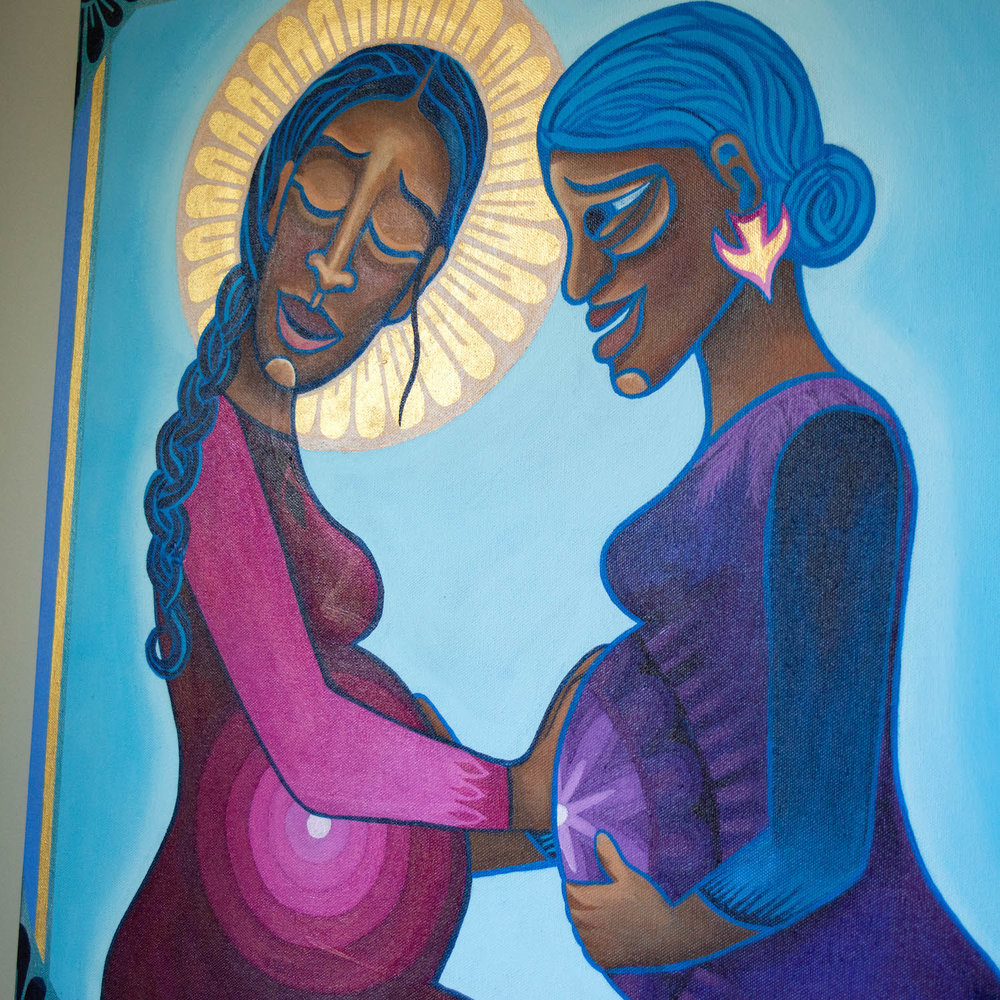
Mary and Elizabeth, by Lauren Wright Pittman

In those days Mary set out and went with haste to a Judean town in the hill country, where she entered the house of Zechariah and greeted Elizabeth. When Elizabeth heard Mary’s greeting, the child leaped in her womb. And Elizabeth was filled with the Holy Spirit and exclaimed with a loud cry, “Blessed are you among women, and blessed is the fruit of your womb. And why has this happened to me that the mother of my Lord comes to me? For as soon as I heard the sound of your greeting, the child in my womb leaped for joy. And blessed is she who believed that there would be a fulfillment of what was spoken to her by the Lord.”

And Mary said,

“My soul magnifies the Lord,
    and my spirit rejoices in God my Savior,
for he has looked with favor on the lowly state of his servant.
    Surely from now on all generations will call me blessed,
for the Mighty One has done great things for me,
    and holy is his name;
indeed, his mercy is for those who fear him
    from generation to generation.
He has shown strength with his arm;
    he has scattered the proud in the imagination of their hearts.
He has brought down the powerful from their thrones
    and lifted up the lowly;
he has filled the hungry with good things
    and sent the rich away empty.
He has come to the aid of his child Israel,
    in remembrance of his mercy,
according to the promise he made to our ancestors,
    to Abraham and to his descendants forever.” (New Revised Standard Version)

Mary had a visitation by an angel, informing her that she would give birth to the Son of God. She immediately hurried to visit her relative Elizabeth, who was pregnant with the forerunner to the Son of God.

In the two women’s encounter, the baby within Mary is portrayed as of greater significance than the one within Elizabeth. And that was not because of the adults, but because of the babies themselves.

Something amazing and spectacular was about to occur in history. It would be so cataclysmic that these two babies, especially the one within Mary, would change the world in profound ways.

There was nothing particularly special about either Mary or Elizabeth – which is probably why they were perfect for the jobs of raising the Messiah and the Prophet.

The lowly non-descript persons are usually favored by God, even though the world knows nothing about them. After all, the kingdom of God knows nothing of billionaires and those in high places, even though the world knows nearly everything about them.

Throughout the history of the world, women have often been overlooked and underrated. Even in today’s Western world, even though it’s better than it was, women are still viewed not as qualified like men are. But that’s a topic for another time.

The Visitation, by Sadao Watanabe (1913-1996)

The most obvious observation from today’s Gospel story is that we wouldn’t have babies born without women. There were two in utero babies that had responses, because of two women.

Inside of Elizabeth’s womb, John leaped at the voice of Mary carrying his new cousin. Indeed, even before birth, John was filled with the Holy Spirit and began pointing to Jesus. (Luke 1:15)

John, although getting his prophetic leap from the Spirit, also got some significant prophetic oomph from his mother. Elizabeth spoke the prophetic word about Mary, who is “the mother of my Lord.”

Good people bestow blessing on others. And that is what Elizabeth did for Mary. This then, enabled Mary to express her own inspired blessing to God. To bless and be blessed means, on the practical level, that spiritual eyes are opened to see what is truly there.

Mary is a blessed person, not only because she is the Lord’s mother, but more fundamentally because she is faithful, and trusted in the promise of God to her.

To be blessed is to have God’s stamp of approval on your life. It has little to do with wealth or abundant resources. But it does have a lot to do with living a life of godly virtue and values.

So, again, it only makes sense that God used Mary and Elizabeth, two women who embodied being poor in spirit (humble) as the divine conduits for blessing the world.

Both Mary and Elizabeth believed. Elizabeth believed the words of the angel to her husband Zechariah. And Mary believed the angel’s direct words to her when she heard them. Without hesitation or any ambiguity.

Faith accepts what it cannot see; and when faith does see with actual eyes, it can see what is underneath the physical appearance.

Let’s also make sure to observe that this sort of faith, this particular way of seeing, has its consequences. Elizabeth and Mary both knew quite well that one of them was an unmarried pregnant woman.

They understood the social judgments to come, along with the shaming, and perhaps even the ostracism that would likely occur – even though all of this is divine through and through.

But grace can always use the eyes of faith to see beyond social status and convention in order to do what is right, just, and good. Mercy can always see what is truly honorable.

Elizabeth was perfectly comfortable extending hospitality to a person for whom others were likely to whisper, judge, and reject. Which is why I like Elizabeth. Every generation needs more women like her.

The welcome and love of Elizabeth is of the same sort that Jesus would show to prostitutes, tax collectors, and sinners. Like Elizabeth, Jesus could see beyond any societal shame to what was divinely happening in front of him.

Mary magnified the Lord with immortal words infused from the blessing bestowed upon her by Elizabeth. To bless another person is to open them to the possibilities of God’s actions in them and through them to the world.

That is the real gift that keeps on giving. And it is the most appropriate and valuable gift that we can give to another this season.

O God of Elizabeth and Mary, you visited your servants with news of the world’s redemption in the coming of the Savior. Make our hearts leap with joy, and fill our mouths with songs of praise, so that we may announce glad tidings of peace, and welcome Christ in our midst. Open our souls to receive the One who came to love your flock. Amen.

Second Sunday of Advent – Prepare the Way (Luke 3:1-6)

The Call from John the Baptist to Repent, by Renier de Huy, 12th century

In the fifteenth year of the reign of Tiberius Caesar, when Pontius Pilate was governor of Judea, and Herod was ruler of Galilee, and his brother Philip ruler of the region of Ituraea and Trachonitis, and Lysanias ruler of Abilene, during the high priesthood of Annas and Caiaphas, the word of God came to John son of Zechariah in the wilderness. He went into all the region around the Jordan, proclaiming a baptism of repentance for the forgiveness of sins, as it is written in the book of the words of the prophet Isaiah,

“The voice of one crying out in the wilderness:
‘Prepare the way of the Lord;
    make his paths straight.
Every valley shall be filled,
    and every mountain and hill shall be made low,
and the crooked shall be made straight,
    and the rough ways made smooth,
and all flesh shall see the salvation of God.’ ” (New Revised Standard Bible)

In this Christian season of Advent, we are reminded that God is not only high above us, transcendent, far away; God is also close to us, immanent, and with us.

We remember at this time of year that God does not remain distant, but entered our time and space at a particular moment in history, for a distinct purpose.

The Roman Empire was powerful, large, and very much in control of every place where it existed. The litany of imperial rulers and authorities which the Gospel writer Luke listed is meant to give us a feel of the Roman weight, and how much Roman might was ensconced in Judea.

The world at the turn of the common era was under the dominion of powerful people with lots of influence. But God did not come to any of them. Instead, God came to a loner – a man who spent his time out in the wilderness. His name was John, the son of Zechariah. We know him as John the Baptist.

With God coming to John at a precise point of time in a particular place, that made John a prophet with a singular message. John was born for this. (Luke 1:76)

It is fitting that a man hanging out on the fringes of society all by himself would be the one to prepare the way for Messiah.

After all, Messiah’s message would be one of bringing good news to the poor, proclaiming release to prisoners, and freeing those who are oppressed. (Luke 4:18-19; Isaiah 61:1-2)

God’s prophetic calling for John was one of preparation. John was to prepare the way of the Lord. He was to get the people ready to receive Messiah.

John went about his ministry of preparation by calling folks to repent, to change their minds and amend their ways, so that there might be forgiveness.

In a reference from the prophet Isaiah, Luke alluded to Jewish exiles returning from their Babylonian captivity. The actual physical road from Babylon to Jerusalem was a hard journey due to the distance and topography.

The “road” or the “way” in Holy Scripture is also a metaphor for the spiritual journey we take in this life. And that road has a lot of challenges to it. The very act of walking as a pilgrim over a long arduous journey changes a person.

It is rarely the destination that makes a person; it’s the journey itself which leads one to a changed life of thinking differently, and seeing things from a perspective we’ve never seen before.

The smoothing out of the road is a way of saying God is making it easier for people to return to the Lord, to get them ready for a new life with promises fulfilled and unexpected joy.

In other words, valleys raised and mountains flattened represent God’s efforts at helping us experience a complete transformation of life. The Lord will do everything possible to make renewal and restoration happen for us.

The Lord will set things right. In our contemporary world that is now largely controlled by powerful oligarchs and the super-rich, God will turn it upside-down. All of the world’s current powerful people will find themselves looking up, not down.

It would be nice and reassuring if I could give you certainty about the journey ahead. But I cannot do that. Yet, what I can do is assure us of what is at the end of the road. Look beyond the current days of self-centered leadership and popular ignorance, and understand that all flesh shall see the salvation of God.

Prepare the way of the Lord. We do that by how we go about walking the road. Each step we take every day is important and makes a difference. And when we stumble, there is plenty of grace to help get us back on our feet and moving forward.

We are all collectively journeying together to Bethlehem. And as we daily move and walk, at the end of our journey, Jesus is there.

But when the fullness of time had come, God sent his Son, born of a woman, born under the law, in order to redeem those who were under the law, so that we might receive adoption as children. (Galatians 4:4, NRSV)

And nothing can stop us or separate us from the love of God that is in Jesus Christ our Lord.

For I am convinced that neither death, nor life, nor angels, nor rulers, nor things present, nor things to come, nor powers, nor height, nor depth, nor anything else in all creation will be able to separate us from the love of God in Christ Jesus our Lord. (Romans 8:38-39, NRSV)

The journey may be arduous. You might feel like giving up. But Jesus is our Immanuel, God with us. In him, is our hope and our joy.

O Holy One of Israel, out of the embrace of mercy and righteousness, you have brought forth joy and dignity for your people. Remember now your ancient promise; make straight the paths that lead to you, and smooth the rough ways, so that in our day we might bring forth your compassion for all humanity. Amen.