
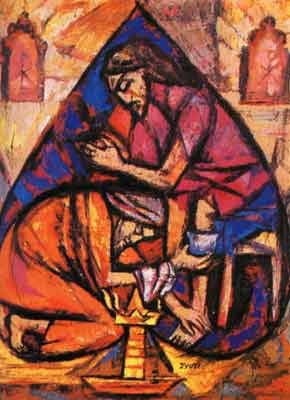
“I Have Set You an Example” (John 13:1-17)

Jesus Washes Peter’s Feet

Now before the festival of the Passover, Jesus knew that his hour had come to depart from this world and go to the Father. Having loved his own who were in the world, he loved them to the end. The devil had already decided that Judas son of Simon Iscariot would betray Jesus. And during supper Jesus, knowing that the Father had given all things into his hands and that he had come from God and was going to God, got up from supper, took off his outer robe, and tied a towel around himself. Then he poured water into a basin and began to wash the disciples’ feet and to wipe them with the towel that was tied around him. 

He came to Simon Peter, who said to him, “Lord, are you going to wash my feet?” Jesus answered, “You do not know now what I am doing, but later you will understand.” Peter said to him, “You will never wash my feet.” Jesus answered, “Unless I wash you, you have no share with me.” Simon Peter said to him, “Lord, not my feet only but also my hands and my head!” Jesus said to him, “One who has bathed does not need to wash, except for the feet, but is entirely clean. And you are clean, though not all of you.” For he knew who was to betray him; for this reason he said, “Not all of you are clean.”

After he had washed their feet, had put on his robe, and had reclined again, he said to them, “Do you know what I have done to you? You call me Teacher and Lord, and you are right, for that is what I am. So if I, your Lord and Teacher, have washed your feet, you also ought to wash one another’s feet. For I have set you an example, that you also should do as I have done to you. Very truly, I tell you, slaves are not greater than their master, nor are messengers greater than the one who sent them. If you know these things, you are blessed if you do them. (New Revised Standard Version)

One of the reasons I like Jesus so much is that he loves me as I am, and not merely as I should be. Jesus loves me even with my dirty stinky feet, my herky-jerky commitment to him, and my pre-meditated sin.

In fact, Jesus loved even Judas and washed his feet. Jesus serves people because they need his love, and not so that they will love him back.

I recently read about a man who lived in Paris. His wife had Alzheimer’s. He was an important businessman and his life was filled with busyness. Yet, he said when his wife fell sick:

“I just couldn’t put her into an institution, so I kept her. I fed her. I bathed her. Through the experience of serving my wife every day, I have changed. I have become more human. The other night, in the middle of the night, my wife woke me up. She came out of the fog for a moment, and she said, ‘Darling, I just want to say thank you for all you are doing for me.’ Then she fell back into the fog. I wept for hours to know this grace.” A Severe Mercy, by Sheldon Vanauken

Sometimes Christ calls me to love people who either cannot or will not love me in return. They live in the fog of some sort of disability, depression, poverty, or common spiritual blindness. As I serve them, I may only receive brief glimpses of gratitude. Just as Jesus loves me within my own spiritual confusion, so I desire to continue loving others as they walk through whatever fog they are in.

Lord willing, my life will be useful through my words and my witness. If God desires, my life will bear fruit through my prayers, my service, and my love. Yet, the usefulness of my life is God’s concern, not mine; it would be indecent of me to worry about that. I simply desire to follow my Lord’s example.

Ethiopian Orthodox Church icon of Jesus washing the disciples’ feet

Neither many Christians nor churches wash feet anymore. So, the following is today’s Gospel lesson put in a slightly different contemporary context:

It was just before the biggest and most important feast of the year. Jesus knew that it was finally the time for him to face the cross and die for the world’s sins. Having spent the past three years loving his followers, he now wanted to leave them with a clear demonstration of his love that they would never forget.

The evening meal was being served, and the devil had already gotten a hold of Judas Iscariot to betray Jesus to those who wanted him dead and gone. But it was all according to plan. Jesus knew that his heavenly Father had given him all authority because he was his Son, and he was ready to do what needed to be done to secure salvation and return to his rightful place at his Father’s right hand. 

So, Jesus got up from the meal, rolled up his sleeves, put an apron on, and ran a sink full of hot water. Jesus told the servants to take the night off, and he began taking the dishes from the dinner table and started washing them, taking care to do all that waiters and dishwashers would do.

When Jesus came to take care of Simon Peter’s dishes and serve him dessert and coffee, Peter said to him, “Lord, are you going to serve me?” Jesus replied, “I know you do not understand why I am doing this since it seems like something that is beneath me to do, but later you will look back on this night and understand completely what I am doing.”

“No,” said Peter, “this is not right – you are the Master, and this is not what a well-respected rabbi does – you are only disrespecting yourself and making us all look foolish. You are not going to take my dishes and wash them.”

Jesus answered, “Unless I wash these dishes and serve you, you are not going to be able to follow me anymore, and you will have no part of what I am doing in this world.”

“Well, then, Lord,” Simon Peter replied, “if that is the way it really is, then don’t just wash the dishes – come on over to my place and clean out the fridge and scrub the kitchen floor!”

Jesus answered, “A person who has had a decent meal needs only to wash the dishes so that he can enjoy the freedom of hospitable relationships with me and those around him. And all of you here have had a decent meal, though not every one of you.” For Jesus knew that Judas was only picking at his food in anticipation of betraying him.

When Jesus was all done washing the dishes and serving his disciples, he took his apron off, rolled his sleeves back down, and returned to the table. He looked them all squarely in the eye and said, “Do you understand what I just did for you? 

You call me ‘Teacher’ and ‘Master,’ and rightly so, for that is exactly what I am. So, now that I, your Master, and your Teacher have washed your dishes, you also should wash one another’s dishes. I have set you an example that you should do as I have done for you. I am telling you the plain truth that no follower is greater than the one he follows, nor is a preacher greater than the one he preaches about. 

Now that you know it is your task in this life to provide humble loving service, you will have God’s stamp of approval on your life if you quit thinking about how to possess and use power for your own purposes, and start thinking about how to use the authority I am giving you to love other people into the kingdom of God.

Loving Lord Jesus, how shocking it was for your disciples to be served by you in such a humble manner. But I cannot be spiritually cleansed unless I allow you to love me in an almost embarrassing fashion. Help me not to be so proud that I neither refuse your humble loving service toward me, nor neglect to offer that same kind of service to others. May love be the word, the idea, and the action that governs my every motivation and movement in your most gracious Name, I pray. Amen.


Freedom from Sin (Romans 6:12-23)

Therefore do not let sin reign in your mortal body so that you obey its evil desires. Do not offer any part of yourself to sin as an instrument of wickedness, but rather offer yourselves to God as those who have been brought from death to life; and offer every part of yourself to him as an instrument of righteousness. For sin shall no longer be your master because you are not under the law, but under grace.

What then? Shall we sin because we are not under the law but under grace? By no means! Don’t you know that when you offer yourselves to someone as obedient slaves, you are slaves of the one you obey—whether you are slaves to sin, which leads to death, or to obedience, which leads to righteousness? But thanks be to God that, though you used to be slaves to sin, you have come to obey from your heart the pattern of teaching that has now claimed your allegiance. You have been set free from sin and have become slaves to righteousness.

I am using an example from everyday life because of your human limitations. Just as you used to offer yourselves as slaves to impurity and to ever-increasing wickedness, so now offer yourselves as slaves to righteousness leading to holiness. When you were slaves to sin, you were free from the control of righteousness. What benefit did you reap at that time from the things you are now ashamed of? Those things result in death! But now that you have been set free from sin and have become slaves of God, the benefit you reap leads to holiness, and the result is eternal life. For the wages of sin is death, but the gift of God is eternal life in Christ Jesus our Lord. (New International Version)

The word “sin” is mentioned 10 times in these 12 verses of Scripture. It’s an important word, and so, we need to understand something of it. Discerning the concept of sin in the Bible is crucial to our spiritual growth and development as believers in Jesus. A better grasp of sin’s nature and power will help us to better understand and appreciate God’s grace and how to live the Christian life.

Sin Is Everywhere

We see the evidence of living in a broken world every day. Disaster, disease, and death are realities we all must deal with. The presence and power of sin is everywhere – in our hearts, our world, our institutions, and our families. It’s on television, the internet, social media, and moves in-and-out of smartphones. If it takes one to know one, we are all experts on being sinners.

Definitions of Sin

From the Bible’s vantage, sin is things we do (1 John 3:4) as well as things we leave undone (James 4:17). Sin is both actively breaking of God’s commands, and passively avoiding them. 

Christians throughout the ages have generally understood that the Ten Commandments (Exodus 20:1-17) and Christ’s law of love (Luke 10:27) constitute a brief summary of God’s holy and moral instruction for humanity.  These laws are based in the character of God as a holy and loving Being.

Sin, then, may be defined as anything in a person, group of people, an institution or a system, which does not express, or is contrary to, the basic character of God. In short, sin is a pervasive force which exists everywhere, defined in the following acrostics:

Sinful actionsSinful thoughtsSinful inaction
StressStupidSpiritual
InducedInwardInsidious
NarcissismNoodlingNarcolepsy

Sin Is Contrary to God’s Character      

All sin, whether active or passive, is self-centered and lacks self-awareness. Sin exists wherever a person, group, or organization thinks more about itself than of God and God’s love and justice. Sinful attitudes bring consequences such as:

  • Obsession with lust (1 John 8:34; Galatians 5:16) Lust is the stance of having to possess something, instead of appreciating it without ownership.
  • Broken relationships (Romans 3:23; Galatians 5:17) Wanting something without any concern for it’s cost leaves a trail of broken relationships with God and others.
  • Bondage to Satan (1 Timothy 3:6-7; 2 Timothy 2:26) Obtaining the object of our lust brings slavery, not freedom
  • Spiritual death (Romans 6:23; 8:6) Death is separation from God and estrangement from others
  • Hardening of the heart (Hebrews 3:13) A hard heart happens by stubbornly holding on to what we want, irrespective of what God wants
  • Deception (1 Corinthians 3:18; James 1:22, 26) To be deceived is to believe that other people, even God, are the problem whenever things go sideways

This may all sound like a total Debbie-Downer. Actually, it’s total depravity. Being depraved does not mean we are never capable of doing good; it means that sin has profoundly touched everything in our lives, without exception.

Sin Is Not the Last Word

Paradoxically, experiencing true joy and comfort comes through knowing how great our sin is. We live above sin by being set free from it by the grace of God in Jesus Christ. To be redeemed from sin, a provision is needed. In Christianity, sin has been dealt with once and for all through the person and work of Jesus. Christ is our representative, taking our place and delivering us from sin (Galatians 4:4-5; Ephesians 2:5-6; Colossians 2:9-15; Hebrews 2:17-18; 1 John 2:1).

Jesus Christ is our ultimate substitute (Romans 5:8)…

Which resulted in our redemption (Galatians 5:13)…

Leading to a satisfaction of all justice (Romans 3:25)…

Bringing reconciliation with God (Romans 5:10)… 

And putting sin to death, making us complete in Christ (Colossians 2:10).      

Although sin destroys everything it touches and leaves terrible consequences in its wake, sin does not have the last word: grace does.

Words for Sin

There are 33 different words for “sin” in the original Greek language of the New Testament. Only one of them is used in the verses from Romans: ἁμαρτία (“HA-mar-tee-ah”) literally means “to miss the mark,” or to “fall short.” (Romans 5:12-21; 1 John 1:8-10; 2 Corinthians 5:21)

The concept of missing the mark gets to the heart of why persons, groups, institutions, and systems fall short of God’s standard. We fail to see who we truly are and what God has truly done for us in Christ. And so, sin deceives us into believing that our needs can be met outside of God.

Metaphors for Sin

  • Obstacle. Sin obstructs a truly good and beautiful life. It’s like a blockade that prevents us from entering the kingdom of God; or like large hurdles we have to jump to move forward. Sin is like a bear on our back which slows us down to a crawl.

Let us rid ourselves of everything that gets in the way, and of the sin which holds on to us so tightly, and let us run with determination the race that lies before us. (Hebrews 12:1, GNT)

  • Addiction. The word “sin” is an attempt to meet a legitimate need in an illegitimate way. Sin is an energy which we become fixated on in order to meet our needs for love and acceptance. If unchecked, the sinful method for meeting the need becomes the need itself.

We are tempted by our own desires that drag us off and trap us. Our desires make us sin, and when sin is finished with us, it leaves us dead. (James 1:14-15, CEV)

“Seek what you are seeking – but don’t seek it where you are seeking it!”

St. Augustine
  • Marketing scam. Sin is misleading. It’s a scam or a branding which looks good but the product is all wrong. Sin is a deception, and it leads us to deceive others in order to make ourselves look better than we really are.

When you give to the poor, don’t blow a loud horn. That’s what show-offs do in the synagogues and on the street corners because they are always looking for praise. I can assure you that they already have their reward. (Matthew 6:2, CEV)

Overcoming Sin

Victory over sin and the dark force of this world comes through faith. Believe that you have been set free from sin.

For everyone born of God overcomes the world. This is the victory that has overcome the world, even our faith. Who is it that overcomes the world? Only the one who believes that Jesus is the Son of God. (1 John 5:4-5, NIV)

We need our ultimate faith to rest in God, and not in anyone or anything else. The Scripture says:

Trust in the Lord with all your heart,
    and do not rely on your own insight.
In all your ways acknowledge him,
    and he will make straight your paths. (Proverbs 3:5-6, NRSV)

Eternal God, in whom we live and move and have our being, whose face is hidden from us by our sins, and whose mercy we forget in the blindness of our hearts: cleanse us from all our offenses, and deliver us from proud thoughts and vain desires, that with reverent and humble hearts we may draw near to you, confessing our faults, confiding in your grace, and finding in you our refuge and strength; through Jesus Christ your Son. Amen.

Let Mercy Be Our Guide (Matthew 12:1-8)

At that time Jesus went through the grainfields on the Sabbath. His disciples were hungry and began to pick some heads of grain and eat them. When the Pharisees saw this, they said to him, “Look! Your disciples are doing what is unlawful on the Sabbath.”

He answered, “Haven’t you read what David did when he and his companions were hungry? He entered the house of God, and he and his companions ate the consecrated bread—which was not lawful for them to do, but only for the priests. Or haven’t you read in the Law that the priests on Sabbath duty in the temple desecrate the Sabbath and yet are innocent? I tell you that something greater than the temple is here. If you had known what these words mean, ‘I desire mercy, not sacrifice,’you would not have condemned the innocent. For the Son of Man is Lord of the Sabbath.” (New International Version)

I’ll just say it plainly: We people are quick to judge. All of us have been on the end of someone judging us for something we did or said; and also all of us have played the judge, telling someone they aren’t right, when we really don’t know what’s going on or don’t have the full picture.

In today’s Gospel lesson, the Pharisees take issue with Christ’s disciples doing something unlawful (that is, unbiblical). Since the Pharisees chose to respond to the situation using the ground of Scripture, Jesus responded to them on Scriptural grounds.

Jesus went back to the Bible, with three pointed biblical retorts: “Haven’t you read?” “Haven’t you read in the Law?” and “If you had known what these words mean….”

David and His Companions

The first example of Jesus, in reply to the Pharisees’ issue with the disciples picking heads of grain on the Sabbath, was to lift up David and his men. They had the audacity to waltz into the holy place, take the sacred Bread of the Presence, and proceed to eat it. And it was all done above board.

In a usual circumstance, it would be unlawful for anyone other than a priest to eat the bread. However, under unusual circumstances or extreme situations, it is very much permitted for the priest(s) to give the bread to others. This gets at the spirit and intent of the Law, not just the letter of it.

If we are unable to practice biblical injunctions with both knowledgeable skill and practical art, then we are failing to keep the Law. In other words, meeting the very real needs of people is a high priority – which is a major point of divine commands to begin with.

Priests on Sabbath Duty

The Pharisees had a problem with the disciples “working” on the Sabbath day. Rather than quibble about whether they were working by sowing and reaping, or not, Jesus went to the example and reality that the priests of God “work” on the Sabbath day – an argument which every Christian Pastor knows all too well, since we do a great deal of work on our Sunday of “rest.”

Jesus is merely making a simple observation that priestly work is done on the Sabbath without any guilt, sin, or shame behind it. In fact, it’s expected. Just as the priests are squeaky clean, then so are Christ’s disciples.

Christ brings it closer to his main point – that if the temple and all the ritual laws can validate Sabbath work – then it follows that Jesus has the freedom to “work” on the Sabbath because he is actually Lord of the Sabbath. It’s an argument from the lesser to the greater. If the temple is important, and Christ is greater than the temple, then there ought to be no constraints to Messiah’s work in this world.

If You Only Knew Your Bible

The lynchpin and hinge point of all Christ’s words hangs on the revealed biblical heart of God toward the very situation in which the disciples were in the field getting some heads of wheat. And it is the verse drawn from the prophet Hosea: “I desire mercy, not sacrifice.”

Again, the point of the Law, the aim of the biblical commands, is not self-sacrifice. It isn’t about going without eating because you would need to work in order to prepare food. Rather, it is having a big heart directed toward the needs of humanity. Human willpower, self-discipline, and right theology don’t mean much, at all, next to the weightier matters of empathy, compassion, and relational connection.

Religious duty is just that. But spiritual care which seeks to bring heartfelt compassion, responsible love, and social justice to a community is the sort of divine work that God is looking for in God’s people. Anything less than that is only hollow legalism.

So, instead of ignoring the Law, Jesus was actually upholding and fulfilling God’s Law. Christ was keeping the spirit, heart, and intent of divine instructions – even though it may have looked otherwise to a particular group of people.

Sabbath and the Reformation

In the Protestant Reformation, John Calvin understood this meaning, that the Sabbath is made for humanity, not humanity for the Sabbath, and that Jesus Christ is Lord of the Sabbath. Therefore, we are to observe the Lord’s Day (Sunday) in an intentionally non-legalistic way:

“The Lord’s Day was not established for us to hallow it before all others, that is, to count it more holy. For this is the prerogative of God alone, who has honored all days equally (Romans 14:15). But it was established for the church to gather for prayers and praises of God, for hearing the Word, for the use of the sacraments.”

John Calvin, Institutes of the Christian Religion (Book 1, Chapter 14)

Let mercy, not judgment nor sacrifice, be our interpretive guide through the whole of Holy Scripture and the Christian life, to the glory of God. Amen.

Mercy Is Why Jesus Came (Matthew 9:9-13, 18-26)

The Hem of His Garment, by Crystal White, 2018

As Jesus went on from there, he saw a man named Matthew sitting at the tax collector’s booth. “Follow me,” he told him, and Matthew got up and followed him.

While Jesus was having dinner at Matthew’s house, many tax collectors and sinners came and ate with him and his disciples. When the Pharisees saw this, they asked his disciples, “Why does your teacher eat with tax collectors and sinners?”

On hearing this, Jesus said, “It is not the healthy who need a doctor, but the sick. But go and learn what this means: ‘I desire mercy, not sacrifice.’ For I have not come to call the righteous, but sinners….”

While he was saying this, a synagogue leader came and knelt before him and said, “My daughter has just died. But come and put your hand on her, and she will live.” Jesus got up and went with him, and so did his disciples.

Just then a woman who had been subject to bleeding for twelve years came up behind him and touched the edge of his cloak. She said to herself, “If I only touch his cloak, I will be healed.”

Jesus turned and saw her. “Take heart, daughter,” he said, “your faith has healed you.” And the woman was healed at that moment.

When Jesus entered the synagogue leader’s house and saw the noisy crowd and people playing pipes, he said, “Go away. The girl is not dead but asleep.” But they laughed at him. After the crowd had been put outside, he went in and took the girl by the hand, and she got up. News of this spread through all that region. (New International Version)

The late Abigail Van Buren, better known as the newspaper columnist, “Dear Abby,” was the person who made famous the phrase: “The church is a hospital for sinners, not a museum of saints.” That quote is an accurate reflection of what Jesus was doing and saying. We occasionally need words like Dear Abby’s to remind and reorient us toward why the church exists.  

The church of the Lord Jesus does not remain on this earth solely for our benefit, any more than a hospital exists for the benefit of the doctors or insurance companies! Rather, the church lives to extend the mission of Jesus through proclamation of good news with the restorative touch of grace. The church’s calling is not to find others who can help them with their giving and attendance. Instead, the church is the community of the redeemed, the temple of the Holy Spirit, gathered and sent to be the continuing presence of Jesus on this earth.

Some of us are not healthy. Some are sick – sick with guilt and shame, heart-sick, or just plain sick-and-tired of being sick-and-tired. Jesus came neither to condemn nor heap a pile of unrealistic expectations on us. Rather, Christ points us to the source of healing and restoration; and invites us to admit our need and come to him. 

The question I want us to grapple with is this: Why did Jesus come to this earth? The answer to that question is to also answer the question of our own purpose and existence as followers of Christ.

Jesus came to forgive sin and transform sinners.Forgiveness, healing, and restoration are the three activities which bring about true spiritual and physical healing. There are two healings In today’s Gospel lesson: one is a spiritual healing; and the other a physical healing.

The Calling and Healing of Matthew

At the heart of the human condition is spiritual brokenness. And Jesus is all about taking away guilt and shame, creating a new person and a new community. It’s a radical vision which seeks to encompass and embrace all persons – which means Jesus touched many people overlooked by others.

Jesus came to call the despised people of society, the “sinners.” He called Matthew, a tax collector. Tax collectors were hated. They were corrupt characters who extorted money from innocent people just trying to make ends meet. Jesus not only called the despised Matthew, but he also had dinner with him and all his unsavory buddies. This kind of behavior by Jesus was deeply offensive to the upstanding citizens and religious leaders of the time.

Yet, Jesus did not back down. He responded by saying that it is not the healthy who need a doctor, but those who are sick. And he backed up his social actions with Scripture by encouraging offended folks to meditate on what this biblical phrase means: “I desire mercy, not sacrifice.” (Hosea 6:6)

It is possible to engage in outward rituals of worship, do all the right things, fulfill our duties, yet still miss the heart of God wants for humanity. Mercy is what God wants. Jesus knew this. So, Christ entangled himself with sinners to bring spiritual healing and restoration.

When Corrie Ten Boom sought to bring deliverance of the Jews from the Nazis during World War II, she had to entangle herself with Jewish refugees. When Christian missionaries seek to be the light of Jesus to people, they must entangle themselves with the people’s culture. If we want to see God deliver people from their situations, we must entangle ourselves with them, into complicated lives that are not pretty, with persons who have been tainted by sin. 

Lots of people are in awful predicaments. Christians, like their Lord, will need to get their hands dirty and their feet wet to extend Christ’s ministry of mercy and forgiveness. The gospel was never intended to be proclaimed from afar, but up close and personal through entanglement in people’s lives. If the merciful mission of Jesus is to occur, it requires the following three levels of intimacy with others:

  1. Intimacy with Jesus. Engaging in the spiritual disciplines of prayer, giving, fasting, reading, and meditating on Scripture are the activities which help us to know Christ better and know and how to respond with mercy.
  2. Intimacy with fellow believers. We are hard-wired by God for community. Superficial relationships can only provide superficial community. Christians need to help one another with spiritual growth. They must hold one another accountable for the mission of Christ.
  3. Intimacy with “sinners.” This world is filled with sick, needy, hurt, and lonely, people who are locked in unhealthy patterns of living. They need a merciful change of life that comes from the merciful Jesus acting through merciful Christians.

Mercy, not judgment, is at the heart of all change. If we desire others to be different, we will need to be acquainted with the mercy of God.

The Approach of a Grieving Father and Bleeding Woman for Healing

The dead girl being raised to life and the bleeding woman experiencing healing are, perhaps at the surface, unrelated. Yet, Matthew’s Gospel presents them together in a sandwich story. The dead girl’s father approaches Jesus, and in the middle of the story, while Jesus and the father are on the way to the deceased girl, a woman who had been hemorrhaging for twelve years approaches Jesus without saying a word.

In both cases, the father and the woman exhibited confident faith that their heartfelt desires would be met with Jesus. And, in both situations, two people were restored, not only to health, but to fully functioning members of the community.

And this is where the two of them are related to Matthew. With all three persons, the healings involved a restoration to society. When Jesus heals a person, that person is completely healed – both body and soul – and healed not only of traumatic physical ailments (even death!) but also healed of disordered or demented minds, of deep emotional wounds, and of spiritual neglect and/or abuse.

In the woman’s case, she had to contend with being separated from the community because of her bleeding. She was ritually unclean and could not participate like the others in worship and communal life. And in the case of the father and synagogue ruler with a dead daughter, he would have to put up with not only the severe grief of a lost daughter, but also the misguided cultural beliefs of an untimely death being the result of either the girl’s personal sin, or the sin of the father. Oy.

So, when Jesus heals, Jesus heals completely! It always involves forgiveness (if needed) and a restoration of the individual (and sometimes whole families) back into arms of the society which everyone is dependent upon for each other’s welfare.

And, also like Matthew, Jesus was willing to cut through any cultural barriers and existing societal norms in order to accomplish God’s will and purpose of restoring lost people. I want us to observe that Jesus asks us to follow him because he himself is also willing to do so.

A woman with a bloody discharge and a dead girl’s body were touched by Jesus, who reached across Israel’s purity laws in doing so. Two people who were ritually unclean and not to be touched were given a new lease on life through Christ’s willingness to follow God’s will. Notice that Jesus did not initiate the contact, but followed them in their requests and desires.

Sometimes the church needs to learn the art of following by observing how Christ followed.

Many churches today, including yours and mine, wonder how to draw people in rather than how to engage human beings where they live. Instead of waiting for people to come in, or trying to attract through marketing efforts, perhaps the church should follow our neighbors out into the world, responding to their needs as they emerge.

Maybe, just maybe, we might explore how to participate in what is already going on in the community and follow the leading of the Spirit, who is the continuing presence of Jesus on this earth. Maybe we could put our focus on how to show mercy, not sacrifice.

Lord Jesus Christ, you stretched out your arms of love on the hard wood of the cross so that everyone might come within the reach of your saving embrace. Clothe us in your Spirit so that we, reaching forth our hands in love, may bring those who do not know you to the knowledge of your love, for the glory of your Name. Amen.