Why Are We Here? (Matthew 9:2-13)

Jesus heals and forgives a paralyzed man

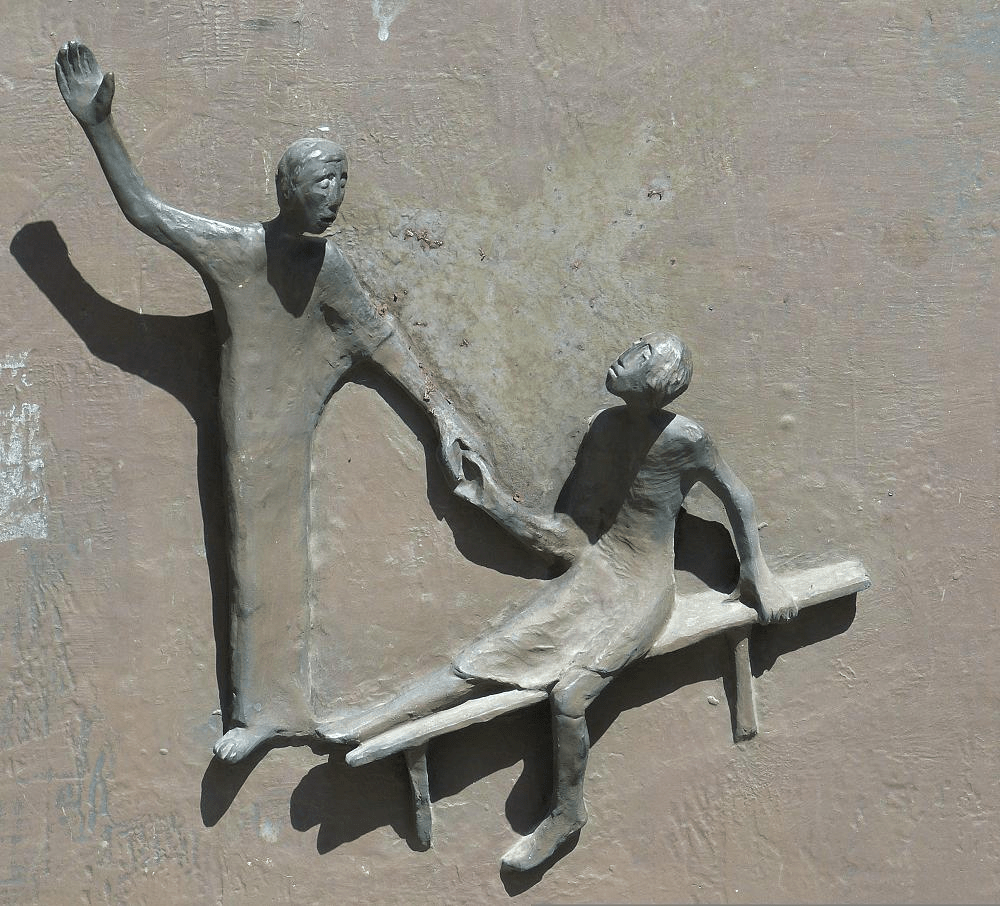
Some men brought to him a paralyzed man, lying on a mat. When Jesus saw their faith, he said to the man, “Take heart, son; your sins are forgiven.”

At this, some of the teachers of the law said to themselves, “This fellow is blaspheming!”

Knowing their thoughts, Jesus said, “Why do you entertain evil thoughts in your hearts? Which is easier: to say, ‘Your sins are forgiven,’ or to say, ‘Get up and walk’? But I want you to know that the Son of Man has authority on earth to forgive sins.” So he said to the paralyzed man, “Get up, take your mat and go home.” Then the man got up and went home. When the crowd saw this, they were filled with awe; and they praised God, who had given such authority to man.

As Jesus went on from there, he saw a man named Matthew sitting at the tax collector’s booth. “Follow me,” he told him, and Matthew got up and followed him.

While Jesus was having dinner at Matthew’s house, many tax collectors and sinners came and ate with him and his disciples. When the Pharisees saw this, they asked his disciples, “Why does your teacher eat with tax collectors and sinners?”

On hearing this, Jesus said, “It is not the healthy who need a doctor, but the sick. But go and learn what this means: ‘I desire mercy, not sacrifice.’ For I have not come to call the righteous, but sinners.” (New International Version)

“The church is a hospital for sinners, not a museum of saints.”

Abigail Van Buren (“Dear Abby”)

Why does the Church exist? Why did Jesus come to this earth? What are we supposed to be doing? Does Christianity make any difference in this world? Why are we here?

The Church is not on this earth solely for the benefit of Christians, any more than a hospital exists for the benefit of the doctors or insurance companies.

Rather, the Church is designed to extend the mission of Jesus through proclamation of good news with the restorative touch of grace. The Church is the community of the redeemed, gathered together for worship and encouragement, and then sent into the world to be the continuing presence of Jesus on this earth.

This mean that the Church’s calling is not to find others who can help them with their tithing and budget, or to keep the pews warm with fresh bottoms.

Some folks are not healthy. Some are sick physically, and others spiritually. Even more are emotionally brokenhearted. And then there are those who are sick-and-tired of being sick-and-tired.

Please know that Jesus came neither to condemn nor heap a pile of unrealistic expectations on us. Christ points us to the source of healing and transformation, and invites us to come to him. 

Conversely, there are many other people today who are healthy, spiritually alive, and have a good well-being. And they possess the opportunity to participate in ways that bring holistic healing to the world as Christians. The mission of Jesus is our mission, as well.

Jesus came to bring forgiveness and transformation. In today’s Gospel healing, it was a case where the person’s paralysis was both physical and spiritual. The paralytic found in Jesus healing of both body and soul.
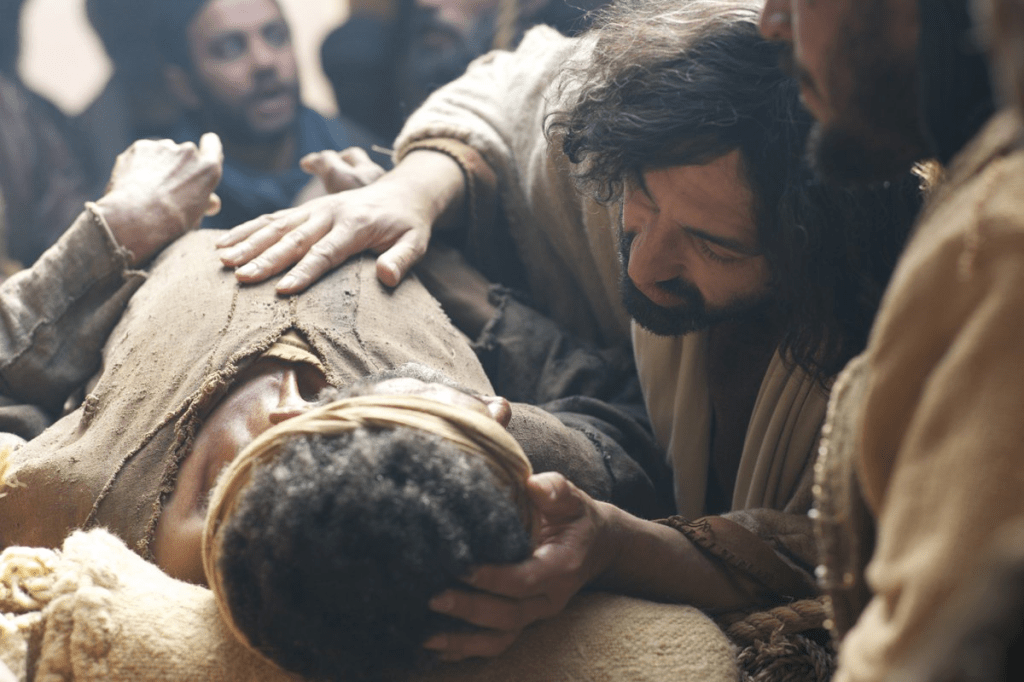
The religious insiders observed the healing of the paralytic. Yet, they didn’t rejoice over it. Instead, they were hung up on Jesus claiming to be God. Although this may have been a hard truth to accept, Jesus labeled their response as evil – because of an inability to perceive the situation as a divine intervention. Since the religious insiders wrongly discerned who Jesus is, they wrongly interpreted the situation. 

It’s important to see Jesus as the Human One who extends compassion and forgiveness. If we fail to see this about Christ, we will get caught up in all kinds of silly matters concerning personal preferences and power plays, based in how we think things should go, rather than how God is shaking out things.

Jesus came to forgive our guilt and shame. Healing the body is good, but it’s not enough. Christ came to heal both the body and the spirit. At the heart of the human condition is spiritual brokenness, and Jesus wants to remove the obstacle of sin and create a new healthy society. This is a radical vision which seeks to encompass all persons – which means Jesus touched many people overlooked by others.

Jesus came to call the despised people of society, the “sinners.” He called Matthew, a tax collector. Tax collectors were hated. They were corrupt characters who extorted money from innocent people. And furthermore, Jesus had dinner with Matthew, along with all of his unsavory buddies. This kind of behavior by Jesus was deeply offensive to upstanding citizens.

However, Jesus did not back down, saying that it’s not the healthy who need a doctor, but the sick. And he backed up his social actions with Scripture by encouraging offended folks to meditate on what the biblical phrase, “I desire mercy, not sacrifice.” (Hosea 6:6)
It is possible to engage in outward rituals of worship, do all the right things, fulfill duty, yet still miss the heart of what God wants for humanity. Mercy is what God wants. Jesus knew this. So, Christ entangled himself with sinners to bring spiritual healing and restoration.

If we want to see God deliver people from their unhealthy situations, we must entangle ourselves with them, into complicated lives that are not pretty, with persons who have been tainted by sin. 

Lots of people are in awful predicaments. Christians, like their Lord, will need to get their hands dirty and their feet wet to extend Christ’s ministry of mercy and forgiveness.

The gospel was never intended to be proclaimed from afar, but up close and personal. The merciful mission of Jesus requires the following three activities:

  1. Intimacy with Jesus. Engaging in the spiritual disciplines of prayer, giving, fasting, reading, and meditating on Scripture. These practices help us to know Christ better and how to respond with mercy.
  2. Intimacy with fellow believers. We are hard-wired by God for community. Superficial relationships only provide superficial community. Christians need to help one another with spiritual growth, and to hold one another accountable for the mission of Christ.
  3. Intimacy with “sinners.” This world is filled with sick, needy, hurting, and lonely people who are locked in unhealthy patterns of living. They need a merciful change of life that comes from the merciful Jesus acting through merciful Christians. 

Mercy, not judgment, is at the heart of all change. For things to be different, we must be acquainted with mercy.

Most merciful God, we confess we have sinned against you in thought, word, deed, and neglect. We have not held fast to your commandments and have strayed from your teachings. We turn away from self-centered actions and pride. For the sake of your Son, Jesus, have mercy on us and forgive us so that we are released from all sinful obstacles. Empower us with your wisdom, revelation, and discernment so that we might be your merciful hands, feet, and words to one another and those who do not yet know you. Amen.

Have a Healthy Spiritual Heart (Matthew 12:9-14)

Going on from that place, he went into their synagogue, and a man with a shriveled hand was there. Looking for a reason to bring charges against Jesus, they asked him, “Is it lawful to heal on the Sabbath?”

He said to them, “If any of you has a sheep and it falls into a pit on the Sabbath, will you not take hold of it and lift it out? How much more valuable is a person than a sheep! Therefore it is lawful to do good on the Sabbath.”

Then he said to the man, “Stretch out your hand.” So he stretched it out and it was completely restored, just as sound as the other. But the Pharisees went out and plotted how they might kill Jesus. (New International Version)

The juxtaposition of this story is pronounced: A man with a shriveled hand stretched it out and is healed by Jesus in full view of everyone in the synagogue; and the synagogue leaders with shriveled hearts withhold their hearts from Jesus, and are not healed of their paralyzed beliefs.

Asking questions out of a desire to make a point, instead of asking out of sincere curiosity, is a telltale sign of the small and shriveled heart. And the surefire signal that the heart is wadded-up like a crumpled piece of paper, is the concern for policy and procedure over people.

There was, of course, an allowance for life-threatening medical situations to be attended to on the Sabbath. The man’s shriveled hand, however, didn’t fall into this category. Jesus could have handled the question of healing by stating that he would do it the next day. That certainly would have protected him and quelled any concerns of his orthodoxy.

But Jesus didn’t go there.

Jesus heals the man with a withered hand, from a 17th century Arabic copy of the Gospels

Instead, he deliberately made a stink in front of everyone. Why? Because the whole situation already stunk to high heaven. The ensconced handling of the law by the religious authorities was calloused to real human need. In other words, such a view of the law was ungodly.

Somewhere along the line, the command of a Sabbath day’s rest had turned from a devoted time for community renewal to an opportunity for showing off one’s religiosity and personal piety.

And the height of offense for Jesus was that God was used as the justification for the peacocking to happen. It is to place the supreme spirituality of a holy person above the hard reality of human need and pain. Jesus wanted nothing to do with such a charade of law.

The divine purpose of the Sabbath command was the health of the entire community – even including animals. It’s meant to be a day of mercy, and not a day of restrictions to the point of perpetuating or even causing ill health.

In truth, to not heal on the Sabbath is a travesty of God’s law.

This isn’t only an ancient problem, but also a contemporary issue, as well. One reason so many modern people today believe that Christianity (and, in some cases, all religion) is nothing but a bunch of goofiness, is that there are far too many Christians and churches who espouse a reading of Scripture that is unhealthy instead of healthy.

Whenever Holy Scripture is used a weapon to keep women in check, existing power structures in place, and people different from one’s religious tradition out of congregational life, then such a practice will eventually be challenged by Jesus. And, ironically, all the nice religious folk will turn on Christ and plot how to be rid of him altogether.

And who, pray tell, wants to be a part of that sort of goofiness?

The bottom line, for many people, is their wealth, money, property, and resources. And if someone happens to get in the way of those economic resources, well then, we’ll simply reinterpret existing biblical commands to protect and maintain our stuff.

For Jesus, the whole point of the banter in the synagogue was to actually help the man right in front of him – to do the right thing on the Sabbath day, and not the hard-hearted thing of nothing.

Sabbath is intended to give everyone, without exception, an opportunity to “be” instead of “do.” The Sabbath is designed for the interests and betterment of all creation, all humanity, and not the other way around. The very fact that the upstanding religious folk even have to be told this, signals that they have drifted very far from the actual commands of God.

“If Jesus had been more diplomatic, he may have reformed Judaism, but he would not have won the world. He would not have give us a gospel that serves the depth intention of the law by freeing us from a slavish service to its surfaces.”

Frederick Dale Bruner

In short, Jesus healed the man’s shriveled hand. But the pious religious persons were not healed of their shriveled hearts. Instead, they were mad as hell. They held an after-church meeting in the parking lot about how to do away Jesus, once and for all.

They did this because the entire movement of maintaining religious power and authority was being threatened to the core.

There are those who hate the one who upholds justice in court and detest the one who tells the truth. (Amos 5:10, NIV)

Therefore, I strongly urge every believer in Jesus Christ to be completely devoted to the Scriptures of the Old and New Testaments, by actually reading them every day; instead of relying upon slick preachers who tell you what you like to hear.

Be discerning and wise in the reading, hearing, and study of God’s Holy Word. It’s a matter of health and illness, hope and despair, life and death. Don’t have a shriveled heart; have a healthy heart, my friend.

Almighty God, to you all hearts are open, all desires known, and from you no secrets are hid: Cleanse the thoughts of our hearts by the inspiration of your Holy Spirit, that we may perfectly love you, and worthily magnify your holy Name; through Christ our Lord. Amen.

Epiphany of the Lord (Isaiah 60:1-6)

Adoration of the Magi, Basilica of the National Shrine of the Immaculate Conception, Washington D.C.

“Arise, shine, for your light has come,
    and the glory of the Lord rises upon you.
See, darkness covers the earth
    and thick darkness is over the peoples,
but the Lord rises upon you
    and his glory appears over you.
Nations will come to your light,
    and kings to the brightness of your dawn.

“Lift up your eyes and look about you:
    All assemble and come to you;
your sons come from afar,
    and your daughters are carried on the hip.
Then you will look and be radiant,
    your heart will throb and swell with joy;
the wealth on the seas will be brought to you,
    to you the riches of the nations will come.
Herds of camels will cover your land,
    young camels of Midian and Ephah.
And all from Sheba will come,
    bearing gold and incense
    and proclaiming the praise of the Lord. (New International Version)

We are drawn to light. I don’t know if you have ever been in a situation with complete darkness surrounding you. When things are totally dark, we begin to fear and panic.

I grew up in a rural area in which there were no lights at night, other than the moon and the stars. More than once, I got myself into a situation, when the sky was overcast, in which I didn’t have a flashlight and could not see my hand in front of my face. I was groping to discern any little bit of light that I could see. Without the light, I was lost.

Our souls are also drawn to light. We no longer want to have darkness enveloping us; we cannot live with the darkness residing within our hearts. This is one reason why the Magi were attentive to the bright star over Bethlehem, and traveled toward it. We have a need for light because nobody can abide in darkness for too long.

The glory of the Lord is associated with bright light. Spiritually, we can find ourselves in such darkness that it’s impossible to discover light, unless God shows up displaying divine mercy and glory.

The Christian season of Epiphany has to do with this divine light. Each year on January 6, on the Church Calendar, and after the twelve days of Christmas, is the celebration of Epiphany. 

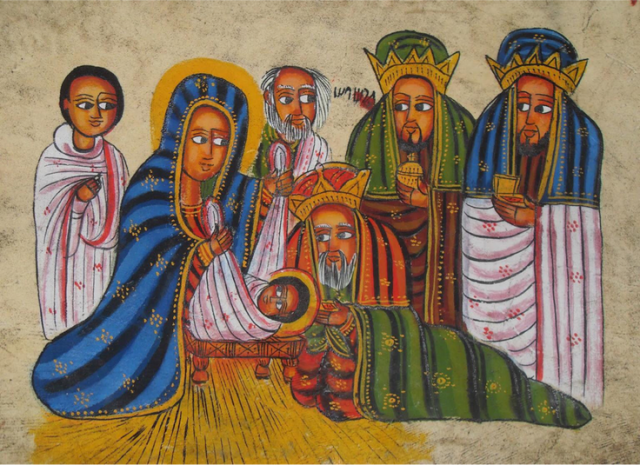
The Three Kings, Ethiopian Orthodox Church

It is a celebration of light – that Christ came to this earth as a child and became like us. Epiphany helps to bring a vision and understanding of God’s glory to all kinds of people in the world.

“Epiphany” literally means “manifestation” or “appearance.” The event most closely associated with this season is the visit of the Magi to Jesus. Included in this time of the year between the seasons of Christmas and Lent is a special emphasis on the teaching and healing ministry of Jesus. 

The people walking in darkness
    have seen a great light;
on those living in the land of deep darkness
    a light has dawned. (Isaiah 9:2; Matthew 4:16, NIV)

The great celebration and focus of these weeks is that salvation is not limited to Israel but extends to the Gentiles, as well.

“I will also make you a light for the Gentiles, that my salvation may reach to the ends of the earth.” (Isaiah 49:6; Luke 2:32; Acts 13:47, NIV)

In this season of Epiphany, the manifestation of God’s grace is one of the most scandalous truths of Christianity: God graces common ordinary people, who seem far from God, with the gift of Jesus. 

God grants repentance that leads to life for all kinds of people, no matter what their race, ethnicity, class, or background. It is a wondrous and astounding spiritual truth that God’s merciful concern is not limited to a certain type of person or a particular group of people.

Grace is (and ought to be) the guiding factor in how we interact with people. 

Losing sight of grace leads to being critical and defensive. Like King Herod of old, a graceless person becomes enamored with earthly power and control. But embracing grace, leads to humility, so that we see the image of God in people very different from ourselves. 

Like the Apostle Peter, who learned in a vision to bring the gospel to non-Jews, old legalisms begin to wear away so that people from all walks of life can have access to Jesus and his gracious saving and healing ministry. 

Grace brings down barriers and causes us to do away with unnecessary distinctions between others. And so, the appropriate response to such a grace is to glorify God for this marvelous and amazing work.

It is a gracious and merciful reality that the Magi, or Wise Men, who were really pagan astrologers, were directed to the Messiah. A light was provided to lead them to Jesus. Apart from God’s care and intervention they would have remained in darkness. 

And it is no less true for people today. This old broken world has a lot of shadowy places to it; there is darkness all around.  All kinds of people have no light at the end of the tunnel of their lives for hope and new life. But the gospel of Jesus Christ brings that light to those walking around with no ability to see. And Jesus exhorted his followers to be the reflectors of divine light for the world.

“Let your light shine before others, that they may see your good deeds and glorify your Father in heaven.”

Jesus (Matthew 5:16, NIV)

Sometimes, maybe oftentimes, the best way to bring resolution to our own troubles and problems is through helping others make sense of their lives through the gracious light of Christ so that they can see an appearance, an epiphany, of what their lives can be in the gracious rule of the kingdom of God. 

As we celebrate Epiphany and journey with Jesus through his earthly upbringing and into his gracious ministry to people, let us keep vigilance to not let our light grow dim. Instead, let us hunger and thirst after Christ’s righteousness so that our joy is full and our light is bright.

God of radiant light, your love illumines our hopes before we know them, and our needs before we ask. Kindle your flame within us, that in our prayers and service, we may know your transforming presence at work in the world around us. All this we ask through Jesus Christ, our Lord. Amen.

Mary’s Magnificat (Luke 1:46b-55)

The Magnificat, a woodcut by Sr. Mary Grace Thul

Mary said,

“With all my heart I glorify the Lord!
    In the depths of who I am I rejoice in God my savior.
He has looked with favor on the low status of his servant.
    Look! From now on, everyone will consider me highly favored
        because the mighty one has done great things for me.
Holy is his name.
    He shows mercy to everyone,
        from one generation to the next,
        who honors him as God.
He has shown strength with his arm.
    He has scattered those with arrogant thoughts and proud inclinations.
    He has pulled the powerful down from their thrones
        and lifted up the lowly.
He has filled the hungry with good things
    and sent the rich away empty-handed.
He has come to the aid of his servant Israel,
        remembering his mercy,
    just as he promised to our ancestors,
        to Abraham and to Abraham’s descendants forever.” (Common English Bible)

Mary, the mother of Jesus, was able to wrap both her head and heart around an incredible reality – that God had done great things for her. And it was enough for her to erupt into a great song of praise. Indeed, the Lord shows mercy to everyone who worships and adores the mighty acts of God.

It strikes me that Mary, instead of being full of worry and afraid of the future, and as an unmarried teen with child, is full of the Spirit and faith. Mary neither complained nor fretted for the nine months of her pregnancy; she praised God and was clear-headed about the grace shown to her.

Mary’s canticle gives us insight into the mystery of the incarnation: God chooses the weak, those of low esteem, and the powerless. Mary was quite ordinary for her day. She had no wealth and nothing which would cause anyone to pick her out of a crowd.

Yet, Mary is the one chosen by God. And her wonderful response to grace demonstrated that there is so much more to any person than what we can see with our eyes and perceive through our earthly glasses of high positions and strength of personalities.

What’s more, Mary had the wisdom to discern that her situation typified the Lord’s egalitarian work of leveling the field so that all persons have what they need. Her son, the Messiah, would carry this into his own life and ministry – declaring good news to the poor, comforting the brokenhearted, proclaiming freedom for captives, telling those who mourn that the time of the Lord’s favor has come.

We may tend to think that the work of God is surprising, only because we might often experience so little of grace and mercy in this old world. But God is always full of grace, mercy, and power to those who are powerless and in need of help. The Lord has our backs. 

Perhaps if we all, both individually and corporately, continually used our words to identify and declare the great things God has done, we would then realize the consistent blessing of the Lord. 

I encourage you to take some time today and either journal and/or speak with another about the ways in which God has been good to you in this Advent season, and like Mary, offer praise for each act of mercy. Mary exhibited no helplessness but had her heart calibrated to detect the grace of God when it was present.

May the joy of the angels, the eagerness of the shepherds, the perseverance of the wise, the obedience of Joseph and Mary, and the peace of the Christ child be yours this Christmas. And may the blessing of God almighty – Father, Son, and Spirit – be among you and remain with you always. Amen.