Be Merciful to Me (Psalm 57)

“For thy mercy is great unto the heavens, and thy truth unto the clouds.” (Psalm 57:10, KJV) by Bible Art

Be merciful to me, O God; be merciful to me,
    for in you my soul takes refuge;
in the shadow of your wings I will take refuge,
    until the destroying storms pass by.
I cry to God Most High,
    to God who fulfills his purpose for me.
He will send from heaven and save me;
    he will put to shame those who trample on me.
God will send forth his steadfast love and his faithfulness.

I lie down among lions
    that greedily devour human prey;
their teeth are spears and arrows,
    their tongues sharp swords.

Be exalted, O God, above the heavens.
    Let your glory be over all the earth.

They set a net for my steps;
    my soul was bowed down.
They dug a pit in my path,
    but they have fallen into it themselves.
My heart is steadfast, O God;
    my heart is steadfast.
I will sing and make melody.
    Awake, my soul!
Awake, O harp and lyre!
    I will awake the dawn.
I will give thanks to you, O Lord, among the peoples;
    I will sing praises to you among the nations.
For your steadfast love is as high as the heavens;
    your faithfulness extends to the clouds.

Be exalted, O God, above the heavens.
    Let your glory be over all the earth. (New Revised Standard Version)

The Human Condition

Maybe it’s just me, yet it seems, over the past several years, that our world has become increasingly depressed, jaded, and unkind. Things like appreciation and encouragement of others are found less and less as time goes on. It’s as if we are all in some sort of collective funk, in which everyone has an underlying sullenness and frustration about them.

Humanity has suffered a great deal of change and loss, without a healthy means of grieving and lamenting for what has happened to them. In other words, we simply don’t know what to do with our hurt, so we end up projecting our hurt onto others. *Sigh*

There is something that we all share together about the human experience: Sooner or later, someone or a group of people will let us down. They will hurt us in some way. And that hurt will change us – either for good or for ill.

What’s worse, many have experienced, or will experience, some sort of abuse and victimization from another person or group – leaving them scarred by trauma. And, what’s more, there are those who have had their very lives at risk, because someone intentionally sought to kill them. 

King David’s Condition

That is the company David found himself in when King Saul, and the later when his son Absalom, sought to do away with his life.

To David’s credit, he never retaliated and did not try and turn the tables by putting a hit out on either Saul or Absalom. Instead, David cried out to God. And we get to listen in on the prayer. Today’s psalm is David’s prayerful reliance upon the God in whom he put all his trust and praise. 

The entire basis of prayer is to let God be God. So, how do we exactly do that?

Our Condition

Whenever the storms of life assail us, calloused persons trample on us with impunity, devious individuals set traps for us, and greedy organizations prey upon us, we must refuse to respond in kind.

Instead, let us deliberately praise the Lord, rely on divine protection, and pray to God, so that we might steadfastly hold on to our confidence. Because if God is for us, nothing nor no one, can be against us.

That advice may seem like a sort of pie-in-the-sky rot of ginning up positive thoughts when there is nothing positive to be seen in the experience. Yet, please keep in mind that we must never, and I repeat, never invalidate another’s experience, nor our own, when those experiences are hellish.

There is always hope. There are two unshakable truths which are constant, and are never diminished by any adverse circumstance:

  1. God is present with us
  2. God loves us

If we know nothing else, and everything seems to be descending into the abyss of tragedy, the twin towers of divine presence and divine mercy stand guard as the strongest sentinels over our dilapidated situation, and struggling faith.

Letting God be God means not to try and control things we have no control over. Rather, it means to affirm that the Lord is willing and capable of handling our worst stuff.

It could be that we are stuck in the belly of a whale because, without our knowing it, there are sharks surrounding us, who cannot get to us because of divine attention and protection.

Our perspective of life-circumstances is, at best, severely limited. It is much better to place faith in the God who sees it all, with an expansive eye which misses nothing.

One of the best things, to me, about the psalms is that they are a wonderful collection of prayers we can adopt for our own. Not only can we use them for ourselves, but we are also obliged to do so. 

If anyone has been in an adverse situation, so deep that it feels like having ambled into a pride of lions, it’s quite likely that the experience leaves one with no adequate words to say. There we are – paralyzed with fear, and unable to move. 

So, let the psalm say for you what you cannot even begin to utter yourself. The Word of God is not meant to sit on a coffee table,  or to rest on a shelf; it is meant to be opened and used for prayer. Allow it to do its intended purpose.

Who knows? Perhaps your faith in the mercy of God, and your praises lifted to God, will give rise to a newfound confidence and peace, so that you can rest secure, even when all around you is going to hell.

Be merciful to me, O God, for in you my soul takes refuge. Even though I feel the slash of people with tongues as swords, my heart is steadfast, and I will exalt your name above the heavens. Let your glory be over all the earth! Amen.

A Sad Family Situation (2 Samuel 14:25-33)

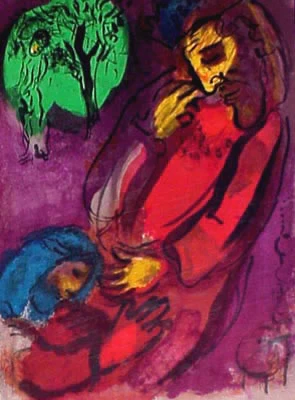
David and Absalom, by Marc Chagall, 1956

In all Israel there was not a man so highly praised for his handsome appearance as Absalom. From the top of his head to the sole of his foot there was no blemish in him. Whenever he cut the hair of his head—he used to cut his hair once a year because it became too heavy for him—he would weigh it, and its weight was two hundred shekels by the royal standard.

Three sons and a daughter were born to Absalom. His daughter’s name was Tamar, and she became a beautiful woman.

Absalom lived two years in Jerusalem without seeing the king’s face. Then Absalom sent for Joab in order to send him to the king, but Joab refused to come to him. So he sent a second time, but he refused to come. Then he said to his servants, “Look, Joab’s field is next to mine, and he has barley there. Go and set it on fire.” So Absalom’s servants set the field on fire.

Then Joab did go to Absalom’s house, and he said to him, “Why have your servants set my field on fire?”

Absalom said to Joab, “Look, I sent word to you and said, ‘Come here so I can send you to the king to ask, “Why have I come from Geshur? It would be better for me if I were still there!”’ Now then, I want to see the king’s face, and if I am guilty of anything, let him put me to death.”

So Joab went to the king and told him this. Then the king summoned Absalom, and he came in and bowed down with his face to the ground before the king. And the king kissed Absalom. (New International Version)

Parents are people, and so, they don’t always make sense. David was both a king and a parent. And those two roles often got mixed and complicated for him.

David’s son Abasalom had killed another son, Amnon, who had sexually assaulted a daughter, Tamar, Abasalom’s sister. Yes, it sounds a lot like a Bible soap opera.

Joab, David’s military general (and cousin) convinces the king to bring Absalom back to Jerusalem, having fled Jerusalem after killing Amnon. And David did so. Yet, he gave an order that Absalom was not to come into his presence, even though David longed for his son.

It was a case of the nonsensical – the parental approach of yearning for an adult child, while at the same time, shunning and shaming them. Indeed, these were incongruent actions on the part of David.

When Tamar was assaulted, David found out and was very angry; yet he neither dealt with Tamar by giving her support and compassion, nor dealt with Amnon in meting out justice.

As for Absalom, David’s feelings for him did not translate into action. It appears the story wants us to see the wide gap between King David’s emotions and actions.

Perhaps the emphasis on Absalom’s sheer beauty is designed to emphasize the incongruence of David – this handsome man is put at arm’s length by his father. Furthermore, this behavior would eventually put David’s royal position in jeopardy.

When guilt and shame are not confronted, it leads to a downward spiral into continued levels of degradation.

The assault of Tamar led to the murder of Amnon, which led to the inactions of David. Everyone ended up responding to someone else’s guilt by adding their own guilt to it. In this scenario, everyone loses something, and there is a lot of unnecessary grief.

Abasalom returned to his hometown of Jerusalem. But everything had changed. He was simply existing. Honestly, Absalom needed something, anything, instead of living day after day in a house without any love or acceptance. Absalom was in that awkward place of wanting either mercy or judgment, acceptance or punishment, because to live in limbo was shrinking him to nothing.

For those who know the story of David and Absalom, you understand where all of this family dysfunction is leading; and it will not end well.

It could be that Jesus had this story in the back of his head when he told the parable of the prodigal son (Luke 15). Perhaps Christ wanted us to see what could happen when a father chooses to respond with actions of grace, acceptance, and undeserved kindness. Even though the son had done something awful and was full of guilt, when he finally made his way home, the father ran to him, embraced him, and accepted him with a blowout party.

We can only wonder what would have happened had David stepped into the situations of his children’s lives when they were going awry. Methinks that had David done so, with his characteristic wisdom and mercy, there would have been a very different outcome in his family.

One way of viewing this story is that the incongruence of King David toward Absalom, with his combination of longing and rejection, was a stubborn passive-aggressive refusal to give his son the grace and love which God had given to him. In light of the story’s eventual end, this view makes a lot of sense.

Yet, this doesn’t have to be the same for you or me in our family relationships today. We can choose to love, instead of inflexibly holding on to a denial of love. One can do all the mental gymnastics of justifying that denial by believing you’re teaching the kid a lesson, or giving them what they deserve, but it’s really, at it’s core, choosing not to love with the love provided by God.

Réconciliation d’Absalom et de David, by Gabriel de Saint-Aubin, 1752

Absalom eventually entered David’s throne room and received a kiss. But it was simply too little, too late. And that’s why, at some point after this, Absalom decided to replace his emotionally and actively distant father as king.

If guilt, shame, evil, and sin go unchecked for too long, it makes for a terrible mess of people’s lives; and usually results in either verbal violence, physical violence, or both.

But it doesn’t have to be that way….

For being quick to see the sins of others, and slow to repent of our own, forgive us, Lord.

For clinging to remembered hurts, and brushing off gestures of kindness, forgive us, Lord.

For the divisions among us that damage our mission to the world, forgive us, Lord.

For the work we have not done because we refused to do it together, forgive us, Lord.

For these and all our sins, O God, we weep in sorrow and ask for your forgiveness, through Jesus Christ our Lord. Amen.

Showing God’s Kindness (2 Samuel 9:1-13)

King David reaching out and receiving Mephibosheth, 13th century Bible illustration

David asked, “Is there anyone from Saul’s family still alive that I could show faithful love for Jonathan’s sake?” There was a servant from Saul’s household named Ziba, and he was summoned before David.

“Are you Ziba?” the king asked him.

“At your service!” he answered.

The king asked, “Is there anyone left from Saul’s family that I could show God’s kindness to?”

“Yes,” Ziba said to the king, “one of Jonathan’s sons, whose feet are crippled.”

“Where is he?” the king asked.

“He is at the house of Ammiel’s son Machir at Lo-debar,” Ziba told the king.

So King David had him brought from the house of Ammiel’s son Machir at Lo-debar. Mephibosheth, Jonathan’s son and Saul’s grandson, came to David, and he fell to the ground, bowing low out of respect.

“Mephibosheth?” David said.

“Yes,” he replied. “I am at your service!”

“Don’t be afraid,” David told him, “because I will certainly show you faithful love for the sake of your father Jonathan. I will restore to you all the fields of your grandfather Saul, and you will eat at my table always.”

Mephibosheth bowed low out of respect and said, “Who am I, your servant, that you should care about a dead dog like me?”

Then David summoned Saul’s servant Ziba and said to him, “I have given your master’s grandson everything belonging to Saul and his family. You will work the land for him—you, your sons, and your servants—and you will bring food into your master’s house for them to eat. But Mephibosheth, your master’s grandson, will always be at my table.” (Now Ziba had fifteen sons and twenty servants.)

Then Ziba said to the king, “Your servant will do whatever my master the king commands.”

So Mephibosheth ate at David’s table, like one of the king’s own sons. Mephibosheth had a young son named Mica. All who lived in Ziba’s household became Mephibosheth’s servants. Mephibosheth lived in Jerusalem, because he always ate at the king’s table. He was crippled in both feet. (Common English Bible)

This is actually one of my favorite stories in all of Holy Scripture. It clearly demonstrates why David is a king and a person who reflects God’s own heart. I believe that King David is at his best here, ruling and living exactly as the Lord wanted him to.

In much of the ancient world, whenever a king came to power and replaced the previous king of whom he was not related, it was a common practice to either exile or outright kill the sons and grandsons who would have become heirs to the throne. It was a literal cutthroat way of securing the new throne, by wiping out any potential rivals.

It’s quite possible that no one would have faulted David or batted an eye if he had made sure there was nobody around related to King Saul – who died in a battle with the Philistines. Not only did David avoid that practice, but he did just the opposite of it.

Finally on the throne of both Israel and Judah, one of the first acts of King David was to wield his power and authority by finding out if there were any relatives of Saul that he could show faithful love toward.

I can just imagine the servant of Saul, Ziba, being brought into David’s presence, thinking for sure that this is the end. Instead, David wanted to know if there’s anyone in Saul’s family to which he could show kindness.

The word King David used to communicate his benevolent intentions was “chesed” (חסד – pronounced “KES-ed”). This is rich Hebrew word which refers to God’s steadfast covenant loyalty and love toward Israel.

Because of its richness, chesed is translated various ways in the English translations, including: “mercy,” “kindness,” “loving-kindness,” “steadfast love,” “compassion,” and even “goodness.”

The big idea in today’s story is that David had the power to destroy, but instead used his authority in order to extend loving loyalty and mercy to Mephibosheth, son of Jonathan, and grandson of Saul – David’s old enemy and nemesis.

What’s more, David could have found out about Mephibosheth, learned that the man was crippled, in no position to ever do anything for or against him, and simply left him alone. And again, nobody likely would have thought anything about ignoring the man.

But not David. He was determined to embody chesed in the life of Mephibosheth. So, he brought him to Jerusalem and provided for him by having him sit at the king’s table for the rest of his life.

David didn’t have to do that. Yet, God’s steadfast love compelled him. You know grace has a hold of someone’s life, whenever they go out of their way to extend human kindness to another person who has absolutely no means of paying them back or reciprocating at all.

Jesus, the Son of David, clearly understood the idea of chesed and lifted it, taught it, and embodied it for his own followers:

“If you love those who love you, why should you be commended? Even sinners love those who love them. If you do good to those who do good to you, why should you be commended? Even sinners do that. If you lend to those from whom you expect repayment, why should you be commended? Even sinners lend to sinners expecting to be paid back in full. 

“Instead, love your enemies, do good, and lend expecting nothing in return. If you do, you will have a great reward. You will be acting the way children of the Most High act, for he is kind to ungrateful and wicked people. Be compassionate just as your Father is compassionate. (Luke 6:32-36, CEB)

I wonder who it is that God wants you to show grace, mercy, and love toward?

Lord Jesus, as you commanded us to love one another, just as you love us, help us to demonstrate that love toward others. We acknowledge that it is impossible on our own, so we ask for the enabling of your Holy Spirit to produce that love in us.

We believe that you love and care for those who are suffering from illness, violence and persecution. We pray for protection, comfort and healing for those in need or who are forgotten.

Enliven us with your Holy Spirit, so that we may be instruments of your peace and love in a troubled world. Use us and all believers as your ambassadors to our families, colleagues and neighbors.

Holy God, you demonstrated your love for us through the Resurrection of your Son and our Savior Jesus Christ. We commit to making decisions as who trust in your ever-present love and grace. Guide us in becoming a people who welcomes all, and values mutuality and partnerships.

Provide us courage and insight as we seek to be a community who provides respite, and a place to sooth souls. Grant us all the things necessary for our common life, and bring us to be of one heart and mind within your Church; through Jesus Christ our Lord. Amen.

The Grace of Redemption and Gratitude (Exodus 37:1-16)

Bezalel made the ark of acacia wood—two and a half cubits long, a cubit and a half wide, and a cubit and a half high. He overlaid it with pure gold, both inside and out, and made a gold molding around it. He cast four gold rings for it and fastened them to its four feet, with two rings on one side and two rings on the other. Then he made poles of acacia wood and overlaid them with gold. And he inserted the poles into the rings on the sides of the ark to carry it.

He made the atonement cover of pure gold—two and a half cubits long and a cubit and a half wide. Then he made two cherubim out of hammered gold at the ends of the cover. He made one cherub on one end and the second cherub on the other; at the two ends he made them of one piece with the cover. The cherubim had their wings spread upward, overshadowing the cover with them. The cherubim faced each other, looking toward the cover.

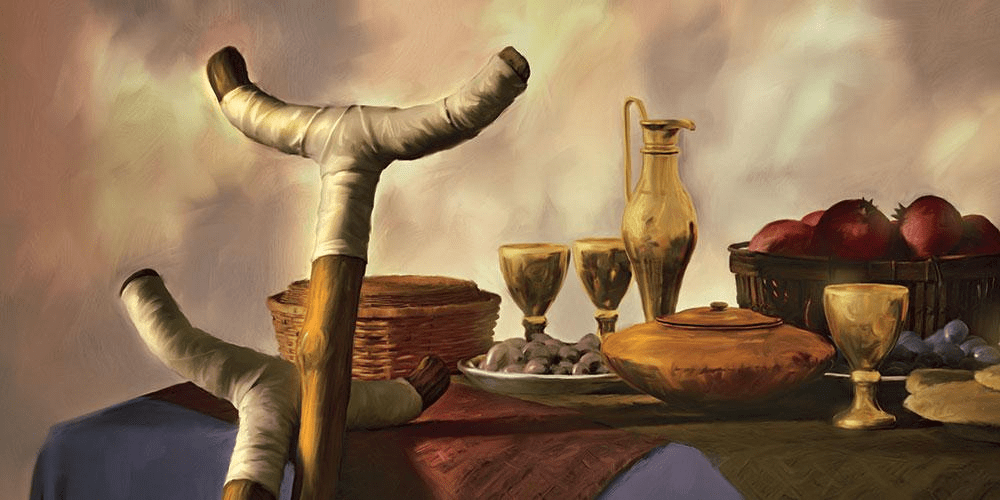
They made the table of acacia wood—two cubits long, a cubit wide and a cubit and a half high. Then they overlaid it with pure gold and made a gold molding around it. They also made around it a rim a handbreadth wide and put a gold molding on the rim. They cast four gold rings for the table and fastened them to the four corners, where the four legs were. The rings were put close to the rim to hold the poles used in carrying the table. The poles for carrying the table were made of acacia wood and were overlaid with gold. And they made from pure gold the articles for the table—its plates and dishes and bowls and its pitchers for the pouring out of drink offerings. (New International Version)

This section is, for the most part, a mirror image of Exodus 25:23-40 – which provides meticulous instructions from God on how to build the Ark of the Covenant and the Table that goes with it.

The purpose of this section in Holy Scripture is to give a detailed report that everything the Lord instructed Moses to do, was obediently done, down to every last detail.

This was of upmost importance to the biblical writer, because half-obedience is really not obedience, at all. And there needs to be obedience in order to realize blessing.

God had a purpose with ancient Israel to establish them as God’s people, with God dwelling amongst them. The way this would happen was by means of all the specific prescriptions for the Tabernacle with its worship implements.

Foremost amongst those worship implements was the Ark and the Table, simply because that was the place of meeting with God – and even more specifically – the place of redemption.

The Tabernacle was built, then erected and put into place, just as it was described by God to Moses. And that is the point. The Lord does not change. There was no Plan B or altering the agenda as things went along, because human sin and people’s foibles mucked up everything. No, that’s not how it went down.

Nothing detracts or sidelines God from accomplishing divine purposes – especially when it comes to redeeming people and coming alongside them.

Just because the Israelites disastrously made an idol in the form of a golden calf, and worshiped it as if it were God, did not mean God’s plan failed.

In fact, the Lord made the plan even better by showing exceeding grace in not wiping out the entire lot of them – but instead used the situation to demonstrate steadfast love and accomplish the divine purpose of redemption.

No matter how you slice or dice it, it always comes out as grace.

My hope is that you can see that through all of the details of worship implements and Tabernacle protocol, God bent over backwards to be with the people.

God is holy. God is absolute purity and light. That holiness and purity would incinerate us in a nanosecond if we didn’t have things in place to help us be with God. That was what the Ark and the Table helped to do for Israel.

There are times in Holy Scripture when things get repeated. Repetition, according to many scholars, communicates emphasis. The repeated details of the Ark and the Table, as well as all the other articles associated with worship, communicate the heart of God in wanting us to have access to the divine. In other words, its repeated because it’s important.

Access, redemption, worship, and mercy are all important for the believer. We learn from today’s seemingly mundane verses that:

  • Sin must be addressed in order to have access to God
  • A way has been made for us to be with God
  • We are enabled and empowered to approach God
  • We have received the mercy of redemption from God
  • We are to therefore give mercy to others through table fellowship and forgiveness
  • And we are to give thanks and have gratitude in our hearts to God

Listening to the instructions of God, obeying them, and enjoying them is at the heart of good religion. May it be so, to the glory of God.

Accept, O Lord, our thanks and praise for all that you have
done for us. We thank you for the splendor of the whole
creation, for the beauty of this world, for the wonder of life,
and for the mystery of love.

We thank you for the blessing of family and friends, and for
the loving care which surrounds us on every side.

We thank you for setting us at tasks which demand our best
efforts, and for leading us to accomplishments which satisfy
and delight us.

We thank you also for those disappointments and failures
that lead us to acknowledge our dependence on you alone.

Above all, we thank you for your Son Jesus Christ; for the
truth of his Word and the example of his life; for his steadfast
obedience, by which he overcame temptation; for his dying,
through which he overcame death; and for his rising to life
again, in which we are raised to the life of your kingdom.

Grant us the gift of your Spirit, that we may know him and
make him known; and through him, at all times and in all
places, may give thanks to you in all things. Amen.