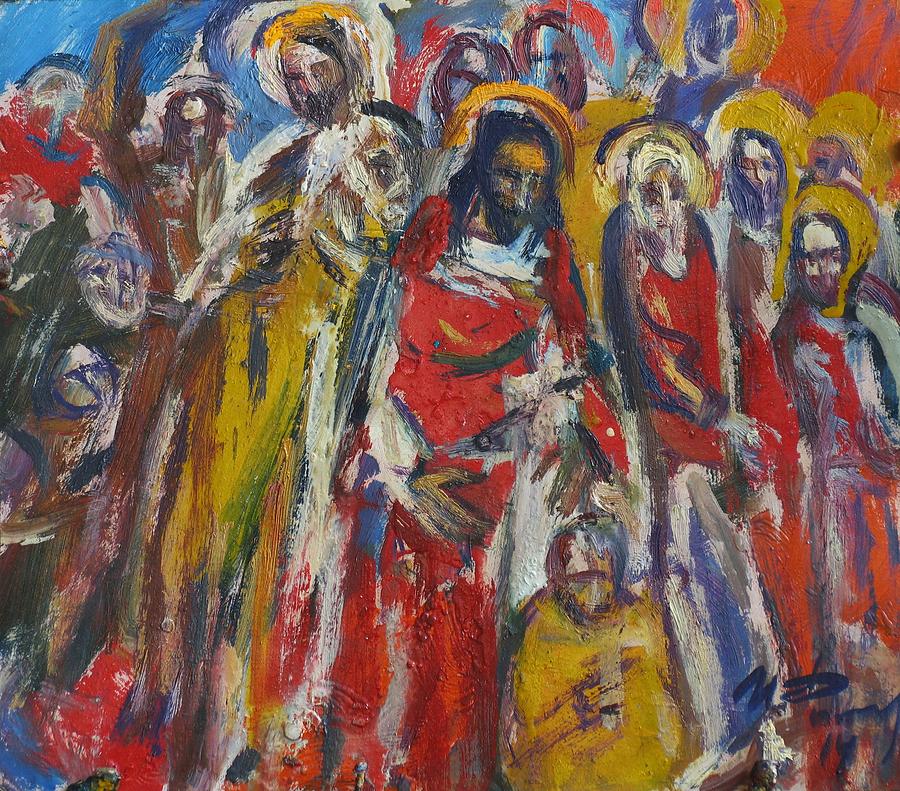
Matthew 9:2-13 – Why Jesus Came

Healing by Russian painter Ivan Filichev

Some men brought to Jesus a paralyzed man, lying on a mat. When he saw their faith, Jesus said to the man, “Take heart, son; your sins are forgiven.”

At this, some of the teachers of the law said to themselves, “This fellow is blaspheming!”

Knowing their thoughts, Jesus said, “Why do you entertain evil thoughts in your hearts? Which is easier: to say, ‘Your sins are forgiven,’ or to say, ‘Get up and walk’? But I want you to know that the Son of Man has authority on earth to forgive sins.” So, he said to the paralyzed man, “Get up, take your mat and go home.” Then the man got up and went home. When the crowd saw this, they were filled with awe; and they praised God, who had given such authority to man.

As Jesus went on from there, he saw a man named Matthew sitting at the tax collector’s booth. “Follow me,” he told him, and Matthew got up and followed him.

While Jesus was having dinner at Matthew’s house, many tax collectors and sinners came and ate with him and his disciples. When the Pharisees saw this, they asked his disciples, “Why does your teacher eat with tax collectors and sinners?”

On hearing this, Jesus said, “It is not the healthy who need a doctor, but the sick. But go and learn what this means: ‘I desire mercy, not sacrifice.’ For I have not come to call the righteous, but sinners.” (NIV)

The late Abigail Van Buren, better known as the newspaper columnist, “Dear Abby,” was the person who made famous the phrase: “The church is a hospital for sinners, not a museum of saints.” That quote is an accurate reflection of what Jesus was doing and saying. We occasionally need words like Dear Abby’s to remind and reorient us toward why the church exists.  

The church of the Lord Jesus does not remain on this earth solely for our benefit, any more than a hospital exists for the benefit of the doctors or insurance companies! Rather, the church lives to extend the mission of Jesus through proclamation of good news with the restorative touch of grace. The church’s calling is not to find others who can help them with their tithing and keep warm seats in the pew. Instead, the church is the community of the redeemed, gathered and sent to be the continuing presence of Jesus on this earth.

Some who are reading this are not healthy. Some are sick with sin; others are heart-sick; yet others are plain sick-and-tired of being sick-and-tired. Jesus came neither to condemn nor heap a pile of unrealistic expectations on us. Christ points us to the source of healing and change and invites us to admit our need and come to him. 

Conversely, many others today are healthy, spiritually alive, and well. It is our job to roll up our sleeves and serve, participating fully in the mission of Jesus to the world. The question I want us to grapple with is this: Why did Jesus come to this earth? The answer to that question is to also answer the question of our own purpose and existence as followers of Christ.

Jesus came to forgive sin and transform sinners.In today’s Gospel healing, it was a case where the person’s sin was connected to his paralysis – and the paralytic found in Jesus not only physical healing, but new spiritual life.

The religious insiders observed the healing. Yet there was no rejoicing by them about the transformation. Instead, they became hung up on Jesus claiming to be God. Granted, this was a hard truth for them to get a hold of. But Jesus labeled such thinking as evil – the inability to see and perceive the situation as a divine intervention, and that Jesus really is the Lord who graciously did it. Because they wrongly discerned who Jesus is, they wrongly interpreted the situation. 

Therefore, it is important to see Jesus as the Human One who extends compassion and forgiveness. If we fail to see this about Christ, we will get caught up in all kinds of silly matters of personal preference and ridiculous power plays, based in how we think things should go, rather than the gospel.

Jesus came to forgive sin. Healing the body is good but not enough. Just focusing on the physical well-being of individuals was not why Christ came. At the heart of the human condition is spiritual brokenness, and Jesus is all about taking away guilt and shame, creating a new person and a new community. It is a radical vision which seeks to encompass all persons – which means Jesus touched many people overlooked by others.

Jesus came to call the despised people of society, the “sinners.” He called Matthew, a tax collector. Tax collectors were hated. They were corrupt characters who extorted money from innocent people. Jesus not only called the despised Matthew but had dinner with him and all his unsavory buddies. This kind of behavior by Jesus was deeply offensive to upstanding citizens.

However, Jesus did not back down. He responded by saying that it is not the healthy who need a doctor, but the sick. And he backed up his social actions with Scripture by encouraging offended folks to meditate on what this biblical phrase means: “I desire mercy, not sacrifice.” (Hosea 6:6)

For I desire mercy, not sacrifice, and acknowledgment of God rather than burnt offerings.

hosea 6:6, niv

It is possible to engage in outward rituals of worship, do all the right things, fulfill our duty, yet still miss the heart of God wants for humanity. Mercy is what God wants. Jesus knew this. So, Christ entangled himself with sinners to bring spiritual healing and restoration.

When Corrie Ten Boom sought to bring deliverance of the Jews from the Nazis during World War II, she had to entangle herself with Jewish refugees. When Christian missionaries seek to be the light of Jesus to people, they must entangle themselves with the people’s culture. If we want to see God deliver people from their situations, we must entangle ourselves with them, into complicated lives that are not pretty, with persons who have been tainted by sin. 

Lots of people are in awful predicaments. Christians, like their Lord, will need to get their hands dirty and their feet wet to extend Christ’s ministry of mercy and forgiveness. The gospel was never intended to be proclaimed from afar, but up close and personal through entanglement in people’s lives. If the merciful mission of Jesus is to occur, it requires the following three activities:

  1. Intimacy with Jesus. Engaging in the spiritual disciplines of prayer, giving, fasting, reading, and meditating on Scripture are the activities which help us to know Christ better and know and how to respond with mercy.
  2. Intimacy with fellow believers. We are hard-wired by God for community. Superficial relationships can only provide superficial community. Christians need to help one another with spiritual growth. They must hold one another accountable for the mission of Christ.
  3. Intimacy with “sinners.” This world is filled with sick, needy, hurting, lonely, unhealthy people who are locked in unhealthy patterns of living. They need a merciful change of life that comes from the merciful Jesus acting through merciful Christians. 

Mercy, not judgment, is at the heart of all change. If we desire others to be different, we will need to be acquainted with the mercy of God.

Most merciful God, we confess we have sinned against you in thought, word, and deed, and by neglect. We have not held fast to your commandments and have strayed from your teachings. We turn from our self-centered actions and pride. For the sake of your Son, Jesus Christ, have mercy on us and forgive us so that we are released from anything that seeks to keep us from delighting in your presence. Empower us with your wisdom, revelation, and discernment so that we might be your merciful hands, feet, and words to one another and those who do not yet know you. Amen.


Matthew 2:1-12 – Epiphany of the Lord

Star of Bethlehem by German painter Waldemar Flaig (1892-1932)

Jesus was born in Bethlehem in Judea, during the reign of King Herod. About that time some wise men from eastern lands arrived in Jerusalem, asking, “Where is the newborn king of the Jews? We saw his star as it rose, and we have come to worship him.”

King Herod was deeply disturbed when he heard this, as was everyone in Jerusalem. He called a meeting of the leading priests and teachers of religious law and asked, “Where is the Messiah supposed to be born?”

“In Bethlehem in Judea,” they said, “for this is what the prophet wrote:

‘And you, O Bethlehem in the land of Judah,
    are not least among the ruling cities of Judah,
for a ruler will come from you
    who will be the shepherd for my people Israel.’”

Then Herod called for a private meeting with the wise men, and he learned from them the time when the star first appeared. Then he told them, “Go to Bethlehem and search carefully for the child. And when you find him, come back, and tell me so that I can go and worship him, too!”

After this interview the wise men went their way. And the star they had seen in the east guided them to Bethlehem. It went ahead of them and stopped over the place where the child was. When they saw the star, they were filled with joy! They entered the house and saw the child with his mother, Mary, and they bowed down and worshiped him. Then they opened their treasure chests and gave him gifts of gold, frankincense, and myrrh.

When it was time to leave, they returned to their own country by another route, for God had warned them in a dream not to return to Herod. (NLT)

The Three Kings, Ethiopian Orthodox Church

Each year on January 6 in the Church Calendar, after the twelve days of Christmas, is the celebration of Epiphany. Christ’s coming to this earth as a child and becoming like us is much more than a baby in a manger.  Epiphany helps to bring a vision and understanding of God’s glory to all kinds of people in the world.

Epiphany means “manifestation” or “appearance.” The event which is associated with this season is the visit of the Magi to Jesus. Included in this time of the year between the seasons of Christmas and Lent is a special emphasis on the teaching and healing ministry of Jesus. The great celebration and focus of these weeks is that salvation is not limited to Israel but extends to the Gentiles, as well.

Every season in the Christian Year has its unique angle of grace. With Epiphany, we see that one of the most scandalous truths of Christianity is that God graces common ordinary people who seem far from God with the gift of Jesus. God grants repentance that leads to life for all kinds of people no matter their race, ethnicity, class, or background. It is a wondrous and astounding spiritual truth that God’s gracious concern is not limited to a certain type of person or a particular group of people.

Grace is and ought to be the guiding factor in how we interact with people. Losing sight of grace leads to being critical and defensive. Like King Herod of old, a graceless person becomes enamored with earthly power and control. But embracing grace leads to the humility of seeing the image of God in people quite different from ourselves. Like the Apostle Peter, who learned in a vision to bring the gospel to non-Jews, old legalisms begin to be worn away so that people from all walks of life can have access to Jesus and his gracious saving and healing ministry. (Acts 10-11:18)

Grace brings down barriers and does away with unnecessary distinctions between others. The appropriate response to mercy is to glorify God for such marvelous light and amazing work.

It is a merciful reality that the Magi, or Wise Men, pagan astrologers, were directed to the Messiah. A light was provided to lead them to Jesus. Apart from God’s care and intervention they would have remained in darkness.  And it is no less true for people today. This old broken world is wrapped in darkness. All kinds of people have no light at the end of the tunnel of their lives for hope and new life. The gospel of Jesus Christ brings that light to those walking around with no ability to see. Jesus, in his teaching ministry, exhorted his followers not to hide their light but to let it shine for all to see. (Matthew 5:14-16)

Sometimes, maybe oftentimes, the best way to bring resolution to our own troubles and problems is through helping others make sense of their lives through the gracious light of Christ so that they can see an appearance, an epiphany, of what their lives can be in the gracious rule of the kingdom of God. 

As we celebrate Epiphany and journey with Jesus through his earthly upbringing and into his gracious ministry to people, let us keep vigilance to not let our light grow dim. Instead, let us hunger and thirst after Christ’s righteousness so that our joy is full, and our light is bright.

God of mercy, Lord of all, you have gifted the Church through the goodness of your grace to be your hands and do your work, to be your voice and share your words, to bring healing to broken lives. You have graciously gifted your people with the blessings of your Spirit, the power to transform lives and make all things new. Now may our hearts receive, our mouths proclaim, our hands prepare for service so that the love that we have may overflow into the hearts of others, and receive your grace, your renewing Spirit, and your love, through Jesus Christ our Savior. Amen.

Luke 6:27-31 – Love Your Enemies

“But to you who are listening I say: Love your enemies, do good to those who hate you, bless those who curse you, pray for those who mistreat you. If someone slaps you on one cheek, turn to them the other also. If someone takes your coat, do not withhold your shirt from them. Give to everyone who asks you, and if anyone takes what belongs to you, do not demand it back. Do to others as you would have them do to you.” NIV)

“Maturity is looking at every person we meet and saying to yourself, ‘I will never, God helping me, do anything to harm you: not by angrily lashing out at you, lusting over you, faithlessly slipping away from you, verbally hitting back at you, or even justifiably disliking you.’”

–Frederick Dale Bruner

Here are a few rhetorical questions, considering the astounding words from Jesus to love enemies: Have you ever had someone not like you?  Offend you? Purposely say or do things that upset you? I once had a next-door neighbor who was plain mean. Once, when my dog accidentally strayed into her yard and left a package, she picked it up and placed the package directly in front of my backdoor. 

When such things happen, it is tempting to respond in kind with the same behavior as the obnoxious person.  Many of us have sly passive aggressive tendencies of getting back at others when they do or say offensive things, and we consider them an enemy.

The situation with my neighbor was frustrating, yet quite benign. It is an entirely different matter trying to love someone who has deeply hurt us. Their words of malice or actions of abuse are evil, and we naturally seek to defend and respond by hurting them back. This is no trite saying of Jesus to proclaim that we are to love the enemy. It will be hard to love a villain apart from the grace of God, and Jesus knew what he was asking of us.  He does not ask of us anything that he himself has not already done.

We are often pleased with ourselves if we love our family and friends, because even that is a struggle for us, at times. We need to treat all people with respect and kindness, even active love, because that is what God does.

Jesus did not say anything new in calling for neighbor love. The Old Testament clearly says to do so: 

You must not take revenge nor hold a grudge against any of your people; instead, you must love your neighbor as yourself; I am the Lord. (Leviticus 19:18, CEB)

Nowhere in the Old Testament does it say to hate your enemy. However, over time, the idea became popular that if we are told to love our neighbor, then we must hate our enemy (who is not our neighbor). Jesus was once asked, “Who is my neighbor?” He responded by telling the parable of the Good Samaritan. The conclusion to that parable is that everyone I encounter is my neighbor, and so must be shown mercy when they are in need. (Luke 10:25-37)

Jesus let us know that when we walk in the way of love, we will sometimes be treated harshly by the world (Matthew 5:10-12).  When that happens, Christ says we must not exact revenge or retaliate. Even more, we are to respond with overt gestures of love, rather than simply ignoring them.

We are to pray for our enemies. It is hard to hate someone or a group of people when we are devoted to praying for them. Pray the Spirit would open their eyes so they can see the error of their way. Make sure to leave the judgment to God, for that is divine business, not ours.

We are to love because God loves. To love those who offend us emulates God’s benevolence. When we love our enemies, without expecting anything in return, we imitate God’s character as children of God:

Watch what God does, and then you do it, like children who learn proper behavior from their parents. Mostly what God does is love you. Keep company with him and learn a life of love. Observe how Christ loved us. His love was not cautious but extravagant. He did not love to get something from us but to give everything of himself to us. Love like that. (Ephesians 5:1-2, MSG)

If we have no love for our enemies, then we are no different from them. Christians are to be distinctive because of the way they treat others, especially outside the faith. We are to model our lives after God’s love, not by the standard of niceness to those who are nice to us. God does not expect us to live as followers of Jesus by only showing reciprocity, that is, just giving back to those who already have given something to us. Instead, we give even when we are persecuted. We do this because God shows no distinction in the distribution of sunshine and rain. Showing basic respect and goodness to all people, no matter who they are, can be God’s rain and sun toward others.

“To return evil for good is devilish. To return good for good is human. To return good for evil is divine. To love as God loves is moral perfection.” Alfred Plummer

Grace, undeserved kindness, is not something we can just conjure up, as if we might will ourselves to love our enemies. It is not natural – it is supernatural, and so must come from a supernatural Being. 

During World War II, a Lutheran pastor, imprisoned in a German concentration camp, was tortured by an S.S. officer who wanted to force him to a confession.  The pastor did not respond to the torture.  His silence only enraged the officer to such a degree that he hit the pastor harder and harder until he finally exploded and shouted at him, “don’t you know that I can kill you!?”  The pastor looked him the eye and said, “Yes, I know – do what you want – but I have already died.”  At that point, the officer lost power over the pastor.  All of the officer’s cruelty had been based on the idea that the pastor would hold onto his life as his most valuable property and would be willing to give a confession in exchange for his life.  But with the grounds for his violence gone, torture had become a ridiculous and futile activity.

Our human relationships may easily become subject to verbal violence, bitterness, and destruction, when we make enemies of each other and treat people as properties to be defended or conquered instead of precious gifts to be received. If we have nothing to defend, then we have no enemies who can harm us.

Jesus, Prince of Peace,
you have asked us to love our enemies 
and pray for those who persecute us.
We pray for our enemies and those who oppose us.

With the help of the Holy Spirit, 
may all people learn to work together 
for the justice which brings true and lasting peace.
Holy Spirit of God, we ask you for the strength and the grace to love those who harm us, that we may shine as beacons of Christian light in a world of revenge, retaliation, and darkness.

We pray for those who have hurt us.
Bless them always and in every way, Lord.

We pray for those who hate us.
Bless them always and in every way, Lord.

We pray for those who insult us.
Bless them always and in every way, Lord.

We pray for those who have stolen from us.
Bless them always and in every way, Lord.

We pray for those who will not hear us.
Bless them always and in every way, Lord.

We pray for those who have hurt our church.
Bless them always and in every way, Lord.  Amen.

Isaiah 49:5-15 – Restoration

Even before I was born,
    the Lord God chose me
to serve him and to lead back
    the people of Israel.
So the Lord has honored me
    and made me strong.

Now the Lord says to me,
“It isn’t enough for you
    to be merely my servant.
You must do more than lead back
survivors
from the tribes
    of Israel.
I have placed you here as a light
    for other nations;
you must take my saving power
    to everyone on earth.

Israel, I am the holy Lord God,
    the one who rescues you.
You are slaves of rulers
and of a nation
    who despises you.
Now this is what I promise:
Kings and rulers will honor you
    by kneeling at your feet.
You can trust me! I am your Lord,
the holy God of Israel,
    and you are my chosen ones.”

This is what the Lord says:
    “I will answer your prayers
because I have set a time
when I will help
    by coming to save you.
I have chosen you
to take my promise of hope
    to other nations.
You will rebuild the country
    from its ruins,
then people will come
    and settle there.
You will set prisoners free
from dark dungeons
    to see the light of day.

On their way home,
they will find plenty to eat,
    even on barren hills.
They won’t go hungry
    or get thirsty;
they won’t be bothered
by the scorching sun
    or hot desert winds.
I will be merciful
while leading them along
    to streams of water.
I will level the mountains
    and make roads.
Then my people will return
    from distant lands
in the north and the west
    and from the city of Syene.

Tell the heavens and the earth
    to celebrate and sing;
command every mountain
    to join in the song.”
The Lord’s people have suffered,
but he has shown mercy
    and given them comfort.

The people of Zion said,
“The Lord has turned away
    and forgotten us.”

The Lord answered,
“Could a mother forget a child
    who nurses at her breast?
Could she fail to love an infant
    who came from her own body?
Even if a mother could forget,
    I will never forget you.” (CEV)

Restoration is a major theme in the prophetic books of the Old Testament. In today’s lesson, God speaks of bringing Israel back to her original calling and purpose. This would be accomplished through the nation of Israel and focused upon God’s Servant, the Lord’s Messiah. The scope and vision of what the Savior would do is enunciated by God: rescue people, lead them home, and show unending mercy. The Servant of the Lord is made a light for the nations so that God’s salvation may reach to the ends of the earth.

Messiah is more than a Jewish thing. The Christian tradition discerns Jesus as the Servant, the Savior of both Jews, and Gentiles – Christ is given to reach the entire planet. The incarnation of Christ was meant for more than gathering Israel together, as if it were some sort of Bill Gaither Homecoming tour. Rather, Messiah’s place and power is so significant that it is to be shared with everyone in the world.  Although Israel was to be a holy entity and separate from the surrounding culture, their mandate had always been to be a light to the nations.

This has great import for Christ’s Church and every individual believer in Jesus. The church is much more than a country club which only caters to club functions and members. The church is a missional community with an outward focus, as well. It has always been God’s vision to reach the nations. The Lord wants more than one group of people; God wants everyone. Along with caring for its own, the church is designed as a missionary enterprise which puts significant resources into shining the light of Christ to every nook and cranny of creation.

However, we are a wounded people living in a culture whose first response to differing voices is to accuse, attack, and injure. Our hurts are carried by all of us collectively and personally, and it gives rise to bitterness, isolation, and resentment. When our hope runs dry, we become marked by cynicism, apathy, and escapism.

The vision of Isaiah gives us an alternative approach. Reflection on God’s mercy, salvation, and loving guidance leads to repentance; repentance of our unholy thoughts, words, and deeds leads to a restoration of our true calling as missionaries of faith, hope, and love to the broken world around us. Restoration brings healing of the stresses and anxieties that plague our planet, and ourselves. 

Since God has a missionary heart, all of God’s people are missionaries to the world. It behooves each believer, then, to be taught, trained, and led into God’s restorative mission to the nations. Let us build caring relationships and extend loving actions both to those within the church and toward those outside of Christian fellowship so that God’s intentions are carried out. For we know that not one person on planet earth is forgotten by God.

Restoring God, you bring us back to close relation and fellowship so that we might extend your gracious purposes throughout the world.  Revive us again, God, so that we can hear your call to the nations through our Savior, Jesus Christ.  Amen.