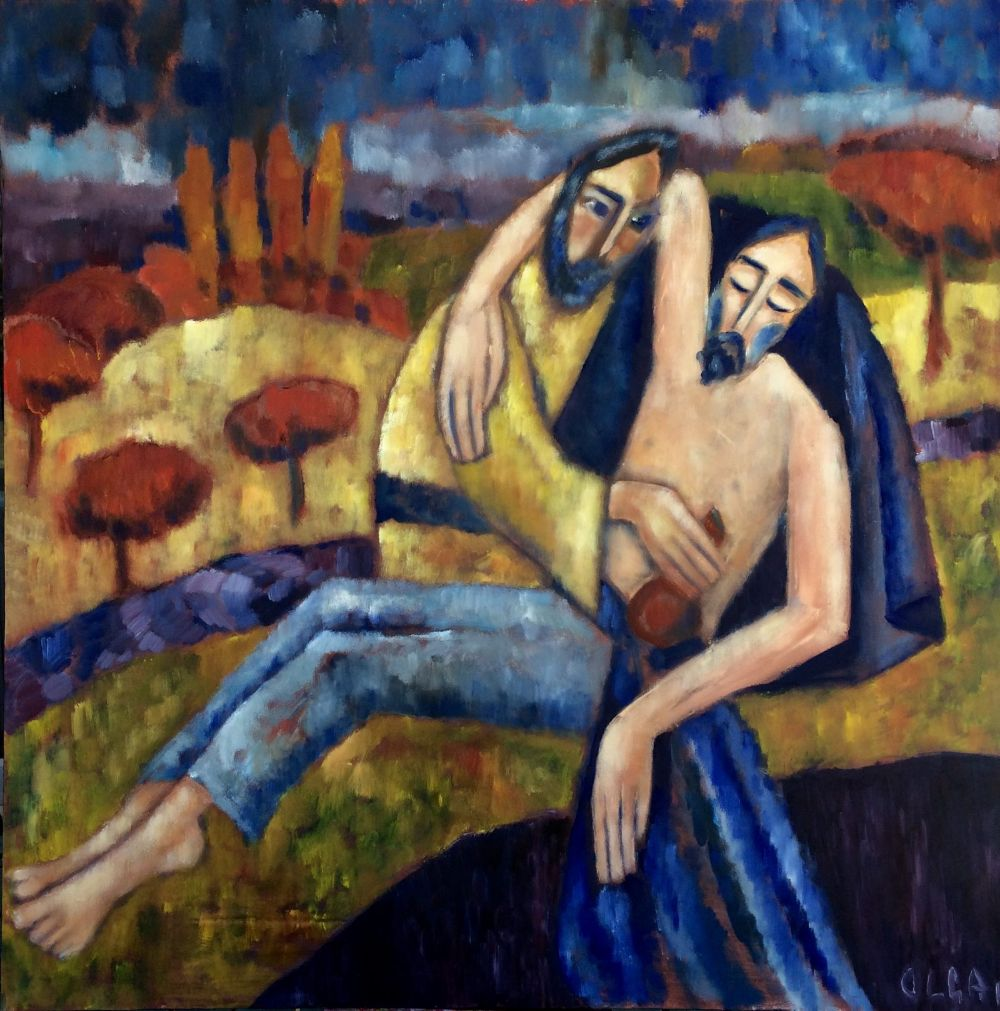
The Parable of the Good Samaritan (Luke 10:25-37)

Good Samaritan, by Olga Bakhtina

An expert in the law stood up to test Jesus. “Teacher,” he said, “what must I do to inherit eternal life?” 

He said to him, “What is written in the law? What do you read there?” 

He answered, “You shall love the Lord your God with all your heart and with all your soul and with all your strength and with all your mind and your neighbor as yourself.” 

And he said to him, “You have given the right answer; do this, and you will live.”

But wanting to vindicate himself, he asked Jesus, “And who is my neighbor?” 

Jesus replied, “A man was going down from Jerusalem to Jericho and fell into the hands of robbers, who stripped him, beat him, and took off, leaving him half dead. Now by chance a priest was going down that road, and when he saw him he passed by on the other side. So likewise a Levite, when he came to the place and saw him, passed by on the other side. 

“But a Samaritan while traveling came upon him, and when he saw him he was moved with compassion. He went to him and bandaged his wounds, treating them with oil and wine. Then he put him on his own animal, brought him to an inn, and took care of him. The next day he took out two denarii, gave them to the innkeeper, and said, ‘Take care of him, and when I come back I will repay you whatever more you spend.’ 

“Which of these three, do you think, was a neighbor to the man who fell into the hands of the robbers?” 

He said, “The one who showed him mercy.”

Jesus said to him, “Go and do likewise.” (New Revised Standard Version)

The Good Samaritan, by Paula Modersohn-Becker

Let’s establish upfront that the chief point of Christ’s parable is mercy shown from one person to another. Mercy is at the heart of Holy Scripture. Mercy is the very heart of Christ – even more than routine obedience:

“Go and learn what this means, ‘I desire mercy, not sacrifice.’” (Matthew 9:13; 12:7; Hosea 6:6)

The message of the Old and New Testaments of the Bible continually reinforces mercy to those who are in need – mercy to immigrants, strangers, the poor, the infirmed, and foreigners.

Therefore, any system – no matter whether church, neighborhood, or government – which seeks to ignore, round up, or get rid of those in need of mercy, is in direct contradiction to the instruction of Jesus, the message of the prophets, and the consistent teaching of the early church fathers (and mothers).

We get in trouble whenever we distinguish between people who “deserve” our help from those who don’t. In truth, there is no such thing. Everyone needs mercy and deserves mercy, simply because they are created in the image and likeness of God.

There are no exceptions. And if we think there ought to be, we are playing the judge and trying to take the reins of decision-making away from God, so that we ourselves can execute our own standard of who deserves mercy and who deserves judgment.

In today’s Gospel lesson, the expert in the law started out by testing Jesus. Then, he changed tactics by trying to justify himself as one who deserves to be recognized as worthy of mercy. He believed that, as one who strictly observes the law and obeys the commandments, he is more deserving than others who are less observant.

It’s this privileged mentality which continually connects adjectival words to humans, and even Christians – when, in truth, there are no adjectives to being a human and/or a Christian.

But, in order to justify ourselves, many people like their adjectives, so they can make sure to distinguish before God who is worthy and right, and who is not. The following are just a smattering of adjectives I’ve heard in the church throughout the years:

  • Backslidden Christian
  • Lukewarm Christian
  • Weak Christian
  • Liberal Christian
  • Conservative Evangelical Christian
  • Real Christian
  • Born Again Christian
  • Committed Christian
  • Fairweather Christian
  • Christmas and Easter Christian
  • True Christian
  • Baptized Christian

Yet, in reality, a Christian is a Christian. If we feel the need to add adjectives in describing how less or more of a Christian they are, then we are no longer describing Christianity at all.

When it comes to the word neighbor, there are a plethora of adjectives that we might use to describe our neighbors. Again, all the words are meant to distinguish between “us” and “them.”

I once lived in a very diverse neighborhood. One day I was outside praying, and looking at all the various houses. I prayed for my neighbors by affixing adjectives to them: my black neighbor; my nerdy neighbor; my lesbian neighbors; my single neighbor; my agnostic neighbor; my mean obnoxious neighbor.

On and on I went, until I heard that still small voice of God whisper to me saying, “Tim, these are not your neighbors with adjectives. They are just your neighbors.”

I got the message. I was praying on my holy hill for all these other folks who were different than me, using my adjectives to keep separate from them. My neighbors, however, are simply my neighbors. We live together in the same neighborhood. We are neighbors – nothing more, nothing less.

Even though my neighbors have many differences about them, we all share the need for receiving mercy and giving mercy. Without mercy, neighborliness vanishes.

My sacrificial offerings of prayer for my neighbors didn’t make me better. But both my attitude of mercy and my actual extensions of mercy toward my neighbors, no matter how little, meant a great deal to them.

The priest and the Levite who passed by the man in need, likely only saw that they would become unclean by helping this needy person. “Besides,” they may have pondered, “there’s nothing in it for me.”

There was no way for the man lying in the ditch to reciprocate or pay back the priest or the Levite. A Samaritan (despised by both priests and Levites) ended up being the one to show mercy to the man.

It didn’t matter who helped the victimized person – whether it was a priest, a Levite, or a Samaritan. It didn’t matter how any of them might describe the other. Only mercy mattered.

I admit that I desperately want to see my national government have at least a little neighborly sense. When I observe the opposite, it’s hard for me to live with. I find myself not wanting to see any mercy extended to them, to the current administration.

Yet just because politicians may not show mercy, doesn’t infer that I should withhold it from them. I really do want to take my cues from Jesus by loving my enemies and doing good to them – even if they ignore, mistreat, or oppress others.

God will sort out the judgment thing. As for me, I’m called to a gospel of grace, not a gospel of judgment.

Nobody can justify themselves. In Christianity, only God can justify the person.

Christ’s mercy is not dependent on what kind of people we are but is based simply on need. God graciously gives us the gift of faith and the mercy of deliverance.

Divine Judge, You framed the earth with love and mercy, declaring it good. Yet we, desiring to justify ourselves, judge others harshly without knowledge or understanding. Keep us faithful so that we may be filled with the knowledge of Your will, and not ignore or pass by another’s need, but plumb the depths of love in showing mercy. Amen.

How Do You Want To Be Remembered?

Someday when I am dead and buried, I would be fine with my gravestone stating, “He was humble and wise.” For I have always sought (however imperfectly) to embrace and live a life characterized by poverty of spirit, largeness of heart, and a sage mind.

Yet, most of all, I’d like to be remembered by the phrase, “He loved God.” The Great Command of Jesus to love God and each other is something I pray and seek in my daily life. And I hope that at the end of my earthly life, the love of God within me has made the world a better place.

In saying this, it means I forsake a lot of other ambitions to be remembered by. I don’t really care if I am remembered for any other virtues or abilities other than love, humility, and wisdom.

For the times that I have unknowingly pursued other things above what is of concern to my Lord Jesus, I admit and renounce those things. Because that is what humility and love does. And it’s the wisest thing a person could do.

That is in direct contrast and opposition to worldly ambitions for wealth and financial resources, power and authority, attention and greatness. Such desires arise from pride, not humility. With arrogance, ignorance and hate are not far behind.

Such virtue is itself the good life. And it is not out of touch for any of us. For Christ himself repeatedly told and reminded his disciples that the kingdom of God is near, so near as to be within us.

“The time has come, and God’s kingdom is near. Change the way you think and act, and believe the Good News.” (Mark 1:15, God’s Word Translation)

“The Kingdom of God is near you now.” (Luke 10:9, New Living Translation)

And we are told to make God’s kingdom a priority. We are to humble ourselves before God and seek the reign of God and the values of how God operates, rather than putting all our equity into material possessions.

“Seek first the kingdom of God and his righteousness, and all these things (material resources) will be given to you as well.” (Matthew 6:33, New International Version)

The super-rich of this world have a super difficult time ever humbling themselves to anyone, including God, because they can so easily rely upon their vast earthly resources.

“Truly I tell you, it will be hard for a rich person to enter the kingdom of heaven. Again I tell you: It is easier for a camel to go through the eye of a needle than for someone who is rich to enter the kingdom of God.” (Matthew 19:23-24, New Revised Standard Version)

God’s kingdom is not something that is so far out of touch for us, or way out there somewhere, as if we could not, and therefore need not, pay much attention to it. No, it is much closer than any of us realize.

You and I have the light within us. For some people (maybe most people) this light has diminished to a tiny little flame or spark. They themselves either cannot or will not perceive there is something right and good that exists down deep in this soul created in the image and likeness of God.

Phrases such as “Let us rely upon our better angels,” and “Get in touch with our nobler instincts,” are more modern ways of expressing that there is inherent worth within us that we can tap into. It doesn’t even take a Christian or a religious person to recognize this reality.

We really do have a higher self, a conscience containing a moral compass, a given benevolent nature, altruistic impulses, and a compassionate side to us. Will we seek this part of ourselves? Will we tap into it? Will we allow it to come out into the world in order to bless it, not curse it?

Yet, as we know all too well, we also a have within us a depraved part which wants to rule over others and acquire as much wealth and power as possible. As with most things, we ourselves are a paradoxical conundrum of competing desires.

How do you want to be remembered? We can pursue the kingdom of God within us, or we can seek the kingdoms of this world outside of us. It’s your choice. But you will need help, if going after such things as humility, wisdom, and love as your way of life – not only help from God, but also help from others.

“Ask, and it will be given to you; search, and you will find; knock, and the door will be opened for you. For everyone who asks receives, and everyone who searches finds, and for everyone who knocks, the door will be opened. Is there anyone among you who, if your child asked for bread, would give a stone? Or if the child asked for a fish, would give a snake? If you, then, who are evil, know how to give good gifts to your children, how much more will your Father in heaven give good things to those who ask him!

“In everything do to others as you would have them do to you, for this is the Law and the Prophets. (Matthew 7:7-12, New Revised Standard Version)

What is true of you, that you would like engraved on your gravestone? How do you want to be remembered? That’s what we need in this world, for this time and for this place.

Living In the Tension of Life (Isaiah 54:1-13)

Shout for joy, O barren one who has borne no children;
    burst into song and shout,
    you who have not been in labor!
For the children of the desolate woman will be more
    than the children of the one who is married, says the Lord.
Enlarge the site of your tent,
    and let the curtains of your habitations be stretched out;
do not hold back; lengthen your cords
    and strengthen your stakes.
For you will spread out to the right and to the left,
    and your descendants will possess nations
    and will settle desolate towns.

Do not fear, for you will not be ashamed;
    do not be discouraged, for you will not suffer disgrace,
for you will forget the shame of your youth,
    and the disgrace of your widowhood you will remember no more.
For your Maker is your husband;
    the Lord of hosts is his name;
the Holy One of Israel is your Redeemer;
    the God of the whole earth he is called.
For the Lord has called you
    like a wife forsaken and grieved in spirit,
like the wife of a man’s youth when she is cast off,
    says your God.
For a brief moment I abandoned you,
    but with great compassion I will gather you.
In overflowing wrath for a moment
    I hid my face from you,
but with everlasting love I will have compassion on you,
    says the Lord, your Redeemer.

This is like the days of Noah to me:
    Just as I swore that the waters of Noah
    would never again go over the earth,
so I have sworn that I will not be angry with you
    and will not rebuke you.
For the mountains may depart
    and the hills be removed,
but my steadfast love shall not depart from you,
    and my covenant of peace shall not be removed,
    says the Lord, who has compassion on you.

O afflicted one, storm-tossed and not comforted,
    I am about to set your stones in antimony
    and lay your foundations with sapphires.
I will make your pinnacles of rubies,
    your gates of jewels,
    and all your wall of precious stones.
All your children shall be taught by the Lord,
    and great shall be the prosperity of your children. (New Revised Standard Version)

Judgment and Grace

Throughout all of the Old Testament prophets, there is a consistent theme within each of them of both judgment and grace.

People continually wax and wane in their faithfulness to God. However, the Lord does not change in being faithful to divine promises and keeping the divine covenant toward Israel.

Judgment comes in order to set things right, and provides justice for oppressed and underprivileged people. The judgment, however, only lasts for a while; whereas grace is continually operative.

Today’s text is one of grace. In the movement and rhythm of God’s judgment and grace, these verses return to the call for celebration and joy in response to divine mercy.

The metaphor of the barren woman refers to the years the city of Jerusalem sat in ruins because of divine judgment. Yet, it will not remain this way. The prophet assures the people that Jerusalem will grow once again. The city will spread out and increase, like a mother with many children.

There is no need for fear, because the Lord is not only the Creator and Maker; God is also Jerusalem’s redeemer and husband. The metaphor is meant to convey the attention and intimacy that God shows to people through divine grace.

Reconciliation and Restoration

Even though the city was like a wife forsaken by her husband, reconciliation is initiated by God through compassion and steadfast love. The Lord will honor the covenant, and not completely toss the people away, never to be seen again.

The Lord scatters; and the Lord gathers. The Lord gives; and the Lord takes away. The Lord extends judgment; and the Lord shows mercy. Blessed be the name of the Lord.

The word “abandon” is not even in God’s lexicon. The Lord is unfamiliar with the concept. There may be natural disasters, terrible diseases, and dilapidated places, but none of these can ever separate us from God’s steadfast immovable love.

Restoration is happening. No matter how bad things get – and things can get awfully bad – nothing can stop the divine band wagon of restoration from coming into town and changing everything.

Renewal and restoration may not happen today, or tomorrow; yet, it is happening, sooner or later. Nothing and no one can stand against the right, good, and just purposes of the almighty and everlasting God.

Redemption and Hope

In Christianity, this hope is focused in the birth of the Christ child. Redemption and new life is a reality in Jesus Christ our Lord. This is the reason for the Christian’s joy and celebration in this season.

On one end of our rubber-band like tension in this present life are the disappointments, brokenness, suffering, and pain we experience. At the other end, is the promise of future glory that is yet to come.

All believers, and every church, lives in this tension between the already and the not yet. We live in an in-between time, an awkward liminal space, that makes hope a sheer necessity in order to make it through the Christian life.

“There is a birth from before the ages, and a birth from a virgin at the fulness of time. There is a hidden coming, like that of rain on fleece, and a coming before all eyes, still in the future.”

St. Cyril of Jerusalem (313-386, C.E.)

The biblical writers, along with the early church fathers and mothers, understood the sacred tension of life:

Without any doubt, the mystery of godliness is great:

He was revealed in flesh,
    vindicated in spirit,
        seen by angels,
proclaimed among gentiles,
    believed in throughout the world,
        taken up in glory. (1 Timothy 3:16, NRSV)

The one who testifies to these things says, “Surely I am coming soon.”

Amen. Come, Lord Jesus!

The grace of the Lord Jesus be with all the saints. Amen. (Revelation 22:20-21, NRSV)

Almighty God, give all of us grace to cast away the works of darkness, and put on the armor of light, now in the time of this mortal life in which your Son Jesus Christ came to visit us in great humility, so that in the last day, when he shall come again in his glorious majesty to judge both the living and the dead, we may rise to the life immortal; through him who live and reigns with you and the Holy Spirit, one God, now and forever. Amen.

Show Some Basic Human Kindness and Love (Ruth 3:8-18)

Art by Chanelle Nibbelink

At midnight the man was startled and turned over, and there, lying at his feet, was a woman! He said, “Who are you?” And she answered, “I am Ruth, your servant; spread your cloak over your servant, for you are next-of-kin.”

He said, “May you be blessed by the Lord, my daughter; this last instance of your loyalty is better than the first; you have not gone after young men, whether poor or rich. And now, my daughter, do not be afraid, I will do for you all that you ask, for all the assembly of my people know that you are a worthy woman. But now, though it is true that I am a near kinsman, there is another kinsman more closely related than I. Remain this night, and in the morning, if he will act as next-of-kin for you, good; let him do it. But if he is not willing to act as next-of-kin for you, then, as the Lord lives, I will act as next-of-kin for you. Lie down until the morning.”

So she lay at his feet until morning but got up before one person could recognize another, for he said, “It must not be known that the woman came to the threshing floor.” Then he said, “Bring the cloak you are wearing and hold it out.” So she held it, and he measured out six measures of barley and put it on her back; then he went into the town. 

She came to her mother-in-law, who said, “How did things go with you, my daughter?” Then she told her all that the man had done for her, saying, “He gave me these six measures of barley, for he said, ‘Do not go back to your mother-in-law empty-handed.’” She replied, “Wait, my daughter, until you learn how the matter turns out, for the man will not rest but will settle the matter today.” (New Revised Standard Version)

Boaz was an unmarried wealthy landowner. He was pious and conscientious. Ruth was a widow, a foreigner from Moab. Naomi was Ruth’s mother-in-law, and also a widow. Naomi and Ruth only had each other.

As one in poverty did in those times, Ruth walked behind the harvesters in the fields during the barley harvest, gleaning whatever was left behind. She was gleaning in the field of Boaz. He noticed.

Boaz was kind enough to make sure that Ruth was able to glean for two people. It turns out that Boaz was an in-law to Naomi, through her late husband Elimelech. Naomi sought to play matchmaker, so that Ruth would be well cared for. So, she instructed Ruth in what to do….

A woodcut of Ruth and Boaz on the threshing floor, by Unknown Artist

Harvest time in Judah was also a time of celebration and feasting. Late one night, on the barley wheat threshing floor, Boaz lay down to sleep after a day of bringing in the grain, and an evening of eating and drinking.

Doing exactly as her mother-in-law Naomi instructed, Ruth went to threshing floor, and then quietly laid down at the feet of Boaz. At midnight, Boaz was startled and woke up. There, at his feet, was a woman!

“Who are you? What do you want?” asked Boaz. And Ruth made herself known with the humble response, “I am Ruth, your maidservant.”

Ruth continued to follow Naomi’s guidance, and asked that Boaz spread his cloak over her, because he is the next of kin, the relative who could be responsible for engaging a levirate marriage with her (that is, a legal marriage involving in-law’s).

Although sleepy, and maybe even a bit tipsy, Boaz knew immediately that Ruth was asking him to marry her. Pious man that he was, Boaz would likely have realized the imagery of his situation, as likened to the prophet Ezekiel’s description concerning God’s love toward Jerusalem:

I spread the edge of my cloak over you and covered your nakedness: I pledged myself to you and entered into a covenant with you, says the Lord God, and you became mine. (Ezekiel 16:8, NRSV)

In following Naomi’s advice, Ruth put herself in a very vulnerable situation. Yet, Naomi’s observation of Boaz was spot on. Ruth’s faith in, and love for, her mother-in-law was well-placed.

The man Boaz responded favorably to the asking and overture of Ruth. He praised Ruth for her steadfast love and faithfulness; and her willingness to be with him, instead of a younger man.

Arising organically and sincerely from within Boaz was a prayer for God’s blessing upon Ruth. Not only would Boaz act to marry Ruth, but he also assured her that she belongs to God and God’s people.

The cloak of Boaz being spread over Ruth not only symbolized their upcoming levirate marriage, but it also communicated her marriage to God. Ruth was coming into God’s covenant as one of the people, as well as entering the marriage covenant.

I like that Boaz did not regard the actions and words of Ruth as something impertinent, immoral, or inappropriate. He fully recognized that she was operating consistent with the law of God in honoring a family obligation. And Boaz reciprocated by being honored to have been asked, and honored to comply with Ruth’s wishes.

It seems to me that this is love, as it is intended to be with us. We respect one another’s character, and seek to do whatever we can to meet this person’s need. When I love, I want to go out of my way to act on behalf of this person I admire and adore.

Boaz was not under a legal obligation to marry Ruth. He could have done nothing. But love compelled him – a love for Ruth which was grounded in an abiding love for God.

It wasn’t that Boaz should have, or could have, done something to help meet the needs of Ruth and Naomi. Boaz wanted to do something. He wanted to help Ruth. Boaz wanted to show kindness and steadfast love to Ruth. He wanted to fulfill her asking.

Naomi came up with a plan, because she trusted in the mercy, kindness, and generosity of Boaz. And also because she loved her daughter-in-law Ruth, and wanted her to be loved and cared for.

To show his goodwill and intention to fulfill Ruth’s request, he gave her a significant gift of barley. That is, he loaded her up with groceries to take home. This was a sign that Boaz would indeed make sure that the needs of Ruth and Naomi would be met this day, and into the future.

I am struck with how simple this story really is, at it’s core. It’s just three people, who each care. Caring is something that all of us can do, no matter who we are, where we are, or what situation we find ourselves in.

We really can show basic human kindness to another. We can be merciful, just, and generous. We can ask for what we want and need. We can help one another.

Perhaps, then, the real question for each of us is not whether we can speak and act with love, grace, and kindness; the real question is: Will I speak and act with love and mercy?

If we want to live in a world where there is justice, mercy, and love, then we must demonstrate those very things in our own lives, today and every day.

Live the way that you yourself want to be treated. And if you want mercy, generosity, and love from others, then ask for it.

God of steadfast love, help us each day in the midst of things we don’t understand, To those of us who are afraid, give courage To those who are exhausted, give strength To those in despair, give hope.

Comfort us in our struggles, O Loving God, and meet every need. Grant us safety, security and stability, and help us learn the lessons you are giving us, so that we may all work together to make this world a better place. Amen.