A legal expert stood up to test Jesus. “Teacher,” he said, “what must I do to gain eternal life?”
Jesus replied, “What is written in the Law? How do you interpret it?”
He responded, “You must love the Lord your God with all your heart, with all your being, with all your strength, and with all your mind, and love your neighbor as yourself.”
Jesus said to him, “You have answered correctly. Do this and you will live.”
But the legal expert wanted to prove that he was right, so he said to Jesus, “And who is my neighbor?”
Jesus replied, “A man went down from Jerusalem to Jericho. He encountered thieves, who stripped him naked, beat him up, and left him near death. Now it just so happened that a priest was also going down the same road. When he saw the injured man, he crossed over to the other side of the road and went on his way. Likewise, a Levite came by that spot, saw the injured man, and crossed over to the other side of the road and went on his way. A Samaritan, who was on a journey, came to where the man was. But when he saw him, he was moved with compassion. The Samaritan went to him and bandaged his wounds, tending them with oil and wine. Then he placed the wounded man on his own donkey, took him to an inn, and took care of him. The next day, he took two full days’ worth of wages and gave them to the innkeeper. He said, ‘Take care of him, and when I return, I will pay you back for any additional costs.’ What do you think? Which one of these three was a neighbor to the man who encountered thieves?”
Then the legal expert said, “The one who demonstrated mercy toward him.”
Jesus told him, “Go and do likewise.” (Common English Bible)
In Christianity, no one justifies themselves. The kingdom of God turns on grace, and not with us working more or harder. As we anticipate Reformation Day, Christians remember the famous posting of the 95 Theses by Martin Luther on the Castle Church door in Wittenberg, Germany in 1517.
Justification by grace through faith, apart from human effort, is the great theological emphasis and legacy of the Reformers. I suppose one would expect to look at the New Testament books of Romans and Galatians when it comes to dealing with justification. However, there might just be a better place to go….
Christ’s parable of the Good Samaritan is a famous and familiar story to many people, even for those outside of the Christian faith tradition. The parable is likely not the place one thinks to go when considering the Reformation. Yet, this parable is just the right place for considering the grand Reformation doctrine of justification.
“Every week I preach justification by faith to my people, because every week they forget it.”
Martin Luther (1483-1546)
The Gospel writer, Luke, gives us insight into the thought process of the person for whom Jesus told the parable to. That man sought to justify himself.
When we view the parable from the angle of justification, we see the perspective of the wounded and hapless man, the victim of robbers. He was left for dead, and, indeed, in the story we know that he would die apart from help – the kind of help the man could not do for himself. He was completely dependent on someone to rescue him from his plight.
The Samaritan, the Christ figure in the story, comes and shows the man mercy. This grace was free, lacked any sort of favoritism, and was full of sheer kindness. Without the Samaritan’s actions of binding up the man’s wounds and getting him to a safe place, the victim would have died.
Reformation Day, and every day, is a good day to celebrate the wonderful and glorious reality that Jesus Christ saves people from their terrible plight.
Christ’s mercy is not dependent on what kind of people we are but is simply based on need. God graciously gives us the gift of faith and the mercy of deliverance. By Christ’s wounds we are healed.
Take some time today to reflect on this most gracious of biblical truths: We do not need to justify ourselves. As Christians, we already possess justification by grace alone apart from human effort.
Read the parable of the Good Samaritan carefully and slowly, absorbing it from this angle of the inability to justify ourselves and the incredible mercy of Christ. Let this wonderful truth sink deep in your soul to bring increased awareness, emotional wholeness, and spiritual healing.
Lord God, heavenly Father, you did not spare your only Son, but gave him up for us all to be our Savior, and along with him you have graciously given us all things. We thank you for your precious, saving gospel, and we pray that you would help us to believe in the name of our Savior faithfully and steadfastly, for he alone is our righteousness and wisdom, our comfort and peace, so that we may stand on the day of his appearing, through Jesus Christ, your dear Son, our Lord. Amen. – A Lutheran Collect of Thanksgiving
For the word of God is alive and active. Sharper than any double-edged sword, it penetrates even to dividing soul and spirit, joints and marrow; it judges the thoughts and attitudes of the heart. Nothing in all creation is hidden from God’s sight. Everything is uncovered and laid bare before the eyes of him to whom we must give account.
Therefore, since we have a great high priest who has ascended into heaven, Jesus the Son of God, let us hold firmly to the faith we profess. For we do not have a high priest who is unable to empathize with our weaknesses, but we have one who has been tempted in every way, just as we are—yet he did not sin. Let us then approach God’s throne of grace with confidence, so that we may receive mercy and find grace to help us in our time of need. (New International Version)
Church Persecution and Christian Suffering
The book of Hebrews was originally a sermon preached to a group of believers who had come to Christ out of Judaism. From the book of Acts, we know there were thousands of Jewish Christians who were dispersed from Jerusalem when Stephen was martyred. A great persecution broke out, and many believers fled west to places like Galatia, Ephesus, Greece and Rome.
The Jewish believers were immigrants in a foreign land, looking to practice their faith without harm. Yet, their experience was anything but ideal. These followers of Christ found fellow ethnic Jews in the places where they went, yet those Jews had no use for these people that they believed were in some sort of aberrant cult.
What is more, the surrounding Gentile culture did not understand Christianity, at all, and many of those who held to pagan religions bought into rumors, such as, that Christians were cannibals who ate at what’s called the Lord’s Table.
So, here we have a situation where these displaced Christians had no respect from both Jews and Gentiles. As a result, they had a difficult time carrying out business because no one trusted them. They were essentially alone in the world.
Losing Their Grip
Initially, they embraced their identity as Christians and held up quite well under the stress. However, over time, their resolve began to slowly erode. The followers of Jesus began to question their adverse situation.
They began listening to their fellow Jews throw doubts on their faith. The hard life was not improving, maybe even becoming worse. Eventually, the church came to a point where they began re-considering their whole way of life as Christians, and their faith commitment started slipping. The Christians actually considered leaving the Church and Christianity and going back to their old life in Judaism.
The Message of Hebrews
It was at this point that a vigorous believer in Jesus came to town, saw the situation of the church, and preached a spirited message to them. The preacher called them to hold tight to their commitment – to see Jesus afresh and anew as superior over all the Old Testament, as the fulfillment of all the promises of God.
So, then, throughout the book of Hebrews we have this wonderful explanation and exposition of how to make sense of Jesus and the Old Testament, and of what Jesus really means to the church. Throughout his sermon, the preacher occasionally paused his teaching and gave the people a stiff warning about falling away from Christ. He called the church to be bold and confident in Christ, to stand up to the suffering, and to confront their temptations so that they would persevere in their commitment to Jesus Christ for the rest of their lives.
God’s Word and Work
We pick up the teaching and the exhortation in chapter four. Hebrews 4:12-16 is composed of two distinct sections that are paired together for a reason. Verses 12-13 give us a graphic visual of the penetrating work of God’s Word, of the reality that God can get deep inside us. The next section, verses 14-16, lays out God’s response to our being under divine scrutiny – that there is grace and mercy available because of Jesus, our great high priest who is superior to every priest of the Old Testament to the point of being the last and permanent priest forever!
These verses are bound together because we all need to struggle with the tension between God’s Word to us, and our words to God; between God’s judgment that opens our souls on a spiritual operating table, and God’s grace which jumpstarts our broken hearts. Our most fundamental need is for God’s mercy in Jesus Christ.
The Christian Life
It is important that our outer lives and our inner lives match each other. Whenever the two are out of sync, we come under the judgment of God’s Word. These early Hebrew Christians had slowly drifted from the truth so that their inner and outer lives did not line up well.
Some of them still performed the outward duties of being a Christian yet were inwardly despising their hard situation. A growing vacuum developed on their insides as they slowly started letting go of Jesus as their object of devotion. Their hearts began to harden because of their hard lives.
On the other hand, there were other Hebrew Christians who began drifting in a different way. Inwardly, they tried to maintain their devotion and commitment to Christ. Yet these believers began compromising their outward life to match the culture around them. In both cases of hardening inwardly, and of compromising outwardly, they each shared the situation of drifting away from their original commitment to Christ.
Even today, it is a real temptation to try and avoid suffering, to grow weary of our present circumstances and look for a way to get out from under the pain and find a quick fix. Whenever we find ourselves in such a situation, the remedy is to be reminded that we must continue to hold firmly to the faith we profess because of who Jesus is.
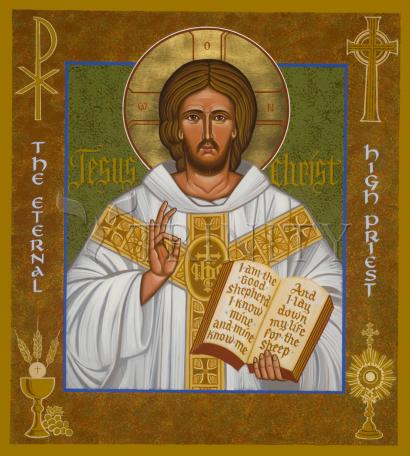
15th Century Orthodox icon of Christ the Great High Priest
Jesus As Permanent High Priest
Jesus is our great high priest. In the Old Testament, among the twelve tribes of the ancient Israelites, the tribe of Levi made up the class of priests. One of those Levites, always a descendent of the original Levite priest, Aaron, had the task of once a year entering a place called the Holy of Holies, which was at the center of the Temple, to offer a bloody sacrifice on behalf of the people, to atone for their sins from the previous year.
Jesus is our great and ultimate high priest. He did not enter the temporary sacrificial system to deal with sins for only a year. Jesus not only took on the role of high priest, but became the sacrifice, as well. As a result, we now have a thorough and permanent forgiveness of sins through Christ. So, the Hebrew Christian who considered going back to an old outdated system needed to be brought back to his senses and embrace again the once-for-all sacrifice of Jesus.
As they considered Jesus, the believers needed to remember that Christ was not so far removed from them that the church could not relate to Jesus. Rather, Jesus is able to sympathize with each and every trouble, trial, and temptation we face because he faced the very same kind of sufferings.
The only difference between Christ and his followers is that Jesus did not succumb to the trouble, but persevered and secured for us deliverance from sin, death, and hell. Jesus is the One who deserves every bit of our commitment, allegiance, and devotion. Christ is the One whom we are to worship inside and out.
Approaching God with Boldness
Let us then approach Jesus with confidence, with boldness, knowing that with him there is mercy and grace. Jesus not only suffered for us in the past; he also suffers with us now, in the present. We, as believers, are in union with Jesus. Christ is our great high priest, the One intimately involved in every nook and cranny of our lives. He knows what you and I are going through and is ready to give grace to help right now.
Approaching Jesus has nothing to do with being good enough to do so. Coming to Jesus is about grace. Whenever we drift from Jesus and are confronted with God’s Word cutting us to the heart, the end result is not wrath or judgment; the result is mercy and grace.
Like the early Hebrew Christians, we all face situations out of our control that wear us down and cause us to become weary. In our tired state, we can be tempted to let our commitment to Christ slide in some small way. Over time, the small compromises of faith can snowball into a big slide away from God.
Yet, Jesus is not sitting in heaven frustrated or confounded. God is not looking for a reason to punish people. It is just the opposite. Jesus, the Son of God, our great high priest, is looking for a reason to give grace and help us in our time of need. Christ is waiting for us to approach the throne of grace with confidence. Right now, Jesus is alive. He is scanning the world and the church, looking to extend mercy to those who need it.
Asking for Help
We must avoid a spiritual hardening of heart which estranges us from approaching Jesus. Every one of us needs help. We are not God. We have weaknesses. We have confusion. We have limitations of all kinds. We need help. And every one of us has something else: guilt and shame. At the bottom of our hearts, we feel undeserving, and so, avoid coming to Jesus. Yet, we need with family, loneliness, work, health, finances.
So, what to do? I can try to deny it all and be a superman who doesn’t need any help. I can try to drown it all with alcohol. I can be obsessive and compulsive about controlling events and/or people. I can simply succumb to discouragement. Here is what God declares: Jesus Christ became a High Priest to shatter despair with hope, to rescue that drowning person and that anxious individual.
God planned for a High Priest, a Savior, a Redeemer, and a gracious Helper. You and I are not trapped. We have Jesus.
The book of Hebrews is all about a call to commitment – an invitation to come to Jesus. And it is the most important invitation you will ever receive. Let us approach the throne of grace with confidence….
This is the confidence we have in approaching God: That if we ask anything according to his will, he hears us. And if we know that he hears us – whatever we ask – we know that we have what we asked of him. Spirit of God, lead us into your will. Help us in all things. Fill our hearts and lives to overflowing with divine mercy and grace so that what comes out of our mouths and the actions we do are compassionate, kind, and good, through our great High Priest, Jesus Christ. Amen.
Eliphaz and the other friends of Job, speaking down to him in his suffering, from a fresco in the Cathedral of the Annunciation in Moscow
Job, will you be annoyed if I speak? I can’t keep quiet any longer. You have taught many people and given strength to feeble hands. When someone stumbled, weak and tired, your words encouraged him to stand. Now it’s your turn to be in trouble, and you are too stunned to face it. You worshiped God, and your life was blameless; and so you should have confidence and hope. Think back now. Name a single case where someone righteous met with disaster. I have seen people plow fields of evil and plant wickedness like seed; now they harvest wickedness and evil. Like a storm, God destroys them in his anger. The wicked roar and growl like lions, but God silences them and breaks their teeth. Like lions with nothing to kill and eat, they die, and all their children are scattered.
Once a message came quietly, so quietly I could hardly hear it. Like a nightmare it disturbed my sleep. I trembled and shuddered; my whole body shook with fear. A light breeze touched my face, and my skin crawled with fright. I could see something standing there; I stared, but couldn’t tell what it was. Then I heard a voice out of the silence: “Can anyone be righteous in the sight of God or be pure before his Creator? God does not trust his heavenly servants; he finds fault even with his angels. Do you think he will trust a creature of clay, a thing of dust that can be crushed like a moth? We may be alive in the morning, but die unnoticed before evening comes. All that we have is taken away; we die, still lacking wisdom.” (Good News Translation)
The Christian spiritual classic, The Dark Night of the Soul, was written nearly five hundred years ago by St. John of the Cross. The gist of John’s observation is that God sometimes takes the Christian through dry times of hiding himself from the believer.
The pain of wondering where God is and if he will even show up; experiencing unanswered prayer; enduring uncaring and misdirected comments from well-meaning people; all these and more are inevitably part of the Christian spiritual experience.
The dark night of the soul is not to be confused with personal sinfulness. Its origin is not in self, but God.
“Silence is God’s first language.”
St. John of the Cross
Whenever one knows with a settled confidence that personal integrity is intact, but trouble abounds, we need not immediately rush to the conclusion that something is wrong with us. It may be the Spirit of God thrusting us into a desert experience to test and approve our faith.
Job’s “friend” Eliphaz offered one of those tired age-old arguments that bad things only happen to bad people. He comes at Job with the inexperience and absurdity of making misguided assumptions. He rhetorically asks: Who that was innocent ever perished? Where were the upright cut off?
The conclusion of Eliphaz, therefore, was bound to be off the mark – believing secret sin must surely be the culprit behind Job’s awful misfortune. Certainly, Eliphaz thinks, Job cannot possibly go through such terrible suffering without having done something to anger God.
Times change; the basic nature of people, not so much. In today’s church and world, the same notions still endure. If I had a quarter for every time I heard crazy comments, like the following, I would be a rich man:
“He’s poor because he is lazy and doesn’t want to work.”
“She keeps having chronic health issues. God is punishing her.”
“The pandemic is God’s judgment on us for not having the Ten Commandments in our courthouses.”
“If you just confess your sin and have faith, you’ll be healed.”
“They’re in big trouble. They obviously did something evil.”
On and on the wrong-headed statements continue, ad nauseum.
The Apostle Peter understood how to view trouble in a healthy way. He said we all suffer – both the good person and the wicked. It’s just a matter of whether we will suffer for doing good and the right thing, or suffer because of saying shallow, illogical, and stupid comments that offend God and hurt others. (1 Peter 3:17-18)
Even Christ suffered. And it wasn’t because of his own sin. It was because of ours. Jesus suffered once for sins, the righteous for the unrighteous, that he might bring us to God.
Jesus suffered; so, the follower of Jesus will suffer. There is a big picture only God sees. Whenever we suffer, there is something going on behind the spiritual scene. We must allow God to do divine work, and then, trust that the Lord bends all human suffering for good and redemptive purposes.
“Where there is no love, pour love in, and you will draw love out.”
St. John of the Cross
So, let’s change the rhetoric. Instead of jumping to judgment, reflexively hop to grace with comments like these:
“He has poverty of spirit. He’s blessed and will inherit the kingdom of God.”
“She’s in chronic pain. God has allowed her the privilege of suffering in solidarity with her Lord.”
“We’re in a pandemic. Here’s a chance for us to live out of the Ten Commandments.”
“If we confess the world’s sins of pride, hate, and injustice, perhaps God’s mercy will deliver us.”
“We’re in a big pickle. No better time than now to grow in grace.”
Where is God? Beside you, quietly and confidently holding you up in your suffering.
Lord God, I entrust myself to you because you know what you are doing. Thank you for the trials of life which humbles my heart to pray. Do your work in me so that my faith is fortified for a lifetime of service in the church and the world, through Jesus Christ, my Lord. Amen.
You religious teachers are nothing but show-offs, and you’re in for trouble! You build monuments for the prophets and decorate the tombs of good people. And you claim that you would not have taken part with your ancestors in killing the prophets. But you prove that you really are the relatives of the ones who killed the prophets. So, keep on doing everything they did. You are nothing but snakes and the children of snakes! How can you escape going to hell?
I will send prophets and wise people and experts in the Law of Moses to you. But you will kill them or nail them to a cross or beat them in your meeting places or chase them from town to town. That’s why you will be held guilty for the murder of every good person, beginning with the good man Abel. This also includes Barachiah’s son Zechariah, the man you murdered between the temple and the altar. I can promise that you people living today will be punished for all these things!
Jerusalem, Jerusalem! Your people have killed the prophets and have stoned the messengers who were sent to you. I have often wanted to gather your people, as a hen gathers her chicks under her wings. But you wouldn’t let me. And now your temple will be deserted. You won’t see me again until you say,
“Blessed is the one who comes in the name of the Lord.” (Contemporary English Version)
Christ’s scathing and damning critique is against a distorted spirituality, a false Christianity, a controlling leadership that stifled and snuffed-out the true worship of God.
Here is what Jesus is getting at with his woe on the leadership who are so concerned with the tombs of the prophets: Honoring dead people, while ignoring live people, is not good. Respecting the prophets and pastors and godly people of the past means nothing if we ignore the prophet and pastor that is right in front of our face.
The surest way to hell is to give credence to those long gone yet fail to honor their teaching and the people keeping the true spirit of that instruction. It is to call evil good, and good evil.
The telltale signs of hypocrisy include:
Not practicing what they preach, rather than embodying and modeling the message.
The goal I pursue is the prize of God’s upward call in Christ Jesus. So, all of us who are spiritually mature should think this way, and if anyone thinks differently, God will reveal it to him or her. 16 Only let’s live in a way that is consistent with whatever level we have reached. Brothers and sisters, become imitators of me and watch those who live this way—you can use us as models. (Philippians 3:14-17, CEB)
Keeping people out instead of inviting them in.
I tell you for certain that I am the gate for the sheep. Everyone who came before me was a thief or a robber, and the sheep did not listen to any of them. I am the gate. All who come in through me will be saved. Through me they will come and go and find pasture. (John 10:7-9, CEV)
Focusing on externals and refusing to do one’s own inner work.
God does not see as humans see. Humans look at outward appearances, but the Lord looks into the heart. (1 Samuel 16:7, GW)
Majoring on the minors through upholding the letter of the law while forsaking the spirit of the law.
You keep meticulous account books, tithing on every nickel and dime you get, but on the meat of God’s Law, things like fairness and compassion and commitment—the absolute basics! —you carelessly take it or leave it. Careful bookkeeping is commendable, but the basics are required. Do you have any idea how silly you look, writing a life story that’s wrong from start to finish, nitpicking over commas and semicolons? (Matthew 23:23-24, MSG)
Despite the presence of hypocrisy and the misplaced energy of people, the last word to everything is God’s grace.
At the end of his tirade, Jesus did something we would do well to follow: He broke into a tear-filled, heart-rending love song for his wayward people. Today’s Gospel lesson is not just a blast-the-bad-guys message; it is a deep concern for people to know the true worship of God.
Keeping the law only truly happens when we can connect our action to a face. For example, if we follow safety protocols at work because we have to, someone will get hurt sooner than later. But if we do it with the faces of people in mind, desiring to do what is best for them, there will likely be fewer incidents.
Jesus wants people to honor God’s law so they will live well. The Lord sees faces and the stories behind those faces. He doesn’t want people damaging one another with their detached sense of moral superiority.
So, let’s be gracious, merciful, and kind – not only because we must – but because we desire to be compassionate toward our fellow humanity, as well as honor our God.
Merciful God, help us to realize when we’re being judgmental of others. Lord, I confess I am neither above you nor the master of all things. I am your servant and your child. Thank you that you have wild and abundant grace for me. Teach me your ways and help me be receptive to them, so I will not fall. I surrender all my ways, thoughts, opinions, perceptions and decisions to you, Lord Jesus. Amen.







 Rev. Tim Ehrhardt