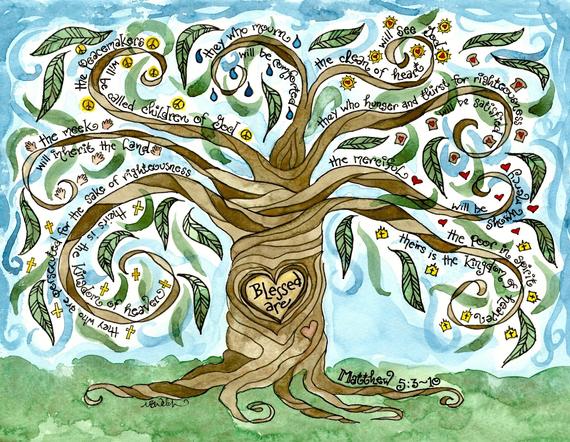
Don’t Forget about Kindness and Truth (Proverbs 3:1-12)

My child, do not forget my teaching,
    but keep my commands in mind.
Then you will live a long time,
    and your life will be successful.

Don’t ever forget kindness and truth.
    Wear them like a necklace.
    Write them on your heart as if on a tablet.
Then you will be respected
    and will please both God and people.

Trust the Lord with all your heart,
    and don’t depend on your own understanding.
Remember the Lord in all you do,
    and he will give you success.

Don’t depend on your own wisdom.
    Respect the Lord and refuse to do wrong.
Then your body will be healthy,
    and your bones will be strong.

Honor the Lord with your wealth
    and the first fruits from all your crops.
Then your barns will be full,
    and your wine barrels will overflow with new wine.

My child, do not reject the Lord’s discipline,
    and don’t get angry when he corrects you.
The Lord corrects those he loves,
    just as parents correct the child they delight in. (New Century Version)

There is no wisdom apart from humility. And humility can only be accessed through being authentic and vulnerable. The proud person doesn’t look to God (or others) because they think they already know what is best and can figure out things without anyone’s help.

Wisdom is a skill that is attained through learning and application, over an extended period of time. The wise person has a solid body of knowledge, and is able to take that know-how and apply it to real life situations.

For the skill of wisdom to be realized, we must first take the posture of a child. We need to listen well, and humbly receive instruction. Without this initial mindset and heart attitude, wisdom will forever be elusive.

Then, when we learn and gain understanding, it’s imperative that we remember it. This is why the best learning engages all of our senses; it presses needed information deep inside us, so that what comes out of us is right, just, and good.

Concerning the Christian life, we can only obey commands which we know. So, it’s important to learn and retain the commands of God. This is one reason why I read my Bible every day; my mind and heart need the continual refreshment and recalling of Holy Scripture’s insight and instruction. I want to be so full of God’s good commands that if you cut me, I bleed Bible.

Kindness and truth are to be worn like a big gaudy necklace around our necks – so that we will always have in front of us what’s most important in living our lives.

The reason so many people are continually at odds with one another is that kindness and truth are neither acknowledged nor remembered. But you cannot have good relations without basic human kindness and a commitment to truth. Put another way, being gruff and mean, and fudging on reality, will not only get you nowhere, but it will also bring a profound lack of success in life.

That stubborn meanness and inattention to truth comes from spending way too much time alone in one’s head. Left alone for too long, every one of us will come up with all kinds of goofy thinking that we believe is the truth. But it’s really only craziness born of a tremendous lack of healthy interaction with others.

At some point, everyone must eventually trust the Lord – who is kindness and truth itself. Going it alone is not an option, that is, unless we want to be lonely, messed-up in the head, and miserable in both body and soul.

Let’s get real. Often, the reason why so many of us choose a path of arrogant pride, radical independence, and selfish loneliness is because we simply do not want to be hurt.

Someone, some group, or many persons have hurt us, and we’re determined to never be hurt and to hurt like that again. So, we shut others out – including God.

We may not go the route of becoming actual hermits, but we build invisible walls which no one can scale. This is why the loneliest people are actually around other people – they’ve shut them out emotionally, mentally, and spiritually, even though they are next to them physically.

Persons who take such a route to living eventually discover that, although they may have avoided the sort of pain they feared, a new kind of suffering is experienced. And it’s the kind of suffering that gnaws at your insides and slowly kills you.

Little does one know, but the fear, anger, and hatred morphs into a bitterness which becomes gangrene of the soul. The person dies a little bit at a time in an agonizing existence. We all must endure pain; it’s just a matter of what sort of pain we will accept: the bad kind or the good kind.

A good sort of hurt is the pain of healing, of making things right, of committing oneself to reconciliation and peace. It’s a soreness of being corrected by Holy Scripture and God’s directives, a suffering that will truly lead to life, not death.

So, what will it be? The book of Proverbs calls us to make a choice, not only between good and bad, but a choice of better and best, and of accepting the sort of pain that helps us grow; or rejecting that and enduring a debilitating hurt that damages deeply, maybe even permanently.

Let go of the pride and adopt humility. Become a student of wisdom. Take up the necklaces of kindness and truth. Honor God with a life full of experiential knowledge and devotion to the betterment of humanity. Learn to trust the Lord and others who are trustworthy. Know what it feels like to be merciful, pure, and peacemaking.

You may just find that the old tools of cynicism, sarcasm, skepticism, distrust, and unbelief become lost in the mental junk drawer of things rarely, if ever, used.

Lord Jesus Christ, you prayed for your friends that they would be one as you and your Father are one. We confess our resistance to your prayer. We have failed to maintain the unity of the Spirit. We have broken the bond of peace.

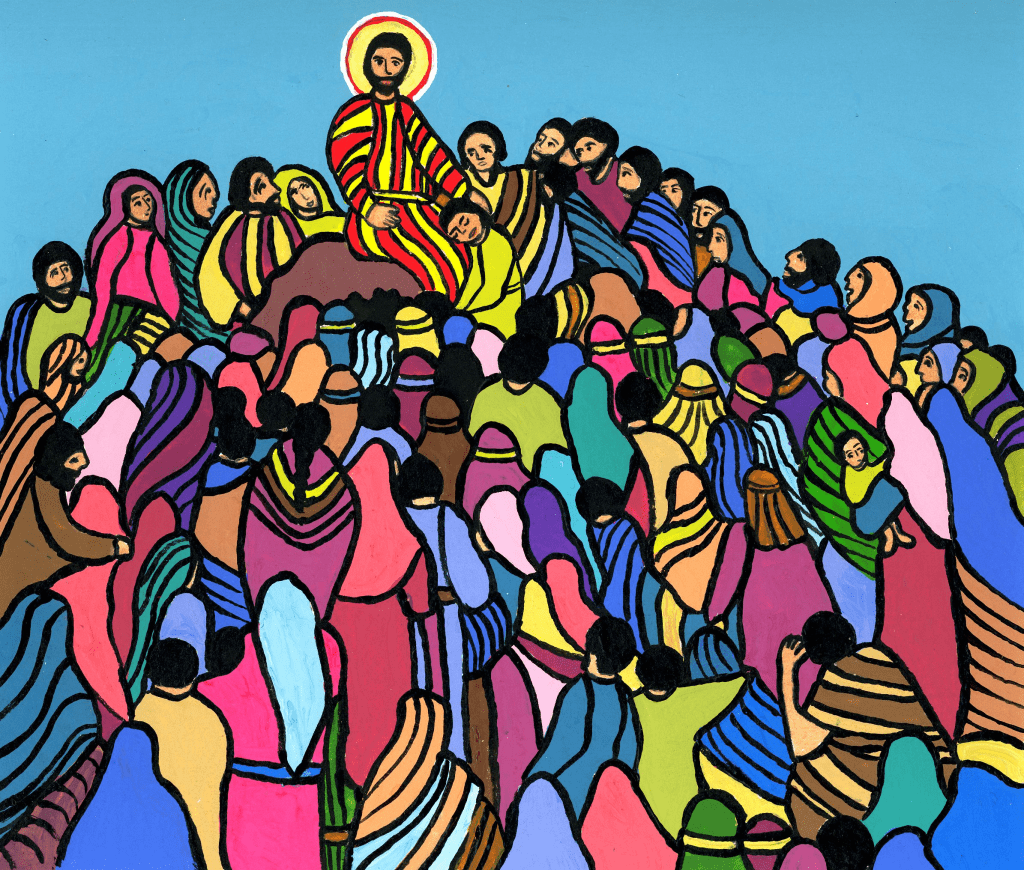
Christ’s Beatitudes (Matthew 5:1-12)

Sermon on the Mount by Gisele Bauche

When Jesus saw the crowds, he went up the mountain, and after he sat down, his disciples came to him. And he began to speak and taught them, saying:

“Blessed are the poor in spirit, for theirs is the kingdom of heaven.

“Blessed are those who mourn, for they will be comforted.

“Blessed are the meek, for they will inherit the earth.

“Blessed are those who hunger and thirst for righteousness, for they will be filled.

“Blessed are the merciful, for they will receive mercy.

“Blessed are the pure in heart, for they will see God.

“Blessed are the peacemakers, for they will be called children of God.

“Blessed are those who are persecuted for the sake of righteousness, for theirs is the kingdom of heaven.

“Blessed are you when people revile you and persecute you and utter all kinds of evil against you falsely on my account. Rejoice and be glad, for your reward is great in heaven, for in the same way they persecuted the prophets who were before you. (New Revised Standard Version)

God’s Law (The Ten Commandments) was given on a mountain. That Law was restated and reframed on a mountain by Jesus in his Sermon on the Mount.

I believe that arguably one of the most important and impactful portions of Holy Scripture are the Beatitudes of Jesus, which serve as the foundation to all of Christ’s teaching.

Christ’s Beatitudes are not simply a random collection of pithy phrases from Jesus on what constitutes approval and blessing from God. They intentionally build upon each other and describe the nature of true righteousness.

The Poor in Spirit

Spiritual poverty, not wealth, is the spiritual base to the Christian life. Most of the original crowd listening to Jesus thought they were on the outside of the kingdom, on the margins of true religion. But Jesus told them they have a place in God’s reign as poor and pitiable people.

To be “poor in spirit” is to be a spiritual beggar who recognizes they have nothing to offer God. It is seeing oneself, one’s sin, and one’s life as spiritually bankrupt apart from God.

Beggars have neither the leverage nor the ability to strike deals with anybody; and so, they do one thing: beg continually.

The proud person would never be caught begging for anything. Yet, the humble spiritual beggar constantly prays because they need God. They discern that without God there is no hope. The kingdom of heaven belongs to the penitent and not to the proud.

The Mourners 

Mourning is the emotional response of acknowledging one’s spiritual poverty. 

Grief and lament have a central place in Christian theology and life. To avoid it, work around it, or short-circuit its process is to refuse Christ; there is no righteousness apart from mourning over sin. Crying, weeping, and even intense tears are important and necessary.

To experience personal grief over one’s sins and the sins of the church and the world is a Beatitude of Jesus. You neither need position, power, privilege, nor pedigree to be a mourner. All can mourn. This is the door by which we enter the kingdom of God.

The Meek

A meek and gentle spirit is the result of realizing poverty of spirit and practicing lament.

At the heart of what it means to be meek is a spirit of non-retaliation. Whenever we are flat on our backs before God, there is no place to look but up. Thus, there is no ability to look down on others.

To be meek is to be broken and moldable before God. A meek person takes personal responsibility for their attitudes and actions. The meek have no need to retaliate, even when egregiously wronged, because they fully entrust themselves to God alone who judges the living and the dead.

Ironically, brokenness is the path to righteous wholeness.

The Hungry and Thirsty

Only those who know their poverty of spirit, personally grieve over sin, and are gentle, end up longing for righteousness.

The desire for righteousness is a recognition that without God I will not make it. I cannot be righteous without Jesus. Simply put, righteousness is a right relationship with God and others.

Those who hunger and thirst for God’s righteousness know they cannot make things right by themselves; they need God’s help.

If we think we can live most days of our lives without God, we do not yet know true righteousness. People who understand their great need for Jesus are easy to spot. They crave and devour God’s Word as their daily food; and they cannot stop blabbering on about Jesus.

There are three practices of living that arise from being filled with God’s righteousness: mercy, purity, and peacemaking. These Beatitudes cannot be conjured up by our own will; instead, they organically grow within us and are freely expressed because of what God is doing in our lives.

You cannot force them any more than you can force a stalk of corn to grow on your terms. Rather, you work with the unforced rhythms of God’s grace and allow righteousness to take root in you.

Down below in the soil, spiritual poverty, mourning, and humility germinate. Then, when the plant breaks the soil and flowers, it produces mercy, purity, and peace-making.

The Merciful 

Mercy begins with a heart that seeks to be generous; it is a loving response to someone or a group of people in misery. We accept them and help them because we ourselves have been there.

The merciful person looks for ways to come alongside others and help, rather than pile expectations and burdens on others without mentoring them in the ways of God.

The Pure In Heart

Purity also results from true righteousness. A stalk of corn might look good, but if you shuck it and it’s filled with worms, it’s not worth much. Legalistic righteousness is concerned to look good; it’s obsessed with performance, perfection, and possessions.

Conversely, the righteousness of God fills our hungry hearts and makes us pure and holy, set apart for good use.

The Peacemakers 

Those who make peace intentionally put themselves in the middle of trouble because they want to live righteously with the mercy and purity that God has provided for them.

Peace is realized through peacemakers. It seems we all desire peace, and yet, peacemakers are hard to come by. It’s a tough gig. To achieve peace, one must first be at peace with God and self – which is why we need the cross of Jesus Christ.

The Persecuted 

Living righteously, as presented by Jesus, tends to bring persecution; and the persecuted consider it a small price to pay for realizing God’s justice in the world.

Folks who are offended by even slight criticisms are usually the ones who are privileged and in power. They have not yet learned the ways of Jesus. Pettiness is nothing more than a sign of unrighteousness.

Yoking up with Jesus, following him, and living into his words and ways has always been risky and dangerous. The Beatitudes of Jesus are not characteristics that lead to power, prestige, or possessions, but likely just the opposite.

“The Beatitudes, spoken with the community of Jesus’ disciples in view, are paradoxes – the standards of the world are turned upside down as soon as things are seen in their right perspective, which is to say, in terms of God’s values, so different from those of the world. It is precisely those who are poor in worldly terms, those thought of as lost souls, who are truly fortunate ones, the blessed, who have every reason to rejoice and exult in their suffering. The Beatitudes are promises resplendent with the new image of the world and humanity inaugurated by Jesus.”

Pope Benedict XVI

Truly righteous persons become living Beatitudes; they are walking, talking blessings to the world. They abide with Christ and are witnesses to a subversive, yet wonderful, way of life, where the last are first and the greatest are the least.

O Lamb of God, that takes away the sins of the world, have mercy upon me.

O Lamb of God, that takes away the sins of the world, have mercy upon me.

O Lamb of God, that takes away the sins of the world, grant me your peace.

James 3:13-4:3, 7-8a – A Spiritual Diagnosis and Treatment Plan

Byzantine icon of the Apostle James, the brother of Jesus

Who is wise and understanding among you? Let them show it by their good life, by deeds done in the humility that comes from wisdom. But if you harbor bitter envy and selfish ambition in your hearts, do not boast about it or deny the truth. Such “wisdom” does not come down from heaven but is earthly, unspiritual, demonic. For where you have envy and selfish ambition, there you find disorder and every evil practice.

But the wisdom that comes from heaven is first of all pure; then peace-loving, considerate, submissive, full of mercy and good fruit, impartial and sincere. Peacemakers who sow in peace reap a harvest of righteousness.

What causes fights and quarrels among you? Don’t they come from your desires that battle within you? You desire but do not have, so you kill. You covet but you cannot get what you want, so you quarrel and fight. You do not have because you do not ask God. When you ask, you do not receive, because you ask with wrong motives, that you may spend what you get on your pleasures….

Submit yourselves, then, to God. Resist the devil, and he will flee from you. Come near to God and he will come near to you. Wash your hands, you sinners, and purify your hearts, you double-minded.

The Apostle James wrote to a church facing all kinds of challenging adversity in their daily lives. Some of the believers responded wisely to their troublesome circumstances. Yet others dealt with their trials and tribulations by being troublesome people themselves. 

It was this breakdown in the church fellowship which spurred James to write his letter. The surface problem was infighting. But James wanted to get down to the root issues below the surface. Like a doctor understanding the pathology of the body, James diagnosed the real problems, and gave a clear treatment plan on how to proceed together in the Christian life. 

His prescription for spiritual health in the Body of Christ was not medication but a lifestyle change. Today’s New Testament lesson answers three diagnostic questions which ailed this ancient church.

First diagnostic question:  Who is wise and understanding among you?

Wise persons live a good life, demonstrated by their humble actions. They have trained themselves in the ways of God through the Scriptures.

Wisdom in the Bible is much like driving a car. You try to keep your eyes on the road and drive defensively while often making quick decisions on the road. You don’t fret about why there is a tight curve or an upcoming stop sign. You don’t try and determine the philosophy behind the mechanics of a stop light. You just try to do what needs to be done on the road to get where you need to go. And as you drive you respond to the road conditions and pay attention to the other drivers. 

Wisdom in the Christian life is more than knowledge; it is also being attentive to the other people around us as we seek to live for God. We respond to every adverse road condition that comes along with a mind dependent on God and a humble heart willing to be directed and re-directed by God’s Holy Spirit.

The unwise person sits and harbors selfish resentment in his heart when he has to wait ten minutes on a train to slowly rumble by on the tracks. The same person then desires to take off like a bat out of hell, freely expressing his road rage at another slow driver in his way.

In his lack of wisdom, the person justifies himself as wise because he believes his destination warrants his way of driving. He has convinced himself that he must drive the way he does. And if pulled over by a police officer, he deludes himself in thinking the officer has a problem for standing in the way of him getting where he wants to go.

Conversely, wise people are characterized by a different set of motivations and practices:

  • Humility and attentive consideration of another’s need.
  • Moral purity and being set apart for Christian service.
  • Peace and harmony, championing the common good of all. 
  • Empathy and an understanding spirit that does not retreat into judgmental criticism or attacking others – putting themselves in another’s shoes and to first understand before trying to be understood. 
  • Submissive to the truth with a teachable spirit and deliberately implement necessary changes to their lives. 
  • Merciful, seeking compassion in action. 
  • Impartial, steady and consistent, with a predictable godly character. Adverse road conditions and selfish drivers do not throw them off. 
  • Sincere, genuine, and vulnerable with a willingness to face their own dark shadows and have no ulterior motives.

God cares as much about why we do what we do and how we go about it, as he does the actual action and its end result. God desires true wisdom, not false wisdom. In diagnosing false wisdom, there is jealous bitter envy and plain old selfishness. The source of the problem is the devil. And if the problem goes unchecked and no lifestyle changes are made, the body will breakdown into disorder and evil destructive behavior.

In diagnosing true wisdom, there is evidence of good deeds done from a good heart devoted to God. The source of the good actions is humility. This results in the good spiritual health of righteousness (right relationships with both God and others) and peace (harmonious relations with both God and others).

Second diagnostic question:  What causes fights and quarrels among you?

After examination, the problem comes from certain desires that act like a disease.  The presenting symptoms are verbal battles and animosities. The cause is “desire” or “pleasure” (Greek: ἡδονῶν) from which we get our English word “hedonism.” 

Hedonism is the belief and practice that pleasure is the chief good in life. It is a consuming passion to satisfy personal wants, and the willingness to do whatever it takes to obtain those wants. The cause of all the in-fighting was hedonism. Certain people wanted what they wanted, and they would do whatever it took to get it.

Hedonism twists our perspective. It skews our judgment. Hedonism calls 911 from the drive through at McDonalds when they run out of chicken nuggets (true story!). Hedonism is a cancer in the Body of Christ. It makes small things big and big things small. Hedonistic desires will do anything it takes to gain satisfaction. A passage in the Screwtape Letters by C.S. Lewis has the Senior Devil giving his understudy, Wormwood, some advice: 

“Never forget that when we are dealing with any pleasure in its healthy and normal and satisfying form, we are, in a sense, on the Enemy’s [God’s] ground.  I know we have won many a soul through pleasure.  All the same, it is God’s invention, not ours.  He made the desires; all our research so far has not enabled us to produce one.  All we can do is to encourage the humans to take the pleasures which our Enemy has produced and get them to go after them in ways in which He has forbidden.  An ever increasing craving for an ever diminishing pleasure is the formula.”

C.S. Lewis, Screwtape Letters

There is an alternative to the no-holds-bar pursuit of hedonism: You do not have because you do not ask God…. And even then, if still holding onto the hedonistic stance through prayer, there will be no answer because of asking with wrong motives. 

Prayer as a cloak for seeking hedonistic pleasure is nothing but spiritual adultery; it is talking to God with a spiritual mistress on the side to meet the needs that God does not seem to care about.

Third diagnostic question:  What does God want?

God wants prayer from a humble heart that seeks to engage the real enemy. Our fight is with our own pride, not with each other. If we have good and godly desires for prayer but find that we do not seek God as we ought; and come to the Scriptures discovering there is a sickness in our soul; then, the prescription is humble submission to God, resistance to evil ways, and drawing near to God.

God wants people to turn from the pride of radical independence and clandestine desires to openly and humbly seeking divine help.

The Apostle James was not trying to be a killjoy when he said to grieve, mourn, and wail; and to change your joy to gloom. He was speaking directly toward the propensity for people to slide into hedonistic attitudes and practices. He was directly accessing the Beatitudes of our Lord Jesus.  Blessed are the poor in spirit for theirs is the kingdom of God.  Blessed are those who mourn for they shall be comforted. 

In other words, true joy and happiness comes through humility. When we realize our great need for God and humbly approach as a spiritual beggar, cut to the heart over our own hedonistic pleasure-seeking, as well as all the filth existing around us, then we discover the prayer that God longs to hear.

God’s prescription for us is:

  • Learn and rely on divine promises in daily life.
  • Do the work of peacemaking and expect a harvest of righteousness.
  • Be humble and let grace and lift us up.
  • Put significant effort into resisting the devil so that he will flee from us.
  • Draw near to God; God will come near to you.

So, let us maintain our therapy appointments for developing humility. Let us admit our wrongs and ask for forgiveness. Let go of bitter envy and selfish ambition. Obey the Scriptures. Bank on God’s promises. For in doing so, we will discover the life that is truly life.

O Lamb of God, by both your example and teaching you instructed us to be meek and humble. Give us grace so that in every thought, word, and deed, we will imitate your meekness and humility. Put to death in us all pride. Keep us from falling prey to the many temptations in our path. Teach us your ways and show us how to clothe ourselves in godly humility. Thank you for your Word and help us to see the beautiful truth about humility. Do the good work of making us more and more like your Son, our Lord, Jesus Christ. Amen.

Blessed are the Merciful

Welcome, friends! The world cannot stand up under judgment, criticism, and unkindness. Instead, the earth spins on the axis of mercy. Everyone needs basic human kindness, compassion, and grace. Click the videos below, and let’s explore the blessing of mercy….

Matthew 5:7, Pastor Tim Ehrhardt

We do not presume to come to you, O merciful Lord,
trusting in our own righteousness,
but in your abundant and great mercies.
We are not worthy so much as to gather up
the crumbs under your table;
but you are the same Lord
whose character is always to have mercy.
Grant us, therefore, gracious Lord,
so to receive your dear Son Jesus Christ,
that our sinful bodies may be made clean by his body,
and our souls washed through his most precious blood,
and that we may evermore dwell in him, and he in us.  Amen.