A Ruler for the Good of the People (2 Samuel 5:11-16)

King David, by Sefira Lightstone

King Hiram of Tyre sent some officials to David. Carpenters and stone workers came with them, and they brought cedar logs so they could build David a palace.

David knew that the Lord had made him king of Israel and that he had made him a powerful ruler for the good of his people.

After David left Hebron and moved to Jerusalem, he married many women from Jerusalem, and he had a lot of children. His sons who were born there were Shammua, Shobab, Nathan, Solomon, Ibhar, Elishua, Nepheg, Japhia, Elishama, Eliada, and Eliphelet. (Contemporary English Version)

Once David became ruler of a united kingdom – Israel and Judah – he established the capital in a central place between the two (much like how Washington D.C. was built at a geographical juncture between North and South of the United States).

The Jebusites were firmly lodged within Jerusalem. Yet, with a good deal of ingenuity, David and his men found a way into the formidable stronghold of Jerusalem and took it. It then became the City of David. (2 Samuel 5:8-10)

King David has the spiritual sense to understand that the Lord was with him; and that his own greatness was directly tied to the greatness of God. The Lord is concerned for the divine/human covenant, and for the glory of Israel and Judah. David did not believe that his success was in any way tied to his own personal skills or abilities.

In light of David’s spiritual stance, it seems a bit strange that today’s text then turns to David’s response of taking more women as wives in Jerusalem. The text also lets us know that David established diplomatic ties with Tyre and worked toward building a royal palace in the new capital.

Typically, Old Testament stories don’t give us explicit moral commentary, telling us what is good and what is bad. Sometimes they inform us of people’s motives, but usually not. So, what was David up to, and why was he doing it? The story invites us to offer up an answer from our own consideration. So, here’s mine…

All of us do the best we can, with what we know at the time. That’s why it is so important to be continually cultivating and nurturing a life of wisdom.

Most things in life don’t have ready-made answers for us. David certainly didn’t Google how to capture Jerusalem, or how to establish a kingdom. He instead had a lifetime of walking with God, learning God’s law, and experiences which God brought him through. And that is exactly what all of us need to do for just about everything.

If you and I were in David’s shoes, within his culture of the ancient world, we might very well do what he did by marrying up and bringing political stability to a new united kingdom that was surrounded by non-Jewish nations.

King David, by Adamo Tadolini, on the Colonna dell’Immacolata, Rome, Italy

Trusting the Lord doesn’t mean that we become passive; it isn’t a let go and let God attitude. Faith requires actively pursuing justice and righteousness for the good of everyone. It takes creativity and a wise mind, a compassionate heart, and a well-attuned sense of one’s own gut.

This approach to life indeed requires a lifetime of learning, growing, and experiencing new things. The following are some ways of developing the experiential knowledge that we understand as wisdom:

Pursue and be open to new experiences

If you don’t like the experience you’re having, create a new one. David was open to following God and engaging in whatever new experiences required fulfilling the will of God. To keep growing as an individual, it’s important to explore unfamiliar and sometimes uncomfortable things; those experiences can teach us how to be more humble and honest, which is especially important for leaders.

Show empathy and be compassionate

This was at the heart of David’s rule as king. He showed steadfast love and commitment to Israel and Judah. Yes, he was a man of war, and did his share of soldiering. And, at the same time, David valued life and went out of his way to show mercy.

After becoming king, instead of wiping out all of King Saul’s family (as was custom for many kings in the Ancient Middle East) David looked for anyone in the family of Jonathan (Saul’s son) to which he could show kindness to (2 Samuel 9:1). There is no path to wisdom that doesn’t go through the land of compassion.

Don’t be afraid to fail

Growth in wisdom usually comes from messing up. How we respond to failure and/or imperfection influences our decision-making and problem-solving skills. A significant part of self-development is learning how not to repeat mistakes. But to do that, you have to make them first.

David made plenty of mistakes, and even outright sinned in ways that effected all Israel and Judah. Yet, he learned his lessons by turning away from the mistakes (repentance) and moving forward (faith).

Ask for help when you need it

A wise person doesn’t have all the answers. They are wise because they know when to consult others and ask for resources. David always had counselors in his court who he knew could give him sage advice whenever he needed it.

Mentor others

One of the best ways of learning and developing wisdom is by coming alongside others and helping them become successful in life. This is one of the main reasons I enjoy teaching and discipling others – so that I can learn from the process, and from the people I mentor. Since David was attuned to this, Israel and Judah had the wisest king in history, his son, King Solomon.

Wisdom is a virtue that goes beyond knowledge. Wisdom is really the study of life. And only by wisdom’s experiential understanding can we make effective changes, influence others, and please God. David was a king for the good of the people.

O God, by whom the meek are guided in judgment, and light rises up in darkness for the godly: Grant us, in all our doubts and uncertainties, the grace to ask what you would have us to do, so that the Spirit of wisdom may save us from all false choices, and that in your light we may see light, and in your straight path, we may not stumble. Amen.

Recover the Relational Commands (1 Timothy 6:13-16)

In the sight of God, who gives life to everything, and of Christ Jesus, who while testifying before Pontius Pilate made the good confession, I charge you to keep this command without spot or blame until the appearing of our Lord Jesus Christ, which God will bring about in his own time—God, the blessed and only Ruler, the King of kings and Lord of lords, who alone is immortal and who lives in unapproachable light, whom no one has seen or can see. To him be honor and might forever. Amen. (New International Version)

Jesus is Lord, and Ceasar is not. The Apostle Paul’s letter to Timothy, in some ways, could be summed up in this way.

As Timothy ministered to the fledgling church in Ephesus, he was to continually keep his eyes on Jesus and take his cues for ministry on the apostolic teaching handed down to him. Timothy was not to get caught up in the fear of living in an Empire that commanded fealty to Ceasar as the supreme being over all.

Timothy was to flee all that is contrary to the sound doctrine of Christian faith. He was instead to pursue righteousness, godliness, faith, love, endurance and gentleness. Paul encouraged and exhorted Timothy to fight the good fight of the faith; and take hold of the eternal life to which he was called. Timothy was to live into his confession of Christ and his call from God.

Embrace Jesus as Lord, and quit trusting in Ceasar as Lord.

Although we see nothing subversive about today’s New Testament lesson, it very much was when Paul originally wrote it. The Apostle was essentially saying that, as Timothy goes about pastoring the church at Ephesus within the Roman Empire, he must always uphold the sovereignty and lordship of Jesus Christ as supreme – which, if seen by Roman authorities, would be taken as a subversive action against the state.

The Empire cares about submission to the state, and would see Jesus as Lord as Timothy and Paul teaching people to submit to a different ruler than Ceasar. And they would be right because neither Paul nor Timothy had any intention of engaging in the cult of Ceasar.

Contrary to the Roman imperial gods, and Ceasar himself, Paul lifted up the God who gives life to everything. It is this God – embodied in the Lord Jesus Christ – whom Timothy is encouraged to maintain a steadfast and consistent commitment to. And, what’s more, this commitment is to be carried out without any spot or blame.

Timothy had no need to bully people or shame others into accepting and holding onto the gospel. The means and the methods of how we embrace our charge from God matters a lot. By persevering in faith, holiness, and humility, Timothy would preserve himself and be of benefit to his listeners.

Believers are to keep up this spiritual commitment until Christ returns. It is always open season on gospel proclamation and Christian growth and maturity – lived with a gracious spirit.

By looking to Jesus, followers of Christ can maintain their witness. Times of discouragement are bound to come. And in those difficult seasons of life, we are not to change or switch our allegiance to the political powers. As important as government is, politicians are not saviors; and a particular system of government is not going to deliver us from our greatest oppressions.

The Apostle Paul described Jesus as the King of kings and Lord of lords, the blessed and only Ruler. Christ is  sovereign over all earthly powers.

Furthermore, God alone is immortal and lives in unapproachable light. God is pure light, and in the Lord there is no darkness. God’s glory is bright and blinding; therefore, no one can see God. To this God deserves honor and might forever.

The mighty and holy God will fulfill all divine promises. Paul was looking to reinforce some courage in Timothy by reminding him of the sort of God they both serve.

In our current and contemporary world, it’s easy to become discouraged. Injustice abounds. Hardness of heart is everywhere. An inability to truly see one another is rife. And people look everywhere and to anyone who appears successful. They want to know the secret in how to survive and thrive on this earth, in their workplaces, and in their homes.

But it’s no secret. The hard work of relationships is what it takes – both human and divine. There is no replacement or surrogate work to the labor of investing yourself into others lives. There’s no substitute for a relationship with God which involves prayer and basic Scripture reading, worship and spiritual disciplines; and face to face relations with actual real people – getting to know them, their joys, their fears, and what motivates them.

Until we recover things such as spiritual mentoring, spiritual practices, group prayer, congregational worship, and create the time for relationships, we shall continue to struggle with a fundamentally broken world and all of its dysfunctional relationships.

No matter the organization, the neighborhood, the family, or the church, we need real people to do honest real work. Whenever a manager, a block captain, a parent, or a pastor allows themselves to be vulnerable and authentic – and lives on the same level as those they serve – then no one is looking for a secret sauce to success.

The Christian’s path of life is always to involve humility, gentleness, mercy, purity, and peacemaking, in doing the work of right relations with the people around them. This is the way of Christ.

Trying to discover a process or a system – apart from the muck of relationships – will fail, every time. This is the way of Ceasar.

Paul took the time and invested the effort into his relationship with Christ. Then, he put himself in a position to mentor others in the faith. Furthermore, he encouraged people like Timothy to do the same. Apart from this work, there is no Christianity.

Believers in Jesus are here today because of Paul and Timothy and the body of teaching and work they passed on to others who, in turn, did the same.

You then, my son, be strong in the grace that is in Christ Jesus. And the things you have heard me say in the presence of many witnesses entrust to reliable people who will also be qualified to teach others. (2 Timothy 2:2, NIV)

It’s time to roll up your sleeves and fulfill the calling you have received, the calling of righteousness (right relationships) with both God and others – because Jesus is Lord, and Ceasar is not.

Eternal Father, you gave to your incarnate Son the holy name of Jesus to be the sign of our salvation: Plant in every heart, we pray, the love of him who is the Savior of the world, our Lord Jesus Christ; who lives and reigns with you and the Holy Spirit, one God, in glory everlasting. Amen.

Jesus the Mentor (Mark 3:13-19)

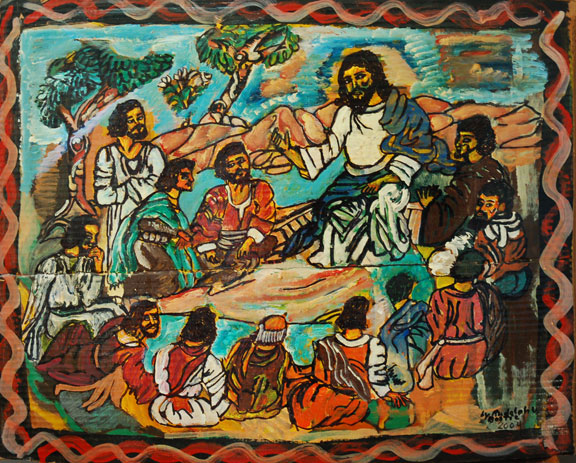
Jesus and the Disciples, by Rudolph Bostic

Jesus went up on a mountainside and called to him those he wanted, and they came to him. He appointed twelve that they might be with him and that he might send them out to preachand to have authority to drive out demons. These are the twelve he appointed: Simon (to whom he gave the name Peter), James son of Zebedee and his brother John (to them he gave the name Boanerges, which means “sons of thunder”), Andrew, Philip, Bartholomew, Matthew, Thomas, James son of Alphaeus, Thaddaeus, Simon the Zealotand Judas Iscariot, who betrayed him. (New International Version)

For me, every place in Holy Scripture is significant, even the seemingly mundane portions of it. Today’s verses might appear rather insignificant. However, there is some important meaning to recording who Christ called as his disciples and why he did it.

Jesus appointed twelve Jewish men to be his close disciples, his apostles. In choosing them, let’s not read into it something that isn’t there. This choosing, in no way, is meant to convey that church leadership boards are always supposed to have twelve men. It seems to me, that if such churches believe this, they ought to go all the way by insisting that they ought also to be Jewish Christians – no Gentiles on the election ballot at the annual meeting!

Excluding women, maintaining a particular number of people to a group, or considering only one ethnicity to leadership is nowhere to be interpreted in this text of Scripture. I can imagine Jesus sitting at the right hand of the Father raising a Spock-like eyebrow to such hermeneutical gymnastics and stating the lone word, “fascinating!”

A disciple is a follower. An apostle is one who is sent out with a specific purpose. Jesus called these particular people in order to send them out with a mission. In other words, Christ’s disciples are really missionaries. And these apostles, these missionaries, are appointed in order that they might be with Jesus, follow him everywhere, learn from him, and then have the received authority to go out and accomplish the mission given them to do.

An apostle can only properly carry out the instructions of the Teacher by first being a disciple who spends copious amounts of time in that Teacher’s presence. Indeed, if we are looking for some contemporary application in these more mundane texts of Scripture, let us find here an insight into our own Christian formation.

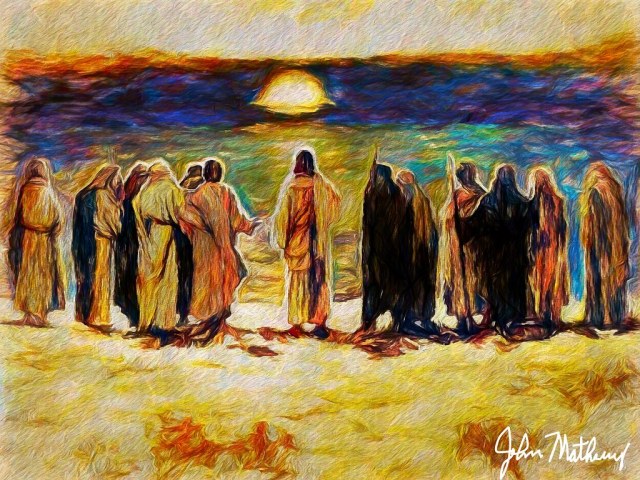
Jesus and the Disciples, by John Mathews

Christian ministry is rightly patterned after the Teacher we follow, Jesus our Lord. Christ himself demonstrated for us the way of mentoring or discipling, through his own words and actions. He called particular individuals, taught them, and equipped them for spiritual warfare in this world by granting them authority to do the work.

If we need a pattern, there it is. It’s a model of mentoring others in the ways of Christian mission and ministry. The idea is that we call, teach, equip, and authorize others in the words and ways of Jesus. I really don’t much care what you call it: Christian discipling, relational mentoring, small group teaching, spiritually forming, or any other word or phrase.

The important thing is to actually understand and do this very Christ-like work of developing mature followers of Jesus who can do the important work of spiritual warfare and ministry, then in turn, develop others. We are to pass on a body of faith and doctrine, of mission and ministry, to a group of people who will do the work. And they then do the same for others.

I rather like the word “mentoring” because for most people it evokes the idea of putting time and effort into some relationships for a specific purpose. And when we look at Christianity as a great mentoring project, perhaps we will see why church is becoming a byword in many parts of the Western world. This also ought to perhaps clue us into how we might move forward as Christians.

I am suggesting that, generally speaking, we have neglected this pattern of Jesus in calling, teaching, equipping, and authorizing. It is one large reason why there is such a decline in church attendance (and participation) in the West. And until we collectively take up this mantle of mentoring ministry, we shall continue to lessen, because we are irrelevant to people’s daily lives – both inside and outside the church.

As a first course of action, I invite you – no matter your age or stage in life – to make it a priority to simply “hang out” with individuals and groups of people. Maybe that sounds like an extrovertish sort of thing to do. However, this invitation is coming from me, an introvert. I didn’t say you have to be the life of the party, or engage in a lot of talking. But I am saying that mature followers of Jesus ought to strongly consider some intentional relationships with people other than family and a few friends.

Hang out around any given church, on any given Sunday, after any given worship service, and you are likely to see small groups of people talking with each other. Those groups typically center around friends according to age. What is often lacking are intentional interactions between the generations.  

Ethiopian Orthodox Church depiction of Christ and his disciples

The younger generations (particularly persons aged 18-29) often need and want to have relationships with more experienced (older!) believers in the faith. Younger adults, however, tend to lack the confidence to go after older adults in order to be mentored or influenced by them. I believe the onus is on the older generations to go after the younger.  

Maybe I’m just old, but it seems like younger generations have an incredible array of relationships, differing levels of friendship, and a complexity to their interactions that I didn’t have “back in my day.” What’s different, it seems, is that their relationships are more gray, and less black and white. And they appear to do a solid amount of hanging out.

Hanging out is typically sitting around with a group of people, eating and drinking, watching movies, studying (or doing bible study) or any other activity. Its doing just about anything, but doing it together with others. And this is the perfect environment for initially establishing how to begin living into the words and ways of Jesus to mentor others.

One of the things we older folks can do is to really understand the reality of younger generations’ relational interactions. For example, when I lived in a university town I used to often just “hang out” with college students, with no agenda other than just being with them. The local Perkins restaurant was at its busiest at midnight, filled with college students hanging out.

There are places in every town and city where young adults go, especially the bar scene. Bars aren’t just places to drink, but are locations of conviviality where persons have the chance to be around one another in a kind of secular church where fellowship happens, looking for a chance to relate meaningfully with others.

All people desire intimacy and want to know that someone else cares about them. This is a very real and felt need. How that need is going to be met can be either legitimate or illegitimate. And we can help with that.

One of the best things we can do for others is to communicate to them that we “have their back,” that we care, love, and genuinely like them.

No one can sniff out a disingenuous attitude quite like a young adult. So, our interactions have to be an authentic desire to be around them. Also, this does not mean we have to pretend to be younger than we are. Instead, one of the greatest needs a young person has is to be in a mentoring relationship with someone older and wiser who can help them navigate life and bring some sort of definition to relationships that they may lack.

The older generations could learn to “hang out” with younger generations and find individuals for whom they can build a solid one on one or group relationship with. If they can have such relationships now, it will serve them for a lifetime.

It seems to me that, as I look at the biblical text, being a mentor, and walking alongside another with love, grace, and wisdom, is built into Christianity by Jesus himself. So, let’s consider how we might best go about this important work.

May your love overflow more and more with knowledge and full insight to help you to determine what really matters, so that in the day of Christ you may be pure and blameless, having produced the harvest of righteousness that comes through Jesus Christ for the glory and praise of God. (Philippians 3:9-11, NRSV)

Real Life (1 Thessalonians 3:6-13)

But Timothy has just now come to us from you and has brought good news about your faith and love. He has told us that you always have pleasant memories of us and that you long to see us, just as we also long to see you. Therefore, brothers and sisters, in all our distress and persecution we were encouraged about you because of your faith. 

For now we really live since you are standing firm in the Lord. How can we thank God enough for you in return for all the joy we have in the presence of our God because of you? Night and day we pray most earnestly that we may see you again and supply what is lacking in your faith.

Now may our God and Father himself and our Lord Jesus clear the way for us to come to you. May the Lord make your love increase and overflow for each other and for everyone else, just as ours does for you. May he strengthen your hearts so that you will be blameless and holy in the presence of our God and Father when our Lord Jesus comes with all his holy ones. (New International Version)

What does it mean to really live? Everyone has their own conceptions of what the good life is. But to live life to the full, to really live in sync with how life actually is (and is supposed to be) brings us true satisfaction, contentment, and meaning.

In the radical individualism of the West, it may seem foreign or strange to us that the Apostle Paul’s life was very much bound up in the lives of others – in the churches he established and with the believers who had come to faith in Christ. For Paul, to really live was to see spiritual growth and development in the places where he ministered.

The thing that really got Paul excited, what really melted his butter, was leading others to Christ, forming them into churches, and watching them carry out their missional mandate by doing the same things that he did with them. I can relate to Paul’s joy and satisfaction over Christian discipleship.

There’s nothing quite like mentoring others in the faith, helping them mature in that faith, and sending them out to live according to the model of faith that you’ve demonstrated for them. To see the Word of God take root in individuals and communities of people is like no other sort of joy and contentment.

In the midst of discouraging circumstances of persecution and distressing situations of opposition, it was gratifying, encouraging, and motivating for Paul to hear a good spiritual report from his protégé Timothy about the Thessalonian church’s faith.

Whether we acknowledge it or not, or like it or not, every one of us is inextricably connected to the other. And that is especially true in families, and in the family of God. The Thessalonian believers’ steadfast commitment to Christ and the Christian faith was a crucial and important dimension of Paul’s own persevering faith.

The Apostle had been on the front lines of faith – taking the good news of grace and forgiveness in Christ to the nations. To have his churches endure through all their own troubles and challenges is a great boon to Paul. They each derive confidence and inspiration from the other. Everyone’s faith is confirmed and strengthened when everyone is striving to live for Christ.

All the believers in Christ were really living because they stood firm in the Lord and were immovable in their faith commitments. Assurance and reassurance comes not in isolation, but through the interdependence and interaction with others who share the same values.

Parents don’t really live, unless they see their children living a life of abundant joy and satisfaction. And it’s the same with spiritual mothers and fathers; they truly live when their spiritual children are walking in faith and patience with the Lord.

This is why Paul was grateful and could not thank God enough for the Thessalonians’ life of faith. God’s powerful and gracious work in the church brought out all kinds of thanksgiving. With that sort of dynamic happening, Paul could face any tribulation with the confidence and trust needed to keep going.

Prayer is the logical response to a healthy spiritual and relational dynamic of faith. The greater the good relations, the greater the desire to come and keep imparting needed teaching and encouragement for the Christian life. In other words, spiritual growth begets spiritual growth.

The best way the Thessalonian converts and all the churches become rooted in faith is by God helping them to have their love increase and overflow for each other, and for everyone else. What’s more, God intends that the love Christians have for one another be a model and a witness to and for the world.

Christian community is the place we learn to love. As we practice again and again how to love one another in the church, we then take this love into the world in loving even our enemies. For if we are to follow our model and leader, Jesus Christ, then we will infuse each word and every action with the love of God in Christ – which is the light that draws others into a healthy spiritual and relational dynamic.

We must pray, as Paul did, for love to increase amongst us, so that our hearts are strengthened with genuine purity and holiness of life. For unless love grows and flowers, selfish desires will increase and turn our love inward to the point of taking love away from God and the world.

It is imperative that we have a genuinely loving stance toward each other as believers, and toward others in the world. Apart from this love – given graciously to us through the cross and resurrection of Christ – there is little hope for anything bad in this old fallen world to ever be better.

The bottom line is that churches wither and die because they lose sight of love; Christians lose faith and go their own way because they forget about love; and believers throughout the world continue on because loving prayers, loving ways, and loving words come their way, despite difficulty and hardship they face.

So, let us love one another as Christ loved us. For this is the way our faith is strengthened and our hope is kindled to keep enduring until Jesus returns to this earth and makes all things new and right. This is real life.

May almighty God give you grace to persevere with joy, so that the work of love begun in you may be completed, through Jesus Christ our Lord. Amen.