The Need to Defend a Ministry (2 Corinthians 10:1-11)

Mosaic of St. Paul Preaching, 12th century, Duomo, Monreale, Sicily, Italy

By the humility and gentleness of Christ, I appeal to you—I, Paul, who am “timid” when face to face with you, but “bold” toward you when away! I beg you that when I come I may not have to be as bold as I expect to be toward some people who think that we live by the standards of this world. 

For though we live in the world, we do not wage war as the world does. The weapons we fight with are not the weapons of the world. On the contrary, they have divine power to demolish strongholds. We demolish arguments and every pretension that sets itself up against the knowledge of God, and we take captive every thought to make it obedient to Christ. And we will be ready to punish every act of disobedience, once your obedience is complete.

You are judging by appearances. If anyone is confident that they belong to Christ, they should consider again that we belong to Christ just as much as they do. So even if I boast somewhat freely about the authority the Lord gave us for building you up rather than tearing you down, I will not be ashamed of it. I do not want to seem to be trying to frighten you with my letters. 

For some say, “His letters are weighty and forceful, but in person he is unimpressive and his speaking amounts to nothing.” Such people should realize that what we are in our letters when we are absent, we will be in our actions when we are present. (New International Version)

I don’t know about you, but I’m not a fan of feeling like I have to defend my ministry – my philosophy of how to go about things, my hermeneutics, my words, my actions, my clothes, my food – and pretty much everything about me. Believe it or not, I’ve been criticized for things like not having shiny enough shoes (and having too nice of shoes), the make and model of the car I drive (and don’t drive), being too serious (and not being serious enough).

So, for me, I detect in the Apostle Paul’s retort to the Corinthian Church, an exasperation. Reading between the lines, I can hear him saying something like, “I can’t believe I’m even talking about this stuff because you guys are about as spiritually aware as a bowling ball – and bowling balls haven’t even been invented yet. Heck, I don’t even know what a bowling ball is! That’s about how much you know what you’re talking about. Sheesh!”

Yet, despite Paul’s annoyance and displeasure with the Corinthians’ line of thinking, the Apostle still made up his mind to craft a response that was as humble and gentle as he could possible come up with.

A modern archaeological site at Corinth, Greece

The Church’s first criticism toward Paul is that he is bold from a distance, but up close and personal, rather weak and unimpressive as an Apostle. I’m willing to be that every church pastor in the U.S. is more than able to know what this feels like in putting themselves in the Apostle’s shoes.

It’s an age old criticism that every preacher faces at various points, or at least with some sermons or writings. The people just don’t appreciate or like what they’re hearing or reading. It often comes out in the ubiquitous phrase, “I’m just not getting spiritually fed.” Wrapped up in that phrase is not only the criticism of oratorical skills, but also that they don’t like something about the preacher’s physical appearance, particular idiosyncrasies, or interaction with other people.

The second criticism of Paul by the Corinthians is that he acts too much according to human standards. In other words, the Apostle is just too worldly for them. If you happen to know anything about the ancient Corinthian Church, you’re either doing a major eye roll right now, or you’re just plain busting a gut in laughter.

There’s no more worldly church in the New Testament than the Corinthian Church. To have them bringing this point up to Paul is both laughable and downright sad. But again, every preacher nowadays knows the criticism all too well. For example, many pastors aren’t paid well with the convoluted reasoning that they shouldn’t be tempted toward worldliness – even though the parishioners themselves have no problem owning large homes, multiple cars, and high paying jobs.

The Corinthians were likely also concerned about Paul’s egoism – that he’s too much into worldly power and philosophies. Again, laughable stuff, considering the source. Yet again, these sorts of criticisms are rife within many churches. And the critics themselves tend to be ones who are enamored with wanting power and control for themselves, wanting to ensure that no one, including an upstart pastor, never treads upon their mastering of a very small world.
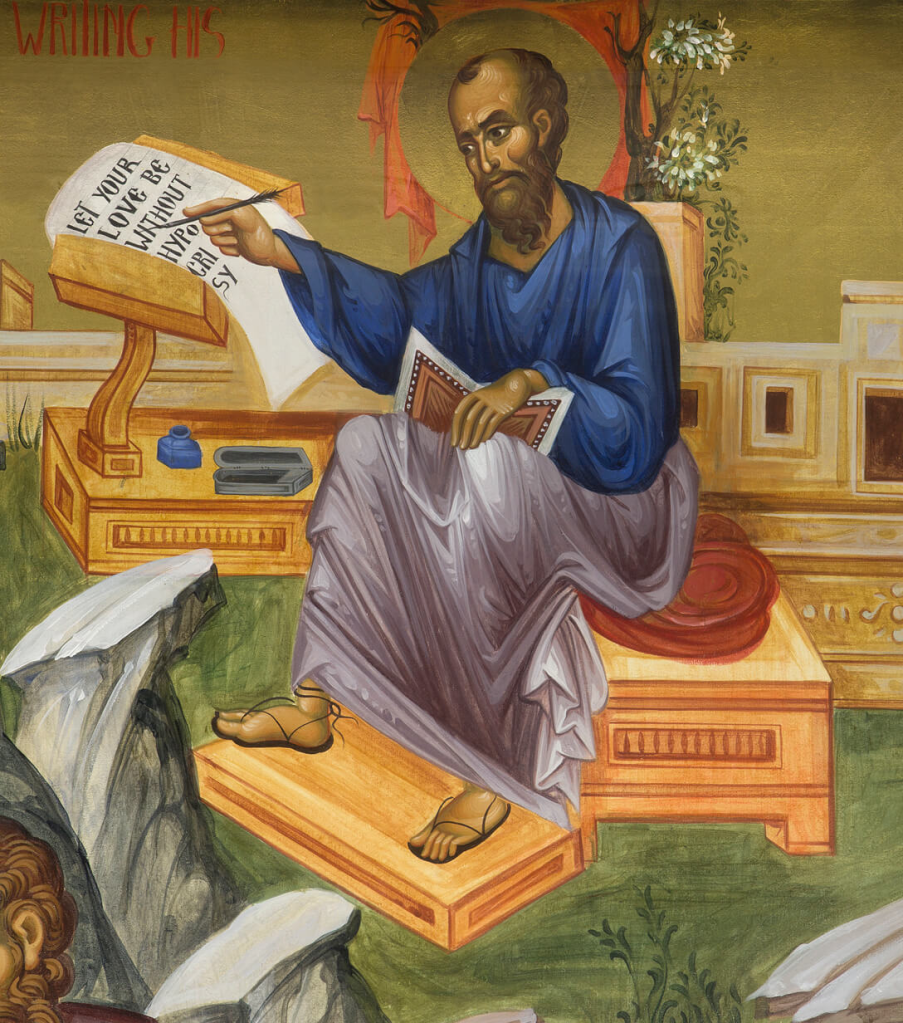
Orthodox icon of St. Paul writing to the churches

Paul responds to this by stating that he is, of course, a human being. However, he wields a different kind of power. Employing military metaphors, the Apostle describes the weapons that he uses as capable of destroying spiritual strongholds of arguments, and obstacles of pride against the knowledge of God – the very sorts of strongholds that were present among the Corinthians.

What’s more, Paul takes captive every thought and makes it obedient to Christ, and not to a self-serving agenda of worldly control and power. And he will use those weapons, if necessary, if the Corinthians keep up their petty criticisms and worldly behavior.

The bottom line of it all is that Christ made Paul an Apostle; and nobody in the Corinthian Church was made one. Paul’s authority was given, not taken, and he will use it to build up and not tear down. In other words, the Apostle Paul was committed to fulfilling his apostolic commission by establishing churches, building up those churches in the strength of faith, and protecting them from misguided and wrongheaded ways of operating.

All I have to say to this is that I am very glad that the Church belongs to Christ. Because that’s the only way we can still be talking about the Church still existing all these centuries later. God works, despite all the human foibles and nonsense.

Even though I talk like this (as does Paul!) there are still good Christian believers and good Christian churches in this world. Not every parishioner lacks self-awareness, is short-sighted, and has a plank in their eye. Nor are all pastors just in it for attention and some sort of worldly gain.

I’m still living and breathing, ministering and mentoring, after decades of Christian labor because of many good people who treated me well, spent good time with me, as well as those who received my teaching and my love, put it into practice, and have produced a harvest of righteousness beyond what I could imagine.

It would be good for all of us to experience supportive community, spiritual maturity, and wise ministry to others. If we can go through any process – no matter what it is – with the humility and meekness of Christ, then no matter what the end is, we have brought some peace and goodness into this old fallen world of ours.

And there is no shame in that!

Almighty and eternal God: Every good and perfect gift comes from you. Send down upon our pastors and parishioners alike a healthy spirit of grace and goodness, so that we all together may truly please you in all we say and do; and continually pour out your divine blessing upon us all. We ask this for the honor of your Son, our Advocate and Friend, Jesus Christ our Lord. Amen.


Power in Weakness (2 Corinthians 13:1-4)

Way of the Cross, by Jyoti Sahi, 2009

This will be my third visit to you. “Every matter must be established by the testimony of two or three witnesses.” I already gave you a warning when I was with you the second time. I now repeat it while absent: On my return I will not spare those who sinned earlier or any of the others, since you are demanding proof that Christ is speaking through me. He is not weak in dealing with you, but is powerful among you. For to be sure, he was crucified in weakness, yet he lives by God’s power. Likewise, we are weak in him, yet by God’s power we will live with him in our dealing with you. (New International Version)

One witness is not enough to convict anyone accused of any crime or offense they may have committed. A matter must be established by the testimony of two or three witnesses. (Deuteronomy 19:15, NIV)

The missionary Apostle Paul had already visited Corinth twice. Citing his upcoming third visit in the context of establishing a crime, this was a warning to the Corinthian Christians: When I get there, it won’t be a pleasure cruise. Paul would flex his apostolic muscles toward the church.

The Apostle was accustomed to people opposing his ministry and generally making a stink of things against him. The Corinthians were being rather stubborn and unrepentant. They were unwilling to change their ways nor their attitudes.

In order to discredit Paul, his opponents labeled him as weak and ineffective. They challenged him as to whether Christ was actually animating his words, or not. But Paul was no weakling, nor was he a simpleton. He used their own language against them by pointing out that Jesus was accused of the very same things – Christ was crucified in weakness, but lives by the power of God.

Christianity is an inherently paradoxical religion. It’s not going to make sense to the ungodly and the unbeliever. The cross – the place of submission, torture, death, and apparent weakness – was actually the supreme demonstration of God’s power. This was proven by the resurrection of Christ from death.

In the same way, although Paul seemed weak, unimposing, always engaged in suffering service, these very things were the ultimate sign that God’s power was at work in his ministry. The Apostle shared in the sufferings of Christ and gloried in the reality that he was weak.

And since Paul also shares in Christ’s resurrection, he therefore shares in the power of Christ. He will use this power, given to him by Christ in the form of apostolic authority, and deal with the recalcitrant Corinthians forthwith.

The Corinthian Church, not knowing who they were really dealing with, had a tiger by the tail. There is a time for gentle and compassionate pastoral care, and then there is the time for using the shepherd’s crook for some tough loving discipline.

If the sin-busting strength of the cross, and the spiritual power of the resurrection, are truly fueling Christian ministry, then it is a fool’s errand to oppose it. Chastisement and a lesson in humility are in store for the haughty opponent working against authentic Christian service.

We really have to get this wrongheaded notion out of our noggins, that power and strength are all about an aggressive exercise of authority. If I see one more church put out an advertisement for a pastor who has “strong leadership” I think I’m going to puke. Because what they typically mean by strength is a command-and-control sort of stereotypical military Sargent type of person.

That’s diametrically opposed to the leadership and authority Jesus exercised, and the kind of values which characterize the kingdom of God. In God’s economy, humility and meekness are the true demonstrations of power. Real power in this world is the power of self-control – and not the control of manipulating others to get and keep power that won’t last.

Little wonder that pastors of churches these days can be some of the worst immoral and unsavory characters around. Congregations hungry for “strong leadership” inevitably hire narcissistic persons. And then when things go sideways, the church wonders what the heck happened.

But the signs were continually there, all along. When the church leaders pray, they’re not addressing God, but publicly telling those listening what they should be doing. In speaking, they tend to preface their comments with “The Bible says…” which is really a clue that they’re about to spout a bunch of opinionated nonsense cloaked in religious garb.

Until we embrace the mystery of the faith, expressed in paradoxical ways, with the weak displaying the real strength and power of the gospel, then we can expect Jesus to show up with a whip and give people what they’ve really wanted all along – and they won’t like it one bit.

Paul, a mentor to many first generation Christian pastors, encouraged them this way:

I solemnly call on you in the presence of God and Christ Jesus, who is going to judge those who are living and those who are dead. I do this because Christ Jesus will come to rule the world. Be ready to spread the word whether or not the time is right. Point out errors, warn people, and encourage them. Be very patient when you teach.

A time will come when people will not listen to accurate teachings. Instead, they will follow their own desires and surround themselves with teachers who tell them what they want to hear. People will refuse to listen to the truth and turn to myths.

But you must keep a clear head in everything. Endure suffering. Do the work of a missionary. Devote yourself completely to your work. (2 Timothy 4:1-5, GW)

Weakness, hardship, suffering, and opposition are part of the work of Christian ministry. In this, there is eternal power, which shall never be overcome.

Almighty God, may your grace be sufficient for me, and my power made perfect in weakness. Help me to rely upon and use my weaknesses, so that Christ’s power may rest on me. For Christ’s sake, I delight in weaknesses, insults, hardships, persecutions, and difficulties. For when I am weak, then I am strong, through Jesus Christ my Lord, in the enablement of the Holy Spirit. Amen.

Humble Leadership (Numbers 11:24-30)

So Moses went out and told the people what the Lord had said. He brought together seventy of their elders and had them stand around the tent. Then the Lord came down in the cloud and spoke with him, and he took some of the power of the Spirit that was on him and put it on the seventy elders. When the Spirit rested on them, they prophesied—but did not do so again.

However, two men, whose names were Eldad and Medad, had remained in the camp. They were listed among the elders, but did not go out to the tent. Yet the Spirit also rested on them, and they prophesied in the camp. A young man ran and told Moses, “Eldad and Medad are prophesying in the camp.”

Joshua son of Nun, who had been Moses’ aide since youth, spoke up and said, “Moses, my lord, stop them!”

But Moses replied, “Are you jealous for my sake? I wish that all the Lord’s people were prophets and that the Lord would put his Spirit on them!” Then Moses and the elders of Israel returned to the camp. (New International Version)

“Blessed are the meek, for they will inherit the earth.”

Jesus (Matthew 5:5)

My dad was on the local schoolboard for many years when I was a kid. I remember him telling me that he could predict was the Superintendent of Schools was going to do. Dad would introduce a motion (an idea or action to take) knowing that it would be struck down by the Superintendent, who then would introduce the same motion months later as if it were his own idea.

We all have likely had the experience of other people taking credit for our work, or at least spinning a situation to make it appear like the person was more responsible or in charge of something good than they actually were. After all, most of us want to look good in the eyes of others. So, leaders sometimes (most of the time?) reinterpret and bend situations to make their leadership shine, especially when it isn’t shining at all.

But Moses was a different sort of leader. He is described in Holy Scripture as “a very humble man, more humble than anyone else on the face of the earth.” (Numbers 12:3, NIV)

Today’s Old Testament lesson illustrates for us what humility and meekness truly look like. And the leadership of Moses had an authentic shine to it which resulted from being close to God. (Exodus 34:29-34; 2 Corinthians 3:12-18)

What is a meek and humble leader?

In a world enamored with issues of power and authority, Moses was a counter-cultural leader who understood his position and embodied the true nature of service to both God and people.

Humility acknowledges that the leader is not the one who is truly in charge. Ultimately, God is, and not any of us. The Holy Spirit is totally sovereign and acts in whatever way the Lord wills. The Spirit will not be stereotyped, nor can anyone really discern or predict what the Spirit will do or not do.

For sure, a life of prayer, faith, and holiness are necessary for the Christian life. Yet, we must not therefore assume that our spiritual disciplines somehow guarantee particular outcomes. It’s plain arrogance to suppose that somehow we can maneuver or manipulate God for our own purposes – which is why we need to cultivate a life of humility and meekness.

The reply of Moses to Joshua’s concern about the Spirit being manifested in an unexpected way illustrates a gentle and generous spirit of heart. Far from silencing the two men prophesying apart from the others, Moses instead longed for such a blessing to be extended to all the people.

Good and godly leaders are such because their sole passion is to honor and glorify the Lord. For them, it doesn’t really matter whether they’re personally involved in the great and spiritual thing happening, or not. That’s humility, my friends.

If there’s a distinction between humility and meekness, it is this: The humble person is self-aware enough to know they can only do anything by the hand of God operating within them; and the meek person is socially aware enough to understand that, in their lowliness, they are unable to look down on anyone else. Therefore, pride, arrogance, and hubris are nowhere to be found.

To have divine validation is all that’s needed for the godly leader; and when one is content with what they need and want most, there’s no need for human accolades and constant attention.

Far too often, we equate meek with weak. If someone is meek, some folks wrongly reason they must be a washrag, or overly introverted, and maybe not taking proper initiative in life. Of all the leadership qualities we may aspire to, I doubt that meekness would make any leader’s top ten list of desired character traits.

Why would I want to be meek?

Jesus, an unquestioned leader, described himself as meek. Yet, many English translations steer clear of the word. For example, “Come to me,” the New International Version of the Bible says, “all you who are weary and burdened, and I will give you rest. Take my yoke upon you and learn from me, for I am gentle and humble in heart, and you will find rest for your souls. For my yoke is easy and my burden is light.” Only the King James Version translates the word as “meek,” instead of “gentle.”

What does it mean to be meek?

“Meek” is a word used in other ancient Greek literature for breaking a horse. It’s the change from being a wild stallion who wants to go his own way, to a broken horse who is able to be guided and used, allowing others on his back without bucking.

At the crucifixion, Jesus was naked, exposed, and vulnerable to the idle curiosity of the crowd and the vulgar frivolity of the soldiers who were having a party around his suffering. “If you are the king of the Jews,”they taunted,“save yourself.” (Luke 23:35-36)

The extraordinary thing is there was no spirit of revenge with Jesus. Christ did not curse his tormentors, but instead prayed, “Father forgive them, for they don’t know what they’re doing.” (Luke 23:34)

What characterizes a meek person?

  • The meek have a desire to put other’s interests ahead of their own, because they know it is not all about them. They practice healthy rhythms of giving and receiving with others, without prejudice or favoritism.
  • The meek are more concerned with edifying and building up their brothers and sisters than justifying themselves. They don’t care who gets the credit. And they receive criticism well.
  • The meek are truly egalitarian and do all things with equity and inclusion. They make no distinctions between rich and poor, beautiful and ugly, intelligent and cognitive deficits, black and white, gay and straight, Democrat and Republican, or insider and outsider. In the meek person’s mind, every person is created in the image of God and therefore deserves respect, attention, and justice.

How do I live as a meek person?

Perhaps repentance is in order. It could be that too many people have made much more of themselves than what they truly are. Maybe we have adopted a stance of shaming others, believing that some people need a bit of guilt from a leader in order to change their obnoxious ways.

Moses did not retaliate against the prophesying men or squelch what the Spirit was doing. Non-retaliation happens whenever we understand that we’re flat on our backs before God, and there is no place to look but up. And it also means there is no ability to look down on others. It is to be broken and moldable before God. 

Most importantly for the spiritual person, Moses had regular and extended times of meeting with God. It’s what kept him humble and maintaining a perspective on life that is healthy and helpful.

This day, almighty and holy God, be within and without me, lowly and meek, yet all-powerful. Christ as a light; Christ as a shield; Christ beside me, on my left and my right, I walk with you in humility of heart in the strength of the Holy Spirit. Amen.

Colossians 3:12-17 – Wear the Right Clothes

God loves you and has chosen you as his own special people. So be gentle, kind, humble, meek, and patient. Put up with each other, and forgive anyone who does you wrong, just as Christ has forgiven you. Love is more important than anything else. It is what ties everything completely together.

Each one of you is part of the body of Christ, and you were chosen to live together in peace. So let the peace that comes from Christ control your thoughts. And be grateful. Let the message about Christ completely fill your lives, while you use all your wisdom to teach and instruct each other. With thankful hearts, sing psalms, hymns, and spiritual songs to God. Whatever you say or do should be done in the name of the Lord Jesus, as you give thanks to God the Father because of him. (Contemporary English Version)

New life is fantastic!… Until it isn’t.

Like a new car eventually losing its new car smell, so it is quite easy for the Christian to experience the mountaintop of transformation, only to lug back down and walk through the boring old valley.

And it’s fun to have a new set of clothes… until they wear out, go out of style, or fall apart in the washing machine. the thing about those new clothes we were so excited about when we got them is that they are wearing out.

When I was eight-years-old (a long time ago!) I still remember my favorite pair of jeans. I wore them every day. My Mom had to order me to take them off so she could wash them. Finally, after having several patches sewn on them, having grown too much, and with the material so thin you could see through them in places, that old ratty pair of jeans actually just fell off my body in a heap, as if to say, “Enough is enough, boy!”

Our nice white spiritual clothes, given to us through Christ’s resurrection, are to be our favorites. We need to clothe ourselves in them every day.

Because of Christ’s redemptive events of crucifixion and resurrection, believers can experience new life, free from sin, death, and hell.  Oh, it isn’t that we never need to deal with evil; we very much do. The difference is that we now have a new awareness of our spirituality.  And with awareness comes choices. 

If we aren’t aware of our feelings, our spirit, and/or old nature, well, then, it’s as if we operate on auto-pilot – losing altitude in an immanent descent into tragedy. When we are aware of our inner selves, then we mindfully ascend through the clouds to join Christ.

You were taught, with regard to your former way of life, to put off your old self, which is being corrupted by its deceitful desires; to be made new in the attitude of your minds; and to put on the new self, created to be like God in true righteousness and holiness.

Ephesians 4:22-24, NIV

We can make choices about what to wear. With awareness, we look in the mirror and see that the grave clothes need to come off. The old raggedy garments of pride and hubris, greed and immorality, selfish lust, jealous envy, spiritual gluttony, unholy anger, and complacency get taken off and tossed in the garbage. 

We then go to God’s expansive walk-in closet and choose the bright raiment of compassion, kindness, humility, gentleness, patience, forgiveness, and grab the beautiful coat of love which covers it all with such dignity and honor.

It would be super weird to try and put the new clothes over the old raggedy grave clothes. That’s not only gross, but it’s also downright wrongheaded. Practical Christianity always involves two actions: taking-off and putting-on. 

“No one cuts up a fine silk scarf to patch old work clothes; you want fabrics that match. And you don’t put your wine in cracked bottles.”

Matthew 9:16-17, MSG

Human willpower and/or ingenuity tries to live a virtuous life while ignoring the vices. This will not do for the Christian. The endearing qualities we so desire to possess cannot be obtained without first dealing with the crud of sin which clings to us like so many stinky dirty clothes. To put this in theological terms: the cross and resurrection go together. Sin must be put to death before a victorious life is put on.

Once we have acknowledged sin, let Christ take it all off, and put on the new clothes. Then we’re ready to hit the town in style!  We walk out the door with a tremendous sense of peace, knowing God in Christ has cleaned us up.  We stroll into the world with lips whistling and a song in our hearts – singing with gratitude for what the risen Christ has accomplished on our behalf. 

After all, we just put on expensive clothes and it didn’t cost us a dime.  In fact, we’re so darned thankful that we don’t just talk to others, we sing our words to them – even though we can’t carry a tune.  It doesn’t matter.  Our coat of love compels us.

Almighty and everlasting God, you willed that our Savior should take upon him our clothing of death upon the cross so that all humanity would have the privilege of wearing humility, gratitude, and love. Mercifully grant that we may both follow the example of Christ’s life, and also be made aware of our participation in his glorious resurrection, in the power of your Holy Spirit.  Amen.