Anxious (Genesis 32:3-21)

Jacob praying for deliverance from his brother Esau, by Gustave Doré (1832-1883)

Jacob sent messengers on ahead to Esau, who lived in the land of Seir, also known as Edom. Jacob told them to say to Esau, “Master, I am your servant! I have lived with Laban all this time, and now I own cattle, donkeys, and sheep, as well as many slaves. Master, I am sending these messengers in the hope that you will be kind to me.”

When the messengers returned, they told Jacob, “We went to your brother Esau, and now he is heading this way with 400 men.”

Jacob was so frightened that he divided his people, sheep, cattle, and camels into two groups. He thought, “If Esau attacks one group, perhaps the other can escape.”

Then Jacob prayed:

You, Lord, are the God who was worshiped by my grandfather Abraham and by my father Isaac. You told me to return home to my family, and you promised to be with me and make me successful. I don’t deserve all the good things you have done for me, your servant. When I first crossed the Jordan, I had only my walking stick, but now I have two large groups of people and animals. Please rescue me from my brother. I am afraid he will come and attack not only me, but my wives and children as well. But you have promised that I would be a success and that someday it will be as hard to count my descendants as it is to count the grains of sand along the seashore.

After Jacob had spent the night there, he chose some animals as gifts for Esau: 200 female goats and 20 males, 200 female sheep and 20 males, 30 female camels with their young, 40 cows and 10 bulls, and 20 female donkeys and 10 males.

Jacob put servants in charge of each herd and told them, “Go ahead of me and keep a space between each herd.” Then he said to the servant in charge of the first herd, “When Esau meets you, he will ask whose servant you are. He will want to know where you are going and who owns those animals in front of you. So tell him, ‘They belong to your servant Jacob, who is coming this way. He is sending them as a gift to his master Esau.’ ”

Jacob also told the men in charge of the second and third herds and those who followed to say the same thing when they met Esau. And Jacob told them to be sure to say that he was right behind them. Jacob hoped the gifts would make Esau friendly, so Esau would be glad to see him when they met. Jacob’s men took the gifts on ahead of him, but he spent the night in camp. (Contemporary English Version)
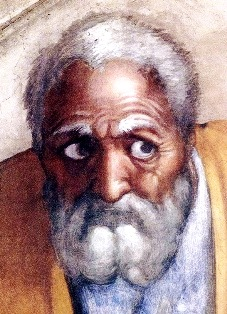
Anxiety’s a booger. It arises as an unwanted guest within our psyche, putting pressure on our chest, and becoming a squatter in the pit of our gut. To be anxious is to have a vague sense of dread, anticipating some upcoming threat.

Jacob knew the feeling well. His mind raced with thoughts of what might happen and how to placate Esau when he encountered his brother. Jacob left home two decades earlier to escape Esau’s vengeance. Now their meeting up was imminent. Jacob was scared spitless.

What do you do when distress and dread wrap you in a straitjacket of anxiety?

Avoid avoidance

The only way to deal with fear is to face it. Avoiding it prevents us from moving forward. It makes us anxious.  One way of facing your fear and/or anxiety is to name it. When fear, anxiety, terror, apprehension, or distress arises, then name it. In naming our fears and anxieties, they become real and, thus, manageable. 

“Every time your fear is invited up, every time you recognize it and smile at it, your fear will lose some of its strength.”

Thict Nhat Hanh (1926-2022)

Another way to face fear is to “sit with it” for a short while. Give yourself permission to feel the anxiety for a set amount of time without judgment or trying to get over it. Pay attention to where you are carrying your anxiety in your body.

Focus on what’s within your control

We cannot control other people. There’s no way Jacob was going to control or manipulate his brother Esau. Many circumstances are outside our control. And yet, we always have the choice of self-control. Giving into addictions, or not facing problems are ways of giving up control of ourselves. Taking good care of ourselves, and focusing on good attitudes are ways of strengthening personal control.

The Serenity Prayer is a good reminder in those times when we feel out of control:

God, grant me the serenity to accept the things I cannot change,

The courage to change the things I can,

And the wisdom to know the difference.

Promote a positive mindset

Positive attitudes help us widen our perspective on things – and with a broader view of things comes more awareness of choices. Making wise choices for ourselves now, builds resilience and fortifies us for difficult situations down the road – without succumbing to old unhealthy coping mechanisms.

Find purpose and meaning in life

Experiencing traumatic events might cause us to question whether our lives have meaning, or not. We may feel unnecessary or expendable, and see no meaning for the future. 

So, it’s important to discover or reconnect with the spirituality within you. Take the time and energy to read Scripture, walk through nature, or discuss matters of the spirit with others. Just as our physical spine helps to support us and is not optional, so we also have a spiritual spine that needs attention for which we cannot live without.

Get support

Other people, like trusted friends and family, can help us make a realistic assessment of the fear and anxiety we are experiencing. With the support of others, we become more confident that we can deal with issues. Finding a church or some other religious gathering can be a fresh means of emotional support.

You are not alone. We are all in this life together. So, let’s rely upon one another and not believe that we just need to pull up ourselves out of impending trouble. There is a God (and God’s people) who are ready to help, if but we just ask.

O God, preserve us from faithless fears and worldly anxieties, and grant that no clouds of this mortal life may hide from us the light of that love which is immortal, and which you have manifested to us in your Son, Jesus Christ our Lord. Amen.


Our Place in the World (Psalm 8)

Lord, our Lord,
    how majestic is your name in all the earth!

You have set your glory
    in the heavens.
Through the praise of children and infants
    you have established a stronghold against your enemies,
    to silence the foe and the avenger.
When I consider your heavens,
    the work of your fingers,
the moon and the stars,
    which you have set in place,
what is mankind that you are mindful of them,
    human beings that you care for them?

You have made them a little lower than the angels
    and crowned them with glory and honor.
You made them rulers over the works of your hands;
    you put everything under their feet:
all flocks and herds,
    and the animals of the wild,
the birds in the sky,
    and the fish in the sea,
    all that swim the paths of the seas.

Lord, our Lord,
    how majestic is your name in all the earth! (New International Version)

I adore the psalms. Many years ago, it was the biblical psalter which helped me come to faith. This little psalm for today is illustrative of why I was moved toward embracing a life with God. Psalm 8 grounds us by dealing with the ultimate questions of human existence:

  • Who am I?
  • Why do I exist?
  • What is the purpose of life?

The answers to those questions are supremely important because people throughout history, and now across the world, are asking what meaning their lives really have.

For example, depression is pervasive throughout the world, as well as the church. It’s a huge issue. Peeling back the layers of a person’s life, many have a deep sense of not truly belonging, and of being profoundly misunderstood by others. Many depressed persons are very aware of their own mortality and have a disconnected sense of their personal role in the world.

Put another way, some folks have lost their original purpose of being a person, that they belong to the human family in a way that makes a significant contribution to the world.

Living on such a big planet causes some people to feel small and wonder how they fit in. With such a large universe, which may at times seem cold and capricious, we may ask, along with psalmist, “What is humanity that you are mindful of them?”

That question forms the center of the psalm. Hebrew poetry is typically set up to have the front and the end of the poem point to the middle where the chief focus is found. So then, the psalmist purposely wrote this psalm so we would consider this great question of what God thinks of humanity within the scope of this immense universe.

And it is a staggeringly huge universe! To put it in perspective, if our galaxy, the Milky Way, were the size of the entire continent of North America, our solar system would fit in a coffee cup.

Even now, two Voyager spacecraft are hurtling toward the edge of the solar system at a rate of 100,000 miles per hour. For decades they have been speeding away from Earth, having now traveled billions of miles. When engineers beam a command to the spacecraft at the speed of light, it takes over half a day to arrive.

Yet this vast neighborhood of our sun—in truth, the size of a coffee cup—fits along with several hundred billion other stars and their planets in the Milky Way, one of perhaps 100 billion such galaxies in the universe. To send a light-speed message to the edge of that universe would take 15 billion years.

Out of the billions of galaxies in the universe, what is the planet Earth that God should care about it? 

Even on our planet there are billions of creatures. Yet, of all those bugs, animals, fish, and birds, God has a special relationship with us, humanity, and cares for us deeply. We know that God cares for us, according to this psalm, because he has entrusted us with the responsibility to care for creation.

We are the only creatures who have the charge to steward all that God has created. As people created in the image of God, we have a job that is befitting of a king. We are God’s vice-regents, in charge of tending and caring for all creation. This incredible job is both a duty and a delight.

God has us playing a crucial role in governing and caring for the world he created. Like a parent or grandparent patiently working with a child to teach them responsibility for all that is around them, God teaches us, and has entrusted to us, this large expansive world we live in. Literally everything in all creation is under our stewardship.

People alone have the self-awareness and perspective of the world that is needed to govern the world. Therefore, we can only find our true purpose and belonging in the stewardship of creation. Caregiving is at the heart of being a person.

The only glitch to all this, and why so many lose their way, is that the world is still living under a curse due to the original fall of humanity.

When we allow other dominions to supersede God’s dominion, then we have issues. Whenever the power of money or the significance of a position, job title, or the ability to do certain tasks is our basic identity and place of belonging, then we will likely succumb to anxiety. That’s because other dominions cannot help us find our true God-given majesty as people created in God’s image.

Living a way other than being a proper steward of the world is beneath us because we have inherent dignity as God’s vice-regents over creation.

Mother Teresa once said that there is no such thing as a small thing – only small things which are done with big love. Her sentiment perfectly captures the vision of the psalmist – that all people are crowned with glory and honor and rule with God to do all the small things of life with a love that comes from our Creator.

We continually have possibilities of engaging in good stewardship of all that God has given us. We have the chance to be attentive to all the little things of life, whether gardening, building a bird house, working with diligence and care at our jobs, or keeping our community clean and its citizens healthy and happy – it’s all important. It brings meaning to our existence as human beings.

People, like all creation, are meant for growth. Putting effort into developing our skills and honing our craft, whatever that may be, is what helps us tap into our God-given purpose for being in this big world.

So, may we continually improve what we do, no matter what it is, so that it befits us as God’s people crowned with honor. May we realize joy and contentment – knowing the majesty we share with God in his wondrous world. 

Almighty God, Creator of the heavens and the earth, words are not enough to express your awesome majesty. Our highest expressions of theology are but baby talk next to you.

Grant us awareness through your Spirit that you are here with us. May this awareness lead us to approach life carefully. The words we speak, the songs we sing, the thoughts we think, the joy and sadness we feel – may it all be pleasing to you, O Lord.

For, despite the inadequacy of our words and actions, our life and worship are addressed to you alone. May you make that life complete, whole, and full to overflowing through Jesus Christ, your Son, our Lord, who with you and the Holy Spirit lives and reigns forever.  Amen.

Good Friday (Psalm 22)

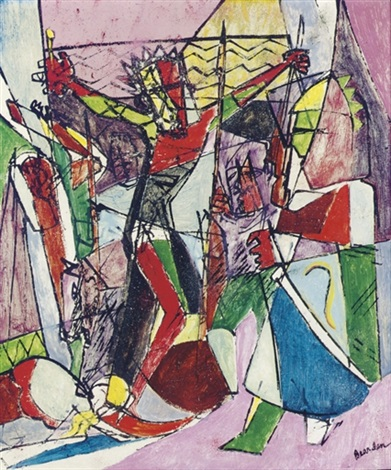
Golgotha – Crucifixion, by Romare Bearden, 1945

My God, my God, why have you forsaken me?
    Why are you so far from helping me, from the words of my groaning?
O my God, I cry by day, but you do not answer;
    and by night but find no rest.

Yet you are holy,
    enthroned on the praises of Israel.
In you our ancestors trusted;
    they trusted, and you delivered them.
To you they cried and were saved;
    in you they trusted and were not put to shame.

But I am a worm and not human,
    scorned by others and despised by the people.
All who see me mock me;
    they sneer at me; they shake their heads;
“Commit your cause to the Lord; let him deliver—
    let him rescue the one in whom he delights!”

Yet it was you who took me from the womb;
    you kept me safe on my mother’s breast.
On you I was cast from my birth,
    and since my mother bore me you have been my God.
Do not be far from me,
    for trouble is near,
    and there is no one to help.

Many bulls encircle me;
    strong bulls of Bashan surround me;
they open wide their mouths at me,
    like a ravening and roaring lion.

I am poured out like water,
    and all my bones are out of joint;
my heart is like wax;
    it is melted within my breast;
my mouth is dried up like a potsherd,
    and my tongue sticks to my jaws;
    you lay me in the dust of death.

For dogs are all around me;
    a company of evildoers encircles me;
they bound my hands and feet.
I can count all my bones.
They stare and gloat over me;
they divide my clothes among themselves,
    and for my clothing they cast lots.

But you, O Lord, do not be far away!
    O my help, come quickly to my aid!
Deliver my soul from the sword,
    my life from the power of the dog!
    Save me from the mouth of the lion!

From the horns of the wild oxen you have rescued me.
I will tell of your name to my brothers and sisters;
    in the midst of the congregation I will praise you:
You who fear the Lord, praise him!
    All you offspring of Jacob, glorify him;
    stand in awe of him, all you offspring of Israel!
For he did not despise or abhor
    the affliction of the afflicted;
he did not hide his face from me
    but heard when I cried to him.

From you comes my praise in the great congregation;
    my vows I will pay before those who fear him.
The poor shall eat and be satisfied;
    those who seek him shall praise the Lord.
    May your hearts live forever!

All the ends of the earth shall remember
    and turn to the Lord,
and all the families of the nations
    shall worship before him.
For dominion belongs to the Lord,
    and he rules over the nations.

To him, indeed, shall all who sleep in the earth bow down;
    before him shall bow all who go down to the dust,
    and I shall live for him.
Posterity will serve him;
    future generations will be told about the Lord
and proclaim his deliverance to a people yet unborn,
    saying that he has done it. (New Revised Standard Version)

Crucifixion, by Romare Bearden, 1947

It’s one thing to be alone because of other’s mocking, yelling, spitting at you, even physically beating you; that, in and of itself, is terribly traumatic. Yet, it’s quite another thing altogether to feel forsaken by one’s God, to experience a deafening divine silence amidst all the human commotion.

There are levels of suffering – and physical suffering is the least of our agony; the experiences of mental, emotional – and I insist, spiritual suffering – is worse than a hundred kidney stones.

“Suffering” is a word many would like to avoid. Simply seeing or hearing the word might make us cringe. Suffering? No thanks. I’ll pass. Yet, something inside us instinctively knows we cannot get around it. Everyone suffers in some way; it’s endemic to the human condition. 

Sometimes, maybe even most times, we are not immediately relieved of suffering because it is meant to have a redemptive purpose to it – that somehow, some way, the awful affliction shall result in eventual blessing to either oneself, another, or perhaps to many.

Miracles are miracles not because they fall from heaven with no connection to what’s happening on this earth. No, miracles occur because of suffering, because something gut-wrenching is happening, because someone or many people are tragically hurt.

Jesus intimately knows suffering, first hand. And he knows what suffering can produce: the deliverance of many.

For Christians everywhere, today is “Good” not because of the pain experienced but because the crucifixion of Jesus Christ means the redemption of the world.

On this Good Friday, followers of Jesus remember and commemorate the events that led up to the cross; unpack those events and interpret them with profound meaning and significance; and worship Jesus with heartfelt gratitude because of the redeeming work of the cross.

It is today that Christians remember the last words of Christ, and recognize the significant impact his death had on the immediate persons around him. Believers also contemplate the lasting results of that singular death as an atoning sacrifice; perfect love; reconciliation between God and humanity; victory over evil; and the redemption of all creation.

For believers, there’s the recognition that something deeply impactful is happening in the egregious suffering of Jesus. Therefore, we acknowledge and remember the anguish of Christ; and also what that horrible torment accomplished.

With such profound meaning, one would think that Good Friday is a hugely observed day for all Christians in every tradition. Yet, for a chunk of churches and Christians, it is not. The cross is not a popular subject. It could be because neither Christian nor non-Christian wants to ponder something so tragically bloody and sad.

“Religious people want visionary experiences and spiritual uplift; secular people want proofs, arguments, demonstrations, philosophy, and science. The striking fact is that neither one of these groups wants to hear about the cross.” 

Fleming Rutledge, The Crucifixion: Understanding the Death of Christ

Indeed, as the Apostle Paul has said, the cross of Christ is “a stumbling block to Jews and folly to Gentiles.” (1 Corinthians 1:23)

A personalized religion which leaves the cross out of the picture (too much violence and sacrifice) might seem appealing, yet will only leave us bereft of the communion of the saints both past and present. Consider the confessional witness of the Church:

Christ suffered “in both body and soul – in such a way that when he sensed the horrible punishment required by our sins ‘his sweat became like great drops of blood falling down on the ground.’ He cried, ‘My God, my God, why have you forsaken me?’ And he endured all this for the forgiveness of our sins. Therefore, we rightly say with the Apostle Paul that we know nothing ‘except Jesus Christ, and him crucified;’ we ‘regard everything as loss because of the surpassing value of knowing Christ Jesus our Lord.’ We find all comforts in his wounds and have no need to seek or invent any other means than this one and only sacrifice, once made, which renders believers perfect forever.”

Belgic Confession, Article 21

And let us consider further the New Testament witness:

“Jesus suffered outside the gate in order to sanctify the people through his own blood. Therefore, let us go forth to him outside the camp, and bear the abuse he endured.” (Hebrews 13:12-13, NIV)

“May I never boast of anything except the cross of our Lord Jesus Christ, by which the world has been crucified to me, and I to the world.” (Galatians 6:14, NRSV)

The extent of Good Friday goes far beyond a day on the calendar; it is the fulcrum upon which all of Christianity hinges.

Because Christ suffered, our suffering has meaning. Each situation of trauma; every case of disease; all suffering, abuse, and hardship makes sense, in the Christian tradition, when they are viewed in solidarity with the cross of Jesus Christ.

So, today, let Christians everywhere contemplate the cross, observe the salvation accomplished through Christ’s death, and offer prayers and petitions for those who need deliverance from the power of evil.

Forsaken (Jeremiah 2:4-13)

Hear the word of the Lord, you descendants of Jacob,
    all you clans of Israel.

This is what the Lord says:

“What fault did your ancestors find in me,
    that they strayed so far from me?
They followed worthless idols
    and became worthless themselves.
They did not ask, ‘Where is the Lord,
    who brought us up out of Egypt
and led us through the barren wilderness,
    through a land of deserts and ravines,
a land of drought and utter darkness,
    a land where no one travels and no one lives?’
I brought you into a fertile land
    to eat its fruit and rich produce.
But you came and defiled my land
    and made my inheritance detestable.
The priests did not ask,
    ‘Where is the Lord?’
Those who deal with the law did not know me;
    the leaders rebelled against me.
The prophets prophesied by Baal,
    following worthless idols.

“Therefore I bring charges against you again,”
declares the Lord.
    “And I will bring charges against your children’s children.
Cross over to the coasts of Cyprus and look,
    send to Kedar and observe closely;
    see if there has ever been anything like this:
Has a nation ever changed its gods?
    (Yet they are not gods at all.)
But my people have exchanged their glorious God
    for worthless idols.
Be appalled at this, you heavens,
    and shudder with great horror,”
declares the Lord.
“My people have committed two sins:
They have forsaken me,
    the spring of living water,
and have dug their own cisterns,
    broken cisterns that cannot hold water. (New International Version)

We are all wounded lovers. Keeping a steadfast commitment to someone who’s fickle, and sometimes spurns our love, is a universal feeling of deep hurt. And that is precisely how God felt about the ancient Israelites.

The feel of today’s Old Testament lesson is like being in a divorce court – God lamenting the distance which evolved between divinity and humanity. It happened because Israel went after other lovers, and practiced infidelity in their relationship with the Lord.

Since a person tends to take on the character of the god they follow, Israel had become a mess of a people. Because the gods they turned to were nothing but worthless idols. The Israelites became empty and vacuous, drained of all the robust spiritual character within their nation.

The object of love determines the quality of love.

To lose God is to lose our way of being in the world.

And the reason we lose God is that we stop telling our stories of grace, love, and forgiveness. New life, over time, becomes old hat. We end up forgetting where we came from, and so, discover that we don’t really know where we’re going.

We suffer from a severe case of spiritual amnesia.

God is who God is; I Am who I Am – and not as we may think God might be. The Lord is tied to justice and righteousness; and so, is concerned for both the individual and the community. Private life and public life each need to be characterized by integrity, service, and meeting one another’s needs.

Public institutions, corporate businesses, and even faith communities all collapse without the guiding compass of civic duty, social justice, and community service. Leaders everywhere have forgotten that power and authority is divinely given, not personally earned.

Whenever a people loses sight of their foundational stories and ethical points of reference, systemic evil arises to keep certain folks in power. And the rest of the people are coerced into serving those in authority. It’s a situation ripe for the judgment of God.

The Lord will take people to task for failing to remember who they are, where they came from, and thus, what they’re supposed to be doing.

Tragically, the Israelites swapped their God for other gods who are utterly unreliable and, frankly, not real. They lost touch with reality itself, not being able to distinguish between truth and error, and unable to discern what the good life actually is.

We must take God on God’s own terms. We are people created in the image of God, not people who create a god in the image they want. We can no more do that than a cake can claim self-existence apart from the baker.

Heaven and earth are witnesses to the folly of human forgetfulness – a lack of memory which forsakes commitment to the Divine. It’s the sort of madness that can result from a lack of sleep or water.

In such a condition, we need living water. We cannot conjure it up. There’s no way to be our own source of life, any more than a child can birth itself without any parents. Life must be given. Life is a gift.

The gift has been given. The real issue is whether we will receive it, open it, and use it.

There are many questions which cry out for us to answer:

  • Will the ego get in the way of living well?
  • Will a false sense of self delude us into believing we are the architects of our own reality?
  • Will we colonize others for what they can do for us, rather than seeking to uphold the common good of all persons?
  • What is our relationship to power and authority?
  • What are we doing with the influence we have?
  • What fault have you found with God?
  • When are we going to renew our vows to God?
  • Who are you?
  • What are you doing?
  • Where are you going?
  • Why are you here?
  • How, then, shall we live?

Sovereign God of all, I will try this day to live a simple, sincere and serene life, repelling every thought of discontent, anxiety, discouragement, impurity, and self-seeking; cultivating cheerfulness, magnanimity, charity, and the habit of holy silence; exercising economy in expenditure, generosity in giving, carefulness in conversation, diligence in appointed service, fidelity to every trust, and a childlike faith.

I will try to be faithful in those habits of prayer, work, study, physical exercise, eating, and sleep which I believe the Holy Spirit has shown me to be right. And as I cannot in my own strength do this, nor even with a hope of success attempt it, I look to you, O Lord God my Father, in Jesus my Savior, and ask for the gift of the Holy Spirit. Amen.