Christ’s Parable of the Sower (Matthew 13:1-9, 18-23)

“The Sower” by Vincent Van Gogh, 1881

…Jesus left the house and sat on the beach. In no time at all a crowd gathered along the shoreline, forcing him to get into a boat. Using the boat as a pulpit, he addressed his congregation, telling stories.

“What do you make of this? A farmer planted seed. As he scattered the seed, some of it fell on the road, and birds ate it. Some fell in the gravel; it sprouted quickly but didn’t put down roots, so when the sun came up it withered just as quickly. Some fell in the weeds; as it came up, it was strangled by the weeds. Some fell on good earth, and produced a harvest beyond his wildest dreams.

“Are you listening to this? Really listening?”…

“Study this story of the farmer planting seed. When anyone hears news of the kingdom and doesn’t take it in, it just remains on the surface, and so the Evil One comes along and plucks it right out of that person’s heart. This is the seed the farmer scatters on the road.

“The seed cast in the gravel—this is the person who hears and instantly responds with enthusiasm. But there is no soil of character, and so when the emotions wear off and some difficulty arrives, there is nothing to show for it.

“The seed cast in the weeds is the person who hears the kingdom news, but weeds of worry and illusions about getting more and wanting everything under the sun strangle what was heard, and nothing comes of it.

“The seed cast on good earth is the person who hears and takes in the News, and then produces a harvest beyond his wildest dreams.” (The Message)

It takes focused attention to listen well. Allowing the understanding of Christ’s words to awash over us – drinking-in the life-giving good news – is required for the act of listening to achieve its intended purpose.

It is most necessary that we all develop the skill of effective listening, so as to understand what is being said. And yet, understanding, as important as it is – all by itself – is inadequate. If hearing isn’t accompanied by obedient follow-through, then all the listening comes to nothing.

Christian discipleship (following the words and the ways of Jesus) demands that the believer takes Christ’s words and walks faithfully in the way of the good news, which has been absorbed into the mind and heart through effective listening.

Failing to both listen and put the words into practice is like the person who looks into the mirror and then walks away forgetting what he looks like.

Don’t fool yourself into thinking that you are a listener when you are anything but, letting the Word go in one ear and out the other. Act on what you hear! Those who hear and don’t act are like those who glance in the mirror, walk away, and two minutes later have no idea who they are, what they look like.

But whoever catches a glimpse of the revealed counsel of God—the free life!—even out of the corner of his eye, and sticks with it, is no distracted scatterbrain but a man or woman of action. That person will find delight and affirmation in the action. (James 1:22-25, MSG)

Appropriate and fruitful action begins with, and is dependent upon, attentive and effective listening – which is why the ability to hear the words of Jesus are so very vital to our lives.

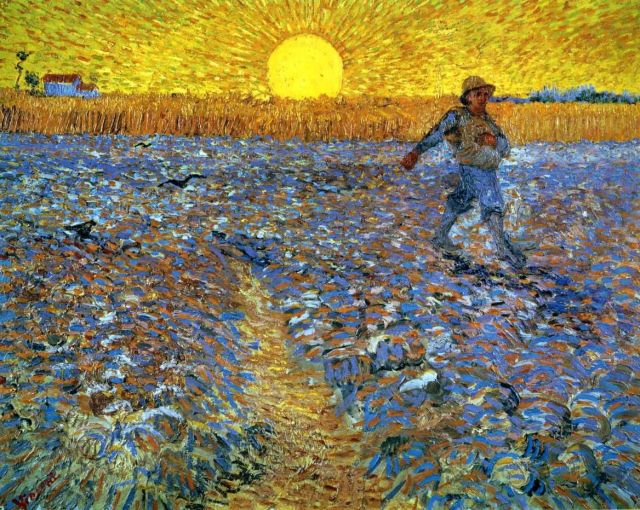
“The Sower” by Vincent Van Gogh, 1888

The Parable

Our ears are the soil of our lives. Ears that are attentive and devoted to listening to Jesus are good soil; ears that are distracted, inattentive, and/or stopped up with ear wax are the bad soil. 

Receptive listening to the Word of God brings a fruitful harvest of righteousness, peace, and joy in the Holy Spirit (Romans 14:17). Christ’s parable lets us know that planting the Word is important. It is sown on four different soils:

  1. The seed on the road. A path is for walking; and for us, a road is for driving – which is why the seed never takes root. Here there is no real listening. When we act without listening, our actions will inevitably be misguided. 
  2. The seed on gravel. Here there is no deep listening. A lack of attentive hearing results in a shallow person who perhaps relies more on Christian clichés or on one’s personality or abilities, instead of the planted Word.
  3. The seed in the weeds. Here there is some significant listening. However, there are too many voices being heard, and not enough singular listening to the sown Word. Listening to the wrong voices will cause an unfruitful life, so we must be careful to whom we choose to give our listening ears to!
  4. The seed on good earth. A devoted listening to the Word without distraction leads to a productive, fruitful believer.

The Parable Interpreted

The interpretation of the parable which Jesus provided to his disciples focuses on the experience of the seed in a variety of soils, as well as the outside powers which act on the message. It all demonstrates that the words of Jesus – the good news of Christ – is central to our lives, and needs to be received well.

  1. The road is the person who hears the message yet is unable to hear Christ’s words because their heart is hard. The forces of evil snatch up the message before any real understanding, and therefore action, can take place. We must observe that the forces of evil are real; they have the ability to influence people with listening issues.
  2. The gravel is the person who hears just enough to respond with joy but drops out when hard circumstances come around. “I didn’t sign up for this!” is their cry. What they needed was to count the cost of discipleship before responding to the message. This is the mere professing Christian, nothing more. Rather than listening well, and internalizing Christ’s words, there is only positive affirmation without any action or practice. Therefore tomorrow, the message is gone.  When difficulty comes, there are no supporting words to draw from. The person then fades away, unable to navigate life successfully.
  3. The weedy soil hears and responds to the message; and is also a professing Christian, nothing more. The issue with such persons is that they also listen to the voices of worry and wealth. Like some sort of spiritual A.D.D., there is no ability to filter all the voices calling out; and so, there is no growth. The words of Jesus for us must reign supreme; there cannot be two thrones of Wealth and Word, nor two Masters of both God and Money.
  4. The good earth listens with the full intention of understanding, and then puts into practice the message heard. This is what brings about the fruit of righteousness and peace in both the individual and the community. Receiving the implanted word through careful listening brings about spiritual growth.  The first priority must be to listening well to this word. And when an entire group listens well and acts accordingly, then it creates a greenhouse effect in which people cannot help but grow in the Lord.

Conclusion

Jesus was not saying anything new, or what wasn’t already in the First Testament:

How well God must like you—
    you don’t walk in the ruts of those blind-as-bats,
    you don’t stand with the good-for-nothings,
    you don’t take your seat among the know-it-alls.

Instead you thrill to God’s Word,
    you chew on Scripture day and night.
You’re a tree replanted in Eden,
    bearing fresh fruit every month,
Never dropping a leaf,
    always in blossom. (Psalm 1:1-3, MSG)

We live in a time of great conflict – largely due to the refusal to listen well to one another, and to Holy Scripture, especially the New Testament Gospels.

Esoteric and harmful interpretations of the Bible result from failing to hear what Scripture itself is saying to us, especially the words of Jesus. Ignoring the Gospels and myopically focusing on particular parts of the Bible is a sure prescription for poor hearing, and thus, misguided decisions and actions.

This is just one reason why reading Scripture aloud with others in a communal setting is important. Robust discussion around the spoken word is what helps us to move in the sort of directions which the Spirit is leading us.

It is what Jesus and his original disciples did. We must do no less.

O Ancient and Wise Gardener, your holy word is planted in our hearts as good seed in fertile soil. So, nurture us, so that we may bear fruit abundantly, through your Son, Jesus Christ our Lord. Amen.

The Parable of the Weeds (Matthew 13:24-30, 36-43)

Jesus told them another parable: “The kingdom of heaven is like a man who sowed good seed in his field. But while everyone was sleeping, his enemy came and sowed weeds among the wheat, and went away. When the wheat sprouted and formed heads, then the weeds also appeared.

“The owner’s servants came to him and said, ‘Sir, didn’t you sow good seed in your field? Where then did the weeds come from?’

“‘An enemy did this,’ he replied.

“The servants asked him, ‘Do you want us to go and pull them up?’

“‘No,’ he answered, ‘because while you are pulling the weeds, you may uproot the wheat with them. Let both grow together until the harvest. At that time I will tell the harvesters: First collect the weeds and tie them in bundles to be burned; then gather the wheat and bring it into my barn….’”

Then he left the crowd and went into the house. His disciples came to him and said, “Explain to us the parable of the weeds in the field.”

He answered, “The one who sowed the good seed is the Son of Man. The field is the world, and the good seed stands for the people of the kingdom. The weeds are the people of the evil one, and the enemy who sows them is the devil. The harvest is the end of the age, and the harvesters are angels.

“As the weeds are pulled up and burned in the fire, so it will be at the end of the age. The Son of Man will send out his angels, and they will weed out of his kingdom everything that causes sin and all who do evil. They will throw them into the blazing furnace, where there will be weeping and gnashing of teeth. Then the righteous will shine like the sun in the kingdom of their Father. Whoever has ears, let them hear. (New International Version)

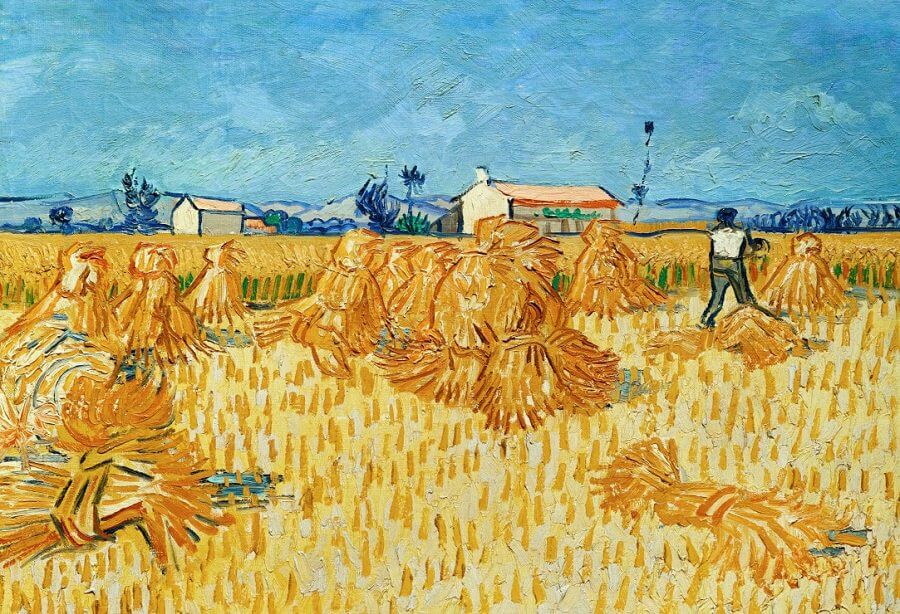
Harvest in Provence, by Vincent Van Gogh, 1888

People of every age struggle with the evil present in this world – and also within the church. For how do we make sense of those who profess Christ but have no fire and passion for their faith? How do we reconcile our own faith with folks in the church who seem to care more about getting their own way than about sacrificing themselves to reach people who do not know Christ. Jesus says, “He who has ears, let him hear.” In other words, listen!

Jesus has informed us that in this present evil age we live in, between his two advents of incarnation and Second Coming, not everything for Christians is going to be rainbows and unicorns.

There are competing pressures on the Church, and sometimes she will fail. The kingdom of God has broken into history and is present, but sin and evil is there, too. So, our focus must be on the hope we have when Christ comes again to judge the living and the dead.

In Christ’s parable of the weeds (or the parable of the wheat and the tares) the enemy of our souls seeks to distract the workers by overwhelming them with evil. If Satan cannot prevent God’s kingdom from being established in the human heart, the devil will try and corrupt the heart by throwing as much evil at it as he can. 

The devil has no problem with people saying they are Christians; the thing Satan has a problem with is people giving themselves unconditionally and unreservedly to God for kingdom business.

“Not everyone who says to me, ‘Lord, Lord,’ will enter the kingdom of heaven, but only the one who does the will of my Father who is in heaven.”

Jesus (Matthew 7:21, NIV)

Where did all these weeds come from?

I’ll frame this question in the modern form that many people have asked me over the years: “If God is a God of love, why is there so much evil in the world?” Or, “If this is Christ’s Church, why is it so messed up?”

Jesus is straightforward in his answer: An enemy did this. In other words, God didn’t plant evil – the source of evil comes from the devil, not God. God’s agenda is for the seed to take root in the human heart and grow into a full-fledged embodiment and commitment to the words and ways of Jesus.

When that growth doesn’t happen, the problem is not because God messed up; it’s because the devil has also done his own work of planting. And the devil wants the opposite of God: to have Christians nit-picking each other like a bunch of crazy chickens, and keeping a demonic pecking order; instead of being the continuing presence of Christ on this earth.

What do we do with all these weeds?

That is, how do we deal with wicked people?  The answer seems obvious: Pull the weeds up and get rid of them. Get rid of wicked people and their wicked behavior. Yet Jesus says in response to this line of reasoning in a clear and unequivocal answer of “No.” But why? Because doing violence to the weeds ends up doing violence to the wheat, as well.

Christ’s answer to the problem of evil is: Let God take care of it. Meanwhile, until that fully happens, we must co-exist with evil, rather than exterminate evil people.

There is always a temptation for believers to force people into the kingdom of God (e.g. the Spanish Inquisition). Yet, at the harvest (the final judgment at the end of the age) evil will be squarely dealt with. Judge Jesus will have the angels separate the wheat from the tares, and the weeds will be burned up.

This teaching from Jesus may open up a whole set of other questions, such as:

  • What am I supposed to do with evil? Just watch it happen? 
  • Am I to let that evil person just be evil? Shouldn’t I give them what they deserve?
  • Shouldn’t I at least tell evil people that they are no good rotten sinners? That they are going to hell because they are wicked?

This doesn’t mean we do nothing. Earlier in Matthew’s Gospel, Jesus has already said: Love your enemies and pray for those who persecute you. (Matthew 5:44)  We are to love and pray people into the kingdom, not force them in.

As for the evil, Jesus will decisively solve the problem of evil, not you, nor me! It isn’t our place to be judge, and if we make it our place, we’ll end up hurting and destroying our brothers and sisters.

Where is evil?

A sobering reality taught by Jesus in this parable is that it’s not a simple matter that we, the wheat are here, and they, the weeds, are over there. It is much more sinister than that; the enemy is within, not out there. 

We have no further to look than in our own hearts and within our own faith communities – which is why we need the lordship of Christ to completely overtake us. Evil is present in the Church, next to the good, seeking to:

  • discourage people in their commitment to Christ
  • offend and hurt others, particularly by overlooking and speaking ill of weaker people
  • step on others in order to get it’s way
  • be a stumbling block to those trying to do God’s will
  • promote ignorance of God’s Word, for no one can live by God’s will if they do not know what it is

The eventual end of sinister people is that, when Christ returns, they will be separated from the righteous and thrown into the fire, just like a harvester would do with a bunch of weeds. As the wicked went about their lives in anger, upsetting others in this life, so they will be tormented in the next.

Conclusion

We may expect God to handle evil in a hurry. But the kingdom of God doesn’t work that way; it’s intended to be planted in the ground, and takes time to grow. While it’s growing, evil is there, like a weed.

Whenever things go sideways because of wickedness, we might expect God to act quickly and drastically to uproot the evil. We may confuse God’s slowness as being uncaring, when in reality it means that God is patient, and desires people to change. And change always begins with you and me.

God Almighty, Creator of heaven and earth, we are a complacent people. While you desire us to be a beacon of light to a world in need, we are preoccupied with all the weeds in the field. We are sorry for the madness unleashed through our own selfish desires. May you plant the seed of love in our hearts for all people, not just our friends. And we shall commit to watering and nurturing that seed with your Word, through Jesus Christ our Lord. Amen.