The Power of Emptiness (Mark 7:24-37)

From there Jesus set out and went away to the region of Tyre. He entered a house and did not want anyone to know he was there. Yet he could not escape notice, but a woman whose little daughter had an unclean spirit immediately heard about him, and she came and bowed down at his feet. Now the woman was a Gentile, of Syrophoenician origin. She begged him to cast the demon out of her daughter. 

Jesus said to her, “Let the children be fed first, for it is not fair to take the children’s food and throw it to the dogs.” But she answered him, “Sir, even the dogs under the table eat the children’s crumbs.” Then he said to her, “For saying that, you may go—the demon has left your daughter.” And when she went home, she found the child lying on the bed and the demon gone.

Then Jesus returned from the region of Tyre and went by way of Sidon toward the Sea of Galilee, in the region of the Decapolis. They brought to him a deaf man who had an impediment in his speech, and they begged him to lay his hand on him. 

Jesus took him aside in private, away from the crowd, and put his fingers into his ears, and he spat and touched his tongue. Then looking up to heaven, he sighed and said to him, “Ephphatha,” that is, “Be opened.” And his ears were opened, his tongue was released, and he spoke plainly. 

Then Jesus ordered them to tell no one, but the more he ordered them, the more zealously they proclaimed it. They were astounded beyond measure, saying, “He has done everything well; he even makes the deaf to hear and the mute to speak.” (New Revised Standard Version)

Two stories. Two suffering people, because of their infirmities. A mother and a community suffering along with them, not knowing how to help them.

Lo and behold, Jesus, of all people, was the last person they expected to hear was in the area. He a Jew. They Gentiles. Yet, what if….

Maybe there is a ray of hope. After all, where there is emptiness, there is potential. And Jesus is the expert on that!

Christ had the rare ability to give the necessary gift of envisioning potential in another’s life, of seeing how the empty space could be filled with life and joy. Indeed, with Jesus there is possibility.

It is important to not only look at what is there, but also on what is not there. Because that’s where we find the quality, opportunity, and potential in another, and in ourselves.

The daughter in the narrative was vexed and incapacitated by an unclean spirit, a demon. The man in the story was deaf and mute, unable to hear and speak, lacking capacity for effective interaction in a society which relied so heavily on the ears and the mouth.

We may imagine their emptiness, feeling bereft of ever experiencing abundant life in their respective circumstances. However, they had those around them who cared, and interceded on their behalf.

Just realizing that Jesus was amongst them seemed to inspire a spark of possibility. Their thinking began to move in a slightly different direction with Christ in the neighborhood.

500 years before Christ’s encounters with these folks, the Chinese philosopher Lao Tzu crafted this poem:

A wheel may have thirty spokes,

but its usefulness lies in the empty hub.

A jar is formed from clay,

but its usefulness lies in the empty center.

A room is made from four walls,

but its usefulness lies in the space between.

Matter is necessary to give form,

but the value of reality lies in its immateriality.

Everything that lives has a physical body,

but the value of a life is measured by the soul.

The immaterial is the real substance. The material is only the form we see around it. It isn’t the material which effects the immaterial; it is the immaterial which has the power to transform the material.

Yet, change is never easy, even the necessary changes we long to see realized. It was not easy for any Gentile living in a Jewish world, and vice versa. Both Jews and Gentiles find out how hard things really can be.

Exorcising the Canaanite Woman’s Daughter, by Peter Gorban, 1990

The word got around that Jesus was in town. Nobody knew where he was. But desperate people discover ways to find the people they believe can help. The mother of the daughter with an unclean spirit found where Jesus was staying.

Furthermore, desperate persons are resilient; they rarely give up. The woman was used to tension in the room. She was unfazed by the Jew and Gentile disparity. I happen to think that the response of Jesus was probably expected by the woman. It certainly didn’t discourage her.

The woman asked for help. Jesus rebuffed her. Perhaps this seems incongruent with your understanding of Christ. It may even shock you. It was anything but Midwest nice.

One of the realities, it seems to me, that we need to understand and grapple with, is that Jesus was a real bona fide human being. He was born, grew up, had to learn things and become mature, in every sense of the word.

Christ also needed to develop and live into his own ministry. He had to learn how to establish personal boundaries, apply wisdom to particular situations, and deal with being hungry and tired with a world of human need around him.

I believe that is what we see in this interaction with the woman. And it in no way diminishes Christ’s divinity. We need to be able to hold all of Jesus – both his divinity and his humanity – at the same time, all the time.

Undeterred, the woman bent the words of Jesus to her advantage. That’s what desperate people do. So, Christ, recognizing true desperation and the faith behind her persistence, then immediately exercised his divinity by expelling the unclean spirit from the daughter and bringing her to full capacity.

I’m glad the Gospel writer Mark recorded the narrative as he did. I see a Messiah who deeply desires to do his Father’s will, and has to struggle with how to accomplish it.

I see Jesus in the story as actively growing in his understanding and ability, learning to break into the world with grace and truth; yet at the same time, not conforming to the world’s status quo.

Methinks that not much of this had anything to do with Christ’s sense of ethnicity and gender, but with everyone else’s understanding of the terms. Jesus, along with all of us who desire to follow the ways of God, must struggle with how to bring God’s kingdom values to people.

Jesus, to his credit, is a quick study. Being oriented to love, mercy, and obedience will do that for you. The woman was an outside voice. Christ was willing to listen and banter with her. He was not threatened when she spoke her truth to his power.

I will suggest to you that perhaps the reason for Christ’s willingness and ability to have effective ministry with the woman and her daughter (as well as everyone else) is that he had his own sacred emptiness.

Whenever we are full of ourselves, full of all our thoughts of how things ought to go, and full of all our settled beliefs, then there is no room to see and listen to another person.

Jesus was empty so that the woman could add to him with her own story and struggle. And when that happened, a miracle occurred.

The same sort of sacred emptiness happened with the deaf and mute man who was healed of his infirmity. Jesus was able to receive and be filled with the people who brought the man to him.

They begged Christ to help the man. Jesus saw them and heard them, because he was not so full of himself. And if anyone ever had a right to be full and tell others what to do, it is Jesus.

But he didn’t. In his empty humility, he had room for others. Since Christ emptied himself, he could empty others of all the stuff that gets in the way of living a peaceful life. (Philippians 2:5-8)

That is precisely why I am here. Because Jesus had room for me. Christ has a very large inner space, big enough to accommodate an untold amount of people. He has room for you, too. He sees you, and is able to listen to you.

So, go ahead; speak your own truth to Christ’s power.

From the Heart (Mark 7:9-23)

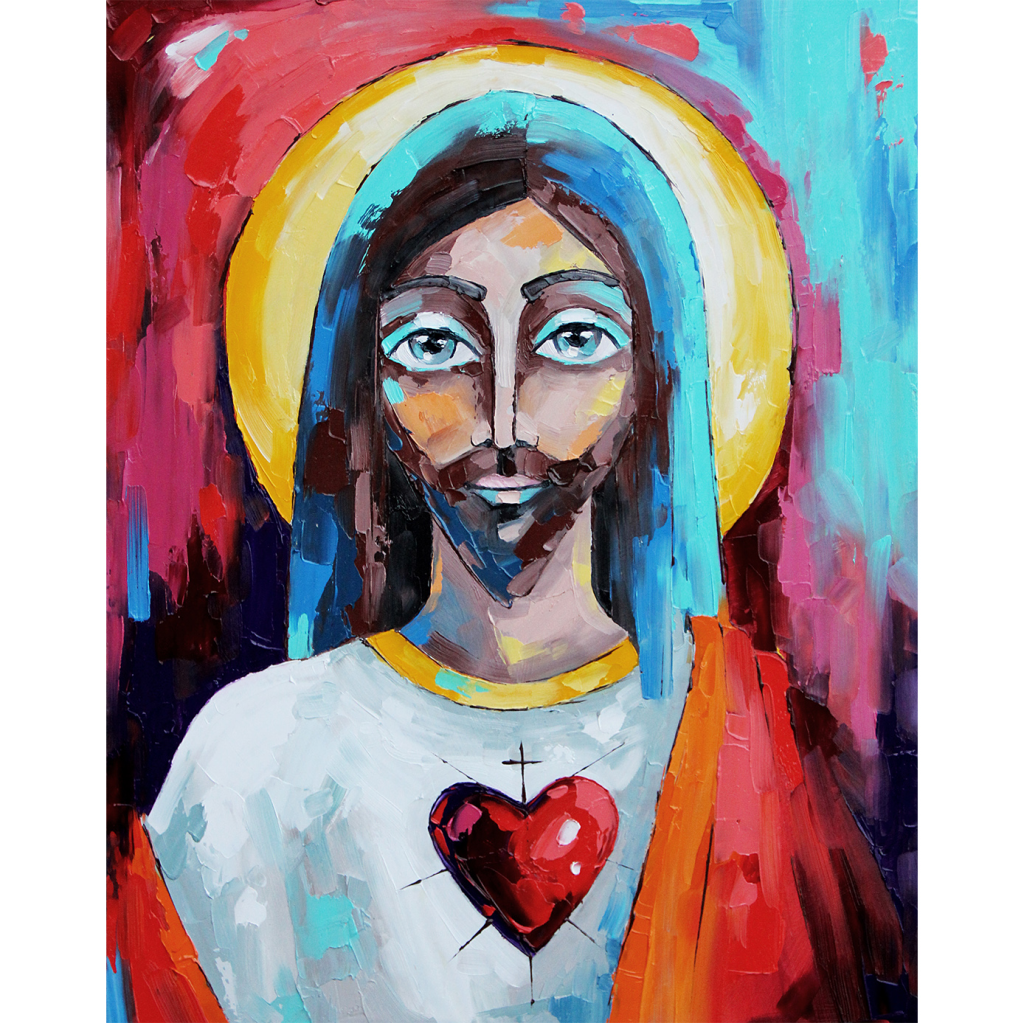
Art by Anna Startseva

Then he said, “You skillfully sidestep God’s law in order to hold on to your own tradition. For instance, Moses gave you this law from God: ‘Honor your father and mother,’ and ‘Anyone who speaks disrespectfully of father or mother must be put to death.’ But you say it is all right for people to say to their parents, ‘Sorry, I can’t help you. For I have vowed to give to God what I would have given to you.’ In this way, you let them disregard their needy parents. And so you cancel the word of God in order to hand down your own tradition. And this is only one example among many others.”

Then Jesus called to the crowd to come and hear. “All of you listen,” he said, “and try to understand. It’s not what goes into your body that defiles you; you are defiled by what comes from your heart.”

Then Jesus went into a house to get away from the crowd, and his disciples asked him what he meant by the parable he had just used. “Don’t you understand either?” he asked. “Can’t you see that the food you put into your body cannot defile you? Food doesn’t go into your heart, but only passes through the stomach and then goes into the sewer.” (By saying this, he declared that every kind of food is acceptable in God’s eyes.)

And then he added, “It is what comes from inside that defiles you. For from within, out of a person’s heart, come evil thoughts, sexual immorality, theft, murder, adultery, greed, wickedness, deceit, lustful desires, envy, slander, pride, and foolishness. All these vile things come from within; they are what defile you.” (New Living Translation)

There is nothing inherently wrong with tradition. Ideally, traditions are helpful ways of remembering and maintaining the values that are important to us.

Yet, what can happen over time is that the tradition itself can become equal to the value we hold to; and eventually, the tradition can become more important than the value it is supposed to remind us of.

In the worst case scenario, the tradition is kept, and the value is forgotten and lost. Whenever that happens, traditions easily become weaponized to protect our interests while harming others. And that is a phenomenon Jesus wanted nothing to do with.

So, Christ affirmed and upheld the essential purpose of the Torah (scriptural law) as the foundation of morality to live justly and righteously in the world. Keeping Torah, therefore, is a matter of inner motives, and intents of the heart, rather than external compliance to ritualized traditions.

Unfortunately, the outward form had supplanted the inward disposition of the heart. Purity then became a matter of observable rituals, and defilement a matter of failing to do the ritual properly. And the original values behind the rituals were lost – which caused souls to become lost, and other people victimized by religious traditions.

Whether one is ritually clean or unclean is not ultimately determined by material objects; it is, instead, determined by the state of the heart.

Art by Andy Perez

In other words, no outward ritual can ever really make a person clean or unclean, pure or impure, spotless or polluted. Inner transformation is what scrubs a person clean and makes them pure.

Ritual traditions, and even scriptural law itself, is unable to effect a transformative change.

Torah can require purity, cleanness, and moral uprightness; but it cannot affect a metamorphosis. We need something other than traditions, rituals, and laws to bring true and sustainable transformation of life.

I say that it is time to hear and observe Jesus. Millions of people throughout history, and up to the present time, have found in Christ (and not in Christian rituals, traditions, church codes, nor in a political Christendom) the answer and the key to what life is really all about.

Again, there is not a problem with our human traditions per se, but with traditions replacing Torah and the word of God.

Jesus gave an example of just such a contradiction between religious tradition and divine law: According to tradition, if a person makes a vow concerning their property and/or possessions as a gift to God at the temple, then those assets cannot be used to support that person’s parents in their old age.

Christ pointed out that this clearly contradicts the command to honor your father and mother. Ironically, the very tradition that was supposed to purify became the means to contamination – because the tradition forbids the person from obeying the command of God.

In a word picture that everyone could understand, Jesus explained that impurity and defilement have to do with what passes through the heart, not the bowels.

People obey or disobey the Ten Commandments due to the state of their heart, and not whether they keep every detail of traditional washing of the hands and body.

People lack virtue not because they fail to do human traditions; but because of what is in their hearts.

This is why Jesus, in his Sermon on the Mount, gets to the heart of why people break commands. For example:

  • The outward act of murder is a result of the inward anger of nurturing bitterness in the heart. (Matthew 5:21-22)
  • The physical act of adultery is the culmination of dozens of mental adulteries which originated in the heart. (Matthew 5:27-28)

Everything that harms and hurts is sourced in the heart, and not in failing to keep a tradition.

Furthermore, the Gospel writer Mark, added the very interesting parenthetical comment that in speaking this way, Jesus meant to declare that all foods are clean; there is nothing eaten that can make us impure.

That may not seem remarkable to most people, but to Jews this statement is cataclysmic and revolutionary. Levitical law details the separating of clean and unclean food, for the purpose of distinguishing the Israelites from all the other surrounding nations. (Leviticus 11:43-44; 20:24-26)

Holding to food laws, and traditional hand washings when it comes to eating, are a way of preserving religious identity and national identity. Jesus had no intention of doing away with Jewish identity, but he very much intended to do away with maintaining practices that keep strict separation from other people.

In other words, Christ was opening the way for ministry to Gentiles. He wanted to bring connection where there was deep division. He wanted the world to know God.

This gets at the “heart” of true religion. Distinctiveness as God’s people does not necessarily nor ultimately come by observing particular traditions; it comes primarily through purity of heart.

And the means of bringing purity of any kind, comes through love. Love always makes a way and finds connections. Love is the sine qua non mark of God.

Traditions infused with love, point people to God, and let them know that they belong.

But traditions for tradition’s sake, repel people, and communicate to them that they don’t belong, and should go away and not pollute the pure ones.

This approach of Jesus toward the religious leaders raises for me several probing questions:

  1. What is the true state of your heart?
  2. Are you aware of your own heart’s dark shadows?
  3. In what sort of direction is your heart inclined to speak and act?
  4. Does encouragement or criticism typically arise from your heart?
  5. Is love the compass of your heart, or does bitterness give you direction?
  6. Will you acknowledge your need of a savior? Will you ask for help?

Blessed God and Father of our Lord Jesus Christ: Make us quick to listen, and slow to speak, so that the Word implanted in our hearts may take root to nourish all of our living. And may the the Word within us overflow into speech and action which blesses the world. Amen.

The Evil Within (Mark 7:1-8, 14-15, 21-23)

Now when the Pharisees and some of the scribes who had come from Jerusalem gathered around him, they noticed that some of his disciples were eating with defiled hands, that is, without washing them. (For the Pharisees, and all the Jews, do not eat unless they wash their hands, thus observing the tradition of the elders, and they do not eat anything from the market unless they wash, and there are also many other traditions that they observe: the washing of cups and pots and bronze kettles and beds.)So the Pharisees and the scribes asked him, “Why do your disciples not walk according to the tradition of the elders but eat with defiled hands?” He said to them, “Isaiah prophesied rightly about you hypocrites, as it is written,

‘This people honors me with their lips,
    but their hearts are far from me;
in vain do they worship me,
    teaching human precepts as doctrines.’

“You abandon the commandment of God and hold to human tradition…”

Then he called the crowd again and said to them, “Listen to me, all of you, and understand: there is nothing outside a person that by going in can defile, but the things that come out are what defile…”

For it is from within, from the human heart, that evil intentions come: sexual immorality, theft, murder, adultery, avarice, wickedness, deceit, debauchery, envy, slander, pride, folly. All these evil things come from within, and they defile a person.” (New Revised Standard Version)

There are many people who believe that evil resides out there, but not in here.

“Out there” is usually in places where people don’t live like me, think like me, and act like me. Rarely does anyone, when asked where evil is, points to their own heart.

The religious establishment of Christ’s day saw evil as something which existed “out there” where the sinners are; but not “in here” where I am.

Jesus had something to say on that subject. The exchange between the religious leaders and Christ began with a query toward Jesus about Jewish traditions and interpretations of the Mosaic law.

The leaders observed that Christ’s disciples were not holding to traditional purity practices. They were not washing their hands in a certain way prior to eating. This was less of a criticism on the followers of Jesus, and much more an indictment on Jesus as their rabbi.

It was believed that there are customs which properly trained disciples ought to know and follow. And Christ’s followers were not, it was assumed, trained well.

The religious establishment understood the words and ways of Jesus as an affront to the teaching of the elders, and of proper scriptural and legal interpretation.

Jesus, however, made a distinction between traditions of the elders and God’s commands. The former are human precepts, whereas the latter are to be obeyed. In no way did Christ demean Mosaic law, or any commandments of God.

Instead, Jesus rejected how particular interpretations – along with practices which arose from those interpretations – end up obscuring the spirit and intent of the law. In other words, purity does not come from hand washing, because neither purity nor impurity originates from the hands.

Christ reached back into the prophecy of Isaiah to show that there is a contrast between what the mouth utters and what is within the heart. The incongruence between the words spoken and the heart’s true state puts the issue of where impurity and evil really come from: The heart, not the mouth.

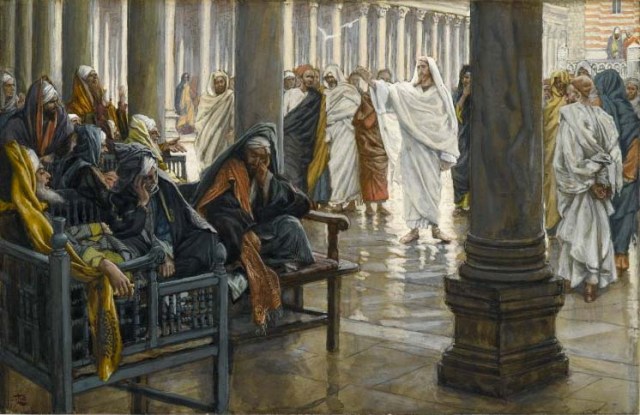
Jesus and the Pharisees, by French painter James Tissot (1836-1902)

Evil intentions originate within. Evil actions are animated by the heart. Evil attitudes are born in the heart. The human heart is the place which needs attention because, for ancient people, this is where a person’s rational will is located. It is where moral pollution dwells, deep within.

Let’s keep in mind that, in the verbal kerfuffle between Christ and the religious leaders, there is no evidence that Jesus disregarded Jewish dietary laws. He instead took the religious establishment to task on elevating outward human traditions, while simultaneously ignoring the inward human heart.

Food and hand-washing are not the chief concern, when it comes to purity and impurity. At issue is the source of defilement, that is, where the pollution is sourced. Jesus insisted that it’s more about who you are, and what is in your heart, than it is about the food you eat or avoid.

In truth, the problem of defilement is important. And keeping the Mosaic law is significant. Yet, Jesus was looking at these issues from a different angle. He affirmed the law’s purpose in restraining evil and avoiding impurity, along with the religious leaders. However, Christ disagreed with them on how the law is practically observed and obeyed.

Jesus did not come up with something new or strange in talking about evil emanating from the heart. Judaism is a religion of the heart, just as much as Christianity or any other religion.

The heart is devious above all else;
    it is perverse—
    who can understand it?
I the Lord test the mind
    and search the heart,
to give to all according to their ways,
    according to the fruit of their doings. (Jeremiah 17:9-10, NRSV)

So, what’s up with the conflict between Jesus and the religious leaders? Over time, many located evil outside, out there, with evildoers and law-breakers, with those disobedient to the law. Christ came along and reaffirmed where the problem originates, scripturally.

One isn’t defiled by improper handling of ritual; one is defiled because being unaware of, or not acknowledging, the dark shadows which reside within every human heart.

Therefore, the discussion of evil and impurity is useless, if we only talk about influences from outside. Deal, instead, with the influences from within.

The heart is not all bad; there’s a lot of good there. But there are spaces within the heart which are camouflaged in darkness. Those places need attention, before we launch into evil which exists elsewhere.

Everyone must come to the point of understanding that they are capable of both great good and great evil. A Pharisee is not all good. And a lawbreaker is not all bad. Until we can see the commonality between ourselves and those we separate ourselves from, we will continually miss the heart of true religion.

Whether a Jew, Christian, Muslim, or any other religious tradition, we must deal with our own collective house, and our own personal heart. Hate speech toward another group has no warrant from Jesus. Injustice has no place in Christianity or anywhere else.

Furthermore, not a one of us can rationalize any unjust words and/or inactions. If that happens, a terrible blindness has occurred in which someone or some group of people refuse to see their own culpability in evil, and project it outward onto another person or group.

If we keep the light of the gospel in our own hearts, then it is much less likely that we will demean or attack others, either verbally, physically, or both.

Using a self-constructed and janky flashlight to shine on another’s heart does nothing but keep the attention off of our own heart. That sort of dubious searching of splinters helps no one, especially ourselves, who already have nasty logs in our own eyes.

Evil is deeper than mere selfishness, bigger than a personal error in judgment, and greater than some individual bad decisions. That’s because there is also a collective heart in every organization, institution, corporation, and faith community. Injustice and unrighteousness resides in those hearts, as well. This makes all of us – personally and communally – both victims of evil, as well as perpetrators of wickedness.

This is why grace and mercy are the real answers to the evil in this world’s systems, and in the human heart. Jesus is trying to pave the way toward a solution of the problem of evil.

Let’s give him an honest look and hearing.

Most merciful God, we confess that we have sinned against you in thought, word, and deed, by what we have done, and by what we have left undone. We have not loved you with our whole heart; we have not loved our neighbors as ourselves. We are truly sorry and we humbly repent. For the sake of your Son Jesus Christ, have mercy on us and forgive us; that we may delight in your will, and walk in your ways, to the glory of your Name. Amen.

Exposing Hypocrisy (Mark 7:1-8)

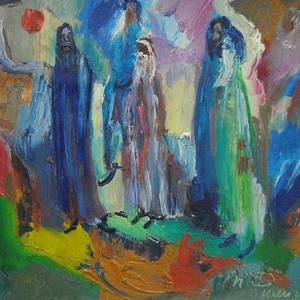
Old Men and Christ by Ivan Filichev, 1992

The Pharisees and some of the teachers of the law who had come from Jerusalem gathered around Jesus and saw some of his disciples eating food with hands that were defiled, that is, unwashed. (The Pharisees and all the Jews do not eat unless they give their hands a ceremonial washing, holding to the tradition of the elders. When they come from the marketplace they do not eat unless they wash. And they observe many other traditions, such as the washing of cups, pitchers and kettles.)

So the Pharisees and teachers of the law asked Jesus, “Why don’t your disciples live according to the tradition of the elders instead of eating their food with defiled hands?”

He replied, “Isaiah was right when he prophesied about you hypocrites; as it is written:

“‘These people honor me with their lips,
    but their hearts are far from me.
They worship me in vain;
    their teachings are merely human rules.’

You have let go of the commands of God and are holding on to human traditions.” (New International Version)

Reading the Gospel text for today, I try to imagine what emotions Jesus might have experienced when confronted by some religious leaders about his lack of attention to traditional and ritual hand washings – maybe frustration, anger, sadness, exasperation, disappointment, irritation, aggravation, or discouragement.

Perhaps Christ felt all those emotions. Whatever Jesus was feeling at the time, I can easily see him taking a deep breath and exhaling a great big *sigh* over the hypocrisy displayed in front of him.

Hypocrisy is a disconnect between espoused values and actual behavior. Whenever there is an incongruence between what we say is important and how we really live, this is being two-faced and duplicitous.

The men who came to see Jesus were plain old insincere hacks who practiced religious quackery. And Jesus saw right through their fake pretention of righteousness.

First off, this narrative is neither a blanket condemnation of Pharisees nor a dig on rituals themselves. Instead, Christ’s words were directed to specific persons using their rituals to leverage an appearance of religious superiority over others.

That type of motivation for engaging traditional rituals completely ignores the ethical and moral intention of those practices.

Sometimes folks can get so doggone wrapped up in how faith is represented that they lose sight of the faith itself.

Jesus and Old Men by Ivan Filichev, 1993

Hypocrisy has to do with our motives – not so much what we do but why we do it. Rituals themselves are good. Why we do them, or not, or how we go about doing them, gets at the heart of our objectives for engaging religious practices.

We need to ask ourselves:

Are our spiritual practices truly a worship offering to God, or are they merely mechanisms for keeping up the appearance of holiness?

Hypocrisy is acting a part which is not our true self. It is, instead, to live from the false self through the attempt of providing an idealized person to the public. What we ought to be doing is embracing the true self and realizing our common humanity with one another in genuine devotion to God and service to others.

Religious hypocrisy is particularly insidious because it uses what is sacred for selfish purposes. It damages the credibility of the religion, creates idolatry, and papers over hate with a veneer of pretentious piety.

The hypocrite is one who is a bundle of disparate parts. They have a massive need of integration to a whole and real self. The cost to facing this is the vulnerability of exposing oneself as flawed, imperfect, even ugly. Many persons have no willingness to be viewed by others as such, and so they maintain their play-acting and continue to seek the attention and accolades as a model religious person.

We all must come to grips with the reality that God cares a whole lot about why we do what we do.

If and when the forms of faith become tools of oppression to place heavy burdens upon others backs, then those forms have supplanted the faith itself.

Out of the overflow of the heart the mouth speaks, and from the heart the hands and feet move. Whenever we care more about being and appearing right than getting it right and becoming better, then we have a heart problem. The heart of the issue is the heart itself. Clean up the heart, and everything else follows – not the other way around.

The probity of today’s Gospel lesson is that we might misinterpret what is important to God. We may be playing the hypocrite yet have the belief we are genuine. The capacity for our hearts to enlarge with love is in direct relation to an awareness of the hidden motives buried within those hearts.

Evil intentions and motivations are what separate us from God – not our race, class, age, gender, religion, ethnicity, behavior, rituals, or anything else on the outside.

If we find ourselves being nit-picky of others, this is usually a clue that the unconscious self is trying to protect us from facing the pain of our own sins by projecting and focusing on another’s supposed missteps with tradition or ritual.

Fortunately, Jesus came to this earth full of grace and truth. There were times that Christ set aside niceness and decorum to go for the heart. In shining a light on the motives behind the deeds of people, some repented and received the good news of the kingdom of God; and others resisted to maintain their illusion of control and superiority.

Nobody could ride the fence with Jesus around. You either loved him or hated him.

The beauty of grace is that when we squarely and uncompromisingly face our sins and let go of the things we consider so important, and turn to God with authenticity, we are welcome at his Table.

Most holy and merciful Father, we acknowledge and confess before you our sinful nature, prone to evil and slow to do good, and all our shortcomings, offenses, and malevolent motives. You alone know how often we have sinned in wandering from Christ’s way of grace and truth, in wasting your gifts of compassion and justice, and in forgetting your love.

O Lord have mercy on us. We are ashamed and sorry for all the ways we have displeased you. Teach us to hate our errors; cleanse us from our secret faults; and forgive us our sins; for the sake of your dear Son, our Lord, Jesus Christ. Amen.