What Is It You Are Trying To Do? (Mark 10:2-16)

Jesus blesses the children

Some, testing him, asked, “Is it lawful for a man to divorce his wife?” He answered them, “What did Moses command you?” They said, “Moses allowed a man to write a certificate of dismissal and to divorce her.” But Jesus said to them, “Because of your hardness of heart he wrote this commandment for you. But from the beginning of creation, ‘God made them male and female.’ ‘For this reason a man shall leave his father and mother and be joined to his wife, and the two shall become one flesh.’ So they are no longer two but one flesh. Therefore what God has joined together, let no one separate.”

Then in the house the disciples asked him again about this matter. He said to them, “Whoever divorces his wife and marries another commits adultery against her, and if she divorces her husband and marries another, she commits adultery.”

People were bringing children to him in order that he might touch them, and the disciples spoke sternly to them. But when Jesus saw this, he was indignant and said to them, “Let the children come to me; do not stop them, for it is to such as these that the kingdom of God belongs. Truly I tell you, whoever does not receive the kingdom of God as a little child will never enter it.” And he took them up in his arms, laid his hands on them, and blessed them. (New Revised Standard Version)

Trying To Parse the Law?

The topic of divorce has always been a hot button issue throughout human history. And there have continually been diverse views and opinions about it. This is also true of Holy Scripture. A variety of interpretations are offered by many about the Bible’s view of divorce, and Christ’s words concerning it.

Much like today, divorce in the first century was accepted as part of what happens in society, even among Jews, although it was more proliferate in other cultures. Most of the discussions about divorce centered in legal details, with some speaking against it as bad for society.

Among the Jewish religious leaders and experts in the law, it was generally recognized that divorce occurs, with Mosaic legislation proscribing how to carry out divorce (Deuteronomy 24:1-4). Yet, other scripture texts frame the existence of divorce as questionable for God’s people. (e.g. Genesis 2:24; Malachi 2:13-16)

Trying to Test Jesus?

Anyone who doesn’t like another, will often confront them on a hot button issue that has plenty of diverse opinion to it. This is why the Pharisees sought to get Christ’s take on the topic of divorce.

Essentially, Jesus reframed divorce so that it was no longer simply a legal topic, but involves real people. Christ talked about divorce in a way that upheld the dignity of persons, especially women; and lifted up the true sanctity of marriage.

In turning the discussion from a legalities to God’s design for humanity and marriage, Jesus cut to the heart of the matter, to God’s intent, and to human frailty. He focused on relationships, because they were inherent from the beginning.

Yes, divorce is a reality, and it is has its place in society. But no, it’s not supposed to be this way. The very word “divorce” means there is a separation, a breech, a disconnection of relationship. This is why Christ went to another topic: adultery.

Trying To Divorce Women?

Jesus said that a person initiating a divorce in order to marry another person commits adultery. In saying this, he was not offering a legal conversation of details. Rather, Christ was focusing on people; he was concerned for wives and women.

The conversation between Jesus and the Pharisees was a discussion between men, and presupposed a man’s point of view on divorce. Women did not have the ability to initiate divorce in the ancient society.

And Christ seems to have had no stomach for being drawn into abstract legal debates between a bunch of men. Instead, he cared about the people involved in an actual divorce, especially the women.

For all intents and purposes, women (and their sexuality) were the property of men – the father, and then later, the husband. In this social milieu, whenever a husband initiated a break in the relationship, it was important for a woman to have a certified document of divorce. Without that certification, a woman divorcee would be landlocked, unable to do much of anything, as well as be the brunt of societal gossip, slander, or worse.

Since Jesus was talking to the men, the Pharisees, he pointedly looked at them and let them know that, although they might initiate a divorce, it in no way justified their sneaking and creeping around. It didn’t cover their adulterous relationship(s) nor their adulterous hearts.

All this is to say that Christ very much opposed divorce on the grounds of putting a wife away out of a desire for a different spouse. He intended on empowering women. In a divorce situation, because a man was in control of the process, it was then the man who commits adultery against the woman.

Both logically and legally, a woman could never commit adultery because of divorce – only the man. What’s more, adultery is not primarily a violation of the law, but of the woman. Jesus believed it was high time for some accountability with the men.

Even though contemporary Western society is much different than the ancient social structure, Christ’s teaching is still relevant. The need to uphold not just the law, but the rights of women is a must for today, as well.

Unless we can observe Christ’s concern for women’s justice and rights, there will be men who continue to leverage their own gender over and against females and wives. And there will continue to be both husbands and wives who initiate divorce for their own adulterous motives, thus putting their spouse in moral, legal, emotional, and spiritual jeopardy.

Trying To Keep Children Away?

The overarching ethics of Jesus, and the law of God, is to provide justice and righteousness for the most vulnerable among us. And this is why the teaching about divorce is coupled with instruction about children.

In our contemporary society, children have rights and are accorded significant status. That was not true in the ancient world. Children were mostly viewed as potential adults. Until then, kids were to stay quiet unless spoken to, and to obey their parents with absolutely no talk-back.

Christ’s disciples did what any student following their teacher would do; they kept the kids at bay so that Jesus could do his important ministry work. But what the disciples discovered is that the kids were actually part of that important ministry work. As children, they were vulnerable, at the low end of the social scale, and had no personal rights other than being part of a family.

To become like a little child in order to enter the kingdom of God did not mean becoming innocent; it meant becoming humble and dependent, and embracing meekness, gentleness, and lowliness. It meant to become the last and the least among us. Because the last will be first, and the least will become great.

Trying To Get It Right?

It’s important for us to uphold the sanctity of human life, and the spirit of the law. The law is intended to preserve and protect life – and is not to be used to find loopholes or ways to get what you want.

Meeting the needs of all people – whether they be men, women, children, and whether they be rich or poor – is to be everyone’s concern. Why? Because justice and righteousness are at the heart of God’s concern for humanity.

Merciful God, who discerns each heart: We confess our family is most often like strangers to us. So, give to all parents and children the grace to see one another as they truly are, and as you have called them to be. In the name of Jesus Christ, our mediator and advocate, we pray. Amen.

The Irony of Christ’s Followers (Mark 10:32-34, 46-52)

A 10th century depiction of Christ healing a blind man

The disciples were confused as Jesus led them toward Jerusalem, and his other followers were afraid. Once again, Jesus took the twelve disciples aside and told them what was going to happen to him. He said:

We are now on our way to Jerusalem where the Son of Man will be handed over to the chief priests and the teachers of the Law of Moses. They will sentence him to death and hand him over to foreigners, who will make fun of him and spit on him. They will beat him and kill him. But three days later he will rise to life….

Jesus and his disciples went to Jericho. And as they were leaving, they were followed by a large crowd. A blind beggar by the name of Bartimaeus son of Timaeus was sitting beside the road. When he heard that it was Jesus from Nazareth, he shouted, “Jesus, Son of David, have pity on me!” Many people told the man to stop, but he shouted even louder, “Son of David, have pity on me!”

Jesus stopped and said, “Call him over!”

They called out to the blind man and said, “Don’t be afraid! Come on! He is calling for you.” The man threw off his coat as he jumped up and ran to Jesus.

Jesus asked, “What do you want me to do for you?”

The blind man answered, “Master, I want to see!”

Jesus told him, “You may go. Your eyes are healed because of your faith.”

At once the man could see, and he went down the road with Jesus. (Contemporary English Version)

“Irony” and “ironic” are terms describing when an outcome of an event is contrary or different from what would be expected.

Here are a few examples of irony: The firehouse burnt down. The police officer got arrested. When I was a kid, my family physician’s name was Dr. Fail (really!). There is an overarching ironic lesson to our Gospel story today:

The people following Jesus with 20/20 vision were spiritually blind.

Their great need is the same as blind Bartimaeus: To have their eyes opened to Jesus and to what God was doing around them. Bartimaeus was marvelously and miraculously given sight by Jesus – the others, however, remained unchanged and in the dark. 

Irony #1: Many followed Jesus, but only a few were his followers.

All kinds of people physically followed Jesus around for various reasons while he was here on this earth. Some wanted to bask in the latest celebrity buzz that Jesus generated. Others wanted to see the cool stuff Jesus did, like healing people. Some were plain curious. And a few were interested in being like Jesus by showing selfless compassion.

Jesus continually sought to press the crowd following him into spiritual seekers who would learn to follow his teaching.

Many people conform to the group and go with the flow. That’s great if the crowd is good, and not so good if they’re going in a bad direction.

In the Old Testament, a few unruly complainers got the Israelites stirred up. The result was making a golden calf and turning away from God. Sometimes it is right and necessary to go against the crowd.

Irony #2: Out of all Christ’s followers, it is a blind man that sees Jesus for who he is: The Son of David.

Bartimaeus discerned it was Messiah who was walking by him. So, he went against the crowd and shouted to Jesus. Blind Bartimaeus didn’t care how he looked to others; it didn’t matter to him that he stuck out like a sore thumb to all the spiritually blind people.

Jesus often avoided crowds. Most of his earthly life occurred away from the centers of power and influence. Jesus swam upstream of the prevailing notions of righteousness. Christ did not cow-tow to the crowd. Instead, he paid attention to the needy and forgotten.

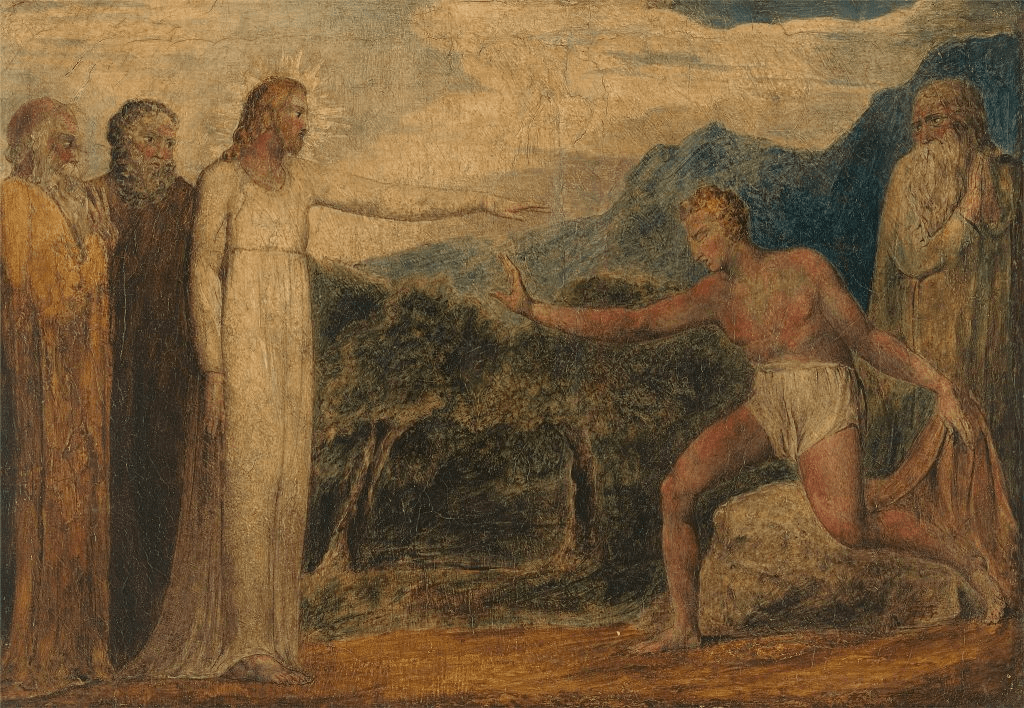
Christ Giving Sight to Bartimaeus, by William Blake (1757-1827)

And while in a large group of people, Jesus did not “work the crowd” to get ahead and further his agenda. He did not cozy-up to the rich and powerful. And Christ deliberately avoided celebrity status. Jesus showed extraordinary love to an overlooked person. He used his immense power for one powerless person.

Irony #3: The ones following Jesus were the ones trying to keep a blind man from Jesus.

One irony of the church is that Christ’s own followers can be the biggest obstacle to others following him.

I can just imagine a group of gossipy church folk shushing Bartimaeus: “Don’t bother Jesus, he is such a busy man! He has important work to do!” I can also picture them standing next to blind Bartimaeus saying, “Just stop, man, you’re embarrassing yourself.” 

But Bartimaeus would not stop. He shouted all the louder. That’s because true and genuine faith is a needy person crying out in desperation for Jesus to help.

Jesus asked a beautiful question: “What do you want me to do for you?”

“I want to see,” Bartimaeus responded. So, Jesus had compassion on him, and gave him his sight. Here we have two men, Jesus and Bartimaeus, ignoring all the people around them, and having a divine encounter.

This encounter raises my curiosity as to why it is so hard for us to simply say what we want.

It could be that we don’t want to buck the crowd, or to look different. Maybe we don’t want to admit our need in front of others. So, we simply stick to superficial conversations and insist that everything is okay, when it isn’t.

Jesus said, concerning the crowd, “Although they see, they don’t really see.” (Matthew 13:13)

If we are concerned about how we are seen by others, we will not be seen by God; we will miss Jesus when he walks by, right in front of us.

Conclusion

How might we raise our ability to see Jesus and truly follow him as he desires us to?

Listen to Jesus

Jesus was headed to Jerusalem and had a lot on his mind and heart with anticipating his passion and death. Christ became attentive to Bartimaeus, out of all the people around him, because he was listening.

If we want to see Jesus and follow him, we must be listeners,  and be attentive to compassion, like Jesus, to the needy and lowly among us. 

I recently read a story from a Christian who lived during Nazi Germany. He said:

“I considered myself a Christian. We heard stories of what was happening to the Jews, but we tried to distance ourselves from it, because what could anyone do to stop it? A railroad track ran behind our small church, and each Sunday morning we could hear the whistle in the distance and then the wheels coming over the tracks.

“We became disturbed when we heard the cries coming from the train as it passed by. We realized it was carrying Jews like cattle in the cars! Week after week the whistle would blow. We dreaded to hear those wheels because we knew we would hear the cries of the Jews in route to a death camp. Their screams tormented us.

“So, when we heard the whistle blow, we began singing hymns. By the time the train came past our church, we were singing at the top of our voices. If we heard the screams, we sang more loudly, and soon we heard them no more.

“Years have passed, and no one talks about it anymore. But I still hear that train whistle in my sleep. God forgive me. Forgive all of us who called ourselves Christians yet did nothing to intervene.” 

Respond to Jesus

Once Jesus listened, he responded by asking a question. Christ took the time to heal Bartimaeus.

Jesus could have simply healed him without even stopping. He could have started a healing factory where everyone with a need just moved through a line and got healed. But Jesus was doing more than giving sight; he was giving a blessing – the blessing of time and relationship.

The gospel is personal, which is why we ought to resist being non-relational in ministry to others.

Christian ministry is about blessing other people with the gift of relationship. It begins with recognizing self as the one who needs Jesus; and it starts with having our own eyes opened to see our own need, and then the great need of people around us.

God of all compassion, I confess that it is natural for me to do things my way. I recognize that I am limited, but that you know all things. I yield my spiritual eyesight to you so that my spiritual vision will be clear. Jesus Christ came to give sight to the blind and to open our eyes. I commit my ways to you so that I can see your ways and not just my own. Amen.

Lord, Have Mercy (Mark 10:46-52)

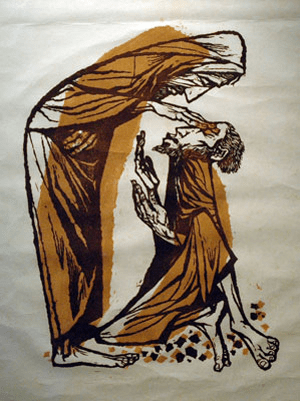
“Christ Healing the Blind Man” by Robert Hodgell

Then they came to Jericho. As Jesus, his disciples, and many people were leaving Jericho, a blind beggar named Bartimaeus, son of Timaeus, was sitting by the road. When he heard that Jesus from Nazareth was passing by, he began to shout, “Jesus, Son of David, have mercy on me!”

The people told him to be quiet. But he shouted even louder, “Son of David, have mercy on me!”

Jesus stopped and said, “Call him!” They called the blind man and told him, “Cheer up! Get up! He’s calling you.” The blind man threw off his coat, jumped up, and went to Jesus.

Jesus asked him, “What do you want me to do for you?”

The blind man said, “Teacher, I want to see again.”

Jesus told him, “Go, your faith has made you well.”

At once he could see again, and he followed Jesus on the road. (God’s Word Translation)

“I’d like to live my life so close to the bottom that when the system collapses I don’t have far to fall.” Dorothy Day

This is one of my very favorite stories in the entirety of Holy Scripture. And I will tell you why….

Because Jesus listens with ears of mercy

Jesus was headed to Jerusalem and had a lot on his mind and his heart. He knew what was coming, that his passion and death awaited him. No one would fault Jesus for not hearing a blind man shouting. But Jesus was listening so that he might hear someone just like the needy blind man. Rather than being distracted and lost in his head, Jesus was just the opposite – being attentive and aware of the humble folk right in front of him.

The Lord is always and continually listening for honesty and vulnerability. His ears of mercy are specially tuned, even today, for those who cry out to him from a place of genuine openness and humility.

Because Jesus speaks with words of mercy

Once Jesus listened, he responded by asking a question. I am impressed with Jesus throughout the Gospels. Christ gave people the gift of choice. He acknowledged people and respected them by not simply and indiscriminately healing, as if he were some fix-it guy. Jesus Christ bestowed on the lowliest of people the human dignity of choice by empowering them to answer a question.

Whereas everyone around Bartimaeus was looking down on him, both literally and figuratively, Jesus granted him the gift of dignity and basic human kindness – which are gifts we can all bestow on one another.

Because Jesus pays attention with a divine appointment of mercy

Our Lord took the time to heal blind Bartimaeus. Jesus could have simply healed him without even stopping his journey. He could have just waved his hand and the man would be healed. What’s more, Jesus could have even started a healing factory where everyone with a need got healed: bring ‘em in, move ‘em out, and keep the line moving!

Jesus was doing more than giving sight; he was giving a man the blessing of time and personal attention. The Gospel is never impersonal, which is why we ought to resist being non-relational in ministry to others. Christian ministry isn’t simply about meeting a need; it’s about blessing other people with the gift of relationship.

Coptic Church icon of Christ healing the blind man

Because Jesus reaches out with the touch of mercy

Jesus touched the man’s eyes (included in Matthew 20:29-34). He didn’t have to do that. The Lord of all most certainly could have healed without touching. In fact, it most likely may have been downright gross. A lot of people had eye diseases with runny pussy eyes in the ancient world.

Because the blind man didn’t listen to the crowd

I really love that! Maybe it’s the rebel in me. I just believe it is such a beautiful thing whenever someone refuses to be shamed by another and embraces their need. That is exactly what the blind man did. He not only refused to give-in to peer pressure, but he also responded to them by shouting all the louder. May his tribe increase!

Blind Bartimaeus teaches us that, when we know Love is there, we can freely acknowledge our needs, our wants, and our pain. With Jesus, who is Love incarnate, it doesn’t matter what anyone else thinks around us; there is no pretense, no propping up a false self to present for others to see. The true self is able to express what is really on the inside.

Because the blind man could actually see

In truth, Bartimaeus already had sight – not physical sight but spiritual eyes which could see better than anyone else in the crowd. One of the great ironies throughout the Gospels is that the sighted crowd seems to never see who Jesus really is, while blind folk see Christ clearly for who he is: the Son of David, the rightful king, the Savior of all.

It matters not how much faith one possesses; but it very much matters in whom that faith is placed. A thimble-full of faith is enough to move mountains, whereas a water tower full of misplaced faith in someone else cannot even provide a single glass of refreshment.

Because the blind man followed Jesus

Throughout the healing ministry of Jesus, there were plenty of persons who simply walked away and went about their lives after receiving what they desired. Yet, Bartimaeus, now given the gift of physical sight, immediately started following Jesus on the road.

This account feels a lot like my own testimony of experiencing the love of God in Christ and not ever wanting to leave it. So, I’ve been following Jesus for over forty years, still profoundly grateful in my heart for the One who loves and heals.

Because one lowly non-descript blind man made a difference

I don’t think Bartimaeus ever set out to change the world. And yet, he did. Here we are reading his testimony all these millennia later. One person, becoming a simple follower of Jesus and living a life of discipleship, changes a crowd from being a group of shushing church ladies to a robust throng of worshipers.

One individual makes a difference. Don’t let anyone tell you otherwise.

Lord Jesus Christ, Son of God, have mercy on me, a sinner.

Lord Jesus Christ, Son of David, heal me, a broken person.

Lord Jesus Christ, Son of Man, help me, a lost and lonely individual.

Lord have mercy, Christ have mercy, Lord have mercy on my love-starved soul and grant me your peace.

Amen.

Mark 10:17-22 – Jesus Intervenes

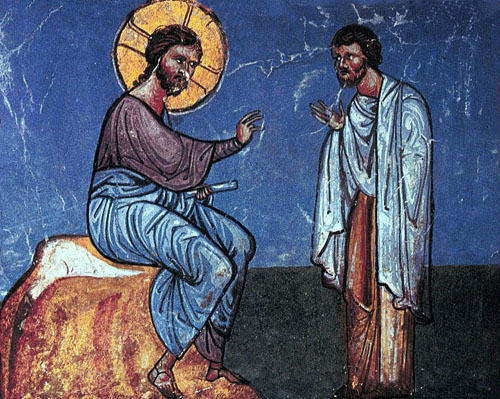
Eastern Orthodox mural of Jesus and the rich man

As Jesus started on his way, a man ran up to him and fell on his knees before him. “Good teacher,” he asked, “what must I do to inherit eternal life?”

“Why do you call me good?” Jesus answered. “No one is good—except God alone. You know the commandments: ‘You shall not murder, you shall not commit adultery, you shall not steal, you shall not give false testimony, you shall not defraud, honor your father and mother.’”

“Teacher,” he declared, “all these I have kept since I was a boy.”

Jesus looked at him and loved him. “One thing you lack,” he said. “Go, sell everything you have and give to the poor, and you will have treasure in heaven. Then come, follow me.”

At this the man’s face fell. He went away sad because he had great wealth. (New International Version)

We are all addicts. 

We all have our own sin addictions which keep us stuck in guilt and shame.

We may not all struggle with the same sin. Yet we all have some besetting sin(s) that we must be weaned off of. The most pervasive addiction found in Holy Scripture is neither substance abuse nor alcohol – it is the addiction to wealth and money.

Maybe your initial response was of someone else, besides yourself: “I don’t have as much money as____” or, “So-and-so has a real problem with that!” Those statements are what we call, in terms of addiction, denial. 

In truth, all of us are in some sort of denial about how much we really trust in paychecks, bank accounts, investments, and owning material stuff. I’m no exception. I own more books than I’ll be able to read in a lifetime, and yet, I tend to believe I don’t have enough of them.

Even the poor can have an addiction wealth and money by thinking about it and wishing for it to an unhealthy degree, as if wealth is the thing that will ultimately make them happy.

People in denial rarely have any idea how much they are hurting others, themselves, and God.  In fact, the consistent witness of the early church fathers is that the sheer accumulation of stuff is the same as stealing from the poor. 

Because of denial, people need an intervention. They need to be jolted back to their senses. Intervention is a gift. Someone cares enough about the person to intervene. Yet, interventions don’t always work. The person can choose to walk away and refuse to change.

Jesus did a gracious intervention with a rich young man. The man was addicted to wealth and money, but he didn’t see it. In fact, he thought he was quite godly and spiritual. It’s a sad story because the man walks away untransformed by his encounter with Jesus and did not accept the gracious invitation to follow the Lord. 

Chinese depiction of Jesus and the rich man, 1879

The man simply did not see himself as hopeless and desperately needing to change. He held to his denial.

The man approached Jesus with a question: “What must I do to inherit eternal life?” Whereas I would probably get all excited about being asked a question like this and launch into some long-winded gospel answer, Jesus immediately picked up on the attitude and the need behind the question. 

What must I do to get? It’s almost as if the man wants to acquire eternal life like he would acquire wealth. “I am a successful businessman with plenty of money, and a respected citizen with lots of wealth – now I want to be a success with God, as well.” 

The question may have been sincere, yet it was misguided. Eternal life is not spiritual real estate for an upwardly mobile person to acquire and possess. The man seems to believe he can purchase eternal life, as if everyone has their price, even God. “After all,” he may have been reasoning, “I have gotten everything else in life, so why not obtain eternal life?”

Jesus questioned the question. He went after the underlying assumption of doing something good to obtain eternal life. The fact of the matter is that the man cannot do anything. He can’t because only God is good. Jesus points him to God by changing the action from getting to entering. And he changed the language from a market acquisition to entering into a journey.

Jesus was inviting the man to walk with him.

Eternal life is a journey of faith in the God who is good, and not a transaction to get it. And, we too, must be careful not to treat eternal life as if it were a transaction, as if we must get a person to sign on the dotted line through a “sinner’s prayer” or some other formula that will seal the deal for eternal life. 

Instead, eternal life is a walk of obedience with God and his commands.

Jesus responded to the rich man with the Ten Commandments, specifically the ones which focus on human relationships. Jesus wanted him to realize that the path into the kingdom of God and eternal life goes through and not around how we treat our fellow human beings.

Christ and the Rich Young Ruler by Heinrich Hofmann, 1889

The Lord sought to expose the impossibility of continuing in life on the rich man’s terms. The guy just could not imagine what he might be lacking. So, Jesus helped him out. Christ gave him some major interventional language…. Sell. Give. Follow.

Sell everything. Give to the poor. Come, follow me.

One cannot simply add Jesus to their life, like adding a new car or a new fishing rod. Rather, one’s heart must change in order to accommodate real, genuine eternal life. 

Jesus offered the rich man someone to be, rather than something to get

It’s one thing to give from what you have; it’s another thing to surrender your life and all you have. 

In the New Testament Gospels, there are no easy conversations with Jesus. He gets personal in every encounter and gets under everybody’s skin. Christ doesn’t settle with superficial small talk when there are people whose hearts are little more than idol factories. 

Jesus never leaves us alone, because there is always the invitation to “Come, follow me.”

Christ exposed the wealthy man’s divided loyalties – he was trying to serve both God and money. But he would have to choose between the two. 

And that is our choice, as well. 

The question for us is not, “Am I completely devoted to money?” Instead, the question from our Gospel story today is, “Am I trying to serve God while maintaining a moonlighting job with the world?” 

God wants from us an undivided heart; the Lord desires absolute allegiance.

Jesus is looking for those who are poor in spirit, who recognize their great need for God – instead of believing that they are okay and just need to add a little Jesus to their lives. 

God is looking for spiritual beggars who understand their desperate situation and don’t practice denial by sugar-coating their actual spiritual state.

Like a drunkard who won’t give up his vodka; like a sex addict who won’t give up strip clubs or emotional affairs; or like a workaholic who just can’t come home; the rich man would not give up his disordered love for money and possessions. 

So, Jesus did an intervention. 

The Lord Jesus didn’t ask everybody to do exactly as he called the rich man to do. He didn’t ask the very wealthy Zacchaeus to do it, and he didn’t tell Peter to sell his fishing business. 

But Jesus does tell us to do something which seems impossible. Yet, where the impossible exists, so exists grace.

Blessed Lord, you have taught us that all our doings without loving generosity are worth nothing. Send your Holy Spirit and pour into our hearts your gift of love, the true bond of peace and of all virtues, without which whoever lives is counted dead before you. Grant this for the sake of your only Son Jesus Christ, who lives and reigns with you, in the unity of the Holy Spirit, one God, now and forever. Amen.